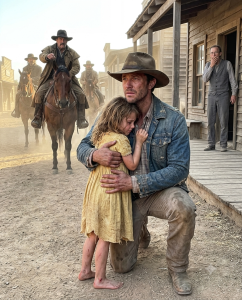
A terrified little girl ran straight into a cowboy’s arms, and the whole town of Elm Bend felt the air change.
It happened in the hottest part of the afternoon, when decent people stayed in shade and even stray dogs gave up trying to bark. The dirt road outside Jessup’s general store looked half-melted under the Texas sun. Nothing moved except the occasional swirl of dust and the slow creak of a sign hanging over the porch.
Cass Whitmore sat in a chair tipped back against the wall, hat pulled low, waiting on a rancher who owed him eleven dollars for mending a broken fence line. He had already decided three separate times to leave and stayed anyway, mostly out of stubbornness. Waiting for money was one of the few habits he still had left.
The rest of him had become hard to pin down.
Two years earlier, cholera had torn through a settlement east of Waco and taken his wife Ada and their infant daughter Rose in three days. The grief had not made Cass louder, meaner, or drunker like people expected from men in stories. It made him quieter. Stranger. He stopped sleeping in the same place more than a few nights. He stopped accepting supper invitations. He would fix barns, string wire, shovel out stables, break horses, and move on before anyone learned enough about him to mention family.
There were rules he kept without saying them aloud.
He didn’t carry children.
He didn’t go into homes where milk was warming on the stove.
He walked away from songs mothers sang under their breath.
He had turned himself into a man built out of road dust, silence, and work paid in cash at day’s end.
Then a little girl came running around the livery stable, and every rule he had ever made for survival died before he even had time to remember them.
She was small, maybe seven, barefoot, and wild-eyed. Her dress had once been yellow, though now it was gray with dirt and torn nearly to the hem. One sleeve hung loose. Her feet were cut up from running. But it was her face that stopped him cold.
Children cried when they were scared.
Children screamed when they were chased.
This one looked like she had run past fear and out the other side.
Cass was off the chair before he understood why. He dropped to one knee and opened his arms.
The girl hit him full force. She tucked herself against his chest and grabbed his shirt in both fists as if letting go would mean death. He felt how hard she was shaking. He waited for tears, but they never came.
A second later, three riders burst into view.
The man in front was broad through the middle and red through the face, riding a horse he had pushed too fast in bad heat. The two behind him wore their cruelty in the easy way they sat a saddle—like men who had spent years turning orders into pain for other people.
The leader pointed at the girl.
“That child comes with us. Hand her over.”
Cass stood slowly, one arm still around her. “No.”
The word landed in the street with enough weight to quiet the afternoon.
The rider frowned. “You don’t understand, mister. The child is under legal guardianship. Delbert Stroud of Prosper County. She’s a runaway. We are here to return her. We’re also looking for her brother.”
Cass felt the little body in his arms go stiff.
“And where is this brother?” he asked.
The man’s expression hardened. “That’s none of your concern.”
“If you’re chasing children,” Cass said, “it became my concern already.”
By then Jessup had come outside. He was a narrow, cautious man in shirtsleeves, more likely to avoid trouble than challenge it. But one look at the girl’s feet, the bruised dirt on her knees, and the terror in her eyes made him stand still beside the door.
“She doesn’t seem eager to go,” Jessup said.
The presence of a witness changed the moment. The rider knew it. So did Cass.
The man’s jaw flexed. “Stroud will be here tomorrow with the proper papers. You interfere now, you answer for it later.”
He jerked his horse around. The others followed. They rode out with dust flying behind them, leaving threat hanging in the empty street.
Cass did not lower the girl until the hoofbeats were gone.
Inside the store, the air smelled of flour sacks, lamp oil, and old wood. Jessup brought water. The child drank carefully with one hand while the other stayed twisted in Cass’s shirt, pressed over his heart as if she needed to feel one still beating.
Cass crouched near her. “Can you tell me your name?”
Nothing.
“Can you tell me where your brother is?”
Her eyes dropped to the floor.
Then the front door slammed open.
A boy stood there, all sharp bones and fury, a kitchen knife gripped in his hand so tightly his knuckles had gone pale. He couldn’t have been older than ten. Sweat darkened his hair. His breathing was shallow from running. But the thing that struck Cass hardest was his eyes. They were not a child’s eyes. They were watchful, old, and tired.
He looked at Cass.
Then at the little girl.
“Put her down,” he said.
Cass stayed where he was. “She ran to me.”
“Birdie doesn’t run to men.”
The room changed with those words. Jessup froze behind the counter. Cass felt something in his own chest pull tight.
“Stroud’s men were after her,” he said quietly. “I didn’t take her. She chose me.”
The boy’s grip on the knife twitched. “Nobody chooses her,” he said. “They just take her.”
No one spoke for a second.
Birdie slowly raised a hand toward the boy, and in that silent movement the whole truth of their bond became visible. He was trying to be older than he was because no one else had been left to stand between her and the world.
“What’s your name?” Cass asked.
“Amos.”
Jessup slid a glass of water onto the counter. “Drink, son.”
Amos didn’t come closer until Cass pulled one hand free from Birdie and laid it in plain view, open and empty. Only then did the boy step forward. He drank like he had crossed a desert, then wiped his mouth with the back of his hand.
“Our mama’s name is Lenore Pressman,” he said, each word sounding memorized, like he had repeated it to himself in case someone ever gave him one chance to tell the truth. “Our father was Thomas Pressman. He died eighteen months ago. After that, our uncle Delbert Stroud took the house, locked Mama away, and made us work on his place.”
Birdie pressed her face into Cass’s shirt again.
Amos kept going. “Mama told us to run. She said find somebody who still had a soul.”
Cass had heard lies before. Heard family disputes dressed up as kidnappings, drunken accusations, inheritance fights. But these children were not inventing pain. Pain had already rearranged them.
“If you hand us back,” Amos said, voice dropping lower, “she won’t survive it a second time.”
The sentence sat there with all the unspoken horror around it.
Cass didn’t ask what had happened to Birdie. Not yet. He could see enough in the way she flinched at boots on the porch, in the way Amos stood between her and every man in the room, in the way both children seemed to believe adults only came in two kinds—those who used you and those who handed you back.
Before he could speak, another horse came tearing down the street.
Amos snatched the knife up again.
Birdie made a broken sound deep in her throat.
Jessup turned toward the window.
The rider who dismounted outside was alone.
He carried a strip of blue ribbon in one hand.
Birdie saw it and recoiled so violently her chair scraped backward. Amos went white, then red.
“That was Mama’s,” he whispered.
Outside, the man smiled and tapped twice on the glass with two fingers, patient as a man calling in a debt.
Cass rose.
“Back room,” he said.
Birdie obeyed instantly, but Amos didn’t move.
“He’s one of Stroud’s house men,” the boy said. “If he’s got that ribbon, then he was in the house. If he was in the house, Mama fought them. If Mama fought them…”
He couldn’t finish.
Birdie suddenly pointed toward the rear of the store. Her whole body strained with urgency.
Cass understood too late.
The rider at the front window was a distraction.
The real danger came through the back.
The rear door burst open and a tall man in a dark coat stepped in with a pistol in one hand and a calm expression that made him worse than the others. He wasn’t hurried. Men who enjoyed fear never rushed when they had already won in their minds.
“Afternoon,” he said.
Jessup lifted both hands at once.
Cass moved sideways, putting himself between the stranger and the children.
The man’s gaze drifted to Birdie. She shrank so far behind Cass that only her fingers still showed, clenched in the back of his shirt. Amos raised the knife. The man noticed and smiled.
“You’ll put that down, boy,” he said, “before somebody gets hurt who matters.”
Cass’s voice came out flat. “You Delbert Stroud?”
The man looked amused. “No. Delbert sends men when children forget their place. I am Silas Gant. I solve complications.”
“Then here’s one,” Cass said. “Turn around and leave.”
Silas laughed under his breath. “You have no standing in this. Those children belong to their lawful guardian.”
Birdie made a tiny choking noise at the word belong.
Cass heard it.
He also saw something else: a flash in Amos’s eyes when Gant said guardian. Not fear this time. Recognition. A memory.
“Ask him about the cellar,” Amos blurted.
Gant’s smile disappeared.
“What cellar?” Cass asked.
Amos was breathing hard now, words tripping over rage. “Under the smokehouse. That’s where Uncle Delbert keeps things he doesn’t want seen. Papers. Money. Ledgers. Mama found them. That’s why he locked her in. That’s why he said Birdie had to start earning her keep. Mama heard him talking with Polk. He was going to sell the north pasture and say Father signed it over before he died. But Father never did. Mama knew the signature was false.”
Gant’s pistol shifted toward Amos.
“Boy,” he said softly, “you should have kept running.”
Cass moved faster than thought. He snatched a bag of flour off a nearby barrel and hurled it. It struck Gant’s arm just as the gun fired. The shot blew through a shelf of tin cups. Jessup shouted. Flour burst white through the air like smoke.
Amos lunged low and drove the knife into Gant’s thigh.
The man screamed and stumbled. Cass hit him full in the chest and sent both of them crashing into a display of feed tins. The pistol slid across the floor under the counter. Jessup, to his everlasting surprise, was the one who kicked it farther away.
Gant fought dirty, clawing for Cass’s eyes, but grief had hollowed Cass out years ago and left behind something stubborn and brutal when pushed. He struck Gant once in the mouth, once in the throat, then pinned him facedown with a knee between his shoulders.
“Rope,” Cass barked.
Jessup didn’t hesitate now. He ran to the stock room, came back with line, and together they tied Gant hand and foot while Amos stood over the man shaking so hard the knife rattled in his hand.
Outside, voices rose. The gunshot had pulled people into the street.
That saved them.
Elm Bend was small, but even small towns knew what kind of fear children wore when it was real. Once folks saw Birdie’s bare feet, Amos’s face, and the blood on Gant’s trouser leg, the story Stroud had planned started falling apart before he ever arrived.
Cass made Amos tell it twice—once to Jessup, once to the town blacksmith, who had come in at the noise and was known for remembering every word he heard. He made Birdie sit by the counter with a quilt around her shoulders and a cup of water in her hands while no man came within arm’s reach unless she nodded first. That mattered. He saw her notice it.
Near sundown, the sheriff rode in from a neighboring settlement after someone sent for him.
Sheriff Boone was old, slow-spoken, and unimpressed by polished lies. He listened to Amos. He listened to Jessup. He looked at Gant, bound on the floor and glowering through split lips. Then he knelt in front of Birdie and said, “No one here is taking you anywhere you don’t want to go.”
Birdie stared at him for a long moment.
Then she pointed at Gant and whispered her first word since arriving in town.
“Cellar.”
It came out cracked and thin, but it changed everything.
Because a child who had not spoken all day had just named the place all of them feared.
Boone did not waste another hour. He took Gant into custody, deputized two men, and rode that same night with Cass, Amos, and three townsmen toward Prosper County.
They reached Stroud’s property close to dawn.
It sat behind cottonwoods and false respectability: a wide house, smokehouse, stable, and fields that looked prosperous enough from a distance. Men like Delbert Stroud always made sure evil wore a decent coat in daylight.
They found Lenore Pressman locked in an upstairs room with the windows nailed shut.
She was weak, bruised, and thin enough to make Amos choke on his own breath when he saw her, but she was alive. When the sheriff forced the door, she stumbled forward with one hand on the wall and the other reaching blindly for her children before she could even see them clearly.
“Birdie? Amos?”
The sound those children made running to her was not joy exactly. It was too painful for that. It was the sound of terror finally finding its way to safety.
Cass turned away because some griefs were private even when witnessed.
Boone put Stroud in irons in the yard.
The man never stopped talking. He insisted everything was lawful. Claimed the children were unruly. Claimed Lenore was unstable. Claimed the property had been signed over properly. Claimed witnesses would support him.
Then Boone opened the smokehouse cellar.
The forged deeds were there.
The ledgers were there.
Receipts, letters, records of illegal sales, payments to hired men, and enough proof of confinement and abuse to bury any pretty lie Stroud had prepared.
And there was one more thing.
In a tin box wrapped in cloth, Boone found Thomas Pressman’s real will.
It left the house, the land, and all holdings to Lenore until both children came of age.
Delbert Stroud had stolen everything.
By noon, Polk and the other two riders had been picked up as well. Gant, seeing the evidence and knowing Stroud could no longer shield him, began talking to save himself. He talked about forged papers, beatings, threats, and what had been done to keep Birdie too frightened to speak.
Some truths arrived in fragments because Lenore couldn’t bear to say them all at once. Some came from Amos in clipped, furious sentences. Some needed no words.
Cass learned enough.
He learned that Birdie had become the target of a particular kind of cruelty once Stroud realized a silent, frightened child was easier to control than a resistant woman or a growing boy. He learned Amos had tried to stop things more than once and had been beaten for it. He learned Lenore had endured lock, hunger, and threat while waiting for one chance to get her children out. He learned that the ribbon Gant had brought to the window was meant as a message: We still have your mother. Come back and submit.
Instead, the children had run far enough to find a tired cowboy who had once sworn never to let himself care again.
The legal part took months. The human part took longer.
Lenore and the children stayed first with Jessup’s married sister in Elm Bend, then returned to the Pressman house after Stroud was formally charged and the property restored. Amos slept with a chair shoved under the bedroom door for nearly a year. Birdie spoke rarely at first and only to a few people. But she no longer flinched at every footstep. She learned to sit on a porch in evening light without checking every road for riders.
Cass meant to leave once the sheriff no longer needed his testimony.
He saddled his horse twice.
The first time, Birdie came and stood by the fence, holding a blue ribbon in one hand. Not the one Gant had carried, but another Lenore had found among her things. Birdie held it out to him, then wrapped it around his wrist without speaking. He took that as a kind of answer and unsaddled.
The second time, Amos asked if he knew how to mend a north fence that had gone crooked by the creek. Cass looked at the boy, saw the almost-smile hidden under the question, and understood he was being asked something larger than fence work. He unsaddled again.
By the following spring, people in Elm Bend had stopped calling him a drifter and started calling him by name.
He never became the kind of man he had been before Ada died. Grief does not return what it takes. But it does sometimes make room for something new if a person stays alive long enough to meet it.
He helped Lenore rebuild the ranch books.
He taught Amos how to set posts straight and judge weather by the smell in the air.
He let Birdie choose when she wanted him near and when she didn’t. The first time she reached for his hand in public, he nearly lost the ability to speak.
Years later, folks would tell the story as if Cass Whitmore had saved those children.
That wasn’t exactly true.
Birdie saved herself the moment she ran.
Amos saved his sister every day he stayed standing.
Lenore saved both her children when she told them to flee and trust that a soul still existed somewhere in the world.
Cass had only done one thing.
He had said no when evil arrived asking politely.
And maybe that was the part people remembered because it unsettled them most. Delbert Stroud had papers, land, hired men, and the kind of confidence that comes from never being challenged. In the end, all of that was weaker than one frightened child choosing a stranger and one brokenhearted man deciding, in a single moment, not to look away.
Some in town said Lenore should never forgive herself for waiting so long to act.
Some said Amos had been forced to become a man too young.
Some said Birdie’s silence was the saddest part of all.
Jessup said the worst warning sign had been there from the beginning: any man who called a child his property deserved a grave, not guardianship.
Cass never argued with that.
But on certain quiet evenings, when the porch boards cooled and the fields turned gold at sundown, he would watch Birdie laugh at something Amos said and see Lenore close her eyes in simple peace, and he would think about how close all of them had come to vanishing into one powerful man’s lie.
Then he would feel the old blue ribbon, still kept folded in his pocket, and wonder the question that never quite left him:
How many people hear terror knocking and call it none of their business?