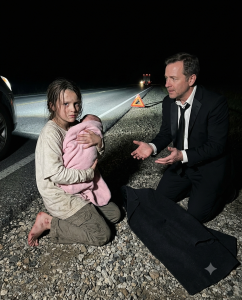
Eight-year-old Lily was carrying her baby sister down a dark highway with a broken arm when Daniel Whitmore saw her in his headlights.
For the rest of his life, he would remember that first terrible second in pieces.
The pale flash of bare feet on gravel.
The blanket clutched against a child’s chest.
The unnatural bend of her arm.
And the way she looked less like someone waiting to be rescued than someone already bracing to be dragged back.
Route 75 stretched ahead in a long black ribbon, nearly empty except for the occasional truck roaring north under a sky threatening rain. Daniel had been driving home from a charity gala in the city, one of those expensive evenings full of polished speeches, crystal glasses, and people congratulating one another for caring. He had smiled when required, nodded at the right moments, and written a check big enough to impress a room full of donors.
He had done all of it automatically.
His wife Sara had been dead for three years, and ever since then his life had become a series of gestures that looked meaningful from the outside and felt hollow from within. He funded shelters, hospitals, scholarships. He sat on boards. He gave interviews when his publicist insisted. But beneath all of it was a private shame he never spoke aloud: most of the time he no longer believed he was helping anyone. He was simply moving money around and hoping it counted as a life.
Then he saw the girl.
At first he nearly drove past.
He hated that truth, but it was still the truth.
He slowed because something on the roadside didn’t look right. For one cold second he told himself it was debris. Then maybe an injured animal. Then he saw movement — small, staggering movement — and his hands tightened on the wheel.
He kept rolling.
Someone else would stop, he thought.
That old, polite cowardice slipped into him so easily it almost felt reasonable. The road wasn’t safe. It might be a setup. There were protocols. He could call for help and keep driving.
Then in his rearview mirror he saw the shape clearly: a little girl, barefoot and filthy, carrying a baby wrapped in pink.
Daniel hit the brakes so hard the coffee in the passenger seat sloshed over.
He pulled onto the shoulder, switched on his hazards, and placed the reflective warning triangle on the road. It was the kind Sara had always insisted he keep in the trunk. She’d believed in preparedness, in practical kindness, in stopping when other people kept driving.
The memory of her made him kneel instead of retreat.
He called 911 first, giving the location with careful precision. When the dispatcher told him to stay back until emergency crews arrived, he agreed — but after hanging up, he approached slowly anyway, lowering himself onto one knee with both hands visible.
The girl watched him without blinking.
She couldn’t have been older than eight, but her face held none of the looseness of childhood. Dirt streaked her cheeks. Her dark hair clung damply to her forehead. Her left arm hung wrong, the forearm twisted inward against her body. Blood had dried in thin lines over both ankles, and the soles of her feet were sliced up from gravel and road grit.
The baby in her arms made a tiny whistling sound with each breath.
“Hi,” Daniel said, keeping his voice calm. “My name is Daniel. Help is coming.”
The girl tightened her grip.
“Don’t take us back.”
He felt those words in the center of his chest.
He’d heard plenty of fear in his life — in hospitals, funerals, courtrooms, board meetings after disasters — but there was something different in the way she said it. It wasn’t panic. It was experience.
“I’m not taking you anywhere,” he said.
She said nothing, just stared past him into the dark as if expecting another car to stop. Not rescue. Pursuit.
Daniel shrugged off his coat and placed it on the gravel between them.
“For the baby,” he said.
The girl hesitated for so long he wondered if she would refuse. Then, with exquisite care, she lowered the bundle onto the coat and wrapped it around the infant. After that she shifted her own body in front of the child, even with the broken arm, even trembling from exhaustion.
“What’s her name?” Daniel asked.
“Mad.”
It took him a moment to realize she meant Madison, or Madeline perhaps, but all she would offer was “Mad.”
“And you?”
“Lily.”
The ambulance siren became audible in the distance. Lily stiffened like prey hearing a trap click shut.
“They’re coming to help your sister,” Daniel said quickly. “That’s all.”
Lily’s eyes met his.
“That’s what they said before.”
When paramedics arrived, they learned immediately how much this little girl had been through. Lily refused to hand over the baby. She wouldn’t even let them separate Mad from her chest while they examined the infant’s breathing. One paramedic finally managed to work around Lily, slipping a small oxygen line near the baby and checking her temperature while another gently stabilized Lily’s arm with a splint.
She never screamed.
That frightened Daniel more than screaming would have.
Pain should have broken through. Shock should have cracked the surface. Instead Lily endured everything in silence, every muscle rigid, every glance fixed on the nearest exit.
At the hospital, the emergency department moved quickly. Mad was underweight, mildly hypothermic, and struggling with chest congestion. Lily’s arm was fractured in two places. She was dehydrated, exhausted, and covered in bruises in varying stages of healing that no one in the room could ignore.
Daniel stayed because leaving felt impossible.
A nurse asked him twice whether he was family. Both times he said no. On the third try she asked why he was still there.
He didn’t have a clean answer.
Maybe because Lily kept checking the doorway whenever anyone stepped out.
Maybe because Mad quieted whenever Lily heard Daniel’s voice in the hall and realized at least one familiar adult shape hadn’t vanished.
Or maybe because for the first time in years, something real had happened in front of him and demanded more than a signature.
Dr. Rebecca Hall treated Lily with the kind of careful respect that children in fear noticed immediately. She explained every touch before making it. She warmed the stethoscope before pressing it to Mad’s chest. She asked permission even when hospital protocol didn’t really require it.
Lily permitted only the bare minimum.
The detective arrived just before midnight.
Angela Brox looked like someone who had forgotten how to be impressed by expensive shoes or expensive lies. She carried a notebook instead of relying on electronics, and when she entered Lily’s room she didn’t start with a barrage of questions. She sat in the chair across from the bed and said, “I’m Detective Brox. Nobody’s making you talk tonight.”
Lily looked at her warily.
Angela added, “But I need you to know you’re not going back with whoever hurt you.”
Lily’s mouth tightened.
“They said that before.”
Angela didn’t try to soothe her. She didn’t offer fake certainty.
“Then I won’t repeat it until I can prove it.”
That answer changed something. Not trust. Not yet. But perhaps the smallest shift away from total rejection.
Daniel waited outside while social services were contacted. Forms began moving. Quiet phone calls started. A child protection hold was put in place. Mad was moved briefly for warming and respiratory treatment, and the moment she left Lily’s arms, the child tried to climb out of bed despite the fracture.
Daniel was the one who calmed her.
“She’s still here,” he said from the doorway. “Nobody’s taking her away. They’re just helping her breathe.”
Lily stared at him, searching his face for deception.
Finally she lay back down.
Around one in the morning, a nurse approached Daniel near the vending machines. “You really should go home, Mr. Whitmore.”
He glanced toward Lily’s curtain. “No.”
“You’re not related.”
“I know.”
“The hospital will handle this.”
He looked at the floor a moment, then said, “If I disappear tonight, she’ll remember that. I won’t let her collect one more adult who left.”
The nurse studied him, perhaps weighing whether this was ego or guilt or something cleaner. At last she nodded toward the plastic chair. “Stay out of the way.”
He sat. The coffee from the machine tasted burnt and metallic. The hallway dimmed into that eerie post-midnight quiet hospitals always acquired, a silence built from exhaustion rather than peace.
An hour later the same nurse returned, holding a torn section of coat lining.
“We found this stitched into the inside seam of Lily’s coat when we cut it away for X-rays,” she said.
Inside was a folded piece of notebook paper, damp from body heat and worn soft at the corners. The handwriting was hurried but deliberate, written by someone trying to make sure a child could carry instructions she might one day need.
At the top were the words: If I’m gone.
Daniel unfolded the rest.
The note was from Lily and Mad’s mother.
It did not ramble. It did not plead. It read like something written under pressure, hidden in desperation, and sewn into cloth by shaking hands.
If I’m gone, do not let him say I left you. Do not go with anyone he sends unless they say the name June. Find a policewoman if you can. Show this to her. The baby’s papers are in the blue bag under the sink if he hasn’t found them. If you reach someone kind, tell them Rey Nolan did this. He will smile first. He will cry if he has to. Do not believe him.
Rey Nolan was underlined twice.
Daniel read the name again.
And from the other side of the curtain, Lily woke with a violent start.
“He already came for us,” she whispered.
Daniel stepped into the room at once. Detective Brox, who had been on a call nearby, came in behind him. Lily had both arms around Mad despite the splint, and pain was twisting her face white. Her eyes were fixed on the doorway with such sharp terror that everyone in the room turned instinctively to look.
Angela crouched beside the bed.
“Who came, Lily?”
Lily swallowed hard. “He whistles before he opens the door.”
The words had barely left her mouth when a low, uneven whistle drifted in from somewhere down the hallway.
No one spoke.
The nurse standing by the medication cart went still.
Angela rose, one hand already moving toward her radio. Daniel felt the paper in his hand turn slick with sweat.
The whistle came again.
Not loud. Not hurried. Almost casual.
Then footsteps.
Slow. Confident. Approaching the room as though the person making them belonged there.
Lily started shaking so hard the bed frame rattled. Mad whimpered against her chest.
Angela signaled sharply to the uniformed officer at the end of the hall, then pulled the curtain wider instead of closing it. Daniel understood why a second later. Whoever was coming expected to find a frightened child, maybe a tired nurse, maybe bureaucracy. He did not expect witnesses.
The footsteps stopped just beyond the doorway.
A man’s voice came, gentle and warm.
“There you are.”
He stepped into view wearing jeans, work boots, and a gray hooded jacket damp from the mist outside. He was in his early forties, broad-shouldered, clean-shaven, and disturbingly ordinary. His expression was exactly the kind strangers trusted: relieved, emotional, almost tender.
Daniel knew instantly that if he had seen this man on the street, he would not have looked twice.
The man’s gaze went first to Lily, then to Mad, then finally to the adults in the room. Not a flicker of surprise. He adjusted too fast for surprise.
“I’ve been searching everywhere,” he said, his voice breaking at precisely the right place. “Thank God. I’m their father.”
Lily made a sound Daniel would later remember more vividly than any shout. It was small, strangled, and full of recognition.
“No,” she whispered.
Detective Brox stepped forward. “Name.”
“Rey Nolan.”
There it was. Easy. Unashamed.
Angela’s face gave away nothing. “You’ll need to wait outside while we verify.”
Rey pressed a hand to his chest as if trying to steady himself. “Please, my girls are terrified. Their mother had… episodes. She ran off before. She fills Lily’s head with things when she’s unstable.”
Lily buried her face against Mad and started crying for the first time.
Not loud, not childish. Silent tears. Pure dread.
Daniel felt something savage rise in him.
He held out the note. “You mean the unstable mother who stitched this into her daughter’s coat?”
For the first time, Rey’s eyes shifted.
Only for a second.
But Angela saw it.
“So you do know her handwriting,” she said.
Rey recovered quickly. “She was paranoid. She needed treatment. I’ve been trying to hold this family together.”
“Funny,” Angela said, “because the child’s covered in healing bruises, her arm is broken, and she’d rather bleed to death on a highway than go back with you.”
Rey’s face changed again then — not fully, not enough for anyone who wasn’t looking closely. But Daniel saw it. The warmth didn’t disappear. It hardened underneath.
A mask adjusting.
“Lily,” Rey said softly, ignoring everyone else. “Tell them you fell. Tell them you got scared when Mommy left. Come on, sweetheart. You know me.”
Lily lifted her head. Her whole body was shaking, but something in her expression had shifted. Maybe it was the open room, the witnesses, the fact that his smile was no longer enough.
“He said if Mad cried again he’d make her stop forever,” Lily whispered.
No one moved.
Then she added, “And when Mama tried to call for help, he pushed her into the stove.”
Angela didn’t wait for another word.
She signaled the officer. “Take him.”
Rey backed up immediately. “This is insane. She’s a child. She’s confused.”
The officer caught his wrist.
Rey’s composure shattered.
It happened so fast Daniel almost missed it — the eyes going flat, the mouth pulling hard, the body twisting with practiced violence. He drove an elbow into the officer’s shoulder and lunged for the bed.
Daniel moved before thinking.
Years of boardrooms and black-tie dinners had not prepared him for the brutal force of another man at full speed, but grief had taught him something about not stepping away when it mattered. He slammed into Rey’s side just enough to throw off the angle. Rey hit the bed rail instead of Lily. The officer recovered, another guard rushed in, and together they forced him to the floor.
All the while Rey kept shouting the same thing: “They’re mine.”
Angela knelt beside him as the cuffs clicked shut.
“No,” she said. “That’s the problem. You thought they were.”
He was arrested before dawn.
By sunrise, the rest of the truth had begun to surface.
Lily and Mad’s mother, Elena, was found alive in a roadside motel thirty miles south, burned on one shoulder, concussed, and barely conscious. She had escaped through a bathroom window after Rey beat her during an argument and searched the house for the hidden documents she’d been collecting for months. She had managed to call a former coworker, who got her to the motel, but her phone died before she could tell anyone where the girls were.
The coworker knew one thing that mattered: Elena had been planning to run.
She had documented everything.
Photos of bruises. Audio recordings. Copies of Mad’s birth certificate and Lily’s school records. A list of dates, threats, neighbors who might have heard fights, and one locked metal cash box containing enough saved money to get them across state lines.
And sewn into Lily’s coat, she had hidden the final insurance policy she could think of: instructions written for a child old enough to understand danger but too young to carry the whole weight of it.
When Angela later asked Lily why she had gone to the highway instead of hiding nearby, the girl answered simply, “Mama said roads lead to people.”
The fracture in Lily’s arm had happened when Rey caught her trying to lift Mad out of the crib. He twisted until she fell. The bruises came from weeks of grabbing, shoving, and punishment disguised as discipline. The fear of police came from years of manipulation. Rey had taught her that uniforms would only bring her back. That judges believed fathers. That rich people were worse because they could buy children and call it kindness.
Daniel heard all of this over the next several days as the case widened.
He expected to return to his old life once the necessary statements were given. Instead he found himself coming back to the hospital, then to the child advocacy center, then later to the quiet foster home where Lily and Mad were placed temporarily with an older woman named Mrs. Alvarez, who had a soft voice and iron rules and somehow convinced Lily that bedtime could happen without danger.
At first Lily spoke to Daniel only in fragments.
“Mad likes warm milk.”
“She hates yellow socks.”
“Don’t stand behind me.”
He took each sentence like a gift.
Mad recovered quickly once treated. Elena survived and, after surgery and weeks of protection under police watch, began the slow process of reclaiming her daughters. Nothing about it was immediate or simple. Trauma didn’t vanish because the right man got arrested. Lily still woke to imaginary whistling. She still checked locks twice. She still hid food in pockets. Mad cried whenever a man raised his voice nearby.
But the terror loosened.
Little by little.
Daniel paid for things quietly when asked and stayed out of sight when told. He funded legal support for Elena through a victim services organization without attaching his name. He replaced Lily’s broken toy car, only to discover she wanted the old one kept too. “So I remember,” she said.
Months later, after Rey Nolan pleaded not guilty and lost every inch of credibility under evidence, Elena sat in court and testified while Lily remained with an advocate in a separate room. The recordings, photographs, medical reports, and Lily’s forensic interview ended whatever performance Rey tried to stage.
He was convicted.
When it was over, Daniel stood outside the courthouse under a low gray sky and watched Elena emerge with both girls. Lily’s arm had healed. Mad had grown heavier, pinker, louder. Elena looked thin and exhausted, but she was standing.
Lily walked straight to Daniel and held out the old broken toy car.
He frowned. “You want me to fix it?”
She shook her head.
“No,” she said. “I just wanted you to see I still have it.”
He understood then that to a child like Lily, staying mattered more than repairing.
Years of wealth had taught him how to purchase solutions, how to sign, transfer, donate, and smooth over damage from a comfortable distance. But Lily had taught him something money never could: sometimes the most radical thing an adult can do is remain visible long enough for a child to believe disappearing is not inevitable.
That night on the highway had begun with Daniel thinking he was a man who no longer knew how to be useful.
He had been wrong.
Not because he became a hero. He didn’t. The real courage belonged to an eight-year-old girl who carried her baby sister barefoot into the dark with a broken arm because staying was more dangerous than running.
And to a mother who, even while trapped, found a way to hide the truth in the seam of a coat.
But Daniel did learn this: the biggest red flags are often the ones wrapped in the gentlest voices, the warmest smiles, the most believable performances. Evil rarely announces itself like a monster. Sometimes it whistles before opening the door.
And once you’ve seen that clearly, you can never again pretend not to know the difference.