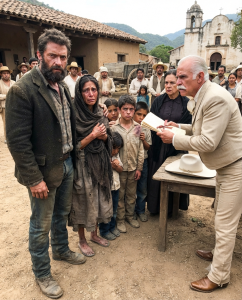
Don Evaristo Roldán raised a whip in the middle of the market and forced his widowed daughter-in-law to pick corn out of the mud while her six children cried from hunger.
That was the moment the town of Valle de Encinos learned two things.
The first was that cruelty can become so ordinary people stop seeing it as a sin.
The second was that even the quietest man will eventually hear one humiliation too many.
The wind came down from the Sierra Madre carrying cold so sharp it felt personal. It brought the smell of pine resin, woodsmoke, and snow gathering somewhere higher in the ravines. In that hard country of northern Chihuahua, winter did not arrive politely. It came like a verdict.
Rodrigo Barrera had lived above the valley long enough to become a story people told more than a man they knew. He was thirty-nine, broad through the shoulders, scarred across one eyebrow, bearded and heavy-browed, with pale gray eyes that made strangers uneasy. Some said he had once fought in the revolution. Others said bandits had murdered his family and left him half-dead. A few swore he had buried a wife and child with his own hands and had not smiled since.
The truth was simpler and sadder. War had taken a brother. Fever had taken his mother. Treachery had cost him the small inheritance his father left behind. By the time he climbed into the mountains for good, silence suited him better than men did.
His cabin stood near a spring beyond the pine line, with room for two mules, a stack of hides, a patch of beans in season, and almost nothing else. He had named the mules Cenizo and Lola because there was no one left to name. He trapped, traded, cut timber, and came into town only when he absolutely had to.
That week, he had to.
By the time he reached Valle de Encinos, the market had swollen with wagons, gossip, and dust. He was unloading hides in front of Elías Medina’s store when the crack of a whip cut across the square.
He turned.
Inés Roldán stood beside a wagon under the weight of a grain sack she could barely lift. Her black mourning dress had been patched too many times to count. Her shawl was torn. One child clung to her hip and another to her hand. Four more hovered close by, each with the look of children who had learned to measure danger by an adult’s breathing.
On the wagon seat sat Don Evaristo Roldán, white-mustached and thick-bellied, dressed in dark wool and polished boots. He had the face of a man who believed ownership and righteousness were the same thing. Beside him sat his wife, Beatriz, thin and severe, her mouth pinched with permanent disgust.
“Lift it!” Evaristo shouted. “Or are widows too weak to work what they eat?”
Inés tried again. Her oldest boy, Mateo, rushed to help. The sack ripped. Corn poured into the mud.
Beatriz shrieked. “Pick it up! Every grain!”
Inés dropped to her knees.
Rodrigo watched her bleeding fingers move through the filth while the youngest boy cried into her skirt. Nobody in the market intervened. Not the men buying tools. Not the women selling cloth. Not the constable near the well, who looked away so deliberately it was almost worse than watching.
Elías Medina grabbed Rodrigo’s sleeve before he could move.
“Don’t be a fool,” the shopkeeper murmured. “Evaristo owns the judge, the constable, half the land, and most of the debts in this valley.”
Rodrigo’s jaw tightened. “Why doesn’t she leave?”
Elías gave a humorless laugh. “Leave with six children and no peso? Her husband died under a horse last year. Evaristo says the burial, medicine, and food put her two thousand pesos in debt. He keeps the title to everything. If she runs, he says he’ll claim the children.”
“Can he?”
“In a place like this?” Elías said. “He can claim the sky if nobody stops him.”
Rodrigo bought flour, coffee, salt, beans, lamp oil, and cartridges. Then instead of turning his mules toward the mountain, he camped near the creek behind the Roldán property.
For three days he watched.
Before dawn the children hauled water in buckets too heavy for them. Inés chopped wood until her palms split. Mateo cleaned stalls. Tomás dragged feed. Lucía cooked what little was given. Elena mended. Juanito stumbled under armfuls of kindling. The baby, Alma, was carried from task to task like an afterthought. They lived not in the big house but in a drafty shack by the far fence, as though the family wanted their labor close but their suffering out of sight.
On the fourth night, Rodrigo heard raised voices from the main courtyard.
He crossed the creek with his rifle and crouched behind stacked logs. Inés was on her knees. Mateo stood in front of her with his fists up, a child trying to become a wall.
“Don Teodoro Arriaga arrives tomorrow at noon,” Evaristo said, waving a packet of documents. “He’s paying five hundred pesos to marry you.”
Inés made a broken sound. “No.”
“He doesn’t want children,” Beatriz added coldly. “So the boys will go to the mines. The girls into houses. The little ones to the orphanage.”
Mateo lunged. Evaristo kicked him in the chest and sent him sprawling.
Rodrigo’s hand tightened around the rifle stock until his knuckles hurt. But he stayed hidden, because a dead tyrant would not save the children once law and gossip turned against the widow.
There was only one answer. Dangerous, absurd, and legal.
At dawn Mateo and Lucía found him near the mesquite stand below the trail. They looked half frozen. Mateo spoke in a voice scraped raw by pride.
“If my mother marries before Teodoro gets here, my grandfather can’t sell her.”
Rodrigo said nothing.
“We work,” Mateo rushed on. “All of us. We won’t be a burden.”
Lucía clasped her hands. “Please.”
Then Mateo said the words that would follow Rodrigo for the rest of his life.
“Please marry our mother.”
Something in Rodrigo gave way—not gently, but all at once. Maybe it was the memory of a little grave in another valley. Maybe it was seeing a boy beg for his family with the dignity of a grown man and the terror of a child. Maybe it was simply that he was tired of living as if surviving was enough.
“Go back,” he said. “Tell no one. I’ll come at noon.”
By the time the church bell struck eleven, half the town had gathered in the Roldán courtyard.
Teodoro Arriaga arrived polished and smug, with a narrow face and rings on his fingers. He looked at Inés as if she were already purchased. The children stood around her, silent and rigid.
Then Rodrigo rode in with Elías Medina, Father Anselmo, and old Don Ramiro—a retired notary who disliked Evaristo enough to remember his conscience for one day.
“What is this?” Evaristo demanded.
Rodrigo swung down from the saddle. “A lawful marriage.”
Teodoro barked a laugh. “To whom?”
“To me.”
The courtyard went still.
Inés stared at him, shock wiping every other expression from her face. Rodrigo met her eyes only long enough to say what mattered.
“If you say no, I leave.”
No promises. No performance. No rescue wrapped in romance. Just truth.
She looked at Mateo. At Lucía. At Tomás, trembling with rage. At the youngest children pressed against her skirt. Then she lifted her chin.
“I consent.”
Beatriz hissed like a cat. Evaristo shouted that she was indebted, disobedient, and ungrateful. Don Ramiro calmly explained that a widow of legal age could choose her husband. Father Anselmo began the ceremony before anyone could invent a new obstacle.
Rodrigo took Inés’s hand. It was cold and shaking. He felt calluses, cuts, fear, and a strength he doubted she herself still recognized.
“It is done,” the priest said at last.
For one brief second, relief flickered across the children’s faces.
Then Evaristo smiled.
“Take them,” he said softly. “But the debt remains.”
He held up a bundle of papers tied with a faded red ribbon.
“Your dead husband signed against land, livestock, labor, inheritance. Before sundown, the judge will confirm what belongs to me.”
Teodoro chuckled. “Congratulations, mountain man. You’ve inherited a widow and a ruin.”
Rodrigo extended his hand. “Show them now.”
“At sundown,” Evaristo said.
Then Elena whispered, “Mamá, I’ve seen that ribbon before.”
Inés went motionless.
Her face changed—not with fear this time, but with sudden recognition.
That ribbon had once bound papers Julián had hidden under a floorboard the week before he died. Receipts, letters, and one folded sheet he had refused to explain when she found him staring at it in the lamplight. He had only said, “If anything happens to me, don’t let my father touch these.”
After his death, the floorboard had been empty.
“Where did you get that?” Inés asked.
A tiny crack passed through Evaristo’s composure.
Rodrigo saw it.
So did Mateo.
That was enough.
Instead of going straight to the mountain, Rodrigo took Inés and the children to Elías Medina’s barn, where they could shelter until dark. He posted Tomás at the back door and Mateo near the loft ladder. Lucía fed the younger children broth with shaking hands. Alma fell asleep against a sack of oats. Juanito, exhausted, curled against Rodrigo’s coat as if he had known him longer than an hour.
Inés stood apart, staring into nothing.
Rodrigo approached carefully. “Tell me about the ribbon.”
She hesitated. Years of fear did not vanish with a wedding vow. But when she finally spoke, the words came quickly.
Three weeks before Julián died, he had come home drunk and frightened. Not angry—frightened. He had said his father was lying about the accounts on the south pasture. Said land had been sold twice, cattle counted twice, debts recorded under false names. He had argued with Evaristo behind closed doors. The next day he began hiding papers.
“And then?” Rodrigo asked.
“And then he was dead,” Inés whispered. “They said the horse threw him.” Her eyes lifted, full of old horror. “But Julián had handled horses since he could walk.”
By sundown, Rodrigo had decided on something reckless.
He took Mateo and Elías to Don Ramiro’s house instead of the judge’s office.
The old notary listened, frowned, and finally admitted what everyone suspected: Evaristo had brought him documents months earlier, asking him to notarize copies of promissory notes supposedly signed by Julián. Ramiro had refused because the signatures looked inconsistent and the dates did not match burial records, seed purchases, or known market sales.
“He went to Judge Ceballos after that,” Ramiro said bitterly. “And Ceballos signs anything with enough silver attached.”
“Can you prove it?” Rodrigo asked.
Ramiro looked toward a locked cabinet. “I kept drafts. Enough to show alterations. Enough to raise doubt.” He paused. “But doubt is not justice. Not in this valley.”
“Then we need more than doubt,” Rodrigo said.
They found it where greed had hidden it badly—under Beatriz’s devotion to appearances.
While the men gathered evidence, Lucía remembered seeing Doña Beatriz keep household ledgers in a painted chest in the linen room. Inés knew the house well enough to describe the windows, the hallway, the warped back latch. After dark, while the estate gathered in the front office for what Evaristo expected would be a public humiliation, Elena slipped through the kitchen yard with the silence of a child trained not to be noticed. Tomás boosted Mateo through the linen room window. They returned with the chest ledger wrapped in a blanket.
When Rodrigo opened it in Elías’s storeroom, the truth stared back at all of them.
The household ledger recorded grain sales never declared to Julián, payments from Teodoro Arriaga weeks before the proposed wedding, and a note in Beatriz’s own hand: “Once the widow is transferred, settle the boys by winter.”
Transferred.
As if Inés were livestock.
There was more. Buried between lists of lamp oil and flour was the line that changed everything: “Harness cut and replaced after the accident—stableman paid to keep silent.”
Inés sat down hard on the bench.
Mateo made a sound Rodrigo would never forget, somewhere between a gasp and a growl.
They did not wait for morning.
Rodrigo, Inés, the children, Elías, Don Ramiro, and Father Anselmo went straight to the office where Judge Ceballos, Evaristo, and Teodoro sat over brandy and lamplight, ready to seal the widow’s ruin.
Evaristo looked up with open contempt. “You came to beg already?”
“No,” Rodrigo said. “We came to read.”
Don Ramiro laid the forged drafts beside the supposed debt papers. Father Anselmo, who had been weak for years in all the ways that mattered, found strength now that evil had become too blatant to ignore. He testified that dates on one note fell on the very days Julián was confined to bed after a broken leg. Elías named witnesses to grain sales Evaristo had hidden. Mateo slammed Beatriz’s ledger onto the desk so hard the ink bottle jumped.
Judge Ceballos began to bluster, but Teodoro snatched up the ledger first.
He read the line about the advance payment for the widow and went pale.
“You took money from me before the marriage was agreed?”
Evaristo tried to recover. “A preliminary arrangement—”
Teodoro turned pages. Then he saw the harness entry.
The room changed.
This was no longer a debt dispute. This was fraud, conspiracy, and possibly murder.
Inés stepped forward with a steadiness that seemed carved from every humiliation she had survived.
“My husband feared his father. He hid papers. Then he died under a horse he had raised himself. And now his children were to be sold off before winter.” She looked directly at the judge. “If you bury this too, then let all of Valle de Encinos hear exactly what kind of justice you sell.”
That was the thing men like Ceballos feared most—not sin, but exposure.
Outside, word had spread. Townspeople crowded the street. Faces pressed at the windows. What had begun as spectacle had become witness.
Teodoro, angry at being cheated, immediately changed sides. Men like him did not care about widows, but they hated being made fools. He demanded his money returned in public and threatened to bring merchants from Parral into the matter. That was enough to make Ceballos sweat.
By midnight, constables were searching the Roldán house.
By dawn, they had found more: unsigned sale drafts for the children’s labor, hidden coin from undeclared cattle transactions, and the stableman drunk enough to confess that Evaristo himself ordered the harness strap cut on the day Julián rode the black gelding down the ravine trail.
Evaristo did not go quietly.
He cursed Inés as a traitor, Rodrigo as a scavenger, Mateo as a bastard snake. Beatriz collapsed into shrill prayers when officers sealed the office. Judge Ceballos tried to claim ignorance until Ramiro produced enough discrepancies to ruin him too.
By week’s end, the provincial authorities in Parral had taken jurisdiction. The valley loved power more than truth, but once bigger power smelled scandal, local loyalties turned quickly. Evaristo lost control of the estate pending investigation. Teodoro sued to recover his payment. The judge was suspended. The constable suddenly remembered his duty.
And Inés?
For the first time since Julián’s death, the law had to admit she had rights.
Not because justice had suddenly become pure, but because too many people had seen too much to pretend otherwise.
The south pasture, the shack, and a share of livestock were placed in trust until the estate was sorted. The fraudulent debts were voided. The children stayed with their mother. No mines. No orphanage. No households in distant towns.
A month later, the first snow came.
Rodrigo had expected the marriage to remain an arrangement of necessity, two wounded adults joined by law and danger and nothing else. He moved carefully through the cabin when Inés and the children came up the mountain, as if one wrong gesture might send them all scattering.
Instead, life arrived noisily.
Juanito followed the mules everywhere. Alma laughed at chickens. Tomás took to chopping wood with almost aggressive devotion. Elena mended Rodrigo’s torn blankets without asking. Lucía turned his rough kitchen into a place that smelled of broth and warm tortillas instead of loneliness. Mateo watched Rodrigo for days with the stern suspicion of someone deciding whether a man’s promises are real. Then one morning, without ceremony, he handed Rodrigo an axe handle he had sanded smooth and said, “This one won’t blister your hands.”
It was the closest thing to trust either of them knew how to offer.
Inés remained cautious longer than the children did. She thanked Rodrigo for every small kindness as if she still believed she had to earn the right to exist in peace. But mountain winters are long, and honesty reveals itself slowly in cramped rooms. Rodrigo never touched her without invitation. Never raised his voice. Never asked for gratitude. He repaired the roof, built two more bunks, planted beans for spring, and taught the boys where to set snares and the girls how to track weather by the cloud line because in his mind these were not girls’ or boys’ tasks. They were survival.
One night, after the children slept, Inés sat by the fire and said, “I kept waiting for the debt to return in another shape.”
Rodrigo looked into the flames. “So did I.”
She turned to him. “And?”
He let out a breath that almost sounded like a laugh. “It didn’t.”
That was how it began. Not with a grand confession. Not with a kiss stolen under moonlight. Just two people discovering that safety itself can feel like a miracle.
In the spring, when the thaw loosened the mountain and green returned to the gullies, Rodrigo found wildflowers in a jar on the table and realized Inés had placed them there. He did not ask why. She did not explain.
By summer, the children no longer flinched at every hoofbeat from the valley.
By the next harvest, Valle de Encinos had a new favorite story: how the mountain recluse had come down for salt and coffee and gone home with a wife, six children, and a war worth winning.
Years later, people would still argue over what mattered most—that Evaristo was finally exposed, that a corrupt judge fell, or that a widow nobody defended found a man who did not mistake possession for love.
But those who knew the whole story said the biggest red flag had never been the whip in the market.
It was everything the town had already accepted before that whip was raised.
And maybe that was the ugliest truth of all.