They gave her a standing ovation before she even opened her mouth.
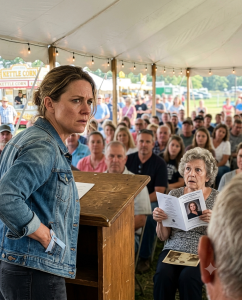
The applause rolled across the renovated fairgrounds in a wave of admiration, warm and immediate, the kind reserved for someone whose name had outgrown the place she came from. Under the white pavilion lights, with state officials on one side of the stage and a packed summer crowd on the other, Ruthanne Mobley stood at the podium in a cream jacket and low heels, one hand resting lightly on the wood, the other curled inside her pocket around a faded blue ribbon no one in that crowd knew existed.
Most of them were clapping for Chef Ruthanne Hale, the polished name on the program, the one attached to two successful restaurants, a bestselling cookbook, and a James Beard nomination that had made food editors who’d never set foot in Sweetwater County suddenly care about Tennessee sour cherries.
But as Ruthanne lifted her chin and turned toward the audience, recognition moved through the crowd in a quieter, more personal ripple.
That’s Ruthanne.
Ruthanne Mobley.
For nineteen years she had imagined coming back to Sweetwater, and in every version she was braver, colder, clearer than she felt now. In every version she knew exactly what she would say. Yet standing there in the July heat, smelling kettle corn and fresh-cut grass and the peculiar sweetness that only county fairs seemed to hold, she felt twenty-six again for one dangerous second.
Nineteen years earlier, in nearly the same spot, she had stood beside a pie and lost much more than a ribbon.
That summer had begun with hope. She and Daniel Mobley had gotten engaged in June, after two years of courtship that had felt, to Ruthanne, like a constant negotiation between love and warning signs she kept telling herself were small enough to ignore. Daniel was charming in the easy, local-boy way that made people trust him. He remembered birthdays, held doors, and kissed her forehead when she was stressed. He also had a mother who could turn a compliment into an insult without changing her smile.
Carol Mobley had never approved of Ruthanne.
She never said it directly in front of Daniel, not at first. She said it through comparisons. Through pauses. Through careful observations disguised as concern. Ruthanne was “smart, certainly,” but maybe a bit headstrong. “Talented with food,” though perhaps too serious about making a career out of it. “Perfectly nice,” but not from a family with “roots like ours.” Sweetwater was the kind of county where class didn’t always announce itself with money. Sometimes it announced itself with last names, church memberships, and which grandparents people still talked about with pride.
Ruthanne’s grandmother had been proud in quieter ways. She had taught Ruthanne to bake in a narrow kitchen with uneven floors and summer windows that never quite closed right. She taught her by feel and smell before measurements. Learn the dough with your hands, she’d say. Butter should stay cold enough to resist you. Fruit tells you when it’s ready. And if you bake for praise, you’ll ruin it. Bake because you mean it.
The sour cherry pie had been her grandmother’s recipe, though Ruthanne had refined it over the years with the careful attention that later made her a chef. That particular fair week, she baked it four times before she entered. One pie had run too loose. One had too much sugar. One tasted good but not right, which was a distinction only a serious cook would understand. The fourth pie was the one that made her stop, close her eyes, and think, There you are.
She carried it to the fair in her grandmother’s pale cream ceramic dish, bluebirds painted around the rim, wrapped in a dish towel that smelled faintly of flour and old wood cabinets. She remembered how Daniel smiled when he saw it on her kitchen counter that morning.
“This is the one,” he said, stealing a cherry from the filling scraps she’d set aside. “Enter it, Ruthie. Show ’em.”
It mattered that he said that. She had almost backed out. Entering the county fair felt suddenly childish now that she was engaged, as though she should have outgrown the need to prove herself. But some part of her wanted the opposite. She wanted to be seen. Not just as Daniel’s fiancée. Not as Carol’s future daughter-in-law under evaluation. As herself.
The judging tent was crowded that afternoon. Folding tables lined the center. Pies of every kind sat under wax paper and ribbons of steam. Lemon meringue, pecan, chess pie, blackberry, apple. The mayor drifted through in shirtsleeves, smiling at everyone. Local judges moved from entry to entry with clipboards. Neighbors clustered close enough to overhear and far enough to pretend they weren’t listening.
Ruthanne stood near her pie trying to keep her breathing even.
Then Carol Mobley walked forward.
She didn’t ask for a private word. She didn’t lean close. She stopped at the table, lifted one manicured hand, and pointed at Ruthanne’s pie.
“That crust came out of a Pillsbury box,” she said. “I saw the wrapper in the trash at her apartment.”
The sentence landed like a plate shattering.
At first Ruthanne didn’t comprehend it. Then came the low murmur, the shift in bodies, the instant transformation of curiosity into suspicion. One judge glanced at another. The mayor actually stepped back. That was what Ruthanne remembered most for years afterward: how quickly respectable people made room around embarrassment, as if it could splash on them.
She tried to answer. She truly did. She opened her mouth and felt the words stall in her throat like stones. I made it myself. She’s lying. The wrapper was biscuits. Say anything, she begged herself.
Nothing came.
And then she looked at Daniel.
He was standing only feet away. He knew she baked the pie from scratch. He had watched her roll the dough. He had eaten the rejected versions. He had licked cherry filling from his thumb in her kitchen and told her she was going to win.
He said nothing.
That silence struck harder than Carol’s accusation. If he had laughed and defended her, the moment might have turned. If he had simply looked offended on her behalf, perhaps the judges would have dismissed Carol as meddling. Instead he froze, eyes flicking once toward his mother, as though measuring the cost of crossing her in public.
The blue ribbon went to someone else.
Ruthanne drove home alone, the untouched pie in the passenger seat. She placed it on her kitchen table, sat down in front of it, and remained there as daylight thinned and darkness filled the corners. She was not just humiliated. She was altered. A public lie had been told about her, and the man who claimed he loved her had chosen convenience over truth.
By September, the engagement had ended in the stale language people use when they cannot bear to say what really happened. They had “grown apart.” They had “different priorities.” No one said Daniel had failed the only test that mattered. No one said Ruthanne had looked at the future and finally seen it clearly.
By spring, she had left Sweetwater.
She told almost no one why.
Nashville remade her the hard way. Culinary school was expensive, exhausting, and full of students who had more money, more polish, or more confidence than she did. She worked mornings in a bakery, classes in the afternoon, and restaurant shifts at night. She burned herself, cried in walk-ins, over-salted sauces, learned to recover fast, learned to move faster. She discovered that talent mattered, but stamina mattered more.
On one particularly bleak winter evening, when she had six dollars to make it to payday and a chef instructor had dismissed her dessert plating as “country pretty,” she reached into the pocket of an old coat and felt the ribbon.
She had picked it up the day of the fair from the dirt near the judges’ table, a pale blue satin ribbon with no official value. On the back was a dark ink smudge shaped almost like a thumbprint. At first she kept it because throwing it away felt too much like surrender. Later she kept it because it became proof, not of victory, but of memory. The day had happened. The humiliation was real. Her silence had cost her. His silence had cost more.
Years passed. She learned classical technique and then broke it skillfully. She opened a tiny restaurant that almost failed before a newspaper review saved it. She opened another. She became known for taking Southern desserts people thought they understood and revealing depths they had overlooked. Her sour cherry tart with brown butter crust became a signature. Food writers loved the story of the self-made Tennessee chef, though none of them knew the true origin of the intensity behind her pastries.
Every morning she touched the ribbon before work.
It was not superstition. It was instruction.
Remember exactly what silence costs.
She never married. Not because of Daniel alone, though that wound had shaped her. Mostly because she learned to mistrust people who wanted her softened. She built a life that asked too much of her to leave room for the wrong person. Her assistant knew not to schedule interviews before coffee. Her sous-chef knew she hated waste. Her investors knew she remembered every broken promise. Nobody knew about the ribbon.
Then the state invitation arrived.
Tennessee’s Department of Agriculture was planning a centennial celebration honoring regional food traditions, and they wanted Chef Ruthanne Hale to headline the opening event at Sweetwater County Fairgrounds. Her team was thrilled. The venue was local, meaningful, nostalgic. They used all the words she privately disliked.
She nearly declined.
In the previous decade she had turned down three bookings within driving distance of Sweetwater, each time inventing a conflict. She told herself she was busy. The truth was simpler: success had carried her far, but not past that tent.
This invitation was harder to escape. It had the governor’s office attached. It had press. It had her photo already drafted into a promotional layout. More than that, something in her was tired of evasion. She had spent years proving she could thrive without ever returning. Suddenly that felt incomplete.
She accepted.
The morning of the event, she dressed carefully and slipped the ribbon into her jacket pocket as always. During the drive in, Tennessee rolled past in green hills and familiar heat haze. She told herself she was coming as a professional, not as a ghost looking for old bones.
The fairgrounds had changed. New pavilion. New bleachers. Fresh paint. White tents with string lights and cleaner walkways than she remembered. But some things remained beyond renovation. The smell. The humidity. The hum beneath a county gathering where everyone is two conversations away from everyone else.
Backstage, an event coordinator offered her bottled water and reviewed the order of speakers. Ruthanne nodded, barely hearing. Her pulse beat hard but even. She had spoken before crowds larger than this. She had filmed television segments with cameras inches from her face. But public skill and private history are different beasts.
The MC introduced her with enthusiasm. “Award-winning chef, restaurateur, champion of Tennessee agriculture…” The applause began before she reached the podium. She saw admiration. Curiosity. Pride, even, from people who liked claiming a hometown success after once failing to protect them.
Then the recognition deepened.
That’s Mobley’s girl.
No, not Mobley’s. Ruthanne.
The one with the pie.
And then she saw Carol.
Twelve feet away in the crowd, older now, hair thinner and posture less imperious, but unmistakable. She was holding a printed program with Ruthanne’s face on the cover. Beneath it, partly tucked from view, was a faded photograph.
At first Ruthanne only noticed Carol’s expression: all the color gone, as if the last nineteen years had suddenly collapsed and left her exposed. Then Ruthanne’s eyes caught the photograph itself. A candid image of the old judging tent. Prize table. People crowded beyond it. And there, frozen in grainy color, a hand reaching across the ribbons.
A hand with a ring Ruthanne recognized.
Her breath shortened.
The image was angled, partial, but enough. Enough to see what she had never been able to prove: someone had tampered with the ribbons after the accusation. Someone had reached across the table in the chaos. And the hand was not Carol’s.
It was Daniel’s.
Ruthanne stood at the podium with the microphone warm under her fingers and understood, all at once, the shape of the betrayal. Carol had launched the lie publicly, but Daniel had not simply stood silent. He had acted. Whether out of panic, obedience, or cowardice, he had crossed that table. Had he removed something? Switched something? Dropped the ribbon she later found? The questions flashed through her like lightning, but the truth beneath them was already devastating.
He had been part of it.
From the far edge of the tent, as if summoned by her realization, Daniel himself appeared. Older too. Broader through the middle. The kind of face that might still be handsome to strangers but looked weak to those who remembered. He had probably come out of nostalgia or curiosity, perhaps thinking she would give a pleasant speech about cherries and perseverance and leave the past buried.
He saw the photograph in Carol’s hand. Then he saw Ruthanne looking at it.
The color left his face exactly as it had left his mother’s.
Ruthanne leaned toward the microphone.
“I used to think silence was the cruelest thing that happened here,” she said.
The crowd quieted immediately.
“But silence only works when everyone agrees to leave the lie alone.”
She reached into her pocket and held up the ribbon.
People squinted. A murmur passed. It was such a small object to command so much attention, a faded scrap of satin carrying nearly two decades of anger.
“I found this in the dirt near the judges’ table nineteen years ago,” she said. “I kept it because it reminded me of the day I learned what people will do when they’re afraid of the wrong woman being seen clearly.”
Carol lowered the program a fraction. Her hand shook.
Ruthanne continued, voice calm now, sharpened by certainty. “This morning I learned there was also a photograph from that day. And photographs are useful because they don’t get quieter over time. They just wait for someone to look closer.”
An event coordinator in the front row had noticed the image by then. So had a county board member. People were turning, following Ruthanne’s gaze to Carol, then beyond her to Daniel.
Carol’s composure cracked first. “This isn’t the place,” she said, not into a microphone but loudly enough to carry.
Ruthanne gave a small, humorless smile. “That’s exactly what should have been said nineteen years ago before you lied in front of half the county.”
The tent inhaled as one.
Daniel stepped forward. “Ruthanne—”
“No,” she said, and the single word stopped him.
Then, with the crowd hanging on every breath, she asked the coordinator to bring her the photograph.
Carol resisted for one embarrassed second too long, which only confirmed everything. The coordinator took it gently but firmly and passed it to the stage. Ruthanne looked down at the image close-up. There it was: Daniel’s hand, his college ring unmistakable, reaching across the corner of the prize table where the ribbons had been stacked. In the confusion after Carol’s accusation, while Ruthanne had been frozen and the judges distracted, he had moved.
Ruthanne lifted her eyes to him.
“Did you think I would never come back?” she asked.
Daniel’s mouth worked uselessly. Finally he said, “It got out of hand.”
A collective noise rose from the crowd, shock edged with disgust.
“Out of hand?” Ruthanne repeated. “Your mother accused me of cheating. You stood there and let them believe her. And then you touched the ribbons.”
Carol’s voice turned brittle. “He was trying to fix a mess you made by showing off.”
There it was. The old truth at last, no veil, no manners. Not the crust. Not the competition. Not concern over fairness. Carol had feared Ruthanne becoming visible, valued, harder to diminish.
Ruthanne looked at Carol almost with pity. “You really believed a pie ribbon would decide your son’s life?”
“It wasn’t about the ribbon,” Carol snapped.
“I know,” Ruthanne said.
Daniel closed his eyes briefly, then opened them with the exhausted look of a man who had spent years hoping the past would remain sealed. “The judges had already scored them,” he said. “Mother said if there was any confusion left, if your pie stayed on that table, people would keep talking. She wanted it gone. I moved the ribbons and knocked one down. That’s all.”
That’s all.
Ruthanne felt the old humiliation rise, but it no longer controlled the room. Now everyone heard it for what it was: a confession wrapped in minimization.
“You wanted my chance erased so thoroughly,” she said, “that even the evidence had to land in the dirt.”
Nobody applauded. Nobody moved. The silence this time belonged to her.
One of the original judges, now gray-haired and seated near the aisle as an honored guest, slowly stood up. “I remember that day,” she said. “I remember the score sheets too. We were pressured into acting fast after the accusation. If there was interference with the ribbons on top of that…” She did not finish. She didn’t need to.
The county board member asked quietly to see the photo. Others were already whispering. Someone said Carol should be ashamed. Someone else muttered that Daniel always had been weak. In a small county, public opinion can turn with shocking speed once the right story breaks open.
Ruthanne looked down at the faded ribbon in her hand. For nineteen years it had been a private object, weighted with grief and discipline. Now it felt lighter.
She set it on the podium beside her notes.
“I didn’t come here for revenge,” she said. “I came because I was tired of giving one afternoon more power than it deserved. But since we are here, let’s say it plainly. I made that pie from scratch. I was lied about in public. And the people who should have defended me chose instead to protect themselves.”
Then she turned to the audience, to the women holding children, to the teenagers in 4-H shirts, to the older men in seed-company caps, to the local bakers and officials and neighbors who had watched one version of the story for too long.
“If any of you have ever been told to stay quiet so someone else can stay comfortable,” she said, “do not confuse that with dignity. It is not dignity. It is surrender with better manners.”
The applause started slowly this time, not celebratory but fierce. Then it built and built until the tent shook with it. Not because she was famous. Not because of the cookbook or the restaurants. Because everyone there knew they had just watched a debt come due.
Afterward, the event coordinator asked if she wanted Carol and Daniel removed from the grounds. Ruthanne said no. Removal was too easy. Let them walk through Sweetwater under the weight of what had finally been said.
The state officials awkwardly suggested continuing the program. Ruthanne laughed for the first time all afternoon, and the laugh surprised even her. “Of course,” she said. “We’re still here to talk about food.”
And she did. She gave her speech. She talked about Tennessee farmers, regional fruit, preserving family recipes without freezing them in sentimentality. She was brilliant, because pain had not built her talent, only sharpened her use of it.
At the end of the event, the gray-haired former judge found her backstage. In her hand was a newly made blue ribbon from the fair office, unofficial but beautifully printed.
“This doesn’t fix anything,” the woman said.
“No,” Ruthanne replied.
“But I thought perhaps it should belong to you.”
Ruthanne took it, looked at it for a long moment, then smiled softly and handed it back. “Thank you. But the one I needed was the one I found.”
That evening, before leaving Sweetwater, she drove once past the old road where she had lived at twenty-six. The house looked smaller than she remembered. Most painful places do, once you survive them.
At a stoplight, she reached into her pocket and touched the old ribbon again. It no longer felt like a wound. It felt like evidence from a trial that had finally ended.
She did not forgive Carol. She did not forgive Daniel. Some betrayals become less sharp without becoming excusable. But she no longer carried the fairground inside her as a place of defeat. Now it was simply where the truth had taken too long to arrive.
Back in Nashville, when her assistant asked the next morning how Sweetwater had gone, Ruthanne smiled and said, “Productive.”
Then she pinned the faded ribbon to the inside wall of her office, where sunlight from the high window could catch the ink stain in the corner.
For nineteen years it had lived in her pocket like a private ache. Now it hung in plain sight, no longer hidden, no longer heavy, asking a question she suspected would linger longer than the scandal itself:
What ruins people more in the end—the original cruelty, or the years they spend pretending it was nothing?