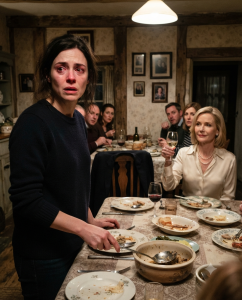
At her father’s memorial dinner, Grace’s sister raised a glass and announced that the family farm had already been sold.
The sentence landed so cleanly, so calmly, that for a second Grace thought she must have misheard it.
The room was full of relatives balancing paper plates on their laps, murmuring polite condolences between bites of ham and scalloped potatoes. A few candles burned on the sideboard beside a framed photograph of her father in his work jacket, smiling into the sun with one hand hooked through a fence rail. His funeral had been that afternoon. The flowers were still fresh. The dirt on everyone’s shoes still came from the cemetery.
And yet there was Vivian at the far end of the dining table, elegant in a cream dress and a string of pearls, lifting a wineglass as if she were making a toast at an anniversary party instead of a memorial dinner.
“Dad wanted us to move on,” she said, with a solemn smile that didn’t touch her eyes. “The papers are signed. The farm has already been sold.”
A hush spread through the room in ripples.
Grace sat motionless near the kitchen door, one hand still curled around the serving spoon she had forgotten to put down. She looked first at her sister, then at the empty chair at the head of the table where their father always sat, and then back again.
Sold?
The word made no sense.
Not because farms didn’t get sold. They did. Families broke apart. Bills piled up. Land got swallowed by debt or development or greed. Grace knew all of that. But her father had never once said he wanted to sell. Not in the hospital. Not during dialysis. Not in the quiet, exhausted hours after midnight when pain made him honest and weakness stripped him down to whatever mattered most.
He had talked about seed prices. About replacing the boards on the north fence. About the old hay baler that still jammed if the humidity got too high. About whether the hens were laying less because the weather had turned colder too fast.
He had talked like a man still rooted to the place.
Grace finally found her voice. “What papers?”
All eyes turned toward her.
Vivian lowered her glass and gave her a look filled with gentle patience, the kind people used when they wanted to appear reasonable in front of an audience. “The legal papers, Grace.”
Grace stood up slowly. “What legal papers?”
A few relatives shifted in their seats. Someone set down a fork. The discomfort around the table was immediate and heavy, but Vivian stayed composed.
“Dad made his wishes clear,” she said.
Grace could feel heat rising behind her eyes. “Not to me, he didn’t.”
That sharpened the silence.
Everyone in that room knew, even if no one wanted to say it, who had been with their father these past five years. Grace had driven him to dialysis before dawn three times a week. Grace had picked up his prescriptions, monitored his oxygen, kept the kitchen stocked with bland food he barely tolerated, and learned how to tell from the sound of his breathing whether she would need to sleep in the recliner beside his bed. Grace had fed the chickens before work, repaired fences in the rain, hauled hay, argued with mechanics, and paid small bills out of her own paycheck when her father’s pride wouldn’t let him ask for help.
Vivian had visited twice.
The first time, she had arrived in a rental car with pastries no one ate, stayed forty-five minutes, and spent half of that time on her phone. The second time, she had brought a bouquet, kissed their father’s cheek, and taken pictures on the porch as though she needed proof she had been there.
Now she stood in the dining room speaking with the polished certainty of someone who had never cleaned a feeding trough in sleet but somehow intended to decide the future of the land.
Vivian sighed softly. “I know this is difficult. But everything’s already handled.”
Handled.
The word cut deeper than Grace expected.
Then Uncle Roy leaned close from his seat beside her and murmured, “Don’t make a scene. You were never good with legal things.”
Grace looked at him.
Roy did not meet her eyes for long. He reached for his tea and stared down at the table instead, like what he had just said was perfectly practical, maybe even kind.
But it wasn’t kind. It was strategic.
And in that moment Grace understood something she couldn’t yet prove: this wasn’t a surprise to everyone.
The room felt smaller by the second. Her father’s chair seemed almost unbearable to look at. So she set down the spoon, pushed back her chair, and walked out before grief and humiliation could weld together into something uglier.
No one stopped her.
Outside, the night air struck her bare arms like cold water. She crossed the yard in a blur, gravel cracking under her shoes, and headed for the barn because it was the only place on the property that still felt honest.
The barn smelled like hay, oil, dust, and old seasons. The smell of work. The smell of her father.
Grace made it to the workbench before she collapsed onto the stool beside it and buried her face in her hands.
She cried for the farm, yes, but not only for the farm. She cried because her father was gone. Because she had been too tired to imagine a betrayal this fast. Because grief had barely had time to settle before someone had already wrapped it in legal language and passed it around like a finished transaction.
After several minutes, she lifted her head and wiped her face with the heel of her hand.
That was when she noticed the bottom right drawer of the workbench.
It sat slightly uneven, as though it hadn’t fully closed. Her father’s workbench was a map of his habits. Everything had a place. Everything. If something sat crooked, there was usually a reason.
She leaned closer and tugged on the drawer handle.
It didn’t move.
She frowned and bent down until her face was level with the drawer front. There, just inside the seam, she saw it: a nail angled from within, pinning the drawer shut from the inside.
Her pulse changed.
Her father had hidden money in coffee tins and tax receipts inside seed catalogs, but this was different. Deliberate. Protected.
Grace searched the bench until she found a rusted screwdriver. The first pry slipped. The second tore loose a splinter of wood. The third popped the drawer open with a crack that echoed through the barn.
Inside lay a leather pouch, a cassette tape, and a folded document sealed in a clear plastic sleeve.
Grace stared at them.
The paper came first.
Her fingers trembled as she opened it under the weak light above the bench. The document was a deed, notarized six months earlier. Her father’s name. His signature. The notary seal. The legal description of the property.
Then the transfer line.
To Grace Elaine Mercer.
She read it again, not trusting her own eyes. Then again.
The farm had been deeded to her.
There were conditions attached, typed neatly in language she had to force herself through twice. The transfer had been structured to protect the property from forced sale or later contradiction. Any attempt to sell without her consent, if the deed was validly recorded or produced, could be challenged and reversed.
Grace’s breath caught. Her father had known.
She looked at the cassette tape next.
The label was written in her father’s rough handwriting: FOR GRACIE ONLY.
An old cassette player sat on the shelf above the bench, dusty but intact. She plugged it in with shaking hands, pushed the tape inside, and pressed play.
Static filled the barn.
Then came her father’s voice, thin and weak, but unmistakably his.
“Gracie.”
Grace clamped a hand over her mouth.
A cough sounded on the tape. A long breath.
Then he said, “If your sister is smiling while you cry, play this for the lawyer.”
Grace shut her eyes as tears spilled again, but this time they came mixed with something harder than grief.
The tape continued. Her father spoke in slow fragments, as though every sentence had been pulled up through pain. He said he had been watching. Watching who came around when there was nothing to gain except inconvenience. Watching who knew the daily rhythms of the property. Watching who talked about memories and who talked about market value.
He said Vivian had been asking questions about title, taxes, and acreage in ways that did not feel innocent. He said Roy had started stopping by more often, offering to “help sort things out” while looking at boundaries and access roads instead of at his health.
Then his voice softened.
“This farm was never just dirt,” he said. “It’s the life built on it. It belongs to the one who carried it.”
Grace bent forward, sobbing soundlessly now.
He kept going. He named the law office that held backup instructions. He explained where he had placed the deed in case anyone tried to move faster than grief would allow. And then, in a tone so tired it nearly broke her, he said, “She’ll try to do it fast. That’s how you know she already planned it.”
By the time the tape ended, Grace wasn’t shaking anymore.
She was furious.
The next morning, she drove to the lawyer’s office the tape had named. The building sat in town above an insurance agency, plain brick, narrow stairs, no pretense. The attorney, Martin Hale, looked to be in his sixties and wore the expression of a man who had seen too many families destroy themselves over property.
He listened without interruption as Grace explained the memorial dinner, handed him the deed, and played the tape.
When it ended, he removed his glasses slowly and rubbed the bridge of his nose.
“This sale should not have happened,” he said.
Grace should have felt relief. Instead, she watched his face and knew there was more.
He pulled a contract from a file folder and turned it toward her.
The buyer was listed as Red Briar Holdings, LLC.
That meant nothing to Grace at first.
Then Hale slid over another sheet. “Mailing address.”
Grace read it and felt all the warmth drain from her body. The address belonged to a property used by Roy’s son for storage equipment outside the next county line.
“Is that—”
“It’s a shell,” Hale said. “Not uncommon. Very useful when someone doesn’t want their name attached immediately.”
Grace stared at the contract. “So Roy—”
“Had a stake in the buyer, directly or through family. That would be my strong suspicion.”
She leaned back, sick with the realization. Roy hadn’t been trying to keep peace at the memorial dinner. He had been trying to buy time.
Hale opened the leather pouch found in the drawer. Inside were three folded notes, a bank deposit slip, and a photograph.
The first note was in her father’s handwriting.
If these papers are being read, I was right not to trust what was said in my sickroom.
The second listed dates. Vivian’s visits. Roy’s visits. Calls made after doctor appointments. Conversations her father must have recorded in memory because he no longer trusted anyone else to document them accurately.
The third note was shorter and shakier.
Do not let them say I was confused. I knew exactly what I was doing.
Grace pressed her lips together so hard they hurt.
Then Hale showed her the bank slip. A substantial deposit into an account associated with Vivian, dated two weeks before their father died.
“What is that?” Grace asked.
“It could be anything,” Hale said carefully. “But paired with this?”
He handed her the photograph.
In it, Vivian stood in the driveway smiling beside Roy. Between them stood a man in a suit Grace recognized after a second’s delay—the same local real estate broker who had attended the memorial dinner, sat near the back, and avoided looking at her the entire night.
He hadn’t been there to pay respects.
He had been there to watch whether the lie would hold.
Hale moved quickly after that. He filed an emergency challenge, contacted the county recorder, and notified the title company that a prior deed existed. By noon, the transfer process froze. By afternoon, the buyer’s attorney was suddenly “unavailable.” By evening, Grace had three missed calls from Vivian.
She didn’t answer.
Vivian came to the farm the next day instead.
Grace heard her car before she saw it, tires crunching up the drive. She stepped onto the porch with the file folder under one arm.
Vivian got out wearing sunglasses too big for her face, though the day was overcast. “Why are you doing this?”
Grace almost laughed.
“Why am I doing this?”
Vivian crossed her arms. “You’re dragging this into court. You’re humiliating the family.”
“The family?” Grace said. “You announced a sale at Dad’s memorial dinner.”
Vivian’s mouth tightened. “He wanted things handled.”
“He transferred the farm to me.”
For the first time, Vivian’s control slipped. Only for a second, but Grace saw it.
Then Vivian recovered. “You don’t understand legal language.”
“Funny,” Grace said. “That’s exactly what Roy said.”
A car door slammed behind Vivian.
Roy had followed her in a truck and now stepped out, face set in grim annoyance. “This doesn’t need to get ugly.”
Grace held up the folder. “A little late for that.”
Roy came up the walk but stopped at the bottom step. “Your daddy was sick. People get ideas in that condition. They forget things.”
Grace felt the air leave her lungs in one sharp pulse.
She opened the folder, pulled out the note, and read aloud: “Do not let them say I was confused. I knew exactly what I was doing.”
Roy’s face went hard.
Vivian looked at him then, not Grace, and that glance told Grace almost everything. Not just that they had worked together. That something about their version of events had depended on silence. On intimidation. On the old family habit of letting louder people define reality.
Grace stepped down from the porch.
“You told everyone he wanted to move on,” she said to Vivian. “You smiled while I sat there thinking maybe I’d lost my mind. You let me hear about the sale in front of the entire family.”
Vivian’s voice sharpened. “Because someone had to be practical.”
“Practical?” Grace took another step. “I bathed him when he was too weak to stand. I drove him to treatment when he threw up the whole way home. I fixed fences at dawn before going to work because he cried when he thought the place was falling apart. Don’t talk to me about practical.”
Vivian’s jaw trembled.
For one fleeting moment, Grace thought she might apologize.
Instead, Vivian said, “He never forgave me for leaving.”
The honesty in it startled them both.
Grace stopped.
Vivian pulled off the sunglasses. Her eyes were wet now, furious and raw. “Everything was always about staying. Staying close. Staying loyal. Staying available. You became the saint because you never left.”
Grace stared at her. “This wasn’t about leaving. This was about lying.”
Roy cut in, impatient. “Enough. You’re making this emotional.”
“No,” Grace said, without looking away from her sister. “They made it a deal.”
She turned back to Vivian. “Did you even ask him? Or did you just assume he owed you something because you were too guilty to come home while he was alive?”
That hit.
Vivian’s face changed, not into remorse but exposure. Grace saw the answer there before any words came.
“We had an agreement,” Vivian said quietly.
“With Roy?”
“With everyone who understood the farm couldn’t survive under you.”
Grace went still.
Roy swore under his breath, as if she had said too much.
Grace looked from one to the other. “Everyone?”
That was when the broker’s car pulled into the lane.
Grace had not called him. Neither had they, apparently, because Vivian turned sharply, startled.
The broker got out with a folder in his hand and looked miserable. “I’m withdrawing,” he said to Roy before anyone could speak. “And if this becomes litigation, I am not protecting either of you.”
Roy stepped toward him. “You spineless—”
The broker raised a hand. “I was told the daughter in residence understood. That consent was coming. That this was family-coordinated.”
Grace felt a sick, burning clarity settle through her.
They had built the whole sale around erasing her without technically naming the erasure. The daughter in residence. The one in the house. The one who did the labor. The one they assumed could be pushed aside because she didn’t speak like them, dress like them, or know how to weaponize paperwork before breakfast.
Hale’s truck turned into the drive moments later, almost as if the story had reached the point where secrets could no longer stay indoors. He stepped out holding additional copies of the deed and addressed Roy directly.
“Any further attempt to interfere with this property will be included in the complaint,” he said.
Roy looked at Vivian, furious now in a way that had nothing to do with grief and everything to do with losing money.
Vivian looked at the house.
At the porch swing their mother once painted blue.
At the field line beyond the barn.
At the place she had tried to turn into an asset before the dirt over her father’s coffin had fully settled.
And suddenly she looked tired. Smaller. Less like a woman in control and more like someone who had mistaken speed for righteousness.
“You don’t know what it was like,” she said, barely above a whisper.
Grace answered just as quietly. “No. I only know what it was like after you left.”
Vivian’s eyes filled again. She seemed about to say something else, something truer perhaps, but Roy barked her name, and whatever fragile honesty had surfaced vanished.
She got back into her car.
Roy lingered longer, glaring as though hatred alone might revive the sale, but he eventually followed.
The broker left next.
Hale stayed long enough to explain the next steps. There would be filings, statements, likely a formal challenge. The fraudulent transfer would collapse. There could be consequences. Vivian might claim misunderstanding. Roy might deny beneficial ownership. None of that would change the central fact.
The farm belonged to Grace.
When everyone finally drove away, the property fell quiet again.
Grace stood alone in the yard between the house and the barn, listening to the wind move through the trees. It was the first peaceful silence she had heard since her father died.
A few days later, after the first legal notices went out, several relatives began calling. Some apologized for saying nothing at the memorial dinner. Some claimed they had been confused. One aunt admitted she had suspected Vivian was rushing but didn’t want to interfere.
Grace listened, thanked them when it felt honest, and let the rest pass.
Weeks later, the county officially voided the pending sale.
The title reverted cleanly under the earlier deed.
It should have felt like triumph.
Instead, it felt like standing in the middle of a field after a storm, taking stock of what remained.
Her father was still gone.
Her sister was still her sister, but now Grace knew what sat underneath the polished manners and careful words: resentment, guilt, entitlement, maybe old wounds she never bothered to name until they turned dangerous.
Grace found the cassette one evening and played it again in the barn.
This time she didn’t cry at once.
She listened to the rasp in her father’s voice, the pauses between words, the effort it took him to protect her even while dying.
At the end of the tape, after the legal instructions, there had been one part she had missed the first night because she was crying too hard.
“Gracie,” he said, softer than before, “taking care of things doesn’t mean taking care of everyone. Remember that.”
She sat there a long time after the tape clicked off.
That sentence changed something in her more than the deed had.
Because for years she had believed loyalty meant carrying whatever others dropped. Swallowing what hurt. Explaining away selfishness. Enduring silence. Enduring insult. Enduring people who only saw her value when they needed her labor.
Her father had known better, in the end.
He had not rewarded polish. He had not trusted appearances. He had chosen the person who stayed when staying was ugly, exhausting, and unseen.
And that was not only about land.
In the months that followed, Grace repaired the barn roof, replaced two gates, and kept the chickens despite telling herself she might cut back. The work was still hard. Some mornings grief arrived before sunrise and sat at the table with her coffee. But the farm no longer felt like something slipping away under her feet.
It felt like truth restored.
She and Vivian did not speak for a long time. When they finally did, it was brief and strained and nowhere near forgiveness. Some betrayals didn’t heal because the paperwork got fixed. Some things remained lodged under the skin. But on the quiet nights, Grace sometimes wondered whether Vivian’s worst mistake had been trying to steal the land—or believing the years Grace spent beside their father counted for less because they weren’t glamorous enough to be admired.
That was the part that stayed with people who heard the story.
Not just the hidden deed. Not just the secret tape. Not even the sale that stopped cold the next morning.
It was the image of a sister smiling over a memorial table, confident grief would make everyone else too stunned to challenge her.
And the father who knew exactly who she was.
Maybe that was the hardest truth of all.
Not that money changes people.
That sometimes it simply reveals them.