They said Darlene wouldn’t show up.
By the morning of the party, that had already become the running assumption all over Millbrook.
Some people said it kindly, with pity in their voices. Others said it with the slick confidence of people who believed they understood family drama because they’d watched it from pews and front porches. A few said it like a conclusion already proven.
“After everything, I doubt Darlene will come.”
“I can’t say I blame her.”
“It’s probably for the best.”
But by six forty-three that evening, Darlene Harper’s faded ’09 Buick was rolling slowly into the gravel lot of the Millbrook Grange Hall, and every single person who’d been so sure she would stay away was wrong.
She parked beneath the sycamore tree at the edge of the lot and shut off the engine. For a moment, she didn’t move. The hall glowed ahead of her with paper lanterns strung across the porch, and from inside came the thin, cheerful sound of a fiddle being tuned. It would have looked festive to anybody passing by.
Festive wasn’t the word Darlene would have used.
From where she sat, she could see through the tall front window. Her sister Patrice was standing near the center of the room, surrounded by people, one hand wrapped around a champagne flute. She was smiling the way she always smiled when she thought she had control of the story. Her hair was pinned up, her dress was expensive in that quiet way meant to look effortless, and hanging from her ears were their mother’s pearls.
Darlene stared at them until her jaw locked.
Their mother’s pearls.
She reached into the pocket of her coat and pulled out the old recipe card.
The card was soft with age, bent at the corners, the pencil handwriting faded but still legible if you held it under the light just right. Butter cake, it read at the top in their mother’s slanted script. Halfway down the card, there was a smear where a thumb must have dragged across the graphite years ago. In the bottom corner was the water stain Darlene had left herself the day she found it in a rusted tin box in the pantry and cried so hard she hadn’t realized tears were falling directly onto the paper.
She folded the card once. Then again.
When she was a child, her mother had made that cake every year on her birthday. Not just any cake. Butter cake with vanilla glaze, still warm when it hit the table, with the smell filling every room of the farmhouse. Her mother would always cut Darlene the first slice and say, “For my birthday girl.”
The year before the stroke, she had laughed and said, “I’ll make this for you every year until I can’t anymore, Darlene-bug.”
By March, she couldn’t.
Darlene ran her thumb along the fold one last time, slipped the card back into her pocket, lifted the thick manila envelope from the passenger seat, and got out.
The night air was cool. Gravel crunched under her shoes. Nobody outside saw how hard her hand was gripping the envelope.
Patrice’s first mistake had been deciding to celebrate.
Her second had been making it public.
The invitations had gone out two weeks earlier, printed on cream paper with a line drawing of the Harper farmhouse on the front. Their farmhouse. The one their father built board by board before Darlene or Patrice were born. The one their mother spent forty-one years tending, painting shutters, planting peonies, hanging laundry, canning peaches, and keeping every corner alive with the kind of care people now romanticized because they’d never done it themselves.
Inside, the invitation described the gathering as an evening to honor family legacy and welcome a new chapter at the homestead.
New chapter.
By then, the deed had already been filed. According to county records, the property had been transferred solely to Patrice Anne Collier three weeks after their mother’s hemorrhagic stroke.
Their mother had died twelve days later.
Darlene had read the filing so many times the words no longer looked real. She had also read the original will, the one found in the metal lockbox at the back of the linen closet, the one signed years earlier when both women were healthy and on speaking terms and nobody imagined lawyers would ever circle their kitchen table. That will was plain and fair: everything to be divided equally between the two daughters.
Equal.
That word had sat in Darlene’s chest like a stone ever since Patrice first said, “Mama wanted me to handle it.”
Handle it had become claim it, and claim it had become celebrate it.
Patrice had invited seventy-four people to witness that celebration.
Darlene had written down every one of their names.
She entered the hall through the side door, the one that always stuck unless you lifted it slightly while turning the handle. That old trick was muscle memory. She had opened that door carrying casserole dishes, auction donations, Christmas wreaths, and once, when she was thirteen, a chocolate pie she dropped face-first because she was laughing too hard at something their father said.
Patrice used the front entrance now.
Patrice didn’t remember side doors and stuck hinges. Patrice remembered what looked best from the road.
Inside, the smell of ham biscuits, sheet cake, coffee, and lemon cleaner wrapped around Darlene at once. The hall was fuller than she expected. Neighbors from Millbrook. Members of First Baptist. Women from the quilting circle. Her mother’s cousins. A retired school principal. The pharmacist. Men who had known her father. A funeral-home assistant who had been kind to Darlene in ways she would never forget.
The room didn’t freeze when she walked in. It softened.
People came to her immediately.
“Oh, honey.”
“We’ve been thinking of you.”
“I’m so sorry.”
“You look tired, sweetheart.”
“We loved your mama.”
Each kindness pricked at something already raw. Darlene hugged people, thanked them, smiled with lips that felt numb. She noticed their eyes flicking past her shoulder as if checking whether Patrice had seen her arrive.
Through it all, one hand stayed in her pocket.
Fold. Unfold.
Butter cake.
Mama’s handwriting.
The envelope in her other hand felt like a cinder block.
She had assembled it herself at the small kitchen table in her apartment across three sleepless nights. First the letters. Then the copied documents. Then each guest name carefully written on each smaller envelope, because printing labels felt too cold for what this was. This wasn’t a mass mailing. It was a reckoning.
Every envelope contained two things.
The first was a letter Darlene wrote in language so careful it barely sounded like grief. She had stripped out accusation and left in fact. Dates. Times. Filing numbers. The name of the notary public listed on the deed. The county office where the transfer had been recorded. A timeline of her mother’s stroke, hospitalization, and decline. A single question placed in the center of the second page:
How did a woman in the final stage of a hemorrhagic stroke sign a new deed with a steadier hand than she used to sign birthday cards?
The second document was a copy of the original will.
No commentary. No highlighting. Just proof that before illness and confusion and whispered explanations, their mother had intended to leave the house to both daughters equally.
Darlene poured herself sweet tea and stood near the gift table while the bluegrass trio played something bright and fast that felt almost offensive. She watched Patrice making rounds in a pale green dress, accepting congratulations as though she had inherited a blessing instead of engineered a transfer. Glenn stayed close to her side, smiling too much. He was the sort of man who believed charm could flatten any problem if applied quickly enough.
Darlene had once liked him.
That memory embarrassed her now.
At seven thirty, Glenn clinked a spoon against a glass and called for attention. The trio stepped aside. People drifted toward the center of the room, smiling, settling, ready for the official part of the evening. Darlene remained at the edge.
Glenn raised his glass and delivered a toast about history, stewardship, and “keeping Miss Evelyn’s memory alive.” He spoke warmly, as if he had not stood in Darlene’s living room a month earlier saying, “Let’s not turn this into a legal circus.”
Patrice dabbed at her eyes once during the toast. It was expertly timed.
Darlene looked away and pressed her fingers to the recipe card inside her pocket.
I’ll make this for you every year until I can’t anymore.
She could almost smell vanilla and browned butter. Almost hear the scrape of her mother’s spatula against the mixing bowl. The grief came up so fast it blurred the lantern light for a second. She swallowed it down.
Not here. Not now.
When Glenn finished, applause filled the room. Warm. Easy. Social.
Darlene set her sweet tea on the gift table.
The master envelope was already there, propped between a vase of grocery-store flowers and a stack of wrapped boxes. She had placed it there earlier while everyone was watching Glenn. On top sat a cover sheet unlike the others. Across it, in bold print, were the words:
Copies distributed to all guests, the county recorder’s office, and one other party — see attached.
The final line was partly strategy, partly instinct. She wanted Patrice to wonder. To panic. To understand that this was now bigger than family whispering.
Darlene smoothed the front of her blue blouse, the one her mother always said brought out her eyes, and started walking.
It happened slowly at first. One person noticed her moving toward the platform. Then another. The bluegrass trio, unsure whether to start again, went silent. Somebody shifted a chair. Glenn stepped back from the microphone stand, still smiling until he realized the room’s attention had changed direction.
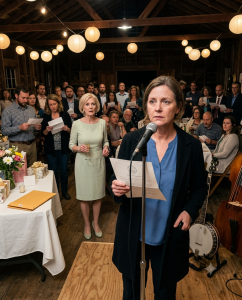
Darlene climbed the two low wooden steps to the platform and reached for the microphone.
The hall hushed.
She could feel all seventy-four sets of eyes on her. Neighbors. Friends. Witnesses. People who had been given one neat version of events and had never thought to ask why it was so neat.
Then Patrice turned.
The expression on her face moved in stages. Mild confusion. Irritation. Recognition.
Then fear.
Because from where she stood, she could suddenly see the room clearly. Envelopes in hands. Papers being opened. Eyes scanning pages. A woman in the third row raising a copy of the will closer to the lantern light. Glenn’s smile collapsing. The master envelope on the table.
Patrice’s champagne flute tipped. A thin stream of sparkling wine slid over her fingers.
Darlene lifted the microphone.
“I almost didn’t come tonight,” she said.
Her voice was calm. That surprised her most of all.
A rustle moved through the room, but nobody interrupted.
“I almost stayed home and let this pass for the sake of peace. But my mother spent her whole life teaching me that peace built on lies is just another name for cowardice.”
The room went dead still.
Patrice took a step forward. “Darlene, don’t do this here.”
Darlene didn’t look at her. Not yet.
“So before anybody in this room celebrates this house becoming one person’s legacy,” she said, “I thought you all deserved to see what my mother signed before the stroke… and what somehow got filed after.”
A murmur broke out instantly. Papers rustled open. Someone whispered, “What is this?” Another voice said, “Wait—equal ownership?” Glenn’s jaw went tight. Patrice’s lips parted, but for a second no words came out.
Then a woman near the front—Mrs. Talley from the quilting circle—stood up halfway from her chair and asked, “After what?”
That was the moment Darlene knew the room had shifted. Not toward her exactly. Toward doubt.
She lowered the microphone and picked up the master envelope. Behind the cover sheet and the copies of the will, clipped separately, was the third document—the one she had kept to herself until the last possible second.
She pulled it free and held it up.
County seal.
Witness correction statement.
The kind of paperwork nobody notices until they understand what it means.
Patrice made a strangled sound. Glenn looked at the page, then at his wife, and something uncertain entered his face for the first time all evening.
Darlene returned to the microphone.
“I requested the deed file yesterday,” she said. “Attached to it was a correction statement saying the original witness to the signing could not be reached. So another signature was accepted later.”
The room reacted all at once.
“Later?”
“What does that mean?”
“Accepted afterward?”
Glenn stepped toward the platform. “This is private family business.”
“No,” Darlene said sharply, finally turning to look at him. “It stopped being private when you invited half the county to celebrate stolen property.”
That hit harder than she meant it to, but she did not take it back.
Patrice found her voice then. “You’re grieving and confused. Mama wanted me there. Mama trusted me.”
Darlene laughed once, without humor. “Mama trusted me enough to leave me half the house.”
Patrice’s face tightened. “That will was old.”
“And the nurse’s chart isn’t.”
Darlene reached into the envelope again and held up the final sheet.
The photocopy looked ordinary, almost boring, except for the highlighted line in the middle:
Patient nonverbal. Unable to identify family members. Sedation administered at 3:40 p.m.
The deed had been signed at 4:12.
This time the silence was violent.
You could hear the buzz of one bad fluorescent light in the back of the hall. You could hear somebody setting down a fork. You could hear Patrice breathing too fast.
One of the older men near the window took off his glasses and said softly, “Lord.”
Glenn stared at the page. “Patrice?”
She didn’t answer him.
Darlene came down from the platform one step at a time, still holding the chart. She stopped a few feet away from her sister. Close enough to see the panic under the makeup. Close enough to see that Patrice already understood denial would not save her.
“You cleared out Mama’s room before the funeral,” Darlene said quietly. “You told me it was because you couldn’t bear to look at her things. But you were looking for papers, weren’t you?”
Patrice swallowed.
“You told the lawyer Mama changed her mind after the stroke,” Darlene continued. “You told everybody she knew exactly what she was doing.”
“I was taking care of her,” Patrice snapped, but her voice cracked in the middle.
“No,” Darlene said. “You were taking advantage of the fact that she couldn’t speak.”
A few people gasped. Mrs. Talley sat down hard, hand over her mouth. Glenn took a half-step back from his wife as if distance might protect him from whatever came next.
Patrice looked around the room, searching for an ally, but the problem with public lies is that when they split open in public, there’s nowhere for the pieces to go. Every face around her had changed. Not all the way to condemnation. Some were still confused. Some were shocked. But none were still celebrating.
Finally, Patrice whispered, “You weren’t supposed to find that.”
Darlene’s chest tightened.
Not because she was surprised.
Because hearing it out loud ended the last tiny part of her that had hoped there might still be some explanation she didn’t know.
Glenn turned to Patrice so slowly it looked painful. “What did you do?”
Patrice wiped at her face, smearing mascara at the corner of one eye. “I did what had to be done. You don’t understand. Darlene would’ve sold it.”
“That’s a lie,” Darlene said.
“You never wanted the work,” Patrice shot back, louder now, almost desperate. “You liked visiting. You liked memories. I’m the one who handled bills. I’m the one who drove Mama to appointments. I’m the one who—”
“You’re the one who saw an opening,” Darlene said.
The words landed between them with ugly precision.
Patrice’s shoulders shook. Whether from rage or humiliation, Darlene couldn’t tell. “She wanted me to keep it together.”
“Then you should’ve asked me to help,” Darlene said. “You don’t forge fairness because you’re scared of sharing.”
A voice came from near the door. It was Mr. Beasley, who had known their father for thirty years. “Patrice… did Miss Evelyn know about this deed or not?”
Patrice looked at him.
Then at Glenn.
Then at the pearls she was touching now with shaking fingers.
And that was when she broke.
“She knew it was the house,” she said. “I told her what it was.”
Darlene’s stomach dropped. “She couldn’t identify family members.”
“She had moments!”
“She was sedated.”
“I told her it was to protect the property!”
The room erupted.
People started speaking over one another. “Protect from who?” “That’s not consent.” “Lord have mercy.” Glenn took another step away. Patrice was crying now, but it did not make her look innocent. It made her look cornered.
Darlene lifted one hand. The room quieted little by little.
“I sent copies to the county recorder,” she said. “And to an attorney in Millbrook.”
That part was true.
She had also sent one to the state licensing board for notaries, because after reading the witness correction statement three times, she had decided not everyone involved deserved the comfort of a quiet phone call.
Patrice stared at her in horror. “You would ruin me over this?”
Darlene looked at her sister—the sister who used to braid her hair on the school bus, who once split a peach with her on the back steps, who later learned that wanting more could become justification for almost anything.
“No,” Darlene said. “You did that yourself.”
Nobody touched the cake after that.
The party dissolved in fragments. Some guests slipped out quietly, clutching the envelopes. Others stayed back to speak to Darlene, to say they were sorry, that they hadn’t known, that something had felt wrong but they hadn’t wanted to believe it. Glenn left before Patrice did. Darlene saw him standing in the parking lot by his truck with both hands on his head, staring into the dark.
Patrice remained inside near the gift table, motionless, as if leaving would make everything real.
Eventually, she removed the pearl earrings and placed them beside the flowers.
Darlene noticed that more than anything else.
The legal fight took months.
There were depositions, affidavits, one notary who suddenly remembered less than before, and a witness who admitted he had never actually seen Evelyn Harper sign anything that day. The correction statement became a problem no lawyer could soften. The nurse’s chart became worse. The judge called the deed transfer deeply suspect before declaring it invalid pending full review, and by the time the case concluded, the original will was reinstated exactly as written.
The farmhouse was restored to both sisters equally.
Patrice was not criminally charged in the end, but only because the county prosecutor said proving intent beyond doubt would be expensive and messy. Civilly, though, she lost everything she’d tried to secure. Glenn moved out before the hearing was over. People in Millbrook stopped inviting Patrice to host committees, then stopped inviting her altogether. Shame travels fast in a small town, but not as fast as paperwork.
Darlene got her key back in November.
The first time she unlocked the front door again, the house smelled shut up and faintly sour. She stood in the entryway with boxes at her feet and cried for a full minute before doing anything else. Then she opened every window. She washed every counter. She stripped beds, boxed Patrice’s leftover decorations, and sat on the kitchen floor around dusk because the silence hurt in a way she had no language for.
Later that week, she found the old cake pan in the lower cabinet under the stove.
On her birthday in January, she made the butter cake herself.
It wasn’t quite her mother’s version. The edges browned too much, and the glaze came out thinner than it should have. But when she took the first bite at the old kitchen table, the taste was close enough to break her heart and mend it a little at the same time.
Patrice didn’t come by.
She sent a letter months later. No excuses this time. No legal language. Just an apology written in a hand Darlene barely recognized. She said grief had turned into panic, panic into entitlement, and entitlement into something she kept defending even after she knew it was wrong. She wrote that every day since the party, she had replayed the moment the glass slipped from her hand and understood she had crossed a line she could never uncross.
Darlene read the letter twice and put it in a drawer.
She did not answer.
Not because forgiveness was impossible.
Because forgiveness, she had learned, was not the same thing as pretending nobody saw what happened.
The farmhouse still stands in Millbrook, with its wraparound porch and fading blue shutters. Some weekends Darlene stays there. Some weekends she doesn’t. She has not decided yet whether to keep her half forever, buy Patrice out if she ever can, or sell and leave the memories where they were made. The future remains unsettled.
But one thing does not.
On the night Patrice tried to turn theft into a toast, Darlene walked into a room full of people who expected silence and gave them the truth instead.
Maybe that was revenge.
Maybe it was justice.
Maybe it was simply the last thing left a daughter could do for the woman who taught her never to leave a table when someone was counting on silence.
And if the sharpest red flag in the whole story was a celebration sent out on cream-colored paper before the paperwork could survive daylight, then the saddest part was this: Patrice might have kept the house for a while, but she lost the one thing no deed could ever transfer back once it was gone.
The right to say her mother would have been proud.