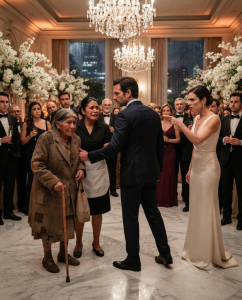
The mansion in Polanco looked as if it had been built for nights exactly like this one.
Every light was warm without being soft. Every flower arrangement had been placed with mathematical care. White bougainvillea climbed crystal stands in the main salon, the silverware shone without fingerprints, and the music drifted elegantly from one room to the next as if even sound had been trained to behave.
Outside, a light rain polished the pavement and turned the line of black cars into blurred reflections. Security guards held umbrellas over guests as they stepped out, while inside, people with expensive watches and polished smiles exchanged greetings that sounded friendly and felt strategic.
It was the kind of gathering society pages loved—wealth, beauty, family names, and the promise of a public announcement.
By the end of the evening, Alejandro Robles was expected to confirm his engagement to Isabela Montes.
For weeks, rumors had circled through business circles and social magazines alike. He was one of the country’s most respected developers, a man who had turned his construction company into a giant without becoming known for arrogance. She came from an old northern family whose money spoke quietly because it never needed to shout.
On paper, they were perfect.
In person, they looked even better.
Isabela moved through the room in an ivory gown that seemed to float around her. Her dark hair was pinned back in a style so exact it looked effortless. She smiled for photographs, accepted compliments with practiced warmth, and kept the entire evening aligned with the version of perfection she preferred.
Alejandro, by contrast, never looked staged. In his dark suit and simple tie, he seemed less interested in being admired than in making sure everyone around him felt seen. He greeted investors, old friends, and distant relatives with the same calm attention. He thanked the waiters by name. He asked one of the bartenders whether his son had recovered from the fever he’d mentioned the week before.
It was never theater with him.
He had been raised too close to hardship to mistake respect for decoration.
His mother had cleaned hotel rooms in Veracruz. His father had spent years on construction sites lifting steel until his hands cracked and bled. Alejandro had grown up watching exhausted people come home with dust in their hair and pain in their backs, only to wake before dawn and do it all again.
He never forgot it.
That was one of the reasons Carmen Salgado trusted him enough to ask for help.
Carmen had worked in his household for nine years. She managed details other people barely noticed—schedules, deliveries, repairs, linens, kitchen coordination, emergency shopping, forgotten medication, broken zippers before events, misplaced cufflinks before meetings. She did her work quietly and well, which meant most guests never really saw her.
But Alejandro did.
He knew she was dependable. He knew she supported her elderly mother. He knew she sometimes left after midnight and still arrived before everyone else in the morning. So when she approached him that afternoon with visible embarrassment, twisting her hands together, he listened.
“My mother is being released from the hospital tonight,” she said. “She had trouble breathing again. I don’t have anyone to stay with her, and I know tonight is important. If I could leave early—”
She had not finished the sentence before shame crossed her face. Important nights in houses like this often came with unspoken rules: do not inconvenience the powerful, especially when they are celebrating.
Alejandro shook his head gently.
“Bring her here,” he said. “She can rest in the service suite until the event is over.”
Carmen blinked at him. “Sir, I couldn’t—”
“You can,” he said. “No one should be alone after leaving the hospital.”
That should have been the end of it.
At 9:17 that evening, Carmen rode the service elevator down to meet her mother at the entrance reserved for staff and deliveries.
Doña Elvira stood waiting with a small cloth bag in one hand and a cane in the other. She was eighty-four years old, thin from age and recent illness, but still determined to present herself with care. Her coat was brown and old, patched at the elbows. Her shoes had been polished so many times the leather had long ago given up pretending to be new. At her collar, she wore a worn brooch she had owned for decades.
Before entering the elevator, she straightened her skirt and touched the brooch lightly.
“Forgive me, daughter,” she murmured. “I know this is your work.”
“You’re not bothering anyone,” Carmen said, though her own nerves betrayed her.
Doña Elvira looked around as the elevator rose, taking in polished metal, mirrored walls, and the faint scent of expensive flowers. She did not look resentful. She looked curious, almost moved.
“It’s beautiful,” she said when the doors opened to a private corridor. “You can tell someone worked hard to make a place like this.”
Carmen smiled despite herself. “Come on, Mama. Let me sit you down somewhere warm.”
She meant to guide her mother straight into a quiet room near the kitchen, where a sofa had been prepared. But a server carrying a tray pushed open the wrong door at the exact wrong moment, and suddenly they were visible from the main salon.
Just for a few seconds.
Long enough.
Alejandro saw them first. From across the room, he nodded politely to the old woman standing uncertainly in the doorway. Doña Elvira answered with the same simple courtesy.
Then Isabela saw them.
The change in her expression was immediate and ugly. Her smile disappeared. Her body turned rigid. She glanced at the patched coat, then at Carmen’s uniform, and crossed the room before anyone could stop her.
“Who allowed that woman in here?” she asked.
She spoke with enough control to avoid looking hysterical, but every word was sharp enough to cut.
Carmen stopped breathing for a moment. “Ms. Isabela, she’s my mother. Mr. Alejandro said she could rest in the service area.”
Isabela gave a short, humorless laugh.
“Then that is where she belongs. In the service area. Not in the middle of the salon as if she were a guest.”
People heard. Of course they heard.
A few nearby women fell silent, their eyes bright with the dangerous excitement of scandal. A businessman several feet away turned to his phone in theatrical discomfort. A pair of musicians near the far wall slowed without fully stopping, sensing tension without understanding it.
Doña Elvira lowered her gaze. Her grip tightened around the cane.
Isabela continued, her voice cool and poisonous.
“A party like this loses all elegance when anyone thinks they can walk among the guests. There are levels, Carmen. Your mother does not belong in this place.”
Carmen’s mouth opened. Nothing came out.
And then the old woman, already exhausted, answered in a voice so fragile that the entire room seemed to recoil from it.
“I’m sorry, ma’am. I didn’t mean to make anyone uncomfortable. I’ll go where I’m not in the way.”
Alejandro heard that line from the terrace doors.
He turned.
And he understood everything at once.
He saw Carmen trying not to cry. He saw the old woman apologizing for taking up space. He saw Isabela smoothing her dress with a look of satisfaction so faint most people would have missed it.
A deep, cold clarity rose in him.
There are moments when a future collapses before a single word is spoken. This was one of them.
He crossed the room in total silence. Guests shifted aside instinctively. By the time he reached the doorway, the musicians had stopped completely.
He did not look at Isabela first.
He looked at Doña Elvira.
Then, with deliberate respect, he bent slightly and offered her his arm.
“Ma’am,” he said, loud enough for half the room to hear, “no one who has worked hard all her life is ever out of place in my home.”
The silence that followed was devastating.
Doña Elvira stared at him, stunned. Carmen covered her mouth with one hand. Somewhere near the back, a glass touched silver with a tiny accidental ring that sounded absurdly loud.
Alejandro guided the old woman forward a few steps into the room where she had just been humiliated. Not one person blocked him.
Then he turned to Isabela.
She attempted a smile first, perhaps thinking he would smooth the scene over privately, the way people of status often do. But there was nothing private in his expression.
“You said there are levels,” he told her evenly. “You were right.”
The words made several guests lean in.
Isabela lifted her chin. “Alejandro, don’t do this here. I was simply protecting the tone of the event.”
“The tone,” he repeated.
“Yes. This evening matters. People are watching.”
He looked around the room. “They are.”
For the first time, a flush rose in her face.
“You’re overreacting,” she said. “No one insulted anyone. I only said there are certain boundaries. Staff have their spaces. Guests have theirs. That’s how events work.”
Carmen flinched.
Alejandro did not. “She is an elderly woman who just left the hospital.”
Isabela’s voice sharpened. “And that is unfortunate, but not relevant to etiquette.”
Several people inhaled at once.
Alejandro reached into his jacket pocket. What he pulled out was not dramatic in appearance—just a small velvet ring box. For a moment, some guests thought he might still continue with the announcement.
Instead, he held the box in his palm and looked directly at Isabela.
“I was planning to ask for a toast tonight,” he said. “I was planning to tell everyone I’d chosen the woman I wanted beside me for the rest of my life.”
The room became so still that the rain beyond the windows could be heard tapping faintly against glass.
“But I cannot build a life with someone who believes dignity is reserved for the rich.”
Isabela’s composure cracked.
“Alejandro,” she said in a low warning voice, “you are embarrassing me.”
“No,” he replied. “You embarrassed yourself the moment you tried to make an old woman feel smaller so you could feel bigger.”
Her parents, who had been speaking with guests across the room, started moving toward them. Her mother looked pale with fury. Her father wore the expression of a man calculating both damage and strategy.
“This is not the place,” Isabela said. “We can discuss this upstairs.”
He closed the ring box.
“There is nothing to discuss.”
The meaning hit the room before the words did.
Isabela took a step forward. “You are not ending our engagement over a misunderstanding with an employee.”
Alejandro’s voice remained calm. “I am ending it because your cruelty was not a misunderstanding. It was instinct.”
The word landed hard.
A tremor passed through her face. “Cruelty? Because I refuse to pretend social rules don’t exist?”
“No,” he said. “Because you looked at a woman old enough to be your grandmother and decided the patched elbows on her coat gave you the right to humiliate her.”
Her father finally arrived. “Alejandro,” he said with strained civility, “surely this can be handled discreetly.”
Alejandro glanced at him. “It could have been handled discreetly when your daughter chose silence.”
No one spoke.
He turned back to Doña Elvira. “Would you sit down, please?”
He guided her to one of the upholstered chairs near the fireplace—one of the best seats in the room. Then he asked a server for tea and a blanket. The young waiter moved so quickly he nearly stumbled.
Doña Elvira was trembling.
“You don’t have to do this for me,” she whispered.
Alejandro crouched slightly so he could meet her eyes. “I’m doing it for me too,” he said. “Because I know what it costs to be treated like you should apologize for existing.”
That sentence changed something in the room.
People who had remained silent now looked ashamed.
An older businessman near the terrace slowly lowered his eyes. One of the women from Isabela’s circle pretended to adjust her bracelet because she could no longer bear to watch. A younger guest, perhaps seeing her own grandmother in the old woman’s face, quietly carried over a cushion and placed it behind Doña Elvira’s back.
But Isabela was not finished.
Her humiliation had cornered her, and cornered pride often becomes uglier.
“This is absurd,” she said, louder now. “Everyone is acting as if I attacked her. I merely said she was out of place.”
Alejandro straightened and faced her again.
“In this house,” he said, “the only person out of place is the one who thinks money makes her superior.”
The sentence moved through the room like a current.
Then Carmen, who had stayed silent from shock more than fear, finally found her voice.
“Mr. Alejandro,” she said shakily, “please, because of me, don’t ruin your night.”
He turned to her. “This night was ruined the moment your mother was humiliated.”
Carmen’s eyes filled instantly.
Doña Elvira touched Alejandro’s sleeve with fragile fingers. “Son,” she said softly, “don’t fight on my account.”
Son.
The word startled several people, though she had clearly used it with age-born affection rather than familiarity.
Alejandro smiled at her, and for a moment his expression softened into something deeply personal.
“My mother used to say the same thing,” he said. “Every time someone mistreated her, she worried more about upsetting others than about herself.”
Doña Elvira studied his face. “Your mother was a decent woman, then.”
“She was,” he said. “Too decent for many of the people who looked down on her.”
That might have been where the scene ended, with broken engagement, public shame, and a room full of witnesses who would spend months repeating the story.
But then Doña Elvira looked more closely at him.
Her brows pulled together.
“Veracruz?” she asked faintly. “Did you say your mother worked in Veracruz?”
Alejandro blinked. “Yes.”
“What was her name?”
“Lucía Robles.”
The old woman’s hand tightened around his sleeve.
For a second, she looked frightened. Then overwhelmed.
“I knew her,” she whispered.
He froze.
The room, already silent, seemed to narrow around the two of them.
“You knew my mother?”
Doña Elvira nodded, tears gathering in her eyes. “Years ago. At the Hotel Mar y Sol. She cleaned rooms. I sold coffee and sweet bread outside in the mornings.”
Alejandro stared at her as if the world had tilted.
“She used to come out through the back entrance when her break was short,” Doña Elvira continued. “Always tired. Always in a rush. But always polite.”
Carmen looked from her mother to Alejandro in disbelief.
“There was one rainy season,” Doña Elvira said, “when your father got hurt. She didn’t have enough money for medicine. I remember because she was crying while pretending she wasn’t.”
Alejandro’s chest tightened.
He remembered that season. He had been a boy. His father’s injury. The unpaid prescription. His mother stretching beans and tortillas for days.
Doña Elvira’s voice shook. “I loaned her money. Not much. What I had from selling coffee. She tried to return it the next week, but I told her no. I said when God lifted her family, she could help someone else.”
Alejandro could not speak.
He had heard fragments of that story from his mother long ago—about a stranger with kind eyes who helped her when she was desperate. She never remembered the woman’s full name. She only remembered the brooch at her collar because it caught the rain.
Alejandro looked at the worn brooch pinned to Doña Elvira’s coat.
It was the same one.
For the first time that night, his composure broke. Not loudly. Not theatrically. But his eyes filled, and he had to lower his head for a second before he could answer.
“My mother looked for you,” he said quietly. “For years. She wanted to thank you properly.”
Doña Elvira smiled through tears. “There was nothing to thank. One poor woman helps another. That is all.”
“No,” Alejandro said. “That is not all.”
He stood, then turned to the room.
“My family ate because of women like her,” he said. “Because ordinary people with almost nothing still chose kindness.”
The weight of that truth fell over every guest, every flower arrangement, every polished surface built to impress.
And at the center of it stood Isabela, who had mocked a woman whose compassion had once kept Alejandro’s own family afloat.
There was no recovering from that.
Her mother closed her eyes briefly, as if praying the floor would open. Her father’s jaw hardened with helpless anger. Isabela herself looked stunned—not repentant, not yet, but wounded by the realization that the entire room had shifted beyond her control.
She made one final attempt.
“If that story is true,” she said, brittle and desperate, “then of course it’s touching. But none of us knew—”
Alejandro cut in.
“That is exactly the point.”
He did not raise his voice. He did not need to.
“You should not need a tragic backstory, a connection to my family, or proof of usefulness before you grant someone basic respect.”
No one in that room would ever forget the way he said it.
Isabela opened her mouth, then closed it. There was nothing left that did not make her look smaller.
Alejandro handed the ring box to his assistant, who had quietly appeared near the edge of the crowd, and said, “Please return this to the jeweler tomorrow.”
The assistant nodded once, eyes lowered.
Then Alejandro turned to Carmen.
“Take your mother to the blue sitting room,” he said gently. “Have dinner there if she feels up to it. The doctor on my staff will come check her breathing.”
Carmen burst into tears.
“Sir, I don’t know how to thank you.”
“You already have,” he said, glancing at Doña Elvira. “More than you realize.”
Guests began to move at last, but not with their earlier ease. The room had changed shape around the truth. Some people quietly left. Others approached Doña Elvira to greet her with embarrassed respect, trying to repair with politeness what they had helped destroy with silence.
One elderly man bent down and kissed her hand. A woman offered her shawl. The same businessman who had stared at his phone walked over to Carmen and muttered, “I should have said something. I’m sorry.”
It was not enough, but it was honest.
Isabela stood motionless until her father placed a hand at her back and guided her toward the exit. She went stiffly, her head high, the picture of dignity from a distance. Up close, anyone could see that dignity and humiliation are not the same thing.
She did not look back.
The rain had strengthened by then. Through the window, Alejandro watched the Montes family disappear behind umbrellas and dark glass.
He felt no triumph.
Only relief, and the ache that comes when a beautiful illusion finally tells the truth about itself.
Later, after most guests had gone, Alejandro walked into the blue sitting room carrying a tray himself—tea, warm bread, soup, and a folded wool blanket. Carmen tried to stand, but he shook his head.
Doña Elvira sat nestled in the chair, breathing more easily now.
When she saw him, she smiled in that tired, gentle way only very old women seem to manage.
“You have your mother’s eyes,” she told him.
He sat across from her. “And according to everyone who knew her, her stubbornness.”
“That too,” Doña Elvira said with a faint laugh.
They talked for nearly an hour.
She told him about the mornings outside the hotel, the little stove she used to boil coffee, the workers who came by before sunrise, the women who sometimes cried when they thought no one noticed. Alejandro told her about his mother’s final years, the house he bought her, the trips she never stopped calling unnecessary, and how she cried the first time she saw her name on the deed.
At one point, Carmen stepped out to take a call from the doctor, leaving the two of them alone.
“Your mother would be proud tonight,” Doña Elvira said.
Alejandro looked down for a moment. “I hope so.”
“She would,” the old woman said firmly. “Not because you are rich. Because you remembered.”
That was what stayed with him after the house was quiet.
Not the broken engagement. Not the gossip sure to explode by morning. Not the strategic fallout or the headlines or the whispers that would crawl through social circles.
What stayed with him was that sentence.
You remembered.
In the weeks that followed, the story spread exactly as people would expect. Some blamed him for humiliating Isabela publicly. Others said he had spared himself a lifetime beside the wrong person. There were articles, rumors, guesses, and plenty of lies from people who had not been in the room but loved speaking as if they had been.
Alejandro did not respond to any of it.
Instead, he did something smaller and more meaningful.
He made sure Doña Elvira had access to the best pulmonary care. He arranged for Carmen and her mother to move to a safer apartment with an elevator and proper ventilation. He created a scholarship fund in his mother’s name for daughters of domestic workers and hotel staff. And at the fund’s first private ceremony, he invited exactly one guest of honor to sit beside him.
Doña Elvira wore the same brooch.
This time, no one questioned whether she belonged.
Months later, when people still occasionally asked why he had ended what seemed like a perfect engagement, Alejandro always answered the same way:
“It only seemed perfect from far away.”
That was true of many things—mansions, reputations, marriages, class, elegance.
Up close, the details mattered more.
A patched coat. A trembling apology. A man who remembered where his life began. A woman who revealed her soul in a single sentence. A room full of people forced to decide whether silence made them innocent.
The strangest part was this: some still argued that Isabela had only said what others were thinking.
Maybe that was the ugliest truth of all.
Because the real question was never whether one cruel woman ruined a celebration.
It was how many others would have let her do it if Alejandro had not walked back into the room in time.
And if you had been there—dressed well, holding a glass, watching an old woman apologize for existing—would you have spoken before the richest man in the house did?