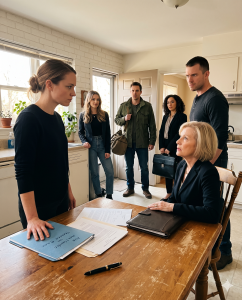
By the time Ava Mercer walked into her kitchen that Tuesday afternoon, the ending had already been arranged for her.
At least, that was what Gloria Mercer believed.
The leather folder was open on the table. Three signatures tabs marked the pages. A black pen with a gold clip lay uncapped beside the documents, angled carefully toward the empty chair as if someone had staged a photograph of surrender. Gloria sat upright at the head of the table with the rigid dignity of a woman who thought legality could be performed by posture alone. Her older son Marcus stood behind her, broad-shouldered and smug, glancing around the room with the proprietary irritation of a man who had long ago decided other people’s property would eventually become his. Tessa, Marcus’s wife, leaned against the window ledge and studied the kitchen cabinets with an amused little smile, like she was already imagining what she’d repaint first.
Ava noticed the pen before anything else.
That unsettled her more than the paperwork.
The pen suggested certainty. It suggested they had not come to ask. They had come to collect.
The house around them was a white brick ranch on a quiet street shaded by old maple trees. It had a narrow front porch, original oak floors, and a kitchen Ava had restored one cabinet door at a time while listening to podcasts about wiring and paint finishes she had never expected to need. The first time she had stepped inside after closing, the place smelled like dust, old wood, and possibility. There were stains on the ceiling, loose drawer pulls, faded wallpaper in the hallway, and a furnace that sounded like it hated winter. None of that had scared her.
Ava had bought the house before Daniel Mercer ever became part of her life.
That fact mattered, though Gloria treated it like a technical inconvenience rather than a truth.
Ava was a consultant, the kind of woman who had built a career through contracts, deadlines, and brutal self-discipline. She had saved for years, taken extra work when her friends went on vacations, and learned the ugly math of homeownership from spreadsheets and sleepless nights. Her down payment came from her own account. Her closing costs came from her own account. The mortgage carried only her name.
Daniel came later.
He was warm where Ava was guarded, steady where she was relentless, and funny in a quiet way that sneaked up on her when she was least defended. He was also in the military, which meant he understood discipline but never confused it with entitlement. The first night she showed him the house properly, when he still felt like a guest and the walls were half-painted and the kitchen smelled faintly of primer, he had stood in the center of the room, taken it all in, and said, “This house is yours first. I’m lucky to be invited into it.”
Ava had loved him for many reasons. That sentence was one of them.
Gloria Mercer had hated him for it.
From the start, Gloria believed her younger son’s marriage should expand the Mercer family’s power, not leave him living in a house his mother could not claim by emotional inheritance. She never said that directly in public, of course. Women like Gloria never used blunt greed when polished guilt would do. Instead she spoke about unity, legacy, security, practicality, family alignment. She talked as though ownership were a sentimental misunderstanding that could be corrected by enough pressure.
Marcus was less subtle. Daniel’s older brother had spent most of his adult life orbiting whatever seemed easiest to acquire without effort. When Daniel enlisted, Marcus milked the family pride. When Daniel was promoted, Marcus talked about “our family sacrifice.” When Daniel married Ava and moved into her home, Marcus began making offhand remarks about how “family property” should stay where blood could protect it.
Tessa weaponized sneers instead of arguments. She understood social hierarchies instinctively and had never forgiven Ava for succeeding without asking the right people’s permission.
So when they appeared that Tuesday, Ava was not surprised by their contempt.
Only by their timing.
Daniel was supposed to be away for training. Gloria knew that because she tracked his schedule with a mother’s attentiveness sharpened into strategy. Ava opened the front door expecting a delivery and found Gloria with a folder, Marcus with the swagger of a man entering land he planned to claim, and Tessa with that appraising look she always wore when entering another woman’s house.
“Still pretending this place suits you?” Tessa said as she stepped inside.
Ava closed the door behind them. “What is this?”
Gloria moved to the kitchen table and sat down without invitation. “We’re going to handle this calmly.”
That sentence alone told Ava they had not come to discuss anything honestly.
When Gloria turned the first page, Ava saw the title printed in bold: Temporary Family Protection Agreement. Beneath it, another line: Transfer of Partial Residential Interest. And below that, the recipient named plainly enough to strip the performance from the room.
Marcus Mercer.
Ava blinked once. “You want me to sign part of my house over to Marcus?”
“To the family,” Marcus said.
“It’s not family property.”
“Oh, Ava,” Tessa murmured, “you’ve been saying that for years.”
Gloria folded her hands. “Daniel is away. This is the right time to do this without his emotions involved.”
That sentence snapped something clear into place in Ava’s mind. This was not just greed. It was calculation. They had chosen a window when Daniel was expected to be absent because they knew he would stop them.
“His emotions?” Ava asked.
“He’s sentimental about you,” Gloria said. “That doesn’t make him practical.”
Marcus picked up the uncapped pen. “You married a soldier, got a house, got security, and now you think you’re above everyone.”
Ava held his gaze. “I bought this house before Daniel.”
Gloria made a dismissive motion. “Technicalities.”
The word struck deeper than Marcus’s insults.
Technicalities, as if a deed were a loophole. As if years of labor could be waved away because a mother did not like the result. As if the legal and financial reality of Ava’s life should dissolve in the face of Mercer family mythology.
Marcus tossed the pen onto the page. “Sign, gold digger.”
The insult landed exactly where he wanted it to, but not in the way he expected.
Ava had spent enough of her life around men who mistook volume for authority. She knew the moment they expected tears, outrage, panic. Those reactions made them feel powerful. Calm unsettled them more.
So she did not shout.
She turned to the drawer beside the stove, opened it, and removed a blue folder secured with an elastic band. On the tab, in thick black handwriting, was one word: HOUSE.
Tessa rolled her eyes. “Of course you have a folder.”
“Yes,” Ava said. “I do.”
She set it on the table.
Marcus grabbed it first, already half-smiling, expecting sentimental clutter—paint swatches, photos, maybe decorative closing documents. What he found instead was evidence.
The deed: Ava Mercer, sole owner. Purchase date two years before marriage.
The down payment receipt: paid from Ava’s account.
Mortgage records: all in order.
Renovation invoices: materials and labor paid through Ava’s consulting business.
And then, the document Daniel himself had insisted they create after his last deployment: a postnuptial agreement reaffirming that the house remained Ava’s separate property unless she voluntarily chose otherwise in writing.
Marcus’s face changed first.
Tessa moved closer.
Gloria read each page with a growing tightness around her mouth. “This isn’t necessary.”
“It’s exactly necessary,” Ava replied.
Marcus snapped the folder shut. “Paper doesn’t make a home.”
“No,” Ava said. “But it makes ownership harder to rewrite.”
That was when Gloria shifted tactics.
“You’re trying to divide Daniel from his family.”
Ava gave a humorless little smile. “You brought transfer papers to my kitchen while he was away.”
Tessa crossed her arms. “Daniel will be disappointed when he hears how selfish you were.”
Ava looked down the hallway, then back at them. “He already knows.”
The silence that followed was brief and electric.
Her phone buzzed on the counter.
Daniel: At the door.
The lock turned.
Every head in the kitchen snapped toward the entryway. Daniel stepped inside in his dark jacket with a duffel over one shoulder, eyes scanning the room in a single practiced sweep. Behind him came Mara Hill, the attorney Ava and Daniel used for everything from wills to deployment documents. Mara was in her forties, elegant, unsmiling, and impossible to rattle.
Gloria stood so fast her chair scraped the floor. “Daniel, this is not what it looks like.”
Daniel set his bag down without taking his eyes off the papers. “It looks like you came to my wife’s house to pressure her into signing away property she owns.”
Marcus scoffed. “Your wife?”
Daniel turned to him. “Yes. My wife. In her house.”
Mara stepped forward and picked up the transfer document. She read in silence, flipping one page, then another. “This has no authority without voluntary execution by the owner,” she said calmly. “And the owner appears to be Ava.”
“She’s manipulating him,” Gloria said.
Daniel’s expression hardened. “No. You waited until you thought I was gone.”
Tessa muttered, “She has you trained.”
Daniel ignored her. He looked at the deed folder, then at Ava. He remembered what his family had never respected: the late nights she spent balancing invoices, the paint under her fingernails, the evenings she came home from work and still climbed ladders to patch cracks and sand trim. He remembered her voice shaking the day she told him what that first empty house had meant to her—a place that was hers, safe, quiet, earned.
“You called her a gold digger?” he asked.
Marcus looked away.
Daniel lifted the deed with two fingers. “My name isn’t on this.”
Gloria drew herself up. “Because she wanted control.”
“No,” Daniel said. “Because I asked her to keep what she built.”
The room went flat after that.
Mara slid the fraudulent transfer packet into her briefcase. “All future communication regarding this property should go through counsel.”
Tessa laughed incredulously. “Counsel? For family?”
Mara met her gaze. “For people carrying deceptive transfer documents into someone else’s home.”
Marcus made one last attempt. “Daniel, blood means something.”
Daniel nodded once. “It does. So does ink.”
He tapped the blue folder.
“And this ink says the house is hers.”
Ava watched Gloria’s face empty of confidence. Not remorse. Not shame. Just the sudden recognition that she no longer controlled the narrative. She had entered that kitchen expecting compliance. Instead she had found a paper trail she couldn’t erase and a son who refused to betray his wife for the comfort of old loyalties.
At the door, Marcus turned back. “You’ll regret choosing a house over family.”
Ava answered before Daniel could. “I’m choosing the truth over people who brought paperwork to steal it.”
He had nothing left to say.
They left in the order power left them. Tessa first, brisk and angry. Marcus next, jaw clenched. Gloria last, pausing long enough to look back at the kitchen as though betrayal might still reverse itself if she stared hard enough.
The house remained very still after the door shut.
On the table, the uncapped pen still waited.
Ava picked it up and clicked the cap into place. The sound was small and final.
Daniel moved beside her. “I’m sorry.”
She looked at the deed folder, then toward the door. “They came for my house because they thought I was alone.”
What happened next revealed the worst part.
As Mara gathered the abandoned papers, she paused. There was a second packet tucked beneath Gloria’s folder, partially hidden. “Ava,” she said, her voice changing.
Daniel frowned. “What is it?”
Mara opened the packet.
It was a draft petition concerning Daniel himself—temporary incapacity language, emergency family oversight, power of attorney contingencies tied to deployment history and future absence. Ava felt the blood drain from her face.
“They weren’t just trying to take the house,” she said.
“No,” Mara replied. “They were creating a pattern. If you had signed a transfer voluntarily, it would support later claims that family control of assets had already begun.”
Daniel went silent in a way Ava had learned to fear more than shouting.
At the back of the packet were clipped handwritten notes. Marcus’s name. Tessa’s name. And one line underlined twice:
Convince Ava first. Daniel follows Ava when pressured.
Daniel stared at the words for so long Ava thought he might tear the page in half. Instead he handed it to Mara with frightening steadiness. “What do we do now?”
“Now,” Mara said, “we make sure they never get close enough to try this again.”
The legal response was immediate. Mara filed formal notices documenting the attempted coercion and the fraudulent transfer effort. She sent a cease-and-desist letter to Gloria, Marcus, and Tessa, instructing them that all communication regarding property, financial authority, or estate matters must go through her office. She advised Daniel to revise his emergency contacts, medical directives, and deployment paperwork. Within forty-eight hours, Gloria’s name was removed from any family-adjacent role that relied on trust, and Daniel appointed Ava as sole decision-maker for every document that mattered.
Then came the harder part, the human part.
Daniel called his mother one final time on speaker with Mara present. Gloria cried first, then protested, then accused Ava of poisoning him against his family. Daniel let her speak until she reached for the oldest weapon she had—sacrifice, motherhood, blood, loyalty.
Then he stopped her.
“You didn’t make a mistake,” he said. “You made a plan.”
The silence on the line lasted several seconds.
“You brought papers into our home while I was away. You tried to pressure my wife. You tried to build a legal basis to control my property and hers. Don’t call this love.”
Gloria’s voice sharpened. “You are humiliating your own mother over a woman.”
“No,” Daniel said. “I’m refusing to humiliate my wife for my mother.”
After that, there was no bridge left to pretend existed.
Marcus sent one furious email accusing Ava of “weaponizing paperwork.” Mara replied with a single paragraph informing him that any further harassment would be preserved for the record. Tessa posted vague comments online about greed and family betrayal, but took them down after Mara’s office sent a warning about defamation. The Mercer relatives who had only heard Gloria’s version grew quieter when they learned there had been actual transfer documents, an attorney present, and a handwritten note outlining a plan.
Facts were less dramatic than Gloria’s storytelling, but much more durable.
In the weeks that followed, the house felt different to Ava—not less safe, but more honest. Every room carried the memory of what had happened there. The kitchen table where they had tried to corner her became the place where she and Daniel reviewed new locks, updated documents, and made lists of boundaries that should have existed years earlier. He installed a camera by the front door and changed the alarm codes. Mara helped them create a trust and seal every gap Gloria might someday try to exploit.
One evening, after the paperwork was finished, Daniel found Ava in the living room holding the blue folder on her lap.
“You okay?” he asked.
She looked around the house she had built into a home. The repaired baseboards. The pale walls. The shelves she had installed herself. “I keep thinking about how confident they were.”
Daniel sat beside her. “Because they thought you’d be polite before you’d be protected.”
She laughed once, without humor. “They thought being family gave them access.”
He reached for her hand. “They were wrong.”
She turned toward him. “Did you know it would get this bad?”
Daniel took longer to answer than she expected. “I knew my mother resented that I couldn’t offer her this house. I knew Marcus felt entitled. I didn’t think they would walk into our kitchen with documents and a pen.”
Ava studied his face. “And now?”
“Now I know exactly who they are.”
That answer hurt, but it also relieved something in her. Naming the truth always did.
A month later, Gloria appeared once more—this time not inside the house, but at the curb, standing beside her car as if she were waiting for a softer scene than the one she deserved. Ava saw her through the front window and didn’t open the door. Daniel stepped onto the porch instead.
They spoke quietly enough that Ava could not hear the words. Gloria cried again. Daniel did not move closer. After less than three minutes, he pointed toward the street. Gloria looked stunned, then insulted, then defeated. She got into her car and drove away.
When Daniel came back inside, Ava didn’t ask for every detail.
“She wanted to talk about forgiveness,” he said.
“And?”
He looked toward the kitchen, toward the table where everything had cracked open. “I told her forgiveness and access aren’t the same thing.”
That night, Ava opened the deed folder one more time. The papers inside looked exactly as they had before: ordinary, unemotional, factual. Yet now they represented more than ownership. They represented clarity. The line between family and entitlement. The distance between love and control.
She slid the folder back into the drawer beside the stove and shut it.
On the table, Daniel had left a pen while signing the latest security forms. Black ink. Gold clip. Capped.
Ava picked it up, weighed it in her hand, and smiled at the irony. The same object that had been placed there as a tool of pressure had become something else entirely: proof that signatures only matter when they are freely given.
The house stayed quiet around her, steady in the evening light.
She had bought it with her own money. Repaired it with her own hands. Defended it with her own records. And when the moment came, she had not needed to scream to protect what was hers.
Sometimes the strongest answer was a deed folder slid across a table.
Sometimes the clearest act of love was a husband saying, in front of everyone who expected him to fail, My wife. In her house.
Even later, Ava still found herself replaying one detail above the rest: not the insults, not Gloria’s lies, not Marcus’s threat at the door.
The pen.
Uncapped when they arrived. Capped when they left.
That was the whole story, really. They had come expecting her signature. They had left with their own motives exposed instead.
And if there was any lasting aftershock, it lived in the uncomfortable question that lingered long after the legal threat had passed: what was the greater betrayal—wanting the house, or believing Ava was weak enough to hand it over? Daniel believed it was the second. Ava wasn’t sure. Maybe the deepest red flag was that Gloria and Marcus had never mistaken theft for theft. They had called it family, and that might have been the ugliest part of all.