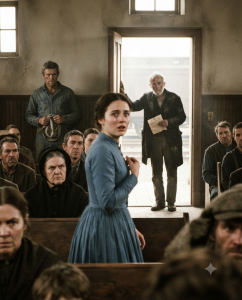
By the time the Monday school board meeting was called to order, half of Clearwater had already decided what it wanted the ending to be.
Some wanted Nora Ellis humbled. Some wanted her gone. A few wanted to pretend the whole thing had become larger than it was, though they had helped enlarge it themselves. And a very small number—too small to matter, it seemed—wanted only for sense to prevail.
But sense rarely arrives first in a town fed by rumor.
The church hall had never held so much interest over so little fact. Men who had not set foot inside the schoolhouse since the previous winter stood near the walls with folded arms. Women in good wool coats sat shoulder to shoulder, their expressions sharpened by certainty. Reverend Mills occupied the second row with the face of a man praying not for truth, but for a version of events he could survive repeating later.
At the front sat the three members of the school board. They had paper, ink, and the grave, uncomfortable posture of men about to decide something they already feared.
Nora stood beside the teacher’s table in a plain blue dress that made her look younger from a distance and stronger up close. She had pinned her hair carefully, as though neatness might protect her from ugliness. It would not. She knew that by now.
James Colton stayed at the back of the room, hat in hand, his shoulders broad enough to draw half the hall’s attention without trying. He had considered not coming. He knew his presence would worsen the talk. But letting Nora stand there alone while the town carved her name into pieces had proven impossible.
The trouble had begun six days earlier on the school steps, though in truth the seeds of it were older. They had been planted the day Nora stepped off the September train with her books and her stubborn honesty. Clearwater tolerated diligence in a woman. It did not tolerate boldness for long.
She had changed the school in six weeks.
The room smelled cleaner. The shelves were organized. Children who once dreaded recitation now fought to answer first. The Tuesday reading circle had become so popular that even boys old enough to pretend books were beneath them drifted close to the windows. Thomas Henderson, who used to crumple his practice sheets rather than let anyone see his uncertain handwriting, had begun to stay after class to write full sentences.
Nora had earned loyalty in the one place that mattered most: among the children.
Which made the town’s hostility all the more revealing.
Because the outrage was never really about the question she asked James. It was about the fact that she asked it the way a man might have—directly, publicly, without apology.
You’ve lived here your whole life, she had said. You have a good ranch. You work hard. You are not cruel. Why did you never marry?
She asked because she had grown tired of hearing half the town discuss James as though he were a piece of weather rather than a person. She asked because Nora believed truth should not always be approached sideways. And perhaps, though she had not admitted it even to herself then, she asked because by that point she already cared what the answer would be.
James’s reply had stunned the town because it stunned him first.
I was waiting for you.
He had not planned to say it. He did not even fully understand it until the words were already in the air. But once spoken, he could not deny they were true.
He had waited for someone who would speak to him without calculation. Someone who cared whether the stream on his land ran clear enough for children to study minnows and reeds. Someone who treated his silence not as a deficiency, but as a space worth entering carefully. He had waited without knowing he was waiting.
And Clearwater, which could have seen the tenderness in it, chose instead to see indecency.
Now, in the church hall, Mrs. Whitcomb rose first.
She was a woman with a disciplined spine, careful gloves, and a gift for sounding outraged on behalf of morals when she was simply defending control. She did not shout. She did not need to. Her voice had the polished edge of judgment already approved by itself.
“A teacher,” she said, “must understand that children learn not only from books but from example. What happened last week on those school steps was not appropriate. It was not modest. And it has invited talk all over this town.”
Nora’s hands remained loosely clasped before her. “The talk did not begin with me.”
Mrs. Whitcomb ignored that. “Then there is the matter of Mr. Colton.”
A murmur stirred.
“Miss Ellis,” one board member said, dabbing at his forehead though the room was cool, “it has reached us that you asked Mr. Colton to accompany you to Cincinnati.”
“Yes,” Nora said.
The answer struck the room harder than a denial would have. It was not merely that she admitted it. It was that she did so without shame.
“And why,” the chairman asked carefully, “would that have been necessary?”
Nora drew in one slow breath. “My father is ill.”
That caused a smaller reaction than it should have, which told James everything he needed to know about the room. Pity, when it interfered with scandal, was always rationed.
“I received word from my mother,” Nora continued. “I need to go home. I asked Mr. Colton because I trust him.”
Mrs. Whitcomb’s lips thinned. “A young unmarried woman should not be traveling under the protection of an unrelated bachelor.”
Nora’s eyes sharpened. “Then perhaps a decent town should have offered another arrangement before condemning the one I found.”
No one answered that.
Because it was true, and truth always embarrasses people who have mistaken cruelty for principle.
James could feel the room turning. Not toward compassion. Toward punishment. Once a woman in a place like Clearwater was described as improper, every act she performed afterward became evidence.
A board member cleared his throat. “Miss Ellis, whether your reasons are understandable or not, the issue remains that a teacher must inspire confidence among parents.”
Nora looked directly at him. “Have the children stopped learning?”
“That is not the issue.”
“Have I neglected the school?”
“That is not the issue either.”
Her voice cooled. “Then say plainly what the issue is.”
The chairman hesitated, because cowardice dislikes exact language. “The issue is that the town has concerns about appearances.”
Nora almost smiled then, though there was no humor in it.
“Appearances,” she repeated. “I see.”
From the back wall, James shifted. Pete Dawson, standing near the side door, gave him a warning look. Not yet. James understood it, but barely.
Then Thomas Henderson, who had slipped in with his mother and taken a seat near the aisle, did something no adult in the room had the nerve to do.
He raised his hand.
At first no one acknowledged him. Then Nora turned.
“Yes, Thomas?”
The boy swallowed hard. “If Miss Ellis leaves, who will help me with my writing?”
The room changed for an instant. Just an instant. Enough for shame to brush a few faces and disappear.
Mrs. Henderson tugged on her son’s sleeve. “Thomas, hush.”
But Nora said softly, “Someone will always help you write, Thomas.”
She said it with such certainty that James wanted to cross the room and stand beside her regardless of what the town thought. He remained still only because he knew she would hate being rescued in the middle of her own fight.
The chairman opened his mouth to continue, and at that exact moment the afternoon train whistle split the air outside.
Every head turned.
It was only sound at first—long, metallic, indifferent. Then came hurried steps on the church path, then the outer door opening, then the station boy entering with a face flushed from running.
“There’s a gentleman from Cincinnati asking for Miss Ellis,” he blurted. “Says he won’t leave till he speaks to her.”
Nora’s pulse jumped. Her first wild thought was that her mother had come. Her second was far worse: that something had changed and her father was dying after all.
Then the doorway darkened.
David Ellis stood there with a traveling coat on his narrow frame and the exhaustion of a man who had spent strength he did not possess. His face was paler than Nora remembered, his beard untrimmed, and there was a faint tremor in the hand he used to brace himself against the doorframe. Yet his eyes remained clear.
“Papa.”
She moved toward him, but he lifted one hand gently. Let me speak first.
That was all it meant, and she understood.
He stepped into the room, coughing once into his handkerchief before straightening. Several people shifted in discomfort. Illness was harder to judge than a healthy woman’s supposed impropriety.
“I apologize for arriving uninvited,” David said, though his tone made it sound less like apology than indictment. “But I was told my daughter’s position was being discussed, and I found I could not remain in Cincinnati while others spoke for her character.”
The chairman rose halfway. “Mr. Ellis, perhaps this is not the right—”
“It is exactly the right time,” David said.
His gaze crossed the room until it found James.
Nora saw it then—the recognition that made no sense to anyone else.
Three nights earlier, after receiving Margaret’s letter, Nora had gone to James. That much the town knew. What it did not know was what James had done after she left.
He had ridden home, sat at his kitchen table under a single lamp, and written a letter in a hand made for ledgers and feed tallies, not difficult truths.
He wrote to David Ellis.
He explained that Nora had received troubling news, that she was determined to return home, and that he believed the town’s gossip might worsen if she traveled under his escort without proper understanding. He wrote that he had no wish to damage Nora’s name. He wrote, after crossing out two failed attempts at elegance, that he cared for her too deeply to let her travel alone. He added that if David objected, he would arrange other help and say nothing of his own feelings again.
Then, after sitting with the paper for a long while, he wrote one final sentence.
If I ever seek your daughter’s hand, sir, I would rather be judged honest too early than respectable too late.
David had read that letter in Cincinnati while his chest burned and his wife pleaded with him to stay in bed. Instead, he had folded the pages, dressed, and taken the train.
Now he reached inside his coat and pulled out the envelope.
“This,” he said, “is why I am here.”
Mrs. Whitcomb frowned. “A private correspondence hardly concerns the board.”
David turned toward her with an expression so mild it became devastating. “On the contrary, madam. It concerns any room prepared to disgrace my daughter while pretending concern for decency.”
Nobody came to Mrs. Whitcomb’s defense.
David unfolded the letter carefully. His fingers shook, but his voice did not.
“Mr. Colton wrote to me before traveling with Nora. Not after. Before. He informed me of my illness. He informed me of the danger to her name. And he asked whether, should he accompany her, I would prefer that he first present himself openly as a man intending honorable courtship.”
Silence spread outward from him.
Nora looked at James. He had gone very still, the stillness of a man whose private heart had just been carried into public by necessity.
David lowered the page. “That is what this town calls indecent?”
No one answered.
He continued, “I have taught boys and men for more than thirty years. I know the difference between appetite and honor. Mr. Colton did not ask how to avoid talk. He asked how to protect my daughter from it.”
Mrs. Whitcomb found her voice at last. “Even so, the teacher’s conduct—”
“Madam,” David said, and for the first time his frailty vanished beneath force, “my daughter asked for help because she had reason to trust the man she asked. If that offends you more than a father coughing blood into a handkerchief while strangers debate his daughter’s virtue, then the defect is not in her.”
A few heads dropped then.
But David was not finished.
“There is something else.”
He looked to the board table.
“Did any of you know this school’s roof needs replacing before winter? Did any of you know the back windows leak so badly the children nearest them wear gloves indoors? Did any of you know your budget shortfall was being discussed at the mercantile last week?”
The chairman blinked. “We were addressing it privately.”
David gave a slight nod. “Mr. Colton addressed it privately as well. In the same letter, he informed me that if Miss Ellis lost her position because of this nonsense, he intended to mortgage the unused south forty to pay for repairs, coal, and books so the school could remain open under her or any teacher she recommended.”
A stunned sound moved through the room.
James shut his eyes once, briefly. Pete Dawson muttered something that was almost a curse and almost admiration.
David held up the page. “He wrote that education was the first reason Nora mattered to this town, and he would not stand by while people too idle to understand her turned that into a weapon.”
The board members stared at James as if seeing him for the first time. Not as the silent rancher. Not as a bachelor to be speculated about. As a man who had acted while they gossiped.
The chairman cleared his throat. “Mr. Colton, is that true?”
James lifted his chin. “Yes.”
“Why did you not say so?”
James looked at Nora first, then back at the board. “Because doing it loudly would have made it about me.”
The simplicity of that answer finished what David’s letter had begun.
Reverend Mills shifted in his seat, visibly uncomfortable. Mrs. Whitcomb looked around and discovered, too late, that certainty has no shelter once exposed to contrast. She had come to judge a woman’s boldness and found herself beside men whose caution had accomplished less than that woman’s courage.
The chairman sat down again. “In light of this new information,” he said weakly, “I see no grounds for dismissal.”
“No,” David replied. “There never were any.”
The vote, when it came, was embarrassingly quick. Nora retained her post unanimously, which was perhaps the most insulting part of all. A town willing to ruin her on rumor wanted credit for sparing her once truth became expensive to deny.
When the meeting ended, people did what people always do after collective cruelty: they became suddenly busy. Coats were adjusted. Chairs scraped. Murmured excuses floated like poor weather.
Thomas Henderson crossed the room first. He held out his notebook to Nora with both hands.
“You’re staying?” he asked.
Nora smiled then for the first time that day, and the exhaustion in her face made the smile all the more tender. “Yes, Thomas. I’m staying.”
The boy beamed and ran back to his mother before emotion could embarrass him.
David swayed slightly. James was beside him in an instant, one hand under his elbow.
“You should sit,” James said.
David studied him for a moment. “You are exactly as your letter sounded.”
James looked almost alarmed by that. “I’m not sure whether that is praise.”
“It is,” David said.
Nora came closer, eyes bright with tears she had refused to shed before the room. “You should not have traveled.”
“No,” David admitted. “But I would travel farther than that before letting small people define my daughter.”
Margaret Ellis, had she been there, might have said the same thing with fewer words and sharper effect.
The stationmaster arranged a room for David at the Dawson house for the night, but before they left the hall, David stopped James near the door.
“One more thing, Mr. Colton.”
James turned.
“You asked in your letter whether you might present yourself openly.”
James glanced once at Nora, whose breath had gone still.
“Yes, sir.”
David’s expression softened. “I would consider it a poor use of my train fare if you failed to do so now.”
For the first time all day, laughter broke through the tension. Gentle laughter. Relieved laughter. The kind that cleans a room.
James, who could bargain over cattle without blinking but looked almost undone by one ill schoolmaster’s permission, turned fully toward Nora.
“I care for you,” he said. No flourishes. No practiced charm. “Enough to have made a fool of myself in writing, and in public, and likely again before I’m done. I would like to court you, if you’ll allow it.”
The whole hall might as well have disappeared. Nora looked at him as if the noise, the fear, the humiliation of the day had all led to this one unguarded moment.
“Yes,” she said.
It was not dramatic. It was better. It was certain.
Word traveled through Clearwater by nightfall, though changed now in tone. The same town that had sharpened itself against Nora’s name began smoothing the story for comfort. People said perhaps they had misunderstood. Perhaps the situation had been unfortunate. Perhaps Mr. Colton had always been more serious than anyone knew.
That, too, was cowardice. But Nora had no energy left to chase every revision of the truth.
David stayed three days before returning to Cincinnati under strict instructions from Nora, James, and half the Dawson household. He improved enough under rest and enforced idleness to complain about being fussed over, which everyone took as a promising sign.
Before he boarded the train home, he stood with Nora on the platform while James loaded his luggage.
“You love him,” David said.
Nora looked toward James, who was arguing with the porter about securing a trunk properly. “Yes.”
David nodded as if confirming a lesson he had already expected her to learn. “Then make sure he keeps telling the truth plainly. Men are praised too easily for becoming mysterious when they are merely afraid.”
Nora smiled. “I think I can manage that.”
James courted her the way he did everything else—steadily, without performance, and with more devotion than speech. He repaired the school windows before the first hard frost. He sent coal anonymously until Nora discovered it was him and forbade the anonymity. He attended Tuesday reading circle once, sat in the back with obvious discomfort, and ended up helping Thomas Henderson shape his capital letters because the boy trusted ranch hands more than grammar.
By spring, the town had settled into a different kind of watching. Not scandal this time. Curiosity mixed with reluctant respect. Mrs. Whitcomb never apologized, which surprised no one. But she did begin sending her youngest grandson to school every day with his assignments complete, which was the closest her pride could come.
When James finally asked Nora to marry him, he did it on the school steps where trouble had started. Sunset lay warm across the town, and the last children had gone home.
“I was waiting for you,” he said again, quieter this time.
Nora laughed through tears. “That line only worked because it was true.”
“Then it still is.”
She said yes before he finished the question.
They married in early autumn, a year almost to the week after she first arrived in Clearwater. David Ellis attended, healthier, thinner, and carrying enough authority in his gaze to keep the town on its best behavior for one blessed afternoon.
Years later, people still told the story of the day the Cincinnati train brought a sick father to defend his daughter and expose the town’s mistake. Some told it as romance. Some as scandal that corrected itself. Some as proof that James Colton had always been a remarkable man.
But the truest version was simpler and less flattering to Clearwater.
A whole town had mistaken a woman’s honesty for indecency because honesty in a woman threatened the comfort of everyone living by pretense. It took a fevered father and a silent rancher to show them the difference between impropriety and courage.
And even then, the most uncomfortable part was not that Nora had asked the question everyone remembered.
It was that she had answered the town’s cruelty with the same thing that started all of it in the first place:
the plain truth.
That was the red flag, in the end—not her behavior, not James’s quiet, not the journey to Cincinnati, not even the gossip itself.
It was how quickly decent people became dangerous the moment a woman refused to be afraid of them.