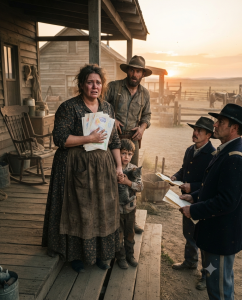
When Lucy Harper arrived in Red Hollow, she knew before her boots hit the ground that the town had already made up its mind about her.
People always did.
At thirty-one, she had been a widow for eight months, and widowhood alone was enough to unsettle decent churchgoing people who preferred grief to look neat and temporary. But Lucy also carried the kind of body strangers believed gave them permission—to stare, to sneer, to assume laziness, weakness, appetite, failure. She had spent most of her adult life watching people decide what she was before she ever opened her mouth.
So when Cobb’s wagon rolled into Red Hollow under a punishing Texas sun and the women on the boardwalk stopped talking at the sight of her, she was not surprised.
Only tired.
Cobb dumped her trunk in the street and nodded toward the road leading west. “Callahan place is two miles that way. He said he’d meet you at noon.”
Lucy looked at the sky. The sun had already shifted.
“It’s well past noon.”
Cobb shrugged as if time were somebody else’s problem, clicked his tongue at the horses, and drove away.
Lucy stood alone in the dust with her trunk, a wire crate, and the gray cat inside it glaring like a queen wrongly arrested.
The advertisement folded in Lucy’s pocket had brought her there from the last town that had turned her away. Housekeeper needed. Cooking, cleaning, care of a seven-year-old boy. Room, board, fair wages.
Fair wages had sounded almost miraculous.
By the time James Callahan came riding into town forty minutes later, Lucy had been measured by every eye on Main Street. James dismounted with the stiff ease of a man who had lived most of his life in a saddle. He was not handsome in the polished way that turned heads, but he carried the weathered steadiness of someone who had survived too much to waste movement.
“Mrs. Harper,” he said.
“Mr. Callahan.”
His eyes moved to the crate. “A cat?”
“She catches rats and minds her business.”
He took her trunk from the ground. “Then she stays.”
It was the first thing anyone had said to Lucy in months that was both practical and kind.
The ranch sat in a stretch of thirsty land beyond the edge of town, modest and worn but meticulously kept. The house had repaired steps, clean windows, and a kitchen garden fighting a losing battle against drought. Nothing about it suggested comfort, but everything about it suggested effort.
Thomas Callahan was waiting on the porch.
He was small, solemn, and almost startlingly still. His clothes were clean but too large, as though someone had guessed at his size rather than measured it. He watched Lucy with dark, guarded eyes that did not belong in so young a face.
James lowered his voice. “He hasn’t spoken in three years. Not since his mother died.”
Lucy did not react the way most people probably did.
She didn’t offer false brightness. Didn’t bend down and coo. Didn’t call him sweet or poor baby or any of the phrases adults used when they needed children to perform softness for them.
She simply nodded once and said, “Hello, Thomas.”
He said nothing.
That first evening James explained the situation in the kitchen while Lucy unpacked the pantry. His wife, Martha, had died suddenly of fever. Afterward Thomas had stopped speaking altogether. Doctors had come. A preacher had come. Even one traveling man who claimed to know the mind had come. Nothing changed. The last housekeeper had lasted fourteen days before leaving in tears and saying the boy was unnatural.
James repeated that part without looking at Lucy. He seemed ashamed of it.
Lucy tied on an apron and said, “Children who lose the world once are always waiting for it to vanish again. The first thing we give him is routine.”
James stared at her. “Routine.”
“Breakfast at seven. Dinner at noon. Supper at six. Laundry on Mondays. Bread on Wednesdays. No surprises unless they can’t be helped.”
He nodded slowly, as if embarrassed that such a simple idea had never occurred to him.
Thomas hovered in the doorway while she cooked. He remained there through the whole meal, not joining them, not leaving either. The cat, Juno, let herself out of the crate after supper, crossed the room with the absolute confidence of a creature who fears no social consequence, and sat directly on the boy’s boot.
Thomas looked down.
That was all. No laugh. No smile. But a tiny shift moved through his face.
Lucy noticed. So did James.
For the next week, Lucy built a house out of predictability.
She kept the same hours. Spoke in the same tone. Opened curtains at the same times. She left a glass of water on the porch rail every afternoon. The day after that she left a biscuit beside it. Then she began sitting nearby while shelling peas or mending, talking casually to Juno about ordinary things.
Not questions. Never demands.
Clouds. Chickens. The sins of overwatered tomatoes. Which horse in the barn was the most stubborn and why. She talked as if silence were not an emergency but simply another kind of company.
Thomas listened.
By the second week he was inching closer. He would place himself in whatever room she was in and remain there quietly, as though testing whether her presence changed shape under observation. It never did.
James noticed that too.
He also noticed Lucy’s competence. The house brightened under her care without becoming precious. Food appeared on time. Sheets smelled sun-dried instead of stale. The garden, though still suffering from the heat, revived under her attention. The hens laid more reliably. Even James’s shirts were repaired so neatly he almost could not see the mending.
But Red Hollow noticed something else first.
At McCreedy’s store, the silence when Lucy entered was sharper than before. The shopkeeper made sure she understood that people were talking about the widower who had hired a strange woman to live under his roof. Two ladies near the counter looked her up and down with the stiff amusement of people who believed decency was visible by size alone.
Lucy paid, collected her flour and coffee, and went home.
That evening James met her near the garden with a strained expression. “Doctor Hensley says Thomas may need institutional care.”
Lucy set down the sack of potatoes she was carrying. “No.”
The force of it startled him.
“Hensley says—”
“I heard what you said.”
James frowned. “You’ve known my son eight days.”
“And in eight days he’s started staying in the same room as another human being. That matters.”
“Hensley thinks he needs treatment.”
“Hensley thinks anything he doesn’t understand should be put behind a wall where it won’t offend him.”
James let out a breath that sounded dangerously close to a laugh, though there was no humor in it. “You don’t care much for him.”
“No,” Lucy said. “I don’t.”
Doctor Hensley arrived three days later in a pressed shirt and self-importance. He spoke about Thomas as though the boy were a puzzle on a desk instead of a child in the room. He crouched abruptly, demanded eye contact, raised his voice when he did not get it, and called the silence “resistance.”
Lucy lasted less than five minutes before interrupting him.
“You are frightening him.”
Hensley looked at her with immediate disdain. “Madam, I am evaluating—”
“You are looming over a child and barking at him. Sit down or leave.”
The room froze.
James, standing near the mantle, said nothing. That silence told Hensley more than any direct challenge could have. The doctor finished his visit curtly and left with professional offense vibrating off him.
That night James admitted Hensley wanted the arrangement reconsidered.
Lucy glanced toward the corner where Thomas sat on the floor drawing while Juno pawed at his bootlace. “He stayed for all of supper.”
James nodded. “I know.”
“He came into the kitchen before breakfast and left me this.” Lucy held up a clothespin Thomas had carefully placed beside the flour bowl.
James stared at it as if it were a relic.
“He hasn’t done that with anyone,” he said.
The changes stayed small, but they came steadily. Thomas started leaving stones lined up on the porch rail where Lucy sat in the afternoons. He moved objects toward her before she needed them. He no longer flinched at every sound in the house. Once, during a storm, Lucy found him hiding under the kitchen table with his hands over his ears.
She remembered fear like that.
Instead of pulling him out, she sat on the floor outside the table and spoke about thunder as if it were simply weather, not a monster. She told him how she had once believed storms split the sky open. She said bodies often remembered fear longer than minds did. She let the silence after those words stretch without trying to fill it.
Juno slid beneath the table and pressed herself against his side.
The boy did not come out until the storm had passed, but he did fall asleep there, curled against the cat.
James had watched the whole thing from the doorway.
“How did you know not to touch him?” he asked later.
Lucy rinsed a plate and said, “Some people only feel safe when kindness stays where they can see it.”
James began looking at her differently after that.
He spoke more. Asked questions. Stayed in the kitchen while she baked bread. Told her things about the ranch that were really other things entirely: drought, debt, repairs, fences, his late wife’s roses that never took again after she died. He did not flirt, and Lucy was grateful for that. What passed between them was rarer and more careful than courtship. It was recognition.
He saw she was not fragile because others called her unfortunate.
She saw he was not cold because grief had hollowed his voice.
Then everything changed.
Dorothia Reigns came just before sundown one evening, riding hard enough to leave her horse trembling. She was known in town for speaking plainly and keeping track of everything. When she climbed the porch steps, James knew before she said a word that the news was bad.
“Hensley’s spoken to the county judge,” she said.
James went still. “About what?”
“About Thomas.”
The doctor, Dorothia explained, had decided the boy was not merely delayed in grief but dangerously neglected. He intended to petition for Thomas’s removal to an institution in Dallas—some place run by men with charts and rules and no understanding of terror. He had already begun gathering testimony from townspeople.
“He says the child is nonresponsive, unstable, and improperly managed,” Dorothia said. Her mouth tightened. “He says the housekeeper is interfering with treatment.”
Lucy almost laughed from the cruelty of it. Treatment. As if shouting and staring and threatening separation were medicine.
James swore softly. “On what basis?”
Dorothia hesitated. “On the basis that folks in town don’t trust this arrangement.”
Lucy knew what that meant before Dorothia finished saying it. A widower. A silent child. A strange woman living in the house. Red Hollow had stitched an ugly story from those facts because ugliness was easier for some people than admitting a child might be healing in a way they could not supervise.
Thomas had come to the screen door without anyone hearing him.
He stood there listening, face drained blank.
Lucy wanted to curse every adult on the porch.
That night Thomas would not leave her side. He sat close at supper, followed her through the house, and at one point Lucy turned to find him holding the edge of her apron with one clenched fist. He did not seem aware he had done it. James saw and had to look away.
The official notice came the next day. There would be a county review and an inquiry into Thomas’s welfare. Hensley had supplied written concerns. So had the former housekeeper. So had two townspeople Lucy had met only in passing.
At the bottom of the document was the line that chilled her most: concerns have been raised regarding the child’s inability to communicate distress.
That was Hensley’s whole strategy.
A child who could not testify in words could be spoken over by everyone.
But Lucy discovered that night that Thomas had not been voiceless after all.
While changing his bed linens, she found a packet of folded papers hidden beneath his pillow. They were drawings. Not random sketches, but scenes. The house. The porch. The kitchen table. Juno asleep in the light. James standing at the fence. Lucy at the stove.
And in the older drawings—the ones clearly made before she arrived—the house was all sharp lines and empty corners, Thomas always alone.
In the newer ones, warmth had entered. Lamps glowed. Bread sat on the table. Three figures occupied the porch together. In one storm drawing, a woman sat outside a table rather than reaching under it. In another, a boy stood in a doorway while a cat touched his boot.
On the last page, printed in awkward block letters that had clearly taken enormous effort, was one word beneath the house:
HOME.
James had to grip the bedpost when he saw it.
“He wrote that?” he whispered.
Lucy looked at Thomas, who had woken and now sat rigid with fear, as if even this small truth might be taken from him.
“He’s been telling us all along,” she said.
The next morning they rode to the hearing.
Red Hollow’s county room was too small for its self-righteousness. The judge sat behind a scarred desk. Hensley arrived with papers, certainty, and the faint smile of a man who believed expertise would crush affection every time. Several townspeople came to watch, including McCreedy, the former housekeeper, and two church ladies who looked almost excited.
Dorothia sat behind James.
Lucy stood with the drawings in her hand.
Hensley spoke first. He described Thomas as withdrawn, unresponsive, and vulnerable to “untrained emotional influence.” He suggested James, overwhelmed by grief and ranch responsibilities, had allowed sentiment to replace proper care. He implied Lucy had become an unhealthy attachment. He used words like dependency and pathology and intervention.
The judge listened gravely.
Then James was asked to speak.
He began badly.
James was not a polished man. He could talk to horses, field hands, and fence posts better than officials. He said he loved his son. He said the ranch was stable. He said Thomas had improved. But under Hensley’s interruptions and the judge’s questions, the words seemed to shrink.
Hensley smiled.
Then Lucy stood.
The courtroom shifted with visible discomfort. People disliked when women like Lucy took up space physically; they hated it more when women like Lucy took up space verbally.
The judge looked skeptical. “And you are?”
“The housekeeper you’ve heard so much about.”
A few people snickered. Lucy ignored them.
She did not argue medicine. She argued observation.
She described Thomas’s routine, his reactions, the way fear showed in his shoulders before it showed in his face. She explained the progress in practical detail: staying through meals, tolerating storms, sleeping without bolting, initiating contact by moving objects, seeking proximity without panic.
Hensley interrupted. “None of that constitutes speech.”
Lucy turned to him. “No. It constitutes trust.”
She laid the drawings on the judge’s desk one by one.
The room quieted as the pages spread out.
Even the church ladies leaned forward.
Lucy showed the storm drawing. The porch drawing. The empty-house drawings from before. Then the final picture with the crooked word at the bottom.
“This child can communicate distress,” she said. “He also communicates comfort, memory, attachment, and understanding. The question is whether anyone was patient enough to notice.”
Hensley called the drawings coached.
That was when James surprised everyone, perhaps most of all himself.
He stepped forward and said, very clearly, “If my son had been coached, doctor, he’d have learned to fear this room.”
A murmur moved through the spectators.
Dorothia rose next. She testified that she had visited the ranch repeatedly and seen firsthand that Thomas was calmer, safer, and more responsive since Lucy’s arrival. Then Mrs. Pritchard—unexpectedly, awkwardly—stood and admitted she had once brought eggs to the house and seen the child rest his head against Lucy’s sleeve without distress. One of the field hands, called in by James at the last minute, testified that Thomas had recently come to the barn and remained there quietly while horses were saddled, something he had not done in years.
Hensley’s certainty began to crack.
The judge asked to see the final drawing again.
Thomas, who had been seated beside James the whole time with Juno’s collar ribbon wound around his fingers for courage, watched the judge’s hand hover over that page.
And then something happened that no one in the room ever forgot.
The judge said, “Do you know what this says, son?”
Thomas stood.
Every adult in the room froze.
He was shaking so badly it looked painful. James half rose, but Lucy gave the smallest shake of her head. Don’t rush him.
Thomas looked at the drawing. Then at Lucy. Then at his father.
When he spoke, his voice came out rough and thin from disuse, more breath than sound.
“Home.”
The word hit the room like a church bell.
James sat back down hard as if his legs had given way. Dorothia put a hand over her mouth. Someone near the back started crying. Hensley went pale.
Thomas swayed.
Lucy moved only when he lifted his hand toward her. She crossed the room, and he grabbed her skirt in a fist that trembled with effort. He said no more. He did not need to.
The judge cleared his throat twice before speaking. He denied the petition immediately. He criticized the doctor’s recommendation as premature and overly influenced by community gossip. He stated that the child showed evidence of meaningful emotional progress in his present home and would remain with his father. He further advised that no future medical intervention occur without less invasive attempts first being honored.
It was as close to a public humiliation as a man in Hensley’s position was ever likely to receive.
Outside the courthouse, Red Hollow had nothing to say for once.
People looked at Lucy differently after that, though not all of them looked better. Some were embarrassed. Some resentful. Some merely curious in a softer way. McCreedy never apologized, but he stopped letting his contempt show. The former housekeeper avoided the ranch road entirely. Hensley kept his distance.
At the Callahan place, life did not transform overnight into a miracle. Thomas did not suddenly become chatty or healed. But once the first word had broken free, more followed slowly over the weeks that came after.
Not many.
Not every day.
Mostly small things: “Juno.” “Water.” “No.” “Pa.”
The first time he called Lucy by name, he did it from the porch while she was hanging wash, as if it were the most ordinary thing in the world. She nearly dropped a sheet.
James laughed—a full, startled laugh Lucy had never heard from him before.
Summer began to turn. Rain finally came. The garden recovered enough to produce late tomatoes. The house grew less haunted by what had happened there and more shaped by what was happening now.
One evening, months later, Lucy found James leaning against the porch rail while Thomas slept inside with Juno at his feet.
“You were right,” he said.
Lucy smiled faintly. “About what?”
“That he wasn’t lost.”
She looked through the window at the sleeping child.
“No,” she said. “He was waiting.”
James was quiet for a while. Then he said, “So was I.”
Lucy looked at him then, really looked, and saw not the widower who had hired her, nor the rancher who had once met her in town with dust on his boots and guarded eyes. She saw a man who had learned that love was not always loud, that rescue could come wearing an apron instead of a badge, that the people a town dismissed most quickly were sometimes the only ones brave enough to stay.
There were other changes after that. Slow ones. Honest ones. The kind built on chores and weather and shared sorrow rather than grand declarations. Red Hollow would gossip about them too, in time. Towns like that always did.
But the story people whispered later was not the one they expected when Lucy Harper first stepped off Cobb’s wagon.
It was this: a silent boy found his voice because one woman refused to treat silence as emptiness. A grieving father kept his son because someone the town had mocked saw the truth before any of them did. And a house on dry land became a home not through perfection, but through steadiness.
Years later, people still argued over the biggest turning point.
Some said it was the day Lucy stood up to Doctor Hensley.
Some said it was the drawing with the word HOME written under it.
Some said it was the moment Thomas spoke in court.
But if Lucy had been asked, she might have named a smaller thing.
A gray cat walking across a kitchen floor.
A child too frightened to move.
And the first tiny flicker in his face when he realized that this time, at last, gentleness intended to stay.
Whether Hensley deserved forgiveness, Lucy never fully decided. Men like him often mistook certainty for care and damage for discipline. Whether Red Hollow deserved her patience was another question entirely. But she knew this much: the worst cruelty was not open hatred. It was deciding you understood someone’s pain before you had listened for even a moment.
And the greatest red flag had never been Thomas’s silence.
It had been how quickly everyone else tried to speak over it.