“Please… pretend to be my son,” the old man begged the stranger.
The request was so raw, so stripped of pride, that for a second even the noise inside the cantina seemed to die around it.
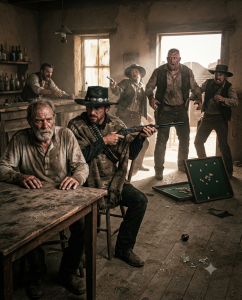
Dust hung in the bars of sunlight cutting through the windows. Somewhere behind the counter a bottle clicked softly against another. Two old men at a domino table stopped mid-game and looked over without speaking. Rosendo, the barkeep, went still with a rag in his hand.
The old man who had asked was trembling, though he was trying hard not to show it. His beard was full of road dust, his shirt dark with sweat, and every breath seemed to scrape his chest on the way in and out. He had likely ridden too fast, too far, in weather no man his age should have faced alone.
The stranger across from him was dressed in black, with silver on his hatband and a woven poncho draped over one shoulder. A Winchester leaned against his chair. Unlike the other men in the cantina, he had not been drinking. There was only a tin cup of water at his elbow, untouched for several minutes now.
He lifted his eyes to the old man’s face.
“How many are after you?”
“Three,” the old man said. “Maybe more if they gathered help on the road.”
“And what do they want?”
The answer came with obvious shame.
“What I buried for my boys.”
The stranger’s gaze stayed fixed on him. “Money?”
The old man nodded once. “Silver. Gold. Forty years of work. Everything I could save.”
The stranger considered him for a moment longer, then reached calmly for the Winchester and pulled it beneath the table.
“Sit easy, Father,” he said.
The old man stared as if he had misheard him.
The stranger gave the slightest nod toward the chair. “If I’m your son, start acting like I’m one.”
Only then did the old man sit.
His name was Don Aurelio Cifuentes, and almost everyone in San Isidro knew some version of his story. He had come to Sonora from Sinaloa as a young man with almost nothing and carved a ranch out of country so dry and unforgiving that even seasoned men crossed themselves before trying to settle there. He married young, buried his wife too early, and raised two boys with the kind of hard love frontier fathers often mistook for tenderness.
He had not become wealthy in the way city men used that word. No polished boots, no strings of cattle stretching to the horizon, no servants. But he had built something better than appearances. He had built survival. Piece by piece, coin by coin, he had hidden away enough that his sons would one day inherit freedom instead of debt.
He had buried that future in a mesquite chest under an old tree on his land.
And the day before, in a moment of tiredness and mezcal, he had said too much.
Now the men who came through the cantina doors meant to take it from him.
Cipriano Leal entered first, all lazy confidence and watchful eyes. He was a thin man, but not a weak one. There was something dry and foxlike in the way he moved, as though he had spent his life measuring risk against profit and had usually chosen profit. Behind him came Fermín Suna, broad-shouldered and scarred, the floor groaning under his boots. Last came Tuerto Bravo, whose right eye was made of glass and whose left moved with the cold alertness of a rattlesnake.
“Don Aurelio,” Cipriano said pleasantly. “We paid a visit to your ranch. Shame you weren’t there.”
Aurelio swallowed and forced steadiness into his voice. “I came to see my son.”
Cipriano looked toward the stranger. “Your son?”
The stranger leaned back just enough to show he was not impressed. “He’s having a meal with his father.”
Fermín laughed. “Then the son can stand up and leave. This is private.”
“I’m not moving,” the stranger said.
The room tightened.
Tuerto’s hand drifted lower toward his revolver.
The stranger noticed.
“I’ll say this once,” he said, quiet but sharp enough to cut. “Walk out the same way you came in and find another old man to rob.”
Cipriano’s smile thinned. “You don’t know who you’re dealing with.”
Tuerto moved first.
The shot from the Winchester shattered the room.
It was so sudden, so violent, that Aurelio flinched in spite of himself. Tuerto was flung backward before his gun cleared leather. He struck the floor hard, and something pale and round skipped away across the boards. For one frozen, absurd second, everyone watched the glass eye roll under a chair leg and come to rest in the dust.
Rosendo dove behind the bar.
One domino player hit the floor so fast he took the table with him. The other simply crossed himself and stayed where he sat, too shocked to do anything else.
The stranger worked the lever with terrifying ease, chambering the next round.
That was when Aurelio understood the truth. This man had not agreed to play a role out of kindness alone. He knew violence the way a blacksmith knows heat. He carried it like a language.
“Who are you?” Cipriano asked.
The stranger’s eyes never left him. “His son.”
The answer might have sounded like mockery from anyone else. From him, it sounded like a sentence.
Then came the sound from outside.
Boots on the porch. More than one set.
Fermín’s mouth curved. “You thought we rode alone?”
Cipriano stepped slightly aside, confidence returning. “You should’ve minded your own business, friend.”
But the stranger’s expression did not change.
Instead he said, “I was wondering how long it would take you to bring the rest of Leal’s men.”
Cipriano went still.
Aurelio turned sharply. “You know him?”
The stranger rose from his chair, and standing, he seemed larger than before. Not wider. Larger in presence, in certainty, in danger. An old scar cut near his jaw, almost hidden beneath beard and shadow.
“I know what he did outside Caborca,” the stranger said. “I know about the burned wagons. I know about the family they left in the sand. I know which boy disappeared after.”
Cipriano stared as if looking at a ghost.
“No,” he said softly. “That’s not possible.”
The stranger’s mouth hardened. “I lived.”
Aurelio felt cold despite the heat. The name Caborca stirred something old in him—rumors from years back, tales of a wagon train hit hard by bandits, bodies found charred, valuables missing, a child never recovered.
Outside, someone shoved the cantina doors once, hard enough to rattle them.
Aurelio asked the question before he could stop himself. “Who are you?”
The stranger reached inside his coat, pulled out a tarnished silver medallion, and tossed it onto the table between them.
Aurelio stared.
It had belonged to his wife.
He knew it instantly. She had worn it on feast days and on the day they buried their youngest daughter, a baby who had not survived one winter. Aurelio had not seen that medallion in more than twenty years. He thought it had been lost forever.
His eyes lifted slowly to the stranger’s face.
The man held his gaze this time. “My mother wore one exactly like it because yours gave it to her.”
Aurelio could barely breathe. “Who are you?”
“My name,” the stranger said, “is Tomás Rivas.”
The name hit Aurelio like another gunshot.
He remembered at once. A woman years ago—Marina Rivas—who had passed through the ranch with a small boy after her husband died in a mine collapse. Aurelio’s wife had fed them, given them blankets, and pressed that silver medallion into Marina’s hand before winter set in. Marina and her son had left at dawn. Aurelio had never seen them again.
“I heard what happened later,” Tomás said, voice hardening as the memory sharpened. “Bandits struck the wagon convoy they joined north of Caborca. Burned the wagons. Killed those who resisted. Took whoever they thought could be sold, used, or ransomed. I escaped. My mother didn’t.”
Silence swallowed the room.
Cipriano’s face had changed. Not to guilt. Men like him rarely reached guilt. But there was recognition, and there was calculation. He knew now exactly who stood before him.
Aurelio’s stomach turned. “You were that boy.”
Tomás nodded once.
Outside, the doors burst open.
The first man through carried a shotgun. Tomás fired before the intruder could level it properly. The blast drove the man backward into the porch rail. Splinters flew. Another shot came from outside and shattered a bottle shelf behind the bar. Rosendo cried out and dropped lower.
“Down!” Tomás barked.
Aurelio crouched behind the overturned table while Fermín lunged for cover near the wall. Cipriano moved fast, diving behind a support post as bullets punched through the cantina’s front panels.
Tomás shot through the doorway once, twice, forcing the men outside to scatter. Then he kicked over a table to widen his cover and looked at Aurelio.
“How many rounds in that Remington you left unloaded at home?”
Aurelio blinked, stunned. “How do you know about that?”
Tomás gave a bleak half-smile. “Because I’ve been watching your ranch for three days.”
That answer hit Aurelio almost as hard as the gunfire.
“Why?”
“Because once I learned Leal was in San Isidro, I knew he’d circle anything that smelled like easy money. Then I heard you in the cantina talking about buried gold, and I knew exactly what would happen next.”
“Were you planning to rob me first?”
Tomás met his eyes with brutal honesty. “I was planning to find out whether you were worth saving.”
Another blast tore through the wall, ending the exchange.
Fermín suddenly made his move. Instead of helping Cipriano, he lunged sideways toward the back exit.
“Coward!” Cipriano shouted.
“Dead men don’t share gold!” Fermín yelled back.
Tomás swung the Winchester and fired. The bullet caught Fermín in the shoulder and spun him against the rear doorframe. He dropped hard, groaning, one arm useless.
Outside, one of Leal’s men shouted, “Set it on fire!”
Aurelio’s blood ran cold.
“No,” Cipriano snapped from behind the post. “The old man knows where the chest is.”
Tomás heard that and his expression changed slightly, as though a final piece of some private puzzle had locked into place.
He looked down at Aurelio. “They don’t know the location yet.”
“No.”
“Good. Then we keep it that way.”
Aurelio almost laughed at the insanity of it. A dying rancher, a stranger posing as his son, a gang of killers outside, and now this stranger was speaking as though the gold mattered less than the principle of denying it to men like Cipriano.
But perhaps that was exactly what bound them for that one impossible afternoon.
Tomás leaned low and said, “When I tell you, you run through the kitchen and out the back. There’s a stable lane. Take the alley to the church wall.”
“And leave you?”
“You asked me to be your son. Let me earn it.”
Before Aurelio could answer, Tomás stood and fired twice in quick succession through the doorway. A scream outside proved at least one bullet found flesh. He used the moment to drag a heavy liquor barrel across the floor and wedge it against the entrance.
Cipriano used the confusion to make his own push, darting toward a side window. Tomás spun and caught him with the rifle butt across the temple. Cipriano crashed into a table, overturning it. The knife that flashed in his hand clattered free.
For the first time, Cipriano looked afraid.
Tomás pressed the Winchester to his chest.
“Caborca,” Tomás said. “Say her name.”
Cipriano’s breath came fast. “I don’t remember all their names.”
Tomás’s face went empty in a way more frightening than rage. “Marina Rivas.”
Aurelio saw it then—memory, real and ugly, surfacing in Cipriano’s eyes. He remembered her.
“She begged,” Cipriano muttered.
Tomás’s finger tightened on the trigger.
Aurelio forced himself up despite the pain in his chest. “Tomás.”
Tomás did not look away.
“If you kill him now,” Aurelio said, “the men outside rush in before we can move.”
For a second that seemed to last forever, Tomás weighed revenge against survival.
Then he lowered the rifle just enough to keep Cipriano alive.
“You’re right,” he said.
Cipriano exhaled shakily, but the relief died when Tomás grabbed him by the collar and dragged him upright like a shield.
The next minutes were chaos. Using Cipriano to cross the line of fire, Tomás forced the gunmen outside to hesitate. Rosendo, shaking and pale, handed Aurelio an old double-barrel shotgun from beneath the bar. The old rancher took it with hands that wanted badly to fail him but did not. Together, he and Tomás pushed into the kitchen and out the back, hauling Cipriano with them while Fermín moaned where he had fallen.
The stable lane was narrow and hot, boxed in by adobe walls. One of Leal’s men appeared at the far end with a revolver. Aurelio fired first. The shotgun kicked like a mule and nearly took him off his feet, but the man at the far end dropped.
They kept moving.
At the church wall, townspeople finally began to appear at doorways, alarmed by the gunfire. A bell started ringing. Somewhere a deputy shouted orders. Leal’s men, who had counted on fear and speed, suddenly lost the advantage that secrecy had given them.
Tomás slammed Cipriano against the church wall and held the rifle under his jaw.
“It ends now,” he said.
Cipriano, bleeding from the temple and breathing hard, gave a crooked smile that did not reach his eyes. “You think killing me brings her back?”
“No,” Tomás said. “But it stops you from doing it again.”
Before he could fire, the sheriff’s deputy and two armed ranch hands rounded the corner. Weapons rose. Voices overlapped. In the confusion, Cipriano twisted, trying one last desperate escape. Tomás fired on instinct.
The shot struck true.
Cipriano folded to the ground and did not move again.
The remaining gunmen fled before sunset. One was caught on the south road. Another was found wounded in a wash by morning. Fermín survived long enough to name names in exchange for a priest and a softer cell, though no one in San Isidro thought his repentance amounted to much.
As for the gold, Aurelio led Tomás and the deputy to the old mesquite tree at dawn the next day. He looked even older in the morning light, as though the long night had collected years from him all at once. They dug until the shovel struck wood.
Inside the chest, the silver and gold gleamed dully beneath a layer of oiled cloth.
Tomás stared at it and then at Aurelio.
“You still want your sons to have it?”
Aurelio nodded. “It was always theirs.”
“And me?”
The question surprised them both.
Aurelio rested a hand on the mesquite chest. “I don’t know what a man owes another man for saving his life. Less than I feel, more than I can say. But I know this. My wife fed you when she didn’t have much. Yesterday you repaid that debt with interest.” He swallowed hard. “You may not be my son by blood. But if you ever come to this land again, you won’t come as a stranger.”
Tomás looked away first.
Sebastián and Mateo arrived two days later, dusty and frightened from the urgency of the summons. Aurelio told them everything except the ugliest details. He introduced Tomás simply as the man who had stood beside their father when death came through the door. That was enough for both sons. They shook his hand like men greeting kin they had not expected to find.
Aurelio lived another seven months.
Long enough to divide the chest properly. Long enough to sit in the shade with his sons and say the things hard fathers too often leave unsaid until it is too late. Long enough to tell Tomás, during one quiet visit, where a smaller pouch of silver was buried near the well.
“For a start,” Aurelio said when Tomás tried to refuse. “Not charity. Family.”
When Aurelio finally died, he did so in his own bed, with Sebastián on one side, Mateo on the other, and the dry Sonoran wind moving softly through the shutters. At the burial, Tomás stood back at first, hat in hand, uncertain of his place.
Mateo stepped aside and made room for him at the front.
No one argued.
Years later, people in San Isidro still told the story of the day Don Aurelio walked into La Sombra del Mezquite and asked a stranger to pretend to be his son. Most told it for the gunfight, for the glass eye rolling over the floor, for the gang that thought an old man would be easy prey.
But the part that stayed with people longest was quieter than that.
A man on the edge of death asked for borrowed family and, by some strange mercy, found the real thing. Another man who had lost everything to cruelty found, in the middle of vengeance, a place where his rage did not have to be the only inheritance he carried.
And depending on who told it, the lesson changed.
Some said Aurelio should never have spoken about the gold.
Some said Tomás should have killed Cipriano years earlier if he had the chance.
Some said blood was blood and nothing else counted.
But the people who knew the full story usually fell silent at the end and looked toward the old road outside town, as if still half-expecting to see a stranger ride in out of the dust and become family before anyone understood why.
Because sometimes the biggest warning is not the gold you hide.
It is the loneliness that makes you say too much to the wrong ears—and the grace that sends the right person through the door anyway.