Please… pretend you’re my son.”
By the time Don Aurelio Cifuentes said those words, his pride had already been worn down to the bone.
It was 1882 in San Isidro, Sonora, where dust worked its way into every doorway and every man’s business eventually became someone else’s rumor. Aurelio had spent forty years believing that if he kept his head low, worked hard, and trusted almost no one, he could protect what mattered. For most of his life, that had been true.
But age changes the rules.
At seventy-two, Aurelio no longer moved like the man he used to be. The desert had not beaten him, but it had carved him into something leaner, rougher, and more brittle than he cared to admit. His hands were still powerful, his voice still capable of stopping hired hands in their tracks, but lately his lungs had begun to betray him. The cough started in the mornings, a dry bark he could wave away. Then it started waking him at night. Then came the heaviness in his chest and the exhaustion that no sleep touched.
When the town doctor told him to rest, Aurelio had nodded and ignored every word.
Rest was for men who had already finished what life asked of them.
Aurelio had not.
He lived alone on a spread of hard ranch land outside San Isidro, a place he had built from almost nothing after arriving from Sinaloa as a young man with a tired mule and a promise in his chest. He had promised himself that one day his children would stand on land no one could take from them. He had kept that promise through drought, bad harvests, rustlers, fever, and years when a weaker man would have sold everything and walked away.
His sons, Sebastián and Mateo, had grown up under that stubbornness. Sebastián was practical, measured, the kind of boy who had become a man by learning to count nails and pesos with equal care. He now owned a hardware store in Hermosillo. Mateo had always been more restless, more drawn to roads than fences, and had taken work driving mule trains between Magdalena and Nogales. Aurelio loved them both fiercely, though they came home less often than he wanted.
He did not blame them for that.
Distance was part of a man’s life in Sonora. So was silence.
Still, when his cough deepened and the doctor’s eyes lingered too long on his chest, Aurelio sent word for both sons to come. He wanted to see them while he still had breath enough to speak plainly. And he wanted to show them where he had hidden the one thing he considered the true proof of his life’s work: a mesquite chest buried beneath an old tree on the property, filled with silver pesos and double-eagle gold coins collected over decades.
Not stolen. Not gambled. Earned.
Each coin had a memory. A season of hunger survived. A cattle run completed. A good year saved instead of spent. A want denied. A luxury rejected. The chest was not vanity. It was his final act as a father.
He might have kept the secret safe if not for one bad night.
La Sombra del Mezquite was the kind of cantina where men talked more loosely than they intended and remembered less than they should. Rosendo, the owner, was a broad-shouldered man with sad eyes and the sensible habit of hearing too much and repeating too little. Aurelio trusted him as much as he trusted anyone in town, which was to say barely enough.
That evening Rosendo poured him mezcal and asked whether he was unwell.
“Just tired,” Aurelio answered.
He stared at the drink in his hand for a long moment, then said, “My boys are coming. I sent for them.”
Rosendo nodded. “That’s good.”
“I’ve got something for them,” Aurelio went on, the mezcal softening a corner of him he usually kept locked tight. “Everything I managed to save. Gold too. Enough so neither of them ever has to bow to another man.”
Rosendo stopped polishing the glass for half a second, then resumed.
He said nothing.
At the back of the room, however, someone else listened.
Cipriano Leal had been in town for weeks, always sitting just far enough away to be ignored, always behaving like a man waiting for a business partner who had been delayed by weather or bad luck. He was thin, patient, and forgettable in the exact way dangerous men often tried to be. Most people barely noticed him.
Rosendo did. Rosendo noticed everyone.
But by the time his eyes flicked toward the corner, Cipriano had already gone back to pretending he was staring at the rafters.
The next morning, three riders appeared on the horizon leading to Aurelio’s ranch.
They were not neighbors and not visitors. Aurelio knew the type long before he made out their faces. They rode without courtesy or urgency, the way men ride when they expect fear to clear the road before them. Cipriano led the way. Beside him rode Fermín Suna, a massive man with a scar across his nose and shoulders like gate hinges. A little behind them came Tuerto Bravo, known in two states for a trigger finger and the unsettling glass eye that never seemed to look where his living eye did.
Aurelio had maybe a minute to decide whether he would die on his porch or try to outrun them.
He reached once toward the Remington over the fireplace, then stopped. There was no time to load it. No time to defend the house. And if they took him there, they would tear the place apart until they found the tree.
He went out the back instead.
In the stable, La Colorada stamped and snorted as though she already understood the urgency. She was fourteen years old, roan-coated, mule-stubborn, and more sure-footed than any horse Aurelio had ever owned. He threw on the saddle with shaking hands and leaned his forehead briefly against hers.
“Today you save me,” he whispered, “or we get buried together.”
Then they rode.
The main road would have gotten him killed. Aurelio took the black lava cuts and dry canyons that twisted toward San Isidro like scars through the land. Horses could outrun a mule on open ground, but not there. Not over jagged rock and narrow ledges where one bad step meant a broken leg and a waiting buzzard.
Still, the ride nearly killed him.
The cough tore at his chest. Twice he thought he would black out. By the time San Isidro appeared, the world had narrowed to heat, pain, and the violent pounding of his own pulse.
He dismounted in front of La Sombra del Mezquite and nearly collapsed on the hitching post before forcing himself inside.
The cantina was quiet that hour.
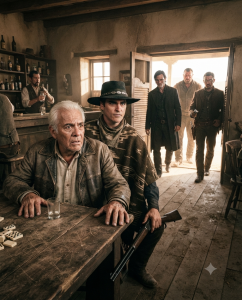
Rosendo stood behind the bar. Two old ranchers bent over a game of dominoes. In the far corner sat a stranger Aurelio had never seen before, back to the wall, silver-trimmed black hat pulled low. A woven poncho hung over one shoulder. Next to his chair leaned a Winchester 1873. On the table in front of him sat only a glass of water.
Something about the man made the room bend around him. Not arrogance exactly. Not menace on display. Just stillness. The kind that suggested he had no need to prove anything.
Aurelio walked straight to him.
“Sir,” he said, voice scraping, “you don’t know me. I’ve no right to ask this. But three men are coming behind me. They want what I buried for my sons.”
The stranger watched him without interruption.
“What do you want from me?”
Aurelio had been a proud man all his life. Asking for help from kin would have been hard enough. Asking it from a stranger felt like peeling off his own skin.
“Please,” he said, swallowing hard. “Pretend you’re my son.”
The domino game stopped.
Rosendo slowly set down the bottle in his hand.
The stranger looked at Aurelio for several long seconds, as though weighing not the request but the man making it. He saw fear, yes. But also the humiliation of a father who had spent a lifetime protecting others and had now been cornered into begging.
“How many?” the stranger asked.
“Three.”
The man reached for the Winchester and rested it under the table.
“Sit easy, father.”
The word hit Aurelio harder than expected.
A minute later the doors swung open.
Cipriano entered first with a smile that had no warmth in it. Fermín came behind him, broad enough to darken the doorway. Tuerto Bravo let his good eye roam the room, taking in exits, cover, distances.
“Don Aurelio,” Cipriano said lightly. “We visited your ranch. You weren’t there.”
“I came to town,” Aurelio replied, surprised at how steady he sounded. “To see my son.”
Cipriano’s eyes shifted to the stranger.
“Your son?”
The stranger lifted his gaze from the water glass. “He’s having breakfast with his father.”
Fermín barked a laugh. “Then the son can move. This is private.”
“I’m not moving.”
It happened quickly after that, though everyone there would later remember it in stretched-out pieces.
Tuerto’s hand slipped lower toward his revolver.
The stranger noticed before anyone else.
“I’ll give you one chance,” he said, voice calm. “Walk out and find some other old man to rob.”
Cipriano’s smile thinned. “You don’t know who you’re talking to.”
Tuerto went for the gun.
The Winchester fired.
Inside the low-ceilinged room, the blast sounded like judgment. Tuerto spun backward, crashing into a table. His glass eye popped loose and rolled over the floorboards with a tiny, grotesque click-click-click that no one in the room ever forgot.
Rosendo dropped behind the bar. One domino player gasped a prayer. The other forgot to breathe.
The stranger stood with the rifle shouldered, expression unchanged.
Fermín jerked for cover behind a support post, cursing. Cipriano stumbled back and grabbed the edge of the wall, whatever control he had hoped to project gone in an instant.
What chilled Aurelio most was not the shooting.
It was the precision.
This man had not fired in panic or anger. He had fired the way a butcher uses a knife or a carpenter drives a nail—with certainty.
Fermín tried to draw, and the stranger fired again, splintering the wood beside his head so violently the big man froze where he was.
“No more warnings,” the stranger said.
Cipriano raised his hands slightly. “Easy. We can still talk.”
“Then talk,” the stranger replied. “Tell me why three men rode out to terrorize a dying rancher over money that isn’t theirs.”
Aurelio’s cough seized him then, a brutal fit that bent him over the table. Rosendo rushed out with water. Aurelio took it blindly, eyes still fixed on the stranger’s face.
Something in that face troubled him now.
The line of the jaw. The shape of the brow beneath the hat. Not familiar enough to name, but enough to stir a memory that would not fully rise.
Cipriano saw it too. And because men like him lived off the wound before the knife, he smiled.
“You should tell him the whole story,” Cipriano said to Aurelio. “About Santa Rosalía. About the winter of ’61.”
The room went dead silent.
Aurelio looked up slowly.
The stranger’s grip on the rifle tightened by the smallest degree.
Fermín glanced from one man to the other and seemed to realize he had stepped into something larger than robbery. Even Rosendo’s face changed.
Cipriano went on, enjoying himself now. “Funny thing about buried gold. Men assume it’s the oldest secret in the room.”
Aurelio’s lips parted, but no sound came out.
There had been a woman in Santa Rosalía.
He had not spoken her name aloud in twenty-one years.
Back then, before his wife died, before the ranch had fully become what it was, Aurelio had spent a winter hauling freight farther south than usual. Storms had trapped men in town for weeks. There had been loneliness, grief he had not yet admitted, and one terrible season of weakness. The woman’s name was Elena Vargas. She had been widowed, proud, and sharper than he deserved. What passed between them had not been some tavern dalliance. It had been brief, real, and then abandoned under the pressure of distance, duty, and cowardice.
He had left. Life had closed over it. Or so he told himself.
Months later a letter had reached him through a trader. He had burned it unread.
That memory hit him now like a shovel to the chest.
The stranger’s eyes had changed. Not with confusion. With recognition.
“Who are you?” Aurelio asked, barely above a whisper.
Cipriano answered before the man could.
“The one with the rifle?” He tilted his head. “That would be Tomás Vargas. Or at least that’s the name he’s been using. Came north asking questions about a woman who died poor, a man who disappeared, and money that ought to have gone to blood.”
Rosendo looked at the stranger in disbelief.
Tomás did not deny it.
Instead he took one measured step forward and kept the Winchester aimed at Cipriano’s heart. “You’ve got five seconds,” he said. “Then you explain why you know my mother’s name.”
Cipriano let out a soft breath through his nose, but for the first time he looked cautious.
“Because she told a priest before she died,” he said. “Because the priest talked when he drank. Because I listen better than most men. And because when I heard that Don Aurelio Cifuentes had sent for his sons and buried a fortune under a tree, I thought perhaps someone else deserved a share.”
Aurelio felt the room tilt.
Tomás.
He saw it now. Not a perfect likeness, but enough. The eyes. The set of the mouth. A cruel mercy from God, to place the proof in front of him only after a rifle shot and a plea for borrowed kinship.
Tomás spoke without looking at him. “My mother said my father was an honest man who made one coward’s mistake and spent the rest of his life pretending it cost nothing.”
Every word landed.
Aurelio gripped the table to stay upright. “I never knew,” he said.
Tomás’s laugh was short and empty. “That was convenient.”
Cipriano saw the fracture opening and tried to widen it. “See? Saves us all trouble. Half the chest for the forgotten son, half for us, and no one has to die.”
Tomás turned the rifle slightly until it centered on Cipriano’s chest again. “You still think you’re part of this?”
Fermín chose that moment to make one fatal decision. Maybe he thought the family revelation had distracted everyone. Maybe he trusted his speed. Maybe he was just stupid. He lunged for the revolver at his belt.
Tomás fired.
Fermín slammed backward into the wall and slid down, clutching his shoulder and screaming. The bullet had torn through muscle without killing him, but the message was clearer than blood.
Rosendo kicked the revolver away before it hit the floor.
Now only Cipriano remained standing.
And suddenly he no longer looked like a patient spider. He looked like a man who had wandered into a trap he had mistaken for prey.
“Here is what happens next,” Tomás said.
His voice was quiet enough to force everyone to hear it.
“You tell us every man who rode with you, every ear you ran this story through, and whether anyone else knows about the chest.”
Cipriano hesitated. Tomás cocked the rifle.
“Just me,” Cipriano said. “Us three. No one else. I swear it.”
Rosendo muttered, “That’s the first wise thing you’ve said all day.”
Tomás stepped close enough to take Cipriano’s pistol from his belt, then forced him to his knees with the rifle barrel under his chin. “You don’t get to swear in here.”
Aurelio found his voice at last. “Why didn’t you come to me plain?”
Tomás turned, and for the first time the anger in him showed fully.
“Because men who walk away from women like my mother usually have a reason ready. I didn’t come for excuses. I came to see what kind of man you were before I decided whether to hate you.”
The words cut deeper than any insult the outlaws could have spoken.
Aurelio closed his eyes briefly. “And now?”
Tomás looked at him for a long moment.
“Now I know what kind of man begged a stranger to be his son rather than let thieves take what he meant for his children.”
It was not forgiveness. But it was no longer hatred alone.
Rosendo sent one of the old domino players to fetch the sheriff, then bound Fermín’s wound and tied Cipriano’s hands with bar rag and harness leather. Tuerto Bravo was beyond helping. The cantina smelled of smoke, fear, and spilled liquor.
When the room finally quieted, Aurelio looked at Tomás and said, “There’s room under that tree for one more share.”
Tomás’s expression hardened again out of habit. “You think this is about money?”
“No,” Aurelio said. “It’s about what I failed to do. Money is the smallest piece of it.”
The sheriff arrived with two deputies, and even he entered carefully after hearing whose body lay on the floor. Statements were taken. Cipriano, now pale and stripped of swagger, said very little. Fermín groaned through clenched teeth as they hauled him away. Rosendo repeated only what needed to be repeated and no more.
By sunset, the town had already started building a legend out of what had happened. Some said the stranger had killed Tuerto before the outlaw blinked. Some said Don Aurelio had hired a gunman from Chihuahua. Others said the whole thing was a feud over hidden Confederate gold, because small towns preferred dramatic lies over ordinary sins.
Only a handful of people knew the truth.
That evening, Aurelio and Tomás rode out together to the ranch.
La Colorada carried Aurelio. Tomás followed on a bay gelding borrowed from the sheriff. They said almost nothing on the road. The silence between them was not empty. It was crowded with years.
At the ranch, Aurelio led Tomás to the old tree.
The sun was low, turning the dry land the color of rust and old fire. Aurelio pointed with a trembling hand. “There.”
Tomás dug first. Aurelio joined in when he could, though the coughing fits came harder now. When the shovel finally struck wood, both men stopped.
The chest was heavy when they raised it out.
Aurelio brushed the dirt from the lid as gently as if touching a sleeping child. Then he opened it.
The coins inside caught the last of the light.
Tomás stared, but not with greed. More with disbelief at the physical weight of so many years saved in secret. Aurelio looked at the gold, then at the man beside him.
“I should’ve read the letter,” he said.
Tomás did not answer immediately.
“No,” he said at last. “You should’ve written one.”
Aurelio bowed his head. “You’re right.”
He divided the contents there in the fading light into three equal shares. One for Sebastián. One for Mateo. One for Tomás.
Tomás frowned. “I didn’t come for this.”
“Maybe not,” Aurelio said. “But it’s yours.”
Tomás looked out across the ranch, across the land built by a man he had every reason to despise and had still chosen, in the worst moment, to call father in front of armed wolves.
Finally he nodded once.
The next morning Sebastián arrived, breathless and confused from hard riding. Mateo came before noon, dusty and anxious. The explanation that followed was raw, incomplete, and painful in all the ways truth usually is. There was shouting. Mateo walked outside and kicked a post hard enough to split the skin over his knuckles. Sebastián went silent in that dangerous way practical men do when their world shifts under them.
But neither of them rejected Tomás.
Maybe it was the evidence in his face. Maybe it was the story Rosendo had already spread about what happened in the cantina. Maybe it was simply that Tomás had stood over their father with a rifle and meant it when he said, Stay behind me.
By the second evening, all four men were sitting outside the ranch house as the heat bled out of the dirt.
Aurelio coughed into a handkerchief and looked at his sons—three sons now, though the count came with pain. “I cannot ask you boys to forgive me,” he said. “Only to know I was a smaller man once than I wanted to be.”
Tomás stared ahead for a while before answering.
“My mother never cursed you,” he said quietly. “That made it harder.”
Aurelio’s eyes shone then with a grief he had postponed too long to control. “I’m sorry,” he said, and this time the apology carried the full weight of the years behind it.
No one rushed to soften the moment.
Some wounds deserved their silence.
Aurelio lived another seven months.
Long enough to watch the first rains darken the earth. Long enough to show Tomás the boundaries of the ranch, the water places, the habits of the cattle, the tree where the chest had slept underground. Long enough for the awkwardness among the brothers to become something sturdier—never simple, but real.
When Aurelio died, they buried him on a rise where he could face the land he had fought for.
Sebastián returned to Hermosillo eventually. Mateo kept to the roads but came more often after that. Tomás stayed the longest, helping settle the estate before taking his share and leaving with his mother’s name no longer stranded in bitterness.
People in San Isidro talked about the gunfight for years. About Tuerto’s glass eye rolling over the floorboards. About the stranger who killed faster than thought. About the outlaw who came hunting for stolen gold and found a family secret instead.
But the real story was quieter.
An old man spent his life trying to leave something behind for his sons, only to discover at the very end that he had left one son behind first. A stranger agreed to become family as a lie, then turned out to be family before anyone in the room was ready for it. And in the space between violence and confession, all of them were forced to decide whether blood mattered more than betrayal, or whether the harder thing—the braver thing—was to admit that both could be true at once.
Some people in town said Aurelio got more mercy than he deserved.
Others said Tomás gave less than he could have.
Maybe both were right.
But anyone who heard the full story and thought about it honestly had to ask the same question in the end:
What was the bigger inheritance—the chest of gold under the tree, or the one terrible truth dragged into the light before there was no time left to face it?