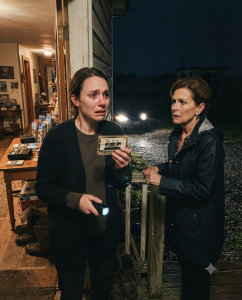
Nina grabbed a flashlight from the junk drawer before she had time to overthink what she was doing.
That was the only reason she made it to the pump house at all. If she had waited even another minute, she might have talked herself out of it the way she had talked herself out of so many other things over the years. She might have told herself the key was meaningless, that old houses collected old keys, that grief could make patterns out of dust and hardware and memory. She might have gone to bed, gotten up in the morning, driven back to the city, and left the farm buried exactly the way her stepmother had always preferred.
But the key was in the junk drawer.
Wrapped in faded blue tape.
Labeled, in her father’s cramped handwriting: Pump house.
He had been dead eleven years.
Nina had found the key less than ten minutes earlier while searching for batteries in the rental house kitchen. She had only come back because the booking calendar was empty for the week and the place needed checking after a storm. At least that was the practical reason. The real reason was harder to admit. Something about being on the property again had scraped open an old irritation she had never fully named. Little things had started bothering her as soon as she walked in. The staged quilts. The mason jars. The framed photographs Marsha kept on the walls, all carefully selected to suggest heritage without revealing anything real. Her father appeared in none of them.
And then there was the key.
Now the pump house stood ahead of her beyond the back field, crooked and gray in the last of the evening light. The grass brushed her knees. The old lilac hedge had swallowed half the path. The door still sagged inward on one hinge, and seeing that small familiar defect gave her such a sharp flash of childhood that she actually stopped walking.
She remembered standing outside that same door when she was fifteen, hearing her father and Marsha arguing inside. Not shouting exactly. Worse than shouting. The tight, low kind of argument where every word has already been repeated too many times.
“You used the land without asking me.”
“It was temporary.”
“You don’t pledge what isn’t clear.”
“You said you trusted me.”
Then the door had opened and both of them had gone silent at once.
For years Nina had filed that memory under Things Adults Handle.
Now she reached the door and slid the key into the rusted brass lock.
It turned on the first try.
A chill ran straight down her arms.
Inside, the air was thick with rust, damp wood, old oil, and a trace of mold. Her flashlight shook over warped shelves, cracked jars of bolts, a collapsed pressure tank, a coil of hose gone stiff with age. The floor dipped in the same places it always had. Nothing looked hidden. Nothing looked important.
Then she saw the workbench.
Her father’s bench.
Marsha had refinished almost everything else on the property over the years, sanding away age until the place looked curated instead of lived in. But the bench still carried marks Nina recognized: a burn scar near the vise, a notch on one leg, a dark stain from some long-ago spilled can of oil. She dropped to a crouch and angled the flashlight beneath it.
Something metal flashed back.
A small lockbox had been wired to the underside with old fencing wire, tucked so tightly into shadow no one would ever notice it casually. Nina’s breath caught. The key fit that lock too.
Inside were three things.
A folded deed copy.
A bank envelope.
And a cassette tape labeled in her father’s handwriting: FOR NINA ONLY.
She stood there in the dust and failing light with the box in her hands and felt the world tilt. Her father had never been a man for secret notes or dramatic gestures. He wrote reminders on feed sacks. Left grocery lists on seed catalogs. Fixed problems with twine and bolts and patience. If he had hidden something for her, it meant he had run out of every other option.
She unfolded the deed copy first.
It was one of the transfer documents from the year the farm changed hands, the paperwork Marsha had always described as sad but unavoidable. Same parcel numbers. Same legal descriptions. Same signatures. Except on the final page, in her father’s unmistakable pen, two furious words had been carved into the paper.
NOT FINAL.
Nina’s stomach turned.
She tore open the bank envelope next. Inside were photographs of boundary markers and equipment, survey maps with sections circled in red, and copies of correspondence. One letter, from an attorney whose name she didn’t recognize, was dated eight months before the tractor accident. It warned her father that the farm had been pledged as collateral on a private note taken out by Marsha before the consolidation papers were signed.
Nina read the date three times.
All her life, the family story had been neat. The accident happened. Her father’s recovery went badly. Bills mounted. He got weak, overwhelmed, easier to pressure. The farm was sold because there was no other way to keep creditors from tearing it apart.
But if Marsha had pledged the farm eight months earlier, the ending had been in motion long before the accident.
The farm had not been lost because her father became vulnerable.
His vulnerability had simply made the theft easier.
Nina leaned one hand against the bench and shut her eyes. Suddenly memory began snapping into place with a violence that made her dizzy. Marsha always handling the calls. Marsha saying the bank had changed things. Marsha insisting there was no point upsetting him with details while he healed. Her father asking for his ledger from the hospital bed. Marsha telling him he needed sleep, not books. The way his jaw had tightened at that, the way he had looked toward Nina and then away, as if trying to decide whether to speak in front of Marsha.
She opened her eyes and looked at the cassette.
There was still an old player in the rental house front room, one of those decorative leftovers Marsha liked leaving out for guests who wanted “an authentic country weekend.” Nina gathered the papers, jammed the tape into her pocket, and hurried back through the field so fast she nearly twisted an ankle.
Inside the house, she locked the door without thinking. The room smelled faintly of lemon cleaner and old wood. Tourist brochures sat fanned beside the cassette player. The whole scene made her angry in a clean, electric way.
She slid the tape in and pressed play.
Static.
A click.
Then her father’s voice.
It wasn’t the booming voice she remembered from childhood. It was thinner, rougher, edged with fatigue. But it was him, undeniably him, and the sound of it hit Nina so hard she had to sit down immediately.
“If you’re hearing this,” he said, “then Marsha either died, left, or finally ran out of people to fool.”
Nina’s hand flew to her mouth.
There was silence except for his breathing and a faint clock ticking somewhere in the room where he had recorded it.
“I need you to listen all the way through before you do anything stupid,” he said. “Especially before you let her see these papers.”
He went on in a voice strained by shame as much as fear. He admitted he had signed documents he did not fully understand because Marsha told him it was temporary, a bridge loan, a way to protect the farm during a cash squeeze. He admitted he had ignored warning signs because he was tired and proud and afraid of losing control. Then he said the sentence Nina would never forget.
“The accident didn’t start this. It just made it easier for her.”
Nina sat frozen, listening as her father explained that Marsha had moved debt around in secret and used his trust to place liens where he never would have allowed them. By the time he realized what she had done, copies were filed in more than one county and men he had never met were suddenly interested in his land.
“If anything happens to me before I get this reversed,” he said, “you do not sign what she brings you. You do not trust any story that starts with urgency. And if she says I agreed to sell because there was no choice…”
The tape crackled.
A chair scraped.
When he spoke again, he was whispering.
“She knew about the tractor before I climbed on it that morning, and when you hear why, you’re going to understand why I hid the—”
The sound tore sideways into static.
Nina lunged for the machine. Rewind. Play. Same thing. The exact same gap. A stretched, damaged segment had swallowed only those words.
Not random damage, she realized. Targeted damage.
Someone had found the tape before and ruined one piece of it.
Her breathing turned shallow. Under what? Under where? What ledger?
Then headlights swept across the front window.
A car rolled up the gravel drive.
Nina knew the shape before it even stopped.
Marsha.
She was out of the chair before the engine died. The deed copy and attorney letter went under a loose stack of tourist pamphlets, then she thought better of it and shoved them inside the oven. The bank envelope disappeared under the sink. The cassette she yanked from the player just as footsteps came up the porch.
The doorknob rattled once.
“Nina?” Marsha called through the screen in a voice so calm it was almost kind. “Why is the pump house open?”
Nina opened the door a crack and stepped into it, blocking the view.
Marsha stood there in a tailored raincoat with her silver hair pinned neatly back, the porch light flattening every line in her face except the eyes. Those eyes were alert. Measuring. Not surprised enough.
“I was checking storm damage,” Nina said.
“At the pump house?” Marsha asked.
“It’s part of the property.”
Marsha smiled a little. “You always were curious.”
Nina felt a small spark of fury at how lightly she said it, as if curiosity were a childish flaw instead of the only reason the truth had survived this long.
“What are you doing here?” Nina asked.
“I could ask you the same.” Marsha’s gaze slid past Nina’s shoulder into the house. “When you didn’t answer your phone, I got concerned.”
Nina hadn’t even heard it ring.
That meant Marsha had called while Nina was in the pump house.
Had she seen her from the road? Had someone told her? Or had Marsha simply known that any return to the property was dangerous now?
“You should go,” Nina said.
Marsha’s expression changed by less than an inch. “Did you find something?”
It was the wrong question.
Not What happened. Not Are you all right. Not Why are you upset. Just: Did you find something?
Nina let the silence stretch. Marsha’s smile thinned.
“Your father was a proud man,” Marsha said softly. “Toward the end, he wrote and recorded all kinds of things when he was confused.”
There it was. The counterstory, ready to go.
“He wasn’t confused,” Nina said.
“No?” Marsha tilted her head. “Then why hide things instead of handing them to a lawyer?”
Nina almost answered. Then she heard the trap inside the question. Marsha did know about the hidden things.
A current of cold ran through her. “How many times did you check that pump house after he died?”
Marsha did not blink. “Enough to know there’s nothing there worth ruining your evening over.”
Nina pulled the cassette from behind her leg and held it up just enough for Marsha to see the label.
For the first time that night, Marsha’s face lost control.
It happened fast. Her mouth parted. Her pupils widened. One hand twitched toward the tape before she stopped herself. But Nina saw it, and once she saw it she could not unsee it. That was fear.
Real fear.
“You should give me that,” Marsha said.
“No.”
“It will only upset you.”
“It already did.”
Marsha stepped closer, lowering her voice. “Nina, listen to me very carefully. Your father was trying to protect you from his own mistakes. He was ashamed. He didn’t understand what he’d done until it was too late.”
“That part’s true,” Nina said. “He says it on the tape.”
Marsha went still.
Nina watched the calculation happen behind her eyes.
“He also says the accident didn’t start this,” Nina added. “It just made it easier for you.”
The porch seemed to narrow around them. Somewhere in the trees a night insect buzzed, thin and relentless.
Marsha’s face hardened. The softness vanished.
“You have no idea how close we were to losing everything,” she said. “No idea what he signed before I stepped in. No idea how much mess I cleaned up.”
“You mean how much you caused.”
Marsha gave a short, humorless laugh. “That farm was dying. Your father would have bled himself into the dirt before admitting it. I did what had to be done.”
“Eight months before the accident?”
That landed. Marsha’s mouth tightened.
“So you found the letter,” she said.
Nina said nothing.
Marsha looked past her toward the dark yard, then back. When she spoke again, she sounded tired rather than frightened, which somehow made her more dangerous.
“There are truths that don’t help anyone once enough time has passed,” she said. “You dig them up now, all you get is rot.”
“Then why are you here?”
This time Marsha didn’t answer immediately.
Finally she said, “Because there’s one thing your father never understood. He thought if he wrote everything down, paper would save him. But paper only matters if the person holding it knows what they’re looking at.”
Nina felt the meaning before she fully understood the words.
The ledger.
Marsha knew she didn’t have it.
Which meant it still existed.
“Where is it?” Nina asked.
Marsha smiled again, but there was no warmth in it now. “That depends on how much of his message you heard.”
Nina didn’t move.
Marsha studied her face, reading it, and then Marsha knew too—the tape had cut off before the hiding place. A flicker of relief passed through her features.
And that was the mistake that ended everything.
Because once Nina saw relief, she understood that the ledger had to be powerful enough to destroy whatever story Marsha had told for eleven years. Powerful enough that Marsha had searched for it. Powerful enough that she was still afraid of it tonight.
Nina stepped back into the house, reached for her phone on the side table, and said, “You can leave now. Or you can stay right there while I call the attorney whose letter you hoped I’d never see.”
Marsha’s composure cracked. “You think one letter proves anything?”
“No,” Nina said. “But I think panic usually does.”
For a second, she thought Marsha might actually lunge for the tape. Instead Marsha gripped the porch railing so hard her knuckles whitened.
Then she said, low and venomous, “Check the barn office. He always believed the floor was safer than the walls.”
Nina stared at her.
Marsha seemed to realize too late what she had just revealed. Her mouth shut hard.
That was all Nina needed.
She didn’t call the attorney first. She called the county sheriff and asked for a deputy to come to the property because she had discovered financial documents connected to an old disputed transfer and did not want to be alone. Then she called the attorney from the letter’s firm, half expecting the number to be dead.
It wasn’t.
The man who answered was the son of the attorney who had written the warning. His father had kept copies. He remembered the case because it had bothered him for years; the older man had believed the transfer was tainted but never had a cooperative witness willing to challenge it.
By the time the deputy arrived, Marsha had left.
Nina found the barn office locked. She pried up two warped boards under the old desk and uncovered a cloth-wrapped ledger, damp at the edges but intact. Inside was her father’s handwriting in relentless detail: dates, amounts, account numbers, private loan terms, equipment sales that never reached farm accounts, signatures that did not match known filings, notes about conversations with Marsha, and one page marked with three furious lines:
She knew the tractor brake line was failing. Mechanic warned at supper night before. Said she’d call first thing. She never did.
Nina had to sit down after reading that.
The next months moved slowly and brutally. Attorneys reviewed the ledger, the tape, the letters, the county filings, the private note history. What emerged was not a dramatic murder plot, not something clean enough for television, but something colder: deception, concealment, fraudulent collateral use, forged or manipulated supporting paperwork, and a pattern of isolating a vulnerable spouse while stripping assets under the guise of saving them. The brake issue itself became a knot of negligence rather than intent—hard to prove as deliberate sabotage, impossible to dismiss as innocent once paired with everything else.
Marsha denied all of it.
Then she changed her story.
Then she blamed Nina’s father.
Then she blamed the banks.
Then she offered a quiet settlement if Nina would agree not to challenge the transfer history publicly.
That offer alone told Nina what she needed to know.
The farm was never restored exactly to what it had been. Too much time had passed. Parcels had changed hands. Money had moved. But the legal challenge forced disclosures, reopened old records, and unraveled enough of the transfer chain to win Nina compensation, partial land recovery, and—more important than anything—the official finding that the original loss narrative had been false.
Her father’s name was cleared in writing.
On the first evening after the final papers were signed, Nina went back to the pump house with the same flashlight she had grabbed from the junk drawer. The lock was gone. The door still sagged. The air still smelled like rust and damp wood. But when she looked beneath the bench, there was nothing there now except dust.
She stood in the quiet and tried to imagine her father hiding that box, knowing he might not get another chance, trusting that one day she would come back and look where everyone else had been trained not to look.
He had not saved the farm in time.
He had not protected her from every lie.
But he had left her a trail.
And in the end that mattered because the cruelest part of what Marsha had done was not the money or the land. It was the story. The way she had turned his shame into evidence against him. The way she had made his weakness look like the cause of his ruin instead of the opportunity she used.
Nina understood, finally, that truth rarely arrived whole. It came in fragments—an old key, a torn tape, a note in the margin, a wrong question at the wrong time, a flicker of fear across the face of someone who had always seemed untouchable. Piece by piece, it became enough.
When people later asked whether she forgave Marsha, Nina never answered directly.
She would only say this: the biggest red flag was never the paperwork. It was how quickly Marsha tried to control the meaning of every silence.
And once Nina heard that, she could never unhear it.