By noon, the sidewalk had turned hot enough to make the air shimmer.
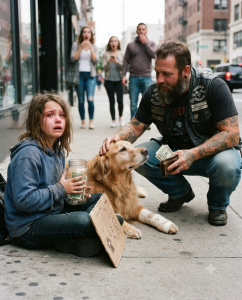
Lily sat with her knees pulled close, one hand wrapped around a glass jar and the other resting on Buddy’s neck. The city moved around them with the impatient rhythm of people who had somewhere to be and no time to notice anyone else’s pain. She had chosen this corner because it was busy. Busy meant more eyes. More eyes, she thought, meant more chances someone would care.
But most people did what people often do when sadness appears too suddenly in front of them. They looked away.
A few slowed down long enough to read the crooked sign leaning against Lily’s backpack.
Please help with Buddy’s treatment.
Some offered sympathetic smiles. A couple of people tossed in coins without stopping. Most kept going, their footsteps quick and detached, as though compassion was a luxury they could not afford before lunch.
Buddy lay beside her on the concrete, his injured front paw wrapped in white bandage already smudged gray from dust. He should have been chasing tennis balls at the park or waiting by the school gate like always. Instead, he rested with his head low, his breathing shallow but steady, trusting Lily with the kind of complete faith only a dog can give.
Lily was eight years old. Old enough to know when adults were pretending not to be scared. Old enough to hear silence where reassurance should have been. Old enough to recognize that when the veterinarian named the price of surgery, her father had gone still in a way that meant the number might as well have been the distance to the moon.
Three days earlier, Buddy had been unhurt.
Lily had been outside their small rented house with a faded tennis ball and a laugh still easy in her chest. She had thrown the ball too hard. It bounced off the curb and rolled into the street. Buddy darted after it with happy, thoughtless devotion.
Then came the car.
There had been the screech of tires, the sharp cry that did not sound like any noise Buddy had ever made before, and Lily running barefoot off the curb while a dark SUV hesitated for one terrible moment. She remembered seeing the front of it dip as if the driver had touched the brake. She remembered hoping, just for a second, that the person inside would get out and help.
But the SUV sped away.
Buddy tried to limp toward her and collapsed.
Their veterinarian was kind, but kindness could not make surgery free. Buddy’s paw had been badly fractured. The operation needed to happen quickly. Delay it too long, and Buddy might never walk normally again.
Lily’s father, Daniel, drove freight trucks and was often away for days. He loved his daughter fiercely, but work had become a constant race against bills, debt, fuel, insurance, repairs, and grief. Ever since Lily’s mother died the previous year, there had been a heaviness in the house that neither of them knew how to name out loud.
Buddy had filled some of that silence.
He walked Lily to school each morning, sitting proudly at the corner until she went through the doors. In the afternoons he somehow knew the exact time to wait by the front window. At night, he slept beside Lily’s bed, and if she cried quietly into her pillow, he would press his warm body against the frame until she reached down to him.
So when the veterinarian named the amount, Lily had not thought like a child. She had thought like someone who could not imagine losing the one creature who stayed.
The next morning, she washed out an empty pasta sauce jar, wrote her sign in marker, clipped Buddy’s leash around her wrist, and walked to the busiest sidewalk she knew.
By noon, she had collected so little that her chest hurt.
“It’s okay, Buddy,” she whispered, stroking the soft fur between his ears. “We’ll get it. I promise.”
Buddy opened his eyes and looked at her, tired but trusting.
That was when the motorcycle arrived.
Its engine rolled down the block like distant thunder, deep and loud enough to turn heads before the bike itself came into view. It was black, polished, and heavy-looking, the kind that made people step back without realizing they were doing it.
The rider pulled to the curb and shut off the engine.
He was enormous.
He wore worn black boots, dark jeans, and a leather vest covered with stitched patches. His beard was thick, his hair tied back, and both arms were covered in faded tattoos that disappeared beneath his sleeves. Silver rings flashed on his fingers when he removed his gloves. There was something intimidating about him even before he moved, the sort of presence that made strangers assume they already knew his story.
Lily’s small body tightened instantly. She gripped the jar against her chest.
The biker looked at the sign, then at Buddy, then at Lily.
“Is this your dog?” he asked.
His voice was rough, deep, not unkind but impossible to ignore.
“Yes, sir,” Lily said quietly.
“What happened?”
“A car hit him. He needs surgery.”
The biker crouched down, slowly enough not to startle the dog. Buddy lifted his head with a faint whimper. For one second Lily wondered whether he would growl or pull away. Instead, the man laid a large tattooed hand gently on Buddy’s head.
Buddy relaxed at once.
The change on the biker’s face was almost invisible, but it was there. Something in him softened. His eyes lingered on the dog’s ears, the shape of his face, the tired loyalty in his expression.
“What’s his name?” the man asked.
“Buddy.”
The biker nodded once, but he did not speak right away. When he finally did, his voice had changed.
Then he reached into his vest.
People nearby stiffened. One woman actually took a step back. A college-aged man near the bus stop raised his phone uncertainly as though he expected trouble. Lily’s breathing caught.
But the biker pulled out only a thick leather wallet. He opened it, looked inside, and removed every bill it held. Not some of them. All of them.
He leaned over and slipped the full stack into the jar. When there was no room left, he folded the rest and tucked it into Lily’s backpack pocket.
She stared at him in shock.
“That should help,” he said.
It was not just the money that silenced everyone. It was the way he did it, without performance, without asking who would notice, without even checking how much he was giving away.
Then he reached into his vest again and withdrew an old photograph. The corners were worn white. He looked at it for a moment before showing Lily.
In the photo, a younger version of the same man grinned with his arm around a golden retriever.
“He looks like Buddy,” Lily said.
The biker’s mouth twitched, almost a smile and not one at all.
“His name was Rusty,” he said. “Best dog I ever had.”
Lily looked from the picture to the man kneeling in front of her and suddenly understood that adults carried old hurts the way dogs carried scars under their fur. Hidden until touched.
Around them, something shifted.
Once one person cared openly, others seemed to remember that they could too.
A woman in a blue blouse opened her wallet and added twenty dollars. A teenage boy emptied a handful of crumpled bills into the jar. An elderly couple stepped forward with a contribution. Even the man who had initially filmed from a distance shoved his phone into his pocket and came over with cash.
Within minutes, the jar that had felt hopelessly light became too heavy for Lily to lift with one hand.
She looked up at the biker. “Why are you helping us?”
He kept his hand resting on Buddy’s neck.
“Because once,” he said, “I was too late.”
Before Lily could ask what he meant, a black SUV pulled hard to the curb near the crowd.
A well-dressed man got out, irritation already on his face. He looked like the kind of person used to spaces opening for him automatically. His shirt was crisp, his watch expensive, his expression impatient.
“What is all this?” he asked.
A woman from the growing crowd answered sharply, “A little girl is trying to save her dog.”
The man’s annoyance flickered. His eyes moved over the sign, the dog, the child, and finally the biker.
And then something changed.
The biker stood up slowly, all softness gone from his posture. He looked at the SUV first, then the front bumper, then the man. The line of his jaw hardened.
Lily felt it before she understood it. The air between the two men seemed to tighten.
The biker took one step closer. “I know that car.”
The man in the suit frowned. “Excuse me?”
“I know that car,” the biker repeated.
The crowd went silent.
The suited man laughed, but it sounded forced. “I think you’re mistaken.”
The biker did not answer immediately. Instead, he reached into his pocket and pulled out his phone.
Three days earlier, he explained, he had been stopped at a red light behind a black SUV when he saw a golden retriever dart into the street. He saw the SUV hit the dog. He saw the brake lights flare. He saw the driver hesitate.
And then drive away.
“I got your plate,” the biker said.
The man’s face lost color so quickly it was almost shocking.
Lily’s stomach turned over. “You saw it happen?”
The biker looked at her, and for the first time his expression was openly protective. “Yeah,” he said. “I got off my bike and carried your dog out of the road.”
Lily’s breath caught. A memory flashed back to her in broken pieces: someone kneeling beside Buddy before she reached him, a deep voice telling her not to panic, a leather glove pressing gently near the wound to stop the bleeding. She had been so terrified then that faces had blurred together.
“It was you?” she whispered.
He nodded.
“I followed the SUV after I knew the dog was alive,” he said. “Didn’t catch him that day. But I saved the plate. And my helmet cam saved the rest.”
The crowd turned as one toward the suited man.
He adjusted his cuff, tried to look calm, failed. “This is absurd. You can’t just accuse people in the street.”
The biker tapped his phone and held it up.
The video was clear enough to make several people gasp. There was the intersection. The golden retriever darting out. The black SUV striking him. The brake lights. The slight pause. Then the vehicle pulling away.
And, captured just before it sped off, the plate.
“No,” the man said too fast. “That doesn’t prove I knew I hit anything.”
A woman from the crowd stepped forward. “You slowed down.”
Another voice added, “And then you left.”
Lily felt suddenly cold despite the heat. Buddy pushed his nose against her wrist, and she crouched beside him automatically. The man in the suit looked at her then, maybe expecting pity because she was a child, maybe hoping she did not understand enough to hate him.
But children understand more than adults think.
“You left him there,” Lily said.
Her voice was small, but in the silence it landed like stone.
The man looked away.
Someone had already called the police. Nobody seemed to know exactly who, but the effect was immediate. The suited man’s confidence thinned into sweat. He tried to say it had been an accident. He tried to say he had a meeting. He tried to say the biker was harassing him.
Then an older woman from the crowd said, “An accident is hitting the dog. Leaving is a choice.”
No one argued with her.
When the police arrived, the biker calmly showed them the helmet-camera footage and provided the license plate he had saved. Several witnesses from the sidewalk stayed to give statements. The suited man—whose name Lily learned was Victor Hale, owner of several local car dealerships—stopped trying to sound offended and started sounding afraid.
The officers examined the SUV. There, caught low in the damaged grille, was a strand of golden fur.
That was the moment whatever excuses Victor Hale still had seemed to collapse.
He was cited at the scene and later charged for leaving the scene after injuring an animal, along with related violations. More than that, the video spread locally after one of the bystanders shared the story. By evening, people across town knew what had happened. His public apology, released through a lawyer the next day, sounded polished and empty.
No one believed he would have said anything if he had not been caught.
But something else spread too.
The story of Lily.
The little girl on the sidewalk with the glass jar.
The golden retriever who had kept trusting people.
The biker everyone had misjudged.
His name was Marcus.
He came back with Lily and Buddy to the veterinarian that same afternoon. The donations from the crowd, combined with what Marcus had given, were enough to cover the surgery deposit. Then, after the local story began circulating online, more money came in than Lily and her father had imagined possible. Enough not only for Buddy’s surgery, but for medication, follow-up care, and several months of physical therapy.
The operation lasted hours.
Lily sat in the waiting room with Marcus and her father, twisting the frayed strap of her backpack while Daniel paced. Marcus, so intimidating on the street, sat quietly beside her and bought her crackers from a vending machine when she admitted she was hungry but too nervous to eat much.
Daniel had thanked him at least five times already, but the words never seemed big enough.
“You didn’t just help my dog,” Lily told Marcus. “You helped me.”
Marcus stared at the floor for a second before answering. “Your dog helped me too.”
Later, while they waited for the surgeon, he told them the full story about Rusty. Years ago, Rusty had been hit by a speeding driver on a rainy night. Marcus had gotten there too late. He had carried his dog to the car, driven like a madman, and still lost him before sunrise. Ever since then, any time he saw an animal hurt on the roadside, he stopped. No matter where he was going.
“That’s why I noticed Buddy,” he said. “I couldn’t not notice.”
When the veterinarian finally appeared with tired eyes and a relieved smile, Lily stood so fast her chair nearly tipped over.
“Buddy made it through surgery,” the vet said. “He’s going to need recovery time, but he should walk normally again.”
Lily burst into tears then, the kind she had held in all day, and Daniel dropped to one knee and wrapped both arms around her. Marcus turned away and pretended to be very interested in the vending machine for a moment.
Buddy’s recovery was slow, but steady.
At first he wore a cone and looked deeply offended by it. Then came short assisted walks, gentle exercises, and strict instructions against running. Lily followed every one of them like a nurse on a mission. She measured medication, changed dressings with the vet’s guidance, and sat beside him during every nap.
Marcus visited often.
Sometimes he brought dog treats approved by the vet. Sometimes he brought stories. Sometimes he just sat on the porch with Daniel and fixed small things around the house that had been broken too long because there was never time or money to get to them. Lily stopped being scared of his tattoos and beard and started noticing smaller things instead: how carefully he opened doors for Buddy, how softly he spoke to animals, how he always remembered Lily’s favorite candy without asking.
Buddy adored him.
The first time Buddy managed a full happy tail wag and clumsy trot toward Marcus without pain, Lily laughed so hard she cried.
As for Victor Hale, the consequences did not end with tickets and fines. Public pressure forced attention on previous complaints about his reckless driving. Local animal rescue groups used the case to push for tougher enforcement in hit-and-run incidents involving pets. He eventually appeared in court, where the judge had little patience for money, excuses, or public-relations language. He lost far more than reputation by the end of it.
But Lily rarely thought about him after a while.
Because the story she carried forward was not really about the man who drove away.
It was about the man who stopped.
Months later, on a bright Saturday morning, Lily stood outside a community fundraiser for a new emergency veterinary aid program inspired by what had happened to Buddy. There were folding tables, donated pastries, music from a portable speaker, and a big banner with paw prints all over it.
Buddy, now fully healed, wore a blue bandana and greeted everyone like a local celebrity.
Marcus stood nearby pretending not to enjoy the attention, which fooled nobody.
A reporter asked Lily what she had learned from everything.
She looked down at Buddy, then across the crowd at Marcus, then at her father, who looked more rested than he had in a long time.
“That people aren’t always who they look like,” she said. “Some people see you hurting and walk past. Some people look scary and are the kindest ones there.”
The reporter smiled, but Lily wasn’t finished.
“And when somebody stops,” she added, “other people remember how.”
That line ended up in the article the next day.
So did the photograph of Lily hugging Buddy while Marcus stood a few feet behind them, awkward and proud at the same time.
People argued online, of course. They argued about whether Victor Hale deserved forgiveness. They argued about whether the crowd would have helped without Marcus stepping in first. They argued about how often people mistake appearance for character and money for decency.
But the part that stayed with most people was simpler than any argument.
A child had believed kindness was still out there, even after being given every reason to doubt it.
A dog had trusted, even while hurt.
And a man who looked like trouble had turned out to be the clearest proof that compassion does not always arrive in the form we expect.
Maybe that was the biggest red flag in the whole story—not the tattoos, not the motorcycle, not the rough voice, not even the anger in Marcus’s eyes when he recognized the driver.
It was how easy it had been for nearly everyone to pass by Lily until someone they feared showed them what courage and mercy actually looked like.