They made the plus-size substitute teacher stand in the hallway while the school board toured the classroom.
Mrs. Elaine Carter stood outside Room 214 with two stacks of graded language arts papers pressed against her chest and felt the familiar burn crawl up the back of her neck. The hallway smelled faintly of floor polish and dry-erase markers. Student artwork lined the walls in bright, cheerful rows. Inside the classroom, voices lifted and blended in that artificial way adults sound when they are trying too hard to appear warm.
The principal had not meant for her to hear him.
But she did.
“She’s temporary,” Principal Nathan Lyle murmured to one of the board members near the door, his voice lowered but not lowered enough. “We need someone more polished for the donors.”
There was a soft chuckle from someone else. Not cruel, exactly. Just complicit.
Mrs. Carter stood perfectly still.
Temporary.
The word didn’t shock her. It never did. It simply found the old bruise and pressed.
She had been a substitute teacher for six years, and before that a receptionist, a seasonal payroll clerk, an after-school aide, a church secretary, and, once, for nine exhausting months, a “floating support professional” at a physical therapy clinic. In every place, she was the extra person. The placeholder. The one who filled in the gap until someone more permanent, more presentable, more easily admired arrived.
She was also, painfully, used to being judged before she spoke. Her size entered rooms before her credentials did. She had learned how often “not the right fit” meant “we don’t want your body representing us.” She had learned how often smiles tightened when donors, administrators, or well-dressed parents appeared.
So she stayed in the hallway.
Because women like her learned early that humiliation was often delivered in tones so polite you were expected to thank people for it.
Through the narrow glass pane in the classroom door, she watched Principal Lyle glide from desk to desk, beaming. He praised the reading scores, the student engagement, the “strong culture of trust.” The board members nodded. Two donors in neat jackets admired the bulletin boards and the organized supply shelves. A woman with a phone took photos.
Everything looked lovely.
Room 214 was lovely, in many ways. Mrs. Carter had made sure of that over the past three weeks while the regular teacher was out on medical leave. She had straightened the library corner, reorganized the writing folders, and remembered which students needed extra time, who preferred to read aloud, and who pretended not to care when they forgot pencils because asking for help embarrassed them.
She knew those children.
More than the principal did.
She knew Ava doodled in the margins when she was anxious. She knew Theo got headaches in the afternoon if he skipped breakfast. She knew Liana read two grade levels above the rest of the class but hated being singled out. And she knew Milo Renner was in trouble.
Milo was a quiet seventh-grader with a serious face and a habit of folding himself inward. He arrived early every day, kept his assignments neat, and spoke so softly teachers had to lean in to hear him. At first Mrs. Carter had assumed he was simply shy. Then she noticed the patterns.
He looked over his shoulder before entering the cafeteria.
His lunch money kept “disappearing.”
His backpack was found overturned twice.
One morning, his homework was wet, though he insisted he had spilled juice on it at home.
Then there were the tremors in his hands. Tiny at first. Then harder to ignore.
Mrs. Carter had asked gentle questions. He had offered careful shrugs.
Nothing.
I’m fine.
It’s not a big deal.
Those are dangerous words in a child’s mouth. Adults like to hear them because they provide an exit.
Mrs. Carter had not stopped noticing.
That morning, as the tour moved through the room, Milo sat in the third row by the window, too still. His workbook lay open, untouched. His gaze stayed fixed on the desk, but not in concentration. In fear.
Principal Lyle positioned himself near the front of the room and launched into his practiced remarks about student safety, academic excellence, and the importance of community support. He smiled at the donors when he said the word community.
Mrs. Carter’s jaw tightened.
Then a chair scraped across the floor.
Every head turned.
Milo stood abruptly, his knees hitting the desk behind him. His hands shook so badly the pencil he had been holding rolled away and bounced to the floor. He looked pale enough to faint.
Principal Lyle’s smile flickered and vanished.
“Milo,” he said, still trying to sound calm. “Sit down.”
The boy didn’t move.
The room changed. That was the only way to describe it. All the staged warmth drained away, and in its place came something raw and dangerous: uncertainty. One board member took a step back. A donor lowered his smile. Several students stared at Milo with wide eyes, the way children do when someone breaks the shared silence they’ve all been forced to keep.
“Milo,” Principal Lyle repeated, more sharply. “Now.”
Instead, Milo bent over, opened his backpack with clumsy fingers, and pulled out a crumpled blue notebook.
Mrs. Carter had seen him writing in that notebook during silent periods. Whenever anyone approached, he closed it immediately. She had assumed it was private thoughts, drawings, maybe poetry. She had never pushed. Every child deserved one place untouched by adult curiosity.
But now he held the notebook like evidence.
His eyes darted toward the front of the room, then toward the board members, and finally toward the door.
Toward her.
There are moments when a person understands, with perfect clarity, that obedience would make them part of the harm.
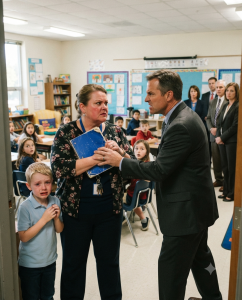
Mrs. Carter opened the classroom door and stepped inside.
Principal Lyle turned, irritation flashing across his face. “Mrs. Carter, we are in the middle of an important visit.”
“I can see that,” she replied.
She did not raise her voice.
Milo crossed the aisle, trembling. When he reached her, he held out the notebook.
“It’s all in there,” he whispered.
She set the papers on the nearest desk and took it carefully.
The first page contained dates.
The second contained names.
By the third page, Mrs. Carter’s stomach had turned cold.
Missing lunch money: September 14.
Threat behind the gym: September 21.
Pushed into locker: October 3.
Called names in cafeteria. Teacher nearby. Did nothing.
Project knocked to floor. They laughed.
Told Mr. Harris. He said maybe I misunderstood.
Told office secretary. She said write it down.
Told principal. He said not to make accusations without proof.
Then, smaller, squeezed into the margin as if Milo had been trying to take up as little room as possible even on paper:
They said Gavin’s father helps the school a lot.
They said donor week is not the time for this.
They know.
Mrs. Carter turned the page.
The entries continued. More dates. More details. More names. Gavin Mercer and Tyler Bell, two boys from influential families. Notes about lunch trays being taken. A hoodie disappearing. A threat whispered behind the gym: Keep talking and it gets worse. One line was underlined three times.
I stopped eating in the cafeteria because they take food from my tray.
Then another:
Mr. Harris told me to toughen up.
By the time she reached the back pages, there were names of other students too. A girl whose lunch account had been emptied after someone stole her number. Another boy who had his shoes hidden during P.E. Repeated mentions of adults who had looked away, dismissed complaints, or promised to “circle back.”
No one had circled back.
“Give me that,” Principal Lyle said.
His voice cracked just slightly.
Mrs. Carter looked up.
He had one hand out, palm open, his expression tight with something far uglier than anger: panic.
“That is a student matter,” he said. “I’ll handle it.”
Mrs. Carter closed the notebook and held it against her chest.
“No,” she said. “You already had your chance.”
The silence afterward felt enormous.
A gray-haired board member, Margaret Hensley, stepped forward first. She was known around the district for being difficult in the best way: she asked specific questions and did not enjoy polished nonsense.
“Principal Lyle,” she said, “why would this child write that reports were ignored?”
Lyle recovered quickly, or tried to. “We have no way of verifying any of this on the spot. This is obviously emotional, and I think for the student’s privacy—”
Milo made a strangled sound.
Mrs. Carter felt him behind her, hovering close, as if the room might swallow him the second she moved aside. She rested one hand lightly on his shoulder.
“He’s not emotional because he wrote it,” she said. “He’s emotional because he lived it.”
Another board member asked to see the notebook.
Lyle protested. Protocol. Process. Liability.
Margaret Hensley extended her hand. “Give it to me.”
For a second, Principal Lyle looked as if he might actually try to take it by force. Then he noticed the donors, the students, the teacher’s aide by the filing cabinet, the woman with the phone who was no longer taking pictures but listening.
He stepped back.
Mrs. Carter handed the notebook to Hensley.
What happened next began with one sentence from the back of the room.
“It happened to me too.”
A girl named Jessa raised her hand halfway, then let it fall. Her cheeks had gone red. “The lunch money thing,” she said. “Mine went missing twice.”
A boy near the windows muttered, “Everyone knows Gavin does that.”
Another said, “Tyler shoved Milo by the bleachers.”
The classroom cracked open.
Children who had been silent for months began speaking in uneven bursts. Not all at once. Not dramatically. But enough. Enough to end the fiction that this was one confused child with a notebook full of exaggerations. Mrs. Carter watched the adults’ faces change as the pattern became undeniable.
One donor removed his glasses and rubbed the bridge of his nose.
The teacher’s aide looked at the floor.
Principal Lyle kept saying, “Let’s not speculate,” but the room had moved beyond his control.
Within the hour, the board tour was over.
Parents were called in.
District administrators were notified.
And Margaret Hensley requested access to incident reports, disciplinary logs, and internal communication related to student safety complaints.
That was when the second layer of rot appeared.
There had been emails.
A lot of them.
Two parents had written directly to the office about Gavin Mercer’s behavior. Another had mentioned Tyler Bell taking money from younger students. A classroom teacher had documented “repeated reports of social targeting” and recommended intervention. A counselor had requested a meeting. One assistant principal had suggested separating certain students during lunch periods.
Nothing meaningful had followed.
Worse, buried in a thread sent three weeks earlier, someone had written: Let’s avoid escalation until after the donor gala. We don’t want unnecessary noise around major families right now.
Major families.
As though money made children less vulnerable and bullies more manageable.
By noon the front office was packed.
Parents arrived with alarm on their faces, then anger. A mother cried as her daughter admitted she had stopped eating lunch in the cafeteria because boys mocked her body and stole her dessert. One father demanded to know why no one had called him when his son reported harassment. Voices rose. Doors opened and shut. Staff moved too quickly with clipboards in hand, the choreography of crisis after months of neglect.
Through all of it, Milo stayed close to Mrs. Carter.
Not clutching her, not hiding. Just staying near. Like someone who had finally found a solid place to stand and was not yet willing to risk losing it.
She sat beside him in the counselor’s office while he repeated the details from the notebook. Each sentence came out rougher than the last. Each date was another proof that the adults who should have protected him had instead taught him to document his own suffering.
“You did exactly the right thing,” Mrs. Carter told him quietly when he faltered.
He stared at his hands. “I almost didn’t.”
That nearly broke her.
Because of course he almost didn’t. Children do not stay silent because they do not know something is wrong. They stay silent because experience teaches them the truth will cost them more than the lie.
Around three o’clock, as the school buzzed with controlled chaos, Margaret Hensley found Mrs. Carter in Room 214.
“May I speak with you?” she asked.
Milo was there too, gathering his books slowly.
Hensley did not waste time. “We found additional emails,” she said. “Complaints, reports, recommendations for intervention. Some from months ago. And one concerning donor optics.”
Mrs. Carter exhaled slowly.
Hensley studied her face. “When you were asked to stand outside this morning, did Principal Lyle say anything to you directly?”
“He didn’t have to.”
“What did you hear?”
Mrs. Carter glanced at Milo. Then she said it plainly.
“He told someone I was temporary and that you needed someone more polished for the donors.”
Hensley’s expression changed, but only slightly. Controlled anger. The dangerous kind.
At the far end of the hall, voices erupted again. A man was shouting. The words became clear as he moved closer.
“You knew? My son told your office twice!”
Gavin Mercer’s father had arrived, expensive suit, furious face, not yet aware that money might not save this one. Behind him came Tyler Bell’s mother, demanding details. Staff tried to contain the confrontation, but the building had passed the point where appearances could still be managed.
Principal Lyle emerged from the office looking wrung out and suddenly older. His hair was no longer perfect. His smile was gone entirely.
For one wild second, his eyes met Mrs. Carter’s.
She saw it then: not remorse. Not concern for Milo. Fear. Fear of exposure. Fear of consequences. Fear that the temporary woman he had hidden in the hallway had become the witness who could connect cruelty to image management in one straight line.
The board convened an emergency closed-door session that evening.
Parents waited in the corridor.
Teachers stood in uneasy clusters.
Milo sat with his mother, who had arrived white-faced and shaking, one arm around him so tightly it seemed she might never let go. She thanked Mrs. Carter through tears she could barely contain.
“I thought he was just withdrawing,” she whispered. “He kept saying it was handled.”
Mrs. Carter touched her arm. There was nothing useful to say to a mother learning how thoroughly her child had been failed.
At 6:40 p.m., the board emerged.
Principal Lyle was placed on immediate administrative leave pending formal investigation.
Mr. Harris, the teacher named repeatedly in the notebook, was removed from student contact until review.
The district announced an outside inquiry into bullying complaints, lunch theft reports, and staff response failures. They promised family meetings, safety audits, and direct reporting channels.
The promises should have come sooner. Everyone in that hallway knew it.
But for the first time all day, the power had shifted.
Not back to normal. Back to truth.
In the days that followed, more students came forward. Some had smaller stories; some had devastating ones. Not every claim was identical, but the pattern held. Favored families had received softer treatment. Certain behaviors had been minimized. Staff had been encouraged, subtly or explicitly, not to create “drama” around well-connected parents.
Mrs. Carter was asked to remain through the end of the term.
Then the district asked if she would consider something more permanent.
The irony was almost laughable.
The woman who had been told to stand out of sight was now the one families requested by name.
But what mattered most to her was smaller and more important.
Two weeks later, during lunch duty, Milo walked into the cafeteria carrying his tray without checking over his shoulder first. He still looked wary. Healing was not magic. But he sat down with two classmates from Room 214, and no one touched his food.
Mrs. Carter watched from the doorway.
Milo looked up once and saw her.
He didn’t smile widely. That wasn’t who he was. But he gave the smallest nod, the kind that says: I know you’re there.
And she nodded back.
The scandal moved beyond the school after that. Local reporters called. Parents demanded policy changes. Board meetings filled. Some people defended Principal Lyle at first, insisting he had been under pressure, that schools were complicated, that one notebook should not define a career.
But one notebook had not done this.
Neglect had done this.
Cowardice had done this.
The instinct to protect money before children had done this.
Months later, when the investigation report was released, it confirmed what the students had been saying all along: repeated complaints had been mishandled, bullying incidents had not been documented properly, and administrative choices had prioritized reputation over intervention.
There were resignations.
There were policy overhauls.
There was training, oversight, and a new principal who stopped pretending that optics and safety could coexist when one required silence.
People in town kept repeating the same line when they talked about how it all came out.
It started with that substitute teacher.
Mrs. Carter never loved hearing that. It hadn’t started with her. It had started with children trying, again and again, to tell the truth. All she had really done was refuse to step aside when the truth finally reached the doorway.
Still, she understood why people said it.
Because institutions often look invincible until the wrong person hears the right sentence at the right moment and decides not to obey it.
For years, Mrs. Carter had been called temporary as if it were a verdict.
Now she understood it differently.
Temporary was what that school’s polished lies had been.
Temporary was Principal Lyle’s smile beside donors.
Temporary was the comfort of adults who thought silence could be managed forever.
What lasted was something else entirely: a frightened boy standing up on shaking legs, a notebook full of dates no one wanted to read, and one woman in a hallway deciding she would not be hidden any longer.
And that is the part that stayed with people.
Not just the exposure. Not just the scandal.
The question underneath it.
How many times had Milo tried to tell the truth before the right adult finally listened?
How many children had learned to whisper because the people in charge were too busy performing care to practice it?
And when the moment comes—when the room goes silent, when the smiling people in power ask you to wait outside, when the easiest thing in the world is to stay quiet—who do you become then?
The principal had called her temporary.
He was right about only one thing.
She was never meant to stay in the hallway.