When Claire first saw the marks on Daniel’s back, she knew two things instantly.
The first was that they were not a rash.
The second was that whatever was happening inside her marriage had just turned into something far more dangerous than humiliation.
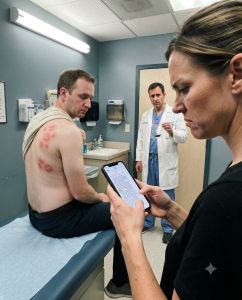
The spots were too deliberate. Three circular clusters sat across the upper half of Daniel’s back, each ringed in angry red and crowded with tiny puncture marks so evenly arranged that they looked almost designed. Not random irritation. Not hives. Not anything she had ever seen from detergent, dust, or stress.
Daniel caught her staring in the mirror and jerked his shirt down in one quick, clumsy motion.
“It’s nothing,” he said. “You switched detergents. That’s probably all it is.”
Claire didn’t answer. She stood in the bathroom with one hand resting on the marble counter and watched him avoid his own reflection.
For twelve years, she had lived inside Daniel’s language. He didn’t shout often. He didn’t need to. He preferred smaller, cleaner cuts. If something went wrong, it was always because Claire had misunderstood, misplaced, overreacted, forgotten, failed. He could turn any problem into evidence against her in under a minute.
And if she argued, he smiled the way people smile at difficult children.
Their house helped him keep that power. It was huge, old, and expensive, perched behind iron gates and carefully pruned hedges, but Daniel loved reminding Claire that it wasn’t hers. In truth, it wasn’t even his. The property sat in a family trust overseen by his mother’s attorneys. Daniel still acted like a king in it.
“Remember,” he liked to say when he was angry, “you live here because I let you.”
His sister Vanessa was worse in a louder, more polished way. Vanessa wore wealth like armor and cruelty like perfume. She dropped by without warning, crossed into rooms as though every door opened for her, and found endless entertainment in mocking Claire.
“There she is,” Vanessa would say, catching Claire with receipts or account statements at the kitchen island. “The little accountant. Save us all with your calculator.”
Daniel always laughed.
What neither of them respected, however, was that Claire had once been very, very good at her work.
Before she married Daniel, before her father died and grief pushed her out of a career she had loved, Claire spent seven years as a forensic accountant working with state prosecutors. She knew how fraud moved. She knew what panic looked like in numbers. She knew the habits of people who thought intelligence meant never being questioned.
Patterns gave them away every time.
And lately Daniel had become impossible not to read.
There were the cash withdrawals, all of them structured just below reportable thresholds. The unexplained late-night drives. The calls from Vanessa that cut off the instant Claire entered the room. The strange protectiveness around his study. The newer lock on the basement door. The sudden interest in paperwork she had never before been allowed to see.
Then, two weeks before the marks appeared, Claire found a receipt in Daniel’s coat pocket while checking for a dry-cleaning slip. It was from a veterinary supply company. Imported tropical insects. Controlled colony. Special handling instructions.
She had stood in the mudroom reading it while the dryer hummed behind her.
Daniel came home ten minutes later to find her making coffee.
She said nothing.
That was what he never understood about her silence. He thought it was surrender. He thought she had become too small to resist him.
In reality, silence was where she did her best work.
That night she photographed the receipt and uploaded it to an encrypted storage folder she kept under a name Daniel would never guess. Over the next several days she added more: screenshots of account discrepancies, photos of ledger pages, timestamps of Daniel’s drives, notes about Vanessa’s visits, a voice memo recorded by accident when Daniel pocket-dialed her during an argument with his sister. Most of it was fragmentary. None of it made complete sense.
But together, it pulsed with intent.
Then Daniel woke up sick.
He said he was freezing and sweating at the same time. He snapped when Claire opened the curtains. By breakfast he looked pale and unsteady. When he reached for a mug, his hand trembled enough to spill coffee over the counter.
“Doctor,” Claire said.
“I’m fine.”
“You have a fever.”
“It’s a virus.”
“You have something on your back.”
He swore at her for overreacting. She told him to save his strength for the car. There was enough steel in her voice that he actually listened.
The drive to urgent care was miserable. Daniel spent most of it criticizing her. Traffic was too slow because she chose the wrong route. The air conditioning was too cold. The clinic she picked was incompetent. She gripped the wheel and let him talk.
She had long since learned that people often reveal the most when they believe they are still in control.
Dr. Patel was a calm, middle-aged physician with soft eyes and efficient hands. He asked basic questions first—duration, fever, travel, allergies, medications. Daniel lied easily until the doctor asked to examine the marks.
The moment the shirt came off, the room changed.
Dr. Patel leaned in. His brows drew together. He put on magnifying loupes from a drawer and studied the pattern in silence for several more seconds than comfort allowed. Then he stepped back, crossed the room, and locked the door.
Daniel sat up. “What are you doing?”
Dr. Patel looked at Claire instead.
“Mrs. Cole,” he said quietly, “I need you to take your belongings and be prepared not to return home.”
The words landed with eerie precision. Claire felt fear rise in her chest, but it did not scatter her. It sharpened her.
Daniel swung his legs off the table. “This is ridiculous.”
Dr. Patel ignored him. “These marks are consistent with triatomine feeding,” he said. “Kissing bugs. But this pattern is not natural exposure. The spacing is controlled. Pressure was applied.”
Claire stared. “Meaning?”
“Meaning someone likely held the insects in place against the skin.”
Even Daniel stopped pretending then.
Dr. Patel lifted a small sealed pouch from a tray. Inside was a dark, flat-bodied insect.
“We found this trapped beneath the waistband of his pants,” he said. “It has veterinary marking dye on the abdomen. This came from a monitored colony.”
Daniel looked genuinely sick now, though it was no longer clear whether the fever was the worst of it.
“That proves nothing,” he said.
“It proves this was engineered,” Dr. Patel replied.
Claire turned to him fully. “Who owns a colony like that, Daniel?”
He opened his mouth, then lunged for his phone on the counter.
Claire moved before he did. Her old work had trained her to read the first inch of panic in a person’s body. She snatched the phone first. The screen lit under her thumb.
A text banner from Vanessa appeared before the phone could lock.
DID SHE TOUCH THE SAFE YET? WE NEED HER PRINTS BEFORE TONIGHT.
The room went utterly still.
Claire read the message twice. Her mind did not race. It clicked. Item by item, piece by piece.
The fake concern over family documents.
Vanessa’s recent questions about where Claire kept personal records.
Daniel asking her to “help” with the office safe after dinner.
The structured cash withdrawals.
The basement.
The insects.
Her fingerprints.
Dr. Patel lowered his voice. “You need to call the police right now.”
Claire nodded, but first she did what Daniel would never have expected. She documented. Photo of the message. Forward to secure account. Upload to encrypted folder. Message copy to a second release address. Then she called 911.
Daniel’s entire face had changed. The smugness she knew so well was gone. In its place sat raw fear—not fear for Claire, not fear of being falsely accused, but fear that the narrative had slipped beyond his control.
He had spent twelve years making her feel forgettable.
Now he was looking at her like she was dangerous.
The officers arrived before Vanessa could. Two uniformed officers took statements while a third remained by the exam room door. Daniel tried several strategies in under ten minutes: confusion, outrage, charm, indignation, vague concern for Claire’s “mental state.” None of them gained traction once Dr. Patel described the injuries and produced the specimen pouch.
Then an officer asked a simple question.
“Is there anywhere in the home you believe may contain evidence related to this?”
Daniel answered too quickly. “No.”
Claire didn’t even glance at him. “The basement.”
One officer asked if there was a key. Daniel hesitated.
It was a tiny pause, less than a second. But guilt lives in timing as much as language. Claire saw the hesitation and knew.
He was protecting that door.
Police accompanied them back to the house. By then the afternoon light had turned watery and cold, flattening the elegant front rooms into something theatrical. Everything looked too arranged. Too practiced. As though the house itself had spent years helping Daniel maintain a polished lie.
The basement door stood at the end of a back hallway near the laundry room. Claire had walked past it a thousand times. Recently, Daniel had installed a heavier deadbolt, claiming moisture was damaging old furnishings in storage.
An officer inserted the key from Daniel’s ring.
The lock clicked.
The door opened only a few inches before a chemical, sour smell slipped through the gap.
Not mildew.
Not dust.
Not old furniture.
Something biological and managed.
The beam of a flashlight cut through the darkness first, then a second beam joined it, sweeping across plastic sheeting, metal shelving, insulated containers, and a long worktable with restraints bolted to both sides.
Claire stopped breathing.
A black case lay open on the table, lined with dense foam and fitted with small ventilated compartments. Beside it stood labeled vials, temperature logs, feeding schedules, printed care instructions, specimen notes. This wasn’t experimentation in the chaotic sense. It was methodical.
One of the officers swore under his breath.
Pinned to the far wall were file folders, photographs, copies of identification, signatures clipped from old documents, life insurance records, trust language, probate notes, and medical printouts. In the center of the board hung a photograph of Claire asleep in her own bed, taken from the doorway. Red circles had been drawn across her shoulder and neck in marker.
There was a calendar beneath it.
Several dates were crossed out.
Tonight’s date was boxed.
A female officer guided Claire backward. “Stay outside this room, ma’am.”
But Claire’s eyes had already locked on a tabbed folder with her name on it.
An evidence technician opened it on the upstairs dining table while officers continued photographing the basement. Inside were articles on Chagas disease and parasitic exposure, symptom progression charts, notes about fatigue, fever, swelling, cardiac complications, delayed diagnosis. Some pages had handwritten annotations in Vanessa’s narrow script.
One line was underlined twice.
She must seem unstable first.
The sentence hollowed the room.
Claire sat down slowly in a dining chair she had never liked and suddenly understood the last six months all at once. The misplaced documents. Daniel insisting she had forgotten conversations that never happened. Medication bottles moved by inches. Her laptop briefly missing, then found in the wrong room. Vanessa making performative comments in front of friends about Claire seeming “tired lately” and “not quite herself.”
They had not only been planning to use her fingerprints.
They had been building a story about her.
A story in which Claire became unreliable, confused, medically compromised, perhaps even delusional. A story in which Daniel, the patient husband, had to assume control for her own good. Depending on what the safe held, or what documents they meant to access, they could have turned illness into incapacity and incapacity into legal disappearance.
The second safe was found behind shelving in the basement, bolted low into concrete and masked by contractor plastic. Unlike the elegant safe in Daniel’s office, this one looked industrial and old. A locksmith from the department was called in. Daniel refused to provide the code. He was arrested before sunset.
Vanessa arrived while they were still processing the scene.
She came through the front door indignant and overdressed, carrying outrage like a handbag. “What is going on in this house?”
When she saw the police, she froze. When she saw Daniel in handcuffs through the formal sitting room doorway, her expression changed too late to hide.
They detained her in the foyer.
Claire watched from the staircase.
For one irrational second, Vanessa’s eyes went not to her brother, but toward the hallway leading to the basement.
Not concern.
Inventory.
That look gave her away almost as much as the text had.
The second safe opened just after dark.
Inside were passports, cash, notarized draft documents, counterfeit signature sheets, a small packet of sedatives, and a sealed envelope labeled for transfer upon incapacity. There were also revised trust documents that would, if accepted as valid, shift authority over certain family-controlled assets once Claire was deemed unable to manage her own affairs. Some forms bore spaces clearly intended for her signature. Others had already been practiced repeatedly on tracing sheets clipped underneath.
More disturbing still was a typed contingency memo.
If illness escalates unpredictably, proceed with competency petition. Use prior observations. Coordinate timeline with Dr. S. Mention confusion, agitation, memory lapses.
Vanessa had added handwritten notes in the margin:
After fingerprints, move jewelry.
Empty secondary account.
Check camera logs.
It was not only financial. It was reputational, legal, and biological all at once. They had built layers so that if one route failed, another might hold. If Claire became ill, Daniel could present himself as guardian. If she fought back, they could point to her supposed instability. If she died, the paperwork would already be waiting in the wings.
The insects were one instrument in a larger orchestra of control.
When detectives searched Daniel’s office upstairs, they found more evidence: shredded drafts of letters, a burner phone, hidden account ledgers, and correspondence with a private document preparer willing to “streamline” urgent incapacity filings. In a locked drawer sat Claire’s old passport, which she had thought she lost years ago.
By midnight, both Daniel and Vanessa had been taken for questioning.
Claire did not sleep.
She sat at the kitchen island while crime scene lights flashed silently beyond the windows, throwing alternating blue and white across the polished cabinets. The same island where Vanessa had mocked her. The same room where Daniel had smiled while calling her paranoid.
Dr. Patel called once to check on her and to confirm that specialists would evaluate any possible exposure risk immediately. His caution probably saved her life. Another few days, another orchestrated “accident,” and Claire might have been too sick or too disoriented to piece anything together quickly.
Over the next week, more facts emerged.
The cash withdrawals had funded off-book purchases and quiet payments tied to document handling and exotic specimen supply. Vanessa had been pushing Daniel to accelerate everything because a pending trust review threatened to expose irregularities in family finances. Claire’s background made her useful at first—they had relied on her to organize records without realizing she could spot manipulation. Once Daniel suspected she was noticing discrepancies, the plan changed. Rather than keep mocking her, they would discredit her.
Investigators also discovered that the photo of Claire asleep was not the only surveillance image. There were dozens. In bed. At her desk. Entering the pantry. Reaching into the medicine cabinet. Sitting outside in the garden. Time-stamped. Cataloged.
Watched.
The knowledge of it made her skin crawl more than the insects had.
Legally, the case became larger than Claire’s marriage. Fraud, conspiracy, unlawful possession of biological vectors, attempted coercive control related to financial instruments, evidence tampering, and additional charges connected to forged documents. Prosecutors moved quickly once the basement inventory was processed. Claire’s own old experience helped her understand the pace. She knew what strong evidence looked like. She knew when the machinery of a case had enough weight behind it to keep moving.
What she did not expect was how grief would arrive beside relief.
People imagine that exposing evil feels like triumph. Sometimes it does, for a moment. But often it feels like standing in the wreckage of a place you spent years trying to call home. Daniel had not become a monster overnight. The truth was worse. He had likely always been building toward this in small permissions granted to himself, small acts of contempt, small experiments in power. Vanessa hadn’t invented his cruelty. She sharpened it.
Claire moved out before the forensic teams finished with the house. The trust froze access during the investigation. She rented a small furnished apartment with plain windows and weak coffee and slept there with lights on for the first three nights. Friends she had drifted from began returning her calls the moment they understood what had happened. One former colleague from the prosecutor’s office helped her find an attorney. Another reminded her, with tears in her voice, that noticing patterns had once been Claire’s superpower.
It still was.
Months later, when the criminal filings were public and the first hearing dates were set, Claire was asked more than once whether she had missed signs or ignored them out of fear.
She answered honestly.
No, she had not missed them.
She had survived them while gathering proof.
That distinction mattered.
Daniel eventually tried a final strategy through his lawyer: remorse. Stress. Family pressure. Misunderstood research. Bad decisions spiraling too far. Vanessa tried distance, suggesting her texts were taken out of context and that she had never believed Daniel would truly go through with anything.
The evidence answered for both of them.
The basement logs. The safe contents. The medical documents. The surveillance photos. The practiced signatures. The typed contingency memo. The message about needing Claire’s fingerprints before nightfall.
All of it told a coherent story.
The kind Claire used to build for prosecutors.
The kind juries understand.
The night before the preliminary hearing, Claire opened the encrypted folder she had been adding to from the beginning. She scrolled through the first photo—the veterinary receipt in Daniel’s coat pocket. Such a small thing. Such an easy thing to dismiss. A scrap of paper most people would forget within an hour.
But patterns begin in scraps.
She closed the file and sat by the apartment window, looking down at the streetlights smearing gold across wet pavement. For the first time in years, the silence around her wasn’t oppressive. It was clean.
What stayed with her most was not the bugs or even the basement. It was the sentence underlined in Vanessa’s handwriting.
She must seem unstable first.
That was the heart of it. Not just greed. Not just theft. Erasure. The plan had depended on making Claire doubt herself before anyone else did. Making her smaller, foggier, easier to narrate over.
That was the real red flag, in the end—the long campaign to define her reality for her.
And once you see that kind of cruelty clearly, one question never quite leaves you:
What kind of person plans your collapse first and only then decides what to steal from the ruins?