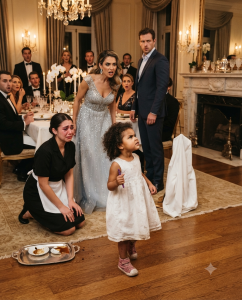
The billionaire’s fiancée humiliated the housekeeper in front of forty guests, but she never expected the smallest person in the room to bring the entire evening crashing down.
By the end of the night, the engagement dinner was no longer about white orchids, crystal glasses, or the diamond on Renata Luján’s finger. It was about a truth too many people had ignored for too long.
Mariana Delgado had learned how to become invisible without actually disappearing.
At twenty-seven, she moved through Santiago Arriaga’s mansion with the precision of someone who knew that if she did her job perfectly, people would barely notice she existed. That was the standard in houses like his. Efficiency without presence. Warmth without familiarity. Total reliability with no room for personal need.
The mansion stood in one of the wealthiest parts of Mexico City, all glass, pale stone, and impossible symmetry. The gardens looked sculpted rather than grown. There were reflecting pools that mirrored the sky. Security at the gates. Drivers on standby. Staff entrances designed so service could appear seamless, almost magical, to the people who lived there.
Mariana saw the machinery behind that illusion every day.
She woke before dawn to start the coffee and review the household schedule. Florists, cleaners, kitchen deliveries, laundry, table settings, guest arrangements, dry cleaning, endless details stacked on top of one another until night fell. She knew where every serving tray belonged, how Santiago liked his shirts organized, which business associates preferred silence and which wanted conversation, which flowers triggered Doña Leonor’s allergies, and how to make a mansion feel effortless for the people who had never once had to effort anything themselves.
Her daughter Lucía lived with her in a small cottage at the back of the property, thanks only to the kindness of Doña Leonor, Santiago’s mother.
When Leonor hired Mariana almost two years earlier, she had seen both competence and desperation in the young woman’s eyes. Mariana had recently left an unstable living situation and needed work that came with housing. She never gave the full story, and Leonor never forced it from her. She had simply said, “The child stays with you. No one separates a mother from her daughter for the convenience of a household.”
Mariana never forgot that.
Lucía was three years old, with black curls that never stayed tamed and a habit of staring at adults until they became uncomfortable. She had the solemn alertness of a child who had grown up listening more than speaking. She noticed when her mother’s smile was forced. She noticed when the cook slipped Mariana a sweet roll because she had skipped breakfast. She noticed when tension entered a room before anyone said a word.
She also noticed that Santiago Arriaga was not the same as the others.
Santiago was thirty-five, successful enough that people used his name with admiration and caution. Real estate. Technology. Investments. He lived inside endless momentum. Meetings. Calls. Flights. Events. The kind of life where everyone wanted something and almost nobody told him the full truth. He wasn’t a warm man, but he wasn’t unkind. He thanked staff when he remembered. He never shouted. He often seemed tired in a way money could not solve.
To Mariana, he was her employer, nothing more.
To Lucía, he was the man who sometimes paused by the koi pond when she was counting fish.
“There are six,” he had once said absentmindedly while looking at his phone.
“There are seven,” Lucía corrected.
He looked up, counted again, and smiled. “You’re right.”
After that, he occasionally asked her, “How many today?”
She took the role seriously. So seriously, in fact, that the gardener joked Lucía knew more about the pond than anyone.
For a while, life in the house settled into a manageable rhythm.
Then Renata Luján entered it, and the balance shattered.
Renata was beautiful in the polished, studied way of women who had always known they were being watched. She came from an old, wealthy family in Guadalajara, wore refinement like armor, and spoke with the confidence of someone who had rarely been contradicted. When she and Santiago announced their engagement, the news spread quickly through society pages. Her ring became a talking point. Her dresses began appearing in lifestyle magazines. Together they looked perfect on paper.
Inside the house, perfection rotted fast.
The first sign had been small. Renata visited one afternoon, glanced at Mariana’s shoes, and said, “You shouldn’t wear those when receiving guests.”
No greeting. No thank you. Just correction.
Mariana had murmured, “Yes, ma’am,” and moved on.
Then came the notes. Left in the kitchen. On counters. Folded beside serving pieces.
The forks are arranged incorrectly.
The flowers in the entryway looked cheap.
That cloth should not be used for glassware.
Learn.
Mariana said nothing.
When Renata began spending more time at the mansion, the insults became more direct. She stopped using Mariana’s name. She referred to her as “the girl,” “the maid,” or, when she was particularly irritated, nothing at all, just a snap of fingers and an expectation.
The worst part was the performance. Whenever Santiago was nearby, Renata’s voice softened. She smiled. She thanked staff with airy graciousness. She touched his arm while speaking, as if tenderness came naturally to her. The moment he left the room, the mask dropped.
Lucía saw the difference before anyone else said it aloud.
One afternoon she whispered to her mother from under the kitchen table, “She has two faces.”
Mariana nearly dropped the dish towel in her hand.
“Hush,” she said, too quickly.
But the child wasn’t wrong.
Doña Leonor began noticing tension as well. She caught Mariana flinching once when Renata’s heels clicked down the hallway. She found Lucía quiet in a corner on a day when the little girl was usually talkative. Twice she asked Mariana if something was wrong. Twice Mariana smiled and said everything was fine.
She didn’t tell the truth because truth can cost people their jobs.
And jobs, for women like Mariana, were often the thin line between safety and catastrophe.
The engagement dinner was meant to be the social event of the month.
Renata planned every detail herself. White orchids flown in from a specialty supplier. A string quartet placed on the terrace. Monogrammed place cards. Imported wine. A private chef. Forty guests selected with strategic precision: investors, politicians, family members, friends who mattered, friends who thought they mattered, and a handful of people there simply because wealthy circles feed on spectators.
Mariana had worked from before sunrise.
She oversaw flower deliveries, checked table settings three times, coordinated timing with the chef, managed replacement glassware, adjusted seating after a last-minute RSVP, and fixed a problem with the lighting in the courtyard before anyone important noticed. By late afternoon, her feet ached so badly she had to pause in the pantry and press one hand against the shelves until the dizziness passed.
Lucía was supposed to stay with a neighbor that evening, but an emergency changed those plans. There was no one else available. No family nearby. No time to arrange anything. So Mariana brought her into the service area and settled her near the kitchen entrance with crayons and a notebook.
“Just stay here quietly, okay, my love?”
Lucía nodded. “I’ll be good.”
“I know.”
By evening, the mansion glowed.
Guests arrived in waves, trailing expensive perfume, polished shoes, and carefully measured laughter. Servers moved in silence. The quartet played softly. Renata floated through the room in a pale blue dress that fit her like a statement. Santiago looked composed, if distracted. Doña Leonor watched more than she spoke.
Mariana kept everything moving.
Appetizers, wine service, coordination with the kitchen, timing, pacing, refills, courses. She crossed the rooms with trays balanced steadily in her hands, anticipating needs before they were voiced. No one complimented that kind of labor because in spaces like this, invisible work is considered the natural order of things.
Dinner ended beautifully.
Which, as Mariana would later think, was probably why Renata chose that moment to be cruel. Public perfection creates the best stage for private character.
When coffee service began, everyone expected a toast.
Mariana entered the dining room carrying a silver tray lined with delicate cups. She had passed that rug countless times. But exhaustion changes everything. One heel caught the edge. Her body jerked. She tried to compensate, but the tray tipped.
A cup slid free.
Hot coffee splashed across the front of Renata’s pale blue dress.
For one heartbeat, the entire room was held inside accident.
Then came humiliation.
Mariana dropped to her knees instantly.
“I’m so sorry, ma’am. I’m so sorry. I’ll clean it—”
Renata shoved back her chair and stood.
“Are you insane?” she snapped. “Do you know how much this dress costs?”
Every conversation died.
Mariana reached for a napkin with trembling fingers. “I’ll pay for cleaning. I promise, I—”
Renata laughed.
“You?” she said. “With what? Your maid’s salary?”
The cruelty of it hit harder because it was deliberate. She didn’t want the stain fixed. She wanted an audience.
Around the table, guests looked away with the cowardice of people who like to think silence makes them innocent. One woman adjusted her bracelet. A man stared into his wine as if trapped inside a difficult thought. Nobody moved.
Santiago rose slowly. “Renata, it was an accident.”
But Renata had tasted the power of the moment.
“No, Santiago. It’s exactly what I’ve been saying. This house has become a charity. The employee living on the property, her child running around, everyone pretending they belong here.”
Mariana froze.
It was one thing to be insulted. Another thing entirely to hear her daughter spoken of like contamination.
Still kneeling, face burning, she felt every buried humiliation of the past months collide inside her chest. She wanted to disappear. She wanted to scream. She wanted to shield Lucía from hearing another word.
Then Renata pointed toward the side table where the child’s notebook and crayons lay visible.
“After the wedding,” she said, “this ends. A house like this needs staff who understand their place.”
The sentence landed like a slap.
Mariana looked instinctively toward the kitchen entrance.
Lucía was standing.
No one had noticed her rise from the chair. Maybe they hadn’t really seen her before at all. But now she stepped into the dining room slowly, purple crayon still in hand, her little face set with unusual seriousness. The string quartet had gone silent. One of the servers near the wall covered her mouth.
Lucía walked past the guests and stopped in front of Renata.
She was tiny next to her.
“My mommy works very hard,” Lucía said clearly. “She is not trash.”
The words echoed harder than any adult voice could have.
Renata stared down at her, stunned not because of the accusation, but because children are not supposed to interrupt power. They are not supposed to refuse it. They are not supposed to expose it.
Lucía held her gaze.
“You are mean,” she said. “And a pretty dress does not hide mean.”
Silence crashed over the room.
Mariana’s eyes flooded. Her shame cracked apart under something fiercer. Love. Pain. Pride so sudden it almost hurt.
Then Lucía turned and held out her hand.
“Mama, get up. You did nothing bad.”
That was the moment the room changed.
Not because a child had spoken.
Because everyone knew she was right.
Doña Leonor appeared in the doorway then, drawn by the silence. She took in the stained dress, Mariana on the floor, Lucía standing guard, and Renata’s expression hard with offended superiority. Leonor’s own face changed instantly.
“Get Mariana off the floor,” she said, looking directly at Santiago.
He obeyed without argument.
When he helped Mariana to her feet, Renata scoffed. “This is ridiculous. We’re letting a child create a spectacle.”
“No,” Leonor said with icy calm. “You created the spectacle. The child told the truth.”
A murmur passed among the guests.
Renata folded her arms. “I was the one humiliated.”
“You were splashed with coffee,” Leonor replied. “Mariana was degraded.”
Santiago looked from one woman to the other, then at Lucía, who had wrapped both arms around her mother’s leg. His expression tightened in a way Mariana had never seen before. It wasn’t simple anger. It was the dawning horror of a man realizing he had failed to see what had been happening in his own home.
“How long?” he asked quietly.
Renata frowned. “What?”
“How long have you been treating her like this when I wasn’t there?”
A few guests shifted in their seats.
Renata laughed once, too sharply. “Santiago, don’t be dramatic. She spilled coffee on me in front of everyone.”
“That wasn’t my question.”
His voice was still low, but the room felt colder.
Renata looked around for support and found none. Some guests avoided her eyes now. Others were studying her with fresh suspicion. The older investor near the end of the table cleared his throat and said, “I’ve heard you speak to staff this way before, actually.”
Renata turned toward him in disbelief.
Another woman, one of Leonor’s old friends, added carefully, “At the charity luncheon last month too.”
That broke something open.
Not loud. Not chaotic. Worse.
Measured truth, one voice at a time.
The valet she had reduced to tears. The caterer she insulted at a private event. The assistant she called stupid over a seating card. Nothing enormous alone. But together it formed a pattern so ugly it could no longer be brushed aside as stress or bad timing.
Renata’s face drained.
“Santiago, are you really going to entertain this?” she demanded.
He looked at Mariana instead.
And that, more than anything, unsettled Renata.
Mariana stood rigid, one hand on Lucía’s shoulder, still shaken, still unsure whether she was dreaming. Nobody ever chose the worker’s version of events in rooms like this. Nobody ever asked what humiliation felt like from below.
“I should have told someone,” she said softly to Leonor, then to Santiago. “I didn’t because I needed the work.”
The honesty of it was devastating.
Leonor took a slow breath. “You should never have had to choose between dignity and security in this house.”
Renata scoffed, but now the sound was brittle. “So what now? We’re all pretending she’s family?”
Lucía answered before anyone else could.
“She’s my family.”
The line broke the last of the room’s restraint. Several guests lowered their heads, embarrassed on Renata’s behalf. One woman quietly stood and walked out to the terrace. Another whispered, “God.”
Santiago’s face closed.
“No,” he said. “What we’re not pretending is that cruelty is elegance.”
Renata stared at him.
He reached slowly toward his pocket, not for a ring box, not for a handkerchief, but for his phone. He silenced it, set it on the table, and gave her his full attention in a way he apparently had not done in weeks.
“I asked you once,” he said, “what kind of home you wanted us to build together.”
Renata’s mouth parted, but no words came.
“You said one with standards.”
He glanced at Mariana. At Lucía. At his mother. At the guests still sitting in horrified silence.
“I didn’t realize you meant one without humanity.”
“Don’t do this here,” Renata hissed.
But Santiago had already made his decision.
“I think this is exactly where it should happen.”
He removed his engagement ring and placed it beside the untouched coffee cup nearest him.
No one moved.
No one dared.
Renata went white.
“You’re ending this because of a maid?” she whispered.
Santiago’s reply was immediate.
“No. I’m ending this because of who you chose to be when you thought someone beneath you couldn’t answer back.”
Renata laughed again, but it broke in the middle. “You can’t be serious.”
Doña Leonor finally stepped closer, her voice quiet and final. “Leave with whatever dignity you still have.”
Renata looked at the room, expecting rescue. She found witnesses. That was all.
She turned sharply, snatched her clutch from the table, and walked toward the foyer with as much grace as panic allowed. Halfway there, she stopped, as if waiting for Santiago to call after her.
He didn’t.
The front doors closed behind her moments later.
The mansion remained silent even after she was gone.
Then the quartet, uncertain, set their instruments down completely. One by one, guests stood. Some approached Mariana to apologize, their shame obvious now that it cost less to show it. Some slipped away without speaking, unable to face what their silence had revealed about them.
Mariana accepted none of it too easily.
An apology after public cruelty doesn’t erase the bruise. It only proves people knew better all along.
Later, after most of the guests had left and the ruined evening lay in pieces across half-cleared tables and wilting orchids, Santiago found Mariana in the kitchen helping Lucía wash purple crayon from her fingers.
Lucía looked up at him first.
“Are you mad?” she asked.
He crouched slightly, meeting her eyes. “No,” he said. “I think you were the bravest person in the house tonight.”
She considered that, then nodded like someone accepting a fact she already suspected.
Santiago turned to Mariana. “I’m sorry.”
It was not polished. Not strategic. Not enough to fix everything. But it was real.
“I should have seen it,” he said.
Mariana looked at him for a long moment before answering. “You should have.”
He accepted that too.
Doña Leonor later insisted that Mariana take the next day off. Then the next two. She also made it clear, in front of the entire staff, that nobody in that house would ever again be made to feel lesser for the work they did. Policies changed after that. Quietly, but permanently. Not because billionaires become saints overnight, but because shame, when it finally reaches the right people, can force change money never volunteered on its own.
As for Renata, society pages never printed the real reason the engagement ended.
They said schedules had conflicted. Priorities had shifted. The couple wanted different things.
That was true, in the most brutal sense.
One wanted appearances. The other, perhaps for the first time in a long while, recognized character.
Mariana stayed on for a while longer, though never in quite the same way. Once someone has been forced into the center of the room, invisibility no longer fits. She walked differently after that night. Not arrogantly. Just upright.
Lucía kept counting the koi fish.
Seven, always seven.
And every now and then, when someone new joined the household staff and asked quietly whether it was true that a little girl had once spoken back to a woman who thought she owned the world, the answer came with the same small smile.
Yes.
That part was true.
What lingered long after the broken engagement, the whispers, and the polished explanations was not the scandal itself, but the question it left behind.
How many adults at that table had known exactly what was happening and said nothing until a child made silence impossible?
Maybe that was the ugliest part of all.
Not Renata’s cruelty, obvious and cold.
But how easy it had been for everyone else to dress cowardice as manners… until a three-year-old, holding a purple crayon, stood in the middle of a glittering room and showed them what dignity actually looked like.