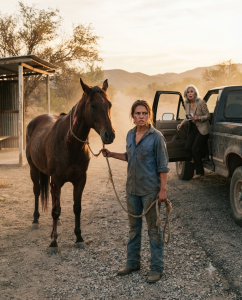
By the time Mariana Sánchez was fired from Rancho Los Mezquites, the men had already decided what kind of story she was supposed to become.
She was supposed to be the soft woman who could not handle real ranch work. The stubborn one who got too attached to broken animals. The fool who thought gentleness mattered more than force. By sunset, they expected she would be gone with a cheap severance envelope, nowhere to sleep, and enough shame to keep her from ever coming back.
Instead, she walked out with the one horse they had already marked for slaughter.
Later, that would be the choice everyone remembered.
It happened under the punishing Sonora sun, with heat pressing down over the ranch yard until even the boards of the corrals smelled baked and bitter. Don Esteban Bojórquez stood behind his desk in the ranch office, clean boots, crisp shirt, heavy watch glinting in the light. He did not need to raise his voice. Men like him built entire lives on the certainty that others would lower theirs.
“You’re too soft, Mariana.”
The words landed harder because he said them like a settled fact.
Mariana stood straight, hands rough with old calluses, jaw tight enough to ache. For three years she had been the first one up and one of the last to rest. She had tended mares through difficult births, repaired fences in summer heat, hauled feed sacks until her shoulders burned, cleaned infected cuts, soothed panicked foals, and done half of it while listening to jokes about how a woman should be grateful just to be allowed onto serious ranch land.
“I’m not soft,” she said. “I know how to work with animals without breaking them.”
Roque Salvatierra, the foreman, leaned against the doorway with a crooked smile that always looked one step from cruelty. He enjoyed these moments. The ranch owner’s judgment gave him permission to become louder, meaner, more inventive in his humiliation.
“What you call caring,” Roque said, “we call getting in the way. That chestnut stallion nearly took a man’s hand off, and you still talk to him like he’s a child.”
Mariana looked past him and saw Matías.
That hurt more than Roque’s voice.
Matías was her half brother, younger by five years, the son of their father’s second marriage. He had gotten work at Los Mezquites because she had begged Don Esteban to give him a chance after months of bad luck and worse choices. She had defended him. Covered for him. Shared her meals with him when he was broke.
Now he would not even look at her.
Don Esteban pulled an envelope from his drawer and slid it across the desk. “Your severance. You have until noon to leave.”
Mariana took it. Inside were 2,300 pesos. Three years measured in folded bills.
She could have pleaded. She did not.
That was one thing life had burned out of her early.
She crossed the yard while the workers watched. Roque spat into the dirt and called out, “Look closely, boys. The miracle trainer leaves with no horse, no house, and no pride.”
The laughter followed her to the employee quarters.
Inside her small room, Mariana packed two blouses, one pair of jeans, the silver comb that had belonged to her mother, and an old photograph of her father sitting tall on a black mare before drink and debt carved the strength from his face. She stood still for a moment after zipping the backpack, waiting to see if tears would come.
They did not.
Not because she was unhurt, but because some humiliations hollow a person out so completely that even grief has nowhere to settle.
She was already near the gate when she heard the crash.
A hard, splintering impact from the old stable everyone called the punishment room.
Then came a horse’s cry so deep and desperate it sent cold through her spine.
She should have kept walking. She no longer worked there. Whatever was happening inside that building was no longer her responsibility.
But conscience is rarely interested in contracts.
She turned and ran.
The punishment stall smelled of sweat, soaked leather, dust, and fear. In the center, tied hard to a post, stood a massive dark chestnut stallion. Rope burns ringed his neck. One front leg was scraped open and bleeding. His flanks heaved. His eyes were wild and white-rimmed, but Mariana recognized the truth immediately.
This was not rage.
This was terror.
“Easy,” she whispered from the doorway. “I’m not here to hurt you.”
The horse lunged against the rope, then froze, trembling.
Roque appeared behind her. “Move.”
Mariana did not. “What did you do to him?”
“What had to be done,” Roque said. “Animals like that need to learn who’s in charge.”
“That isn’t training. It’s torture.”
Roque laughed. “Monday the slaughter truck comes. Esteban isn’t wasting feed on something useless.”
Mariana looked at the horse again. For one second he stopped fighting and stared directly at her, and in that stare she saw a creature exhausted from defending itself against pain dressed up as discipline.
“What’s his name?” she asked.
“The boys call him Trash,” Roque said. “In the papers? I think it says Redención. Stupid name.”
Mariana set her backpack down.
“How much does Don Esteban want for him?”
Roque stared at her as if absurdity itself had spoken. She had just lost her job. She had nowhere to go. And now she wanted to buy the ranch’s most dangerous animal.
Don Esteban named the price at 1,500 pesos because he expected the insult alone to stop her.
It did not.
She paid in full.
That left her with 800 pesos, a backpack, no roof over her head, and a horse everyone at Los Mezquites had already written off as meat.
When she returned with the signed receipt, Roque stepped close enough for his breath to turn her stomach. “If he destroys you,” he said softly, “don’t come crying for help.”
Mariana ignored him.
She untied the ropes with steady hands, speaking low the entire time. It took several minutes for Redención’s breathing to slow enough for him to take one uncertain step. Then another. Outside, the workers gathered by the rails waiting for disaster.
It never came.
The stallion did not bite her. He did not kick. He did not bolt.
He walked beside her, slow and shaking, but willingly.
That silence from the men behind them was sweeter than any victory she had known in years.
Then Matías came running from the corral carrying an old halter. He shoved it toward her without meeting her eyes. “Take it,” he muttered. “You’ll need it.”
Mariana stared at him.
“I needed you before,” she said. “When you stayed quiet.”
His face went pale, but he had no answer.
She took the halter, fitted it carefully, and led Redención through the ranch gate.
Roque shouted after them, “He won’t make it to Monday!”
Mariana did not turn around.
She only felt the horse touch his nose briefly to her shoulder as they reached the road, and something in that small gesture felt less like fear than recognition. As if he understood they had both just been pushed out of the same world.
Then she heard the engine.
A black truck rolled out from the main house and began following them at a distance.
At first she thought it was Don Esteban sending someone to mock her one last time. But the vehicle stayed too far back, neither passing nor speaking, just shadowing them down the dirt road that led away from the ranch.
The Sonoran afternoon burned bright enough to flatten color from the land. Mesquite trees threw thin shadows. Dust clung to Mariana’s boots and to Redención’s bleeding leg. She kept one hand near his neck and spoke softly as they walked.
“You’re safe for now,” she murmured. “Just keep moving.”
The horse flinched at every sharp noise, but each time her voice drew him back.
By the time they reached the abandoned roadside bus shelter half a mile from the ranch, Mariana’s throat was dry and her thoughts were starting to fray around the edges. She had no relatives nearby except a cousin in Hermosillo who barely had room for herself. She could maybe sell the old bracelet in her backpack. Maybe find temporary work in town. Maybe get the horse treated somehow before infection set in.
None of those plans solved the problem of the truck.
It finally stopped.
A woman stepped out.
She was older, maybe mid-sixties, dressed simply but expensively, with silver hair pinned neatly and sunglasses that did little to soften the intensity of her gaze. She did not look at Mariana first. She looked at the horse.
And Redención reacted before either woman spoke.
He jerked hard against the rope, not forward in attack but with a strange burst of alertness, ears high, nostrils wide.
Recognition.
The woman removed her glasses slowly. “Where did you get him?”
“He’s mine,” Mariana said at once.
The woman’s eyes narrowed. “Did Esteban sell him to you?”
Mariana shifted her stance. “Why does it matter?”
The answer came after a pause heavy with old grief.
“Because if that is the horse I believe it is, Esteban had no right to own him in the first place.”
The road seemed to narrow around them.
“My name is Alma Durán,” the woman said. “Three years ago, that horse disappeared the same week my son died.”
Mariana felt a pulse of cold run through her despite the heat.
Alma reached into her purse, and Mariana instinctively stepped back, but the woman only pulled out a photograph. She held it out carefully, giving Mariana time to refuse. Mariana took it.
A young man in his late twenties stood grinning in a paddock, his arm draped over the neck of a dark chestnut colt. On the colt’s shoulder was a pale crescent-shaped marking.
Mariana looked at Redención.
Beneath the dirt and scars, the same mark showed through.
“He named him Redención,” Alma said quietly. “My son, Julián. He raised him from a foal.”
Mariana looked up sharply. “Then why would Esteban have him?”
Alma’s mouth tightened. “That is what I’ve been trying to prove.”
They moved under the meager shade of the bus shelter while Mariana let the horse rest. Alma spoke with the careful control of someone who had repeated painful facts so often they had become polished from handling.
Julián Durán had been a veterinarian by training and an investor by inheritance. Several years earlier he had entered a breeding partnership with Don Esteban Bojórquez, putting money into improved bloodlines and health facilities at Los Mezquites. According to Alma, Julián believed the ranch could become one of the region’s most respected operations if it modernized its practices.
Instead, he began discovering irregularities.
Missing horses. False veterinary reports. Inflated invoices. Animals sold twice on paper. One stallion registered under one name, then moved under another. Quiet deals routed through shell accounts. Julián started questioning everything. He argued with Esteban. He threatened audits. Then one night, he vanished while driving back from the ranch.
His truck was found days later in a ravine.
Authorities ruled it an accident.
Alma never believed them.
“Before he disappeared,” she said, voice thinning for the first time, “he called me. He sounded terrified. He said if anything happened to him, I needed to remember two names.”
“Which names?” Mariana asked.
Alma looked toward the road behind them as if the land itself might be listening. “Esteban Bojórquez,” she said, “and Roque Salvatierra.”
Mariana’s stomach turned.
The horse raised his head suddenly and stared toward the ranch road.
A truck engine roared in the distance.
Dust rose above the mesquite.
Roque.
The black pickup skidded to a stop near the shelter, and Roque leaned out the window with a smile so controlled it was more threatening than anger. “Señora Durán. Didn’t expect to see you out here.”
Alma’s face emptied of color.
Mariana stepped between them and Redención. “Why are you following us?”
Roque ignored her. “That horse is ranch property.”
Mariana almost laughed at the lie. “I have the receipt.”
“For a stolen horse?” Alma said sharply.
For the first time, Roque’s expression faltered.
He killed the engine and stepped out. Mariana noticed the fresh scars on his wrist only when Redención lashed sideways at the sight of him, ears pinned, whole body stiff with remembered panic. Roque’s right hand stayed low near his belt as if hiding something. The horse’s reaction was immediate and visceral. Not the random fear of a difficult animal. The specific terror of one who knows exactly who caused his pain.
“You need to leave,” Roque said. “Both of you.”
Alma’s voice hardened. “My son named you before he died.”
A flicker moved through Roque’s eyes.
That was enough to tell Mariana there was truth here too dangerous to ignore.
Then came another engine, higher pitched, rattling, desperate.
An old motorcycle tore down the road and stopped so abruptly it nearly threw its rider. Matías jumped off before it had fully settled.
He was pale, breathing hard, eyes wild.
“Mariana,” he gasped, “don’t let him take the horse.”
Roque turned on him with instant fury. “You stupid little—”
Matías stepped back but kept talking, words tripping over each other. “I saw the papers. In Esteban’s safe. The horse isn’t the only thing they changed. Julián was going to expose them. There were transfer documents, fake breeding records, insurance forms—”
“Shut up,” Roque snapped.
But Matías had crossed the point where fear could still save him.
“He also had videos,” Matías said, looking at Alma now. “Your son. He recorded them loading sick horses into trucks under different registrations. He recorded Roque beating one so badly it collapsed. Esteban said if those files got out, the ranch was finished.”
Mariana stared at him. “And you knew this?”
Matías looked shattered. “Not then. I only found out last week. I was scared.”
The confession cut, but there was no time to bleed from it.
Roque lunged toward Matías.
Redención exploded.
The stallion surged forward with a force that shocked all of them, jerking the rope from Mariana’s hand and driving straight toward Roque. The foreman stumbled backward, crashing into the truck door. He barely managed to throw himself aside as Redención’s hooves slammed into the dirt inches from his legs.
Roque fell hard. A ring of keys flew from his pocket.
One small key landed near Mariana’s boot.
Matías stared at it and whispered, “The storage room.”
Roque scrambled up, but Alma had already pulled a phone from her bag and begun recording. The moment he saw the camera, something in him cracked. He lunged not at the horse now, but at Alma.
Mariana moved on instinct, slamming into him with her shoulder. They both hit the dirt. Roque was heavier, stronger, furious, and for one sick second Mariana thought he would overpower her easily.
Then Redención came down beside them, snorting, striking the ground with such violent precision that Roque froze.
Not because he feared being kicked.
Because he knew the horse remembered him.
Matías grabbed Mariana’s arm and hauled her backward. Alma stayed far enough away to keep recording, her voice shaking but clear as she said, “Say his name, Roque. Say what happened to Julián.”
Roque looked from the phone to the horse to the road behind them, calculating. Then sirens sounded faintly in the distance.
Matías had called the municipal police before he raced out, not because he trusted them fully but because panic had finally made truth feel less dangerous than silence.
Roque ran for the truck.
He got the door open.
He never got away.
A patrol unit cut him off before he could reverse, and two officers pulled him out in a storm of dust, curses, and denied accusations. Esteban still had enough money to bend some stories, but not enough to bury video, witnesses, forged registrations, a fraudulent sale receipt, and the living proof standing bloodied at the roadside.
The search warrant for Los Mezquites took less than a day.
What they found ended the ranch as everyone in the region knew it.
Hidden documents. Altered animal records. illegal drug stock meant to boost performance and mask injuries. Insurance claims on livestock that had already been quietly sold. Evidence of abuse in the punishment stalls. And in the storage room Matías had mentioned, a damaged hard drive and backup memory cards sealed in an old feed bucket.
Most of Julián’s footage was still recoverable.
It showed enough to destroy every lie Esteban had rehearsed.
There were arguments on camera. Threats. Roque hauling animals with visible injuries. Esteban ordering records changed. One clip, filmed shakily at night, caught Julián whispering into his phone that if anything happened to him, his mother should know the breeding partnership was a fraud and that “they’ll kill me before they let me expose this.”
The official investigation into Julián Durán’s death was reopened within the week.
The ravine accident stopped looking accidental the moment the financial records were compared with the recovered footage and call logs.
No single revelation brought Los Mezquites down.
It was the accumulation—the cruelty, the fraud, the arrogance, the belief that wealth and fear could outrun consequence forever.
Don Esteban was arrested on charges that began with fraud and animal cruelty and widened from there. Roque faced charges of aggravated abuse, evidence tampering, conspiracy, and more once the reopened case gathered force. Several workers claimed they had only followed orders. Some had. Some had enjoyed it. The law sorted them slowly.
Matías gave a full statement.
Mariana did not forgive him quickly.
He had stayed silent when she needed him most. Silence has weight, and family does not make it lighter. But he had come back. He had chosen a side when it finally mattered, and perhaps that did not erase anything, but it kept one more grave from being dug in secret.
As for Redención, the veterinarian in town said he had old trauma, fresh soft-tissue damage, dehydration, and scars that suggested long confinement and repeated rough handling. He also said something else while examining the horse’s shoulder and checking his eyes.
“He’s not ruined,” the vet said. “He’s been surviving.”
That sentence stayed with Mariana.
Alma insisted on covering the treatment costs. Mariana resisted until Alma placed a hand over hers and said, “My son loved that horse. You saved him when I no longer could. Let me do this much.”
Redención was legally restored to the Durán estate after the investigation confirmed the transfer trail had been manipulated. But Alma surprised everyone by asking Mariana to keep him.
“At least for now,” she said. “He trusts you. And trust like that is not paperwork.”
So Mariana brought him to a small boarding property outside Hermosillo owned by a widow who rented pasture cheaply in exchange for work. Mariana cleaned stalls, repaired fencing, exercised other horses, and slowly built something steadier than hope. She built routine.
Redención healed more slowly than people wanted and faster than anyone from Los Mezquites would have believed.
At first he startled at doors sliding open too fast. He trembled at the sight of coiled ropes. Sudden male voices could send his whole body rigid. But he learned Mariana’s footsteps. He learned Alma’s car. He learned that feed could arrive without punishment and that hands did not always come to hurt.
One evening, weeks after the arrest, Mariana stood in the pasture at dusk while Redención grazed nearby under a violet sky. His coat, once dulled by neglect and dust, had begun to shine again. The raw wound on his leg had closed. The scar on his neck would remain, but scars were honest things. They did not pretend the wound never existed.
Alma came to stand beside her at the fence.
“He was never useless,” Alma said.
“No,” Mariana replied. “Just surrounded by people who needed him to be.”
That was true of more than the horse.
News of the case spread across the state. Some people called Mariana brave. Others called her reckless. A few muttered that she should have minded her own business and left powerful men alone. Those people often benefit from the same silence that lets cruelty live so long.
What mattered to Mariana was simpler.
A horse everyone mocked had become the thread that unraveled a lie too big for most people to challenge. A dead man’s truth had not stayed buried. A mother had not been crazy for refusing the official version. A brother who failed once had at least tried, trembling and late, to stop the worst from happening again.
Months later, when Redención finally accepted a saddle without panic, Mariana did not climb on immediately. She only rested her forehead against his neck and laughed softly when he nudged her shoulder, the same way he had on the day they left Los Mezquites with nothing.
People in town still told the story wrong sometimes.
They said she spent her last money on a useless horse and got lucky.
Mariana knew better.
Luck had nothing to do with seeing pain clearly when others preferred profit.
Luck had nothing to do with stepping toward what everyone else had already condemned.
If anything, the real question was not why she bought him.
It was why so many people had looked at a terrified, wounded creature and found it easier to call him trash than to admit they were watching evidence.
And maybe that was the part that stayed with anyone who heard the whole story: the biggest red flag was never the horse they said could not be saved.
It was how hard certain men worked to make sure no one asked why he was afraid.