Mercy Hollis had already buried one man she loved. She had no intention of losing her land next.
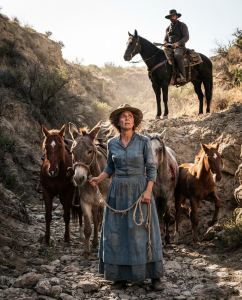
That was why she rode out before dawn on a borrowed mare, wearing a patched brown dress and a hat that wouldn’t stay pinned straight, following the faint tracks of her missing mule through a country so dry it seemed every blade of grass had given up. Solomon had been gone for three days, and for Mercy, that was three days too long.
To most people, Solomon was an ugly, bad-tempered mule with more stubbornness than sense. To Mercy, he was survival. He pulled the plow through hard soil, hauled wood from the creek bed, dragged feed sacks, and carried the weight of a life that had become very small and very expensive since her husband Tom died eight months earlier.
Tom had left her a parcel of land east of Sweetwater and just enough debt to make sleep difficult. Mercy had learned to stretch flour, mend harness, patch dresses, and hide coins in a tin behind the pantry sacks. She had also learned that grief was easier to bear than fear until winter came. Then fear settled into the walls.
She followed Solomon’s tracks west across dry ground and broken scrub until the trail dropped into a shallow wash lined with mesquite. That was where she found him.
He was standing in the bottom of the ravine, ears lifted, looking guilty in the way only a mule could. Beside him were three horses.
Mercy stopped breathing.
One was a red mare with a white star on her forehead. One was a broad gray gelding with dried blood on its shoulder. The third was a young chestnut colt, all wild eyes and trembling muscle, holding one front leg awkwardly off the ground.
Even before she saw the H brand on the mare, Mercy knew they belonged to Holt Howerin.
Everybody in Sweetwater knew Holt Howerin.
He owned the largest ranch for fifty miles. Men worked for him, depended on him, feared him, and lied about him whenever they thought he couldn’t hear. Some said he was fair. Some said he was merciless. Most agreed on one thing: he did not forgive theft.
Mercy looked at Solomon, then at the horses, and felt a chill move through her despite the heat.
If someone came over the ridge now, they would see a poor widow on Howerin land with her own recovered mule and three valuable horses gathered around her. No witness. No explanation. Just bad luck in a place where bad luck could get a person killed.
She ought to have turned around, led Solomon away, and prayed the horses wandered home on their own.
But the gray was hurt. The colt was limping badly. Mercy had not been raised to leave an animal suffering if she could help it.
She stepped forward with both hands visible. “Easy,” she murmured.
Solomon accepted the rope around his neck with insulting calm. The mare let Mercy edge close enough to reach her, but before Mercy could improvise a lead, hoofbeats sounded above.
A rider came down the ridge.
He rode a black horse and carried a rifle across his thighs. He was large, hard-faced, and still in a way that made every movement seem deliberate. Mercy had never stood this close to Holt Howerin before, but she knew him instantly.
“Step away from those horses,” he said.
Mercy straightened. “I’m not stealing them.”
“I didn’t say you were.”
“Your voice did.”
A flicker of amusement crossed his face and vanished. He dismounted, and Mercy saw what power looked like when it didn’t need to shout. He took in Solomon, the mare, the gray, the colt, and finally Mercy herself.
“My mule went missing,” she said. “I came looking for him.”
Holt crouched near the colt, not close enough to startle him. “This one’s been missing two weeks.”
“Then your horse has poor judgment,” Mercy said. “He chose my mule for company.”
That earned her the briefest ghost of a smile.
When she told him her name, and that Tom Hollis had been her husband, something changed in Holt’s expression.
“I knew Tom,” he said. “Not well. He was decent.”
Mercy nodded. “He was.”
There was no ceremony to grief anymore. She had no strength left for it.
Holt touched the gray horse’s shoulder and swore under his breath when he felt the wound. Mercy stepped closer, ignoring the rifle.
“That needs cleaning now,” she said. “I have herbs and honey at my place.”
“I’ve men at the ranch.”
“Your ranch is farther.”
He looked at her for a long moment. “Lead the way.”
They walked together to her farm. Mercy spent the entire journey thinking about what he would see: the tired boards of the house, the garden stripped by insects, the leaning barn, the poverty she had tried so hard to keep private. But when Holt saw it, he didn’t mock her or pity her. He simply noticed.
Under the well shade, Mercy heated water and washed the gray’s shoulder. She removed a mesquite thorn buried deep enough to poison the flesh and packed the wound with honey. The horse stood quietly.
The colt was another matter.
It flinched from every movement, teeth flashing, body wound tight with fear.
“I’ll have one of my men handle him,” Holt said.
Mercy shook her head. “Your men have already taught him to expect pain.”
Holt’s face closed. “They were trying to save him.”
“I know.”
She began to hum an old hymn her mother used to sing in sickrooms. The colt’s breathing slowed. Slowly, gently, Mercy ran a hand down the shaking leg and lifted the hoof. A sharp stone had wedged hard beneath it, turning every step into agony.
She eased it loose.
The colt shivered, then stood still.
Holt exhaled softly. “I was going to have him put down.”
Mercy glanced up, startled. “For a stone?”
“We couldn’t get near him.”
“He wasn’t dangerous,” she said. “He was terrified.”
Holt looked at the colt as though those words applied to more than a horse.
Mercy invited him to stay for coffee because she could not think of a polite reason not to. They sat on the bench beside her door while evening sank gold into the field.
“How will you manage winter?” he asked.
Mercy looked out at her garden. “I’ll manage.”
“That’s not an answer.”
“It’s the only one I have.”
He offered payment for the horses in wood, flour, and meat. She refused at first on instinct, because pride was often all poor people had left. But she remembered Tom’s last winter, the drafts through the wall, the hopeless arithmetic of too little everything.
“All right,” she said finally.
Two days later, a wagon arrived.
Firewood stacked high. Flour. Salted meat. Coffee finer than anything in her pantry. A ranch hand named Judson repaired her barn door without being asked.
Before he left, he tipped his hat. “Boss is a good man, ma’am.”
Mercy wondered why he sounded as if he were defending Holt against accusations she hadn’t made.
A week later, Holt returned alone to report that the gray horse was healing and the colt was walking clean. Mercy offered him water. Then coffee. Then, eventually, supper.
It became a pattern neither of them named. He brought extra seed one week, a harness buckle the next, advice on repairing a fence post after that. Mercy told herself he only came because she had helped his horses. But then he stayed longer than politeness required. He asked her opinions. He listened to the answers. He laughed once—quietly, reluctantly, as if laughter were something he no longer trusted much.
Mercy began listening for hoofbeats toward evening.
Sweetwater noticed before she did.
At church, women measured her with narrowed eyes. At the feed store, conversations thinned when she entered. One widow to another, Mrs. Bell smiled with poisonous sweetness and said, “Careful. Men like Holt Howerin don’t ride out to poor women’s houses for no reason.”
Mercy answered, “Maybe he rides where he pleases.”
But the gossip spread.
Someone said she had trapped him with those horses. Someone else said she had probably hidden them herself. Men who had never looked at her twice now watched her with smirking curiosity, as if kindness from a wealthy man must be purchased one way or another.
Mercy said nothing to Holt. She hated the thought of looking weak. Yet she grew guarded. When Holt came, she kept more distance. He noticed.
One evening he found her by a broken fence rail with her sleeves rolled high and her face streaked with dirt.
“I’m told my visits are causing trouble,” he said.
“Trouble was here before you,” Mercy answered.
His eyes darkened. “And am I adding to it?”
She wanted to say yes. She wanted to say no. Instead she said, “People will think what they want.”
Holt lifted the broken rail from her hands and set it in place. “That wasn’t the question.”
Mercy looked at him. Up close he was handsome in a severe, unadorned way, but there was exhaustion under the surface of him. Not the exhaustion of work. The exhaustion of disappointment.
“I was surviving before you,” she said.
He nodded once. “I know.”
Then he said the thing she had not expected.
“I keep coming because when I’m here, the world is quieter than it is anywhere else.”
Mercy forgot to breathe.
No man had spoken to her that way in years. Not since before Tom became more ill than husband, more pain than person. She had loved Tom. She would always love him. But love and longing were not always the same thing, and this new thing pressing at her ribs felt frighteningly alive.
Before she could answer, a rider came hard down the road.
The ranch hand nearly fell from the saddle. “Mr. Howerin,” he gasped, “they found Tucker Reed at the north fence.”
Holt’s expression sharpened. “Alive?”
“Barely.”
Mercy stepped closer. “Who’s Tucker Reed?”
“One of my foremen,” Holt said.
The hand swallowed. “He says somebody’s been cutting fences and driving stock off at night. Hiding them in ravines east of the creek.”
Mercy went cold.
East of the creek. Near where she had found Solomon and the horses.
“Hiding them where?” she asked, though she already knew.
The hand looked miserable. “Same country where Mrs. Hollis found yours.”
Holt turned toward Mercy. Neither spoke, but a terrible understanding passed between them. Those horses had not simply wandered. Someone had placed them there.
“Did Tucker name anybody?” Holt asked.
The hand hesitated. “Not clear. Lost blood. But he said the widow’s name came up before the drive.”
Mercy stared. “My name?”
“I never met the man,” she said.
“I know,” Holt said at once.
But he knew something else too. His silence had changed shape. It was no longer uncertainty. It was recognition.
“Who?” Mercy asked.
Holt didn’t answer immediately. “Someone who wants two things at once.”
“What things?”
“To ruin me,” he said, “and leave you holding the rope.”
That night he stayed at her farm.
Not in the house. He refused the bed and took a chair near the door with his rifle across his lap while Mercy lay awake listening to every creak of the boards. Near midnight Solomon began braying from the lean-to. Then glass shattered in the kitchen.
Holt was moving before Mercy sat up.
He dragged her low as something flaming burst against the outer wall, splashing fire across dry boards. Mercy grabbed the water bucket while Holt kicked open the door and fired once into the dark. A horse screamed outside. A man shouted. Then hoofbeats tore away into the night.
Between them they got the fire out before it took the house.
In the dirt beneath the broken window lay a bottle ragged with soot and lamp oil. Crude, fast, and meant to frighten—or finish what gossip had started.
At first light, Holt examined the yard. Mercy found him crouched beside a hoofprint and a torn strip of dark blue cloth snagged on a fence splinter.
He stood slowly. “I know that cloth.”
“Whose is it?”
He looked grim. “Eli Barden’s.”
Mercy knew the name. Eli owned the feed warehouse in town and had been smiling too much at her lately. He was also Holt’s nearest competitor in land and cattle, though “competitor” was a generous word. Eli wanted what Holt had and resented that the town respected Holt more.
“Why me?” Mercy asked.
“Because nobody looks twice when a widow is blamed,” Holt said. “And because if my stock keeps vanishing near your place, people stop seeing a theft. They see a scandal.”
They rode to Sweetwater together.
Eli Barden was standing outside his warehouse when they arrived, neat vest buttoned, expression pleasant. Too pleasant.
He smiled when he saw Mercy. “Mrs. Hollis. Mr. Howerin. To what do I owe—”
Holt hit him before he finished the sentence.
Eli sprawled backward into a stack of feed sacks, cursing. Men rushed from the stable, then stopped when Holt leveled the rifle not at them, but at the ground between their boots.
“You’ll stand where you are,” he said, voice quiet enough to terrify every man present.
Eli got up slowly, touching blood at the corner of his mouth. “You’ve lost your mind.”
“Have I?” Holt asked. “Tucker Reed says different. So does the cloth from my widow’s fence.”
“My widow?” Eli’s smile turned ugly. “Town’s been talking true, then.”
Mercy slapped him.
The crack of it stunned even her.
Eli laughed once, but there was fear in it now. “You think anyone will take her word over mine?”
“No,” Mercy said. “But maybe they’ll take yours.”
She had seen men like Eli before Tom died, men who believed everybody weaker had already been bought. So she stepped closer and lowered her voice enough to make him lean in.
“You tried to burn my house with me inside it,” she said. “That makes you desperate. Desperate men talk too much.”
For the first time, uncertainty flashed across his face.
Then Holt spoke.
“We found your driver’s horse lamed from a bad night run. We found lamp oil on the rag. We found your cloth. And if Tucker wakes enough to repeat what he said, you’ll hang for rustling, attempted murder, and assault on a foreman.”
Eli sneered, but it came too quickly. “Tucker won’t wake.”
A terrible silence fell.
Mercy saw it first: the realization in every face nearby that Eli had just said too much.
Holt took one step forward. “What did you just say?”
Eli’s expression broke.
He lunged for the office door, but Judson and two other Howerin men were already there. They pinned him against the wall while he cursed and twisted. Holt did not hit him again. He didn’t need to. Eli’s own panic had done the work.
By evening, the sheriff had Tucker’s statement, the burned bottle, the cloth, and three ranch hands willing to swear Eli had been paying them to move stock through the ravines and spread Mercy’s name in town. He had chosen her for the same reason Holt had guessed: widow, poor, isolated, easy to blame. If Holt turned his fury on her, Eli damaged them both in one blow.
Tucker lived.
He recovered slowly, but he lived long enough to name Eli as the man who ordered the fence cut and the horses hidden near Mercy’s place. He also admitted something else under pain and shame: he had heard Eli suggest that if Holt took too much interest in the widow, all the better. A scandal was often stronger than a knife.
Sweetwater changed its tune overnight.
Women who had whispered now looked embarrassed. Men who had smirked found other things to stare at. Mrs. Bell avoided Mercy entirely.
Mercy expected triumph to feel sweeter. Instead it left her tired.
A few days after Eli was taken away, Holt came to her house without a horse. He had walked from where he tied it down the lane, as if he wanted time to think before he reached her door.
Mercy was shelling beans on the porch. Solomon dozed nearby like a witness too old to be surprised by anything.
Holt stopped at the bottom step.
“I should have seen it sooner,” he said.
“You saw it before anyone else did.”
“I still brought danger to your door.”
Mercy set the bowl aside. “Danger was looking for me long before you rode into that wash.”
He looked up then, and she saw the weariness in him give way to something more vulnerable.
“I’m not good at this,” he said. “Most things in my life can be solved by money, work, or force. You seem immune to all three.”
That pulled a laugh out of her before she could stop it.
Holt came up the steps.
“I can offer help,” he said. “I can offer repairs, cattle, seed, protection. But I think if I call any of that a proposal, you’ll send me back down these steps.”
Mercy folded her hands to keep from showing how badly they trembled. “Depends what you mean by proposal.”
He stood close enough now that she could see the sun at the edges of his scars, the honesty in the lines time had cut into his face.
“I mean this,” he said. “I would like to court you, Mercy Hollis, openly and properly, so no one in this county ever mistakes what I’m doing when I come to your house.”
Mercy looked at him for a long moment.
Tom had been her past. Honest, hardworking, beloved. Holt was not Tom. He was rougher, quieter, harder to know. But he had ridden toward danger for her, believed her when it would have been easier not to, and looked at her as if she were still a woman with a future instead of a widow carrying an ending.
“Sweetwater will still talk,” she said.
“Let them.”
“You may regret saying that.”
“I won’t.”
Mercy thought of the ravine, of the horses, of how close she had come to being ruined for something she had not done. She thought of winter, and pride, and loneliness, and the way Holt had sat outside her door all night because fear had finally found a name.
Then she smiled, small but real.
“All right,” she said. “Properly.”
Holt exhaled like a man who had been braced for gunfire and found mercy instead.
He did not kiss her then. He only took her hand, slowly enough to be refused, and when she let him keep it, the quiet between them changed.
By the next spring, the garden had doubled. The barn stood square on new hinges. Solomon still behaved as if every good decision on earth had been his idea first. The gray horse healed with only a scar. The chestnut colt grew into a fine young gelding no one would ever have guessed had once been marked for death over a stone in his hoof.
Sweetwater kept talking, of course. Towns like that always did.
But now the story was different.
It was about the widow who found three lost horses while searching for one ugly mule. About the rancher who was feared until he chose to be known. About the man who tried to destroy them both and failed because he mistook loneliness for weakness.
Some said Mercy was lucky. Some said Holt was.
Mercy never bothered answering.
She knew luck had very little to do with it.
Sometimes the biggest red flag in a town was not the man people feared most, but the smiling one who made sure everyone feared the wrong person. And sometimes the thing that looked most dangerous at first—a powerful man, a wild horse, a feeling that came back after grief—turned out to be the very thing that saved your life.