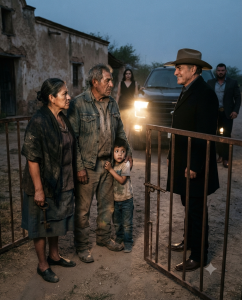
The rancher arrived at dusk with a sleeping boy in his arms and told the widow, “He’s all I have left.”
By the time the truth surfaced, Amalia Robles would realize he had brought more than a hungry child to her gate. He had brought a buried promise, a land dispute years in the making, and a secret powerful men were willing to dress up as family honor in order to steal.
When Amalia first saw him, though, all she noticed was dust.
Dust on his hat, dust on his shoulders, dust caked into the seams of worn leather boots that looked one step away from splitting open. He stood outside the iron gate of La Jacaranda Ranch at sunset with a sleeping little boy in his arms, as still as if he had run out of strength the moment he reached her property.
The child was limp with exhaustion, one cheek pressed against the man’s chest, both fists twisted in his shirt.
Amalia had lived alone too long not to think danger first.
La Jacaranda sat outside Lagos de Moreno, spread wide under jacaranda trees and dry light, with old corrals, a weathered main house, a kitchen that still smelled of coffee even on silent mornings, and a long strip of pasture where her husband Hilario had died four years earlier. Before his death, the ranch had carried a kind of joyful disorder. The radio was always on. Workers came and went. Hens scratched at the yard. Three fat barn cats ruled the grain room. Hilario laughed loudly, spent money too quickly, and could calm a frightened horse with one hand on its neck.
After he died of a heart attack in the pasture, everything narrowed.
Amalia learned accounts, deliveries, feed prices, irrigation schedules, repair lists, vet calls, payroll, and the lonely discipline of making every decision herself. She carried a ledger under one arm and the heavy gate key in the other like both were weapons. Her daughter Teresa wanted her to sell and move to Guadalajara. Her wealthy neighbor Don Severiano Ledesma wanted the same thing, though for very different reasons.
“A woman alone shouldn’t have to carry a place like this,” he would tell her in his polished voice, one boot crossed over the other, hands resting lightly on the saddle horn while he smiled at her as if generosity had brought him there. “Sell it to me, Amalia. I’ll give you a fair price. Go live comfortably with your daughter.”
“La Jacaranda is not for sale,” she always said.
The words had become habit.
So when the stranger at her gate removed his hat and said, “We’re only asking for water, ma’am. The boy hasn’t had anything since morning,” her first feeling was not pity. It was resistance.
Then Doña Chayo appeared at the kitchen doorway, as if old women who had fed generations could smell hunger before anyone spoke of it.
“There are beans, tortillas, and coffee,” Chayo said. Her eyes dropped to the child. “And atole, if he wakes up.”
The stranger introduced himself as Mateo Roldán. The boy was Nicolás, though he called him Nico. Mateo spoke without embellishment, without dramatic pauses, without the rehearsed sadness that often accompanies lies. He was careful, that was clear. But he did not sound slick.
Amalia almost turned them away.
Then Mateo lowered Nico onto a wooden bench with extraordinary gentleness, removed his own jorongo, and tucked it around the child’s feet. It was such a small act, and yet it was the first thing that made her hesitate. People can fake panic. They can fake gratitude. It is harder to fake instinctive tenderness when they think no one is studying them.
“You can sleep in the workers’ room,” she said finally. “At dawn, you continue on.”
Mateo nodded. “Thank you.”
No pleading. No bargaining.
The next morning, Amalia found him already repairing the large corral fence with old wire and salvaged posts. No one had told him to do it. He had simply seen what needed work and started. By noon he had fixed the gate, tightened hinges on the feed shed, and patched a section of roof over the tool room before the next rain could ruin everything stored beneath it.
“That’s been waiting months,” Amalia said.
He shrugged. “It bothered me.”
“Can you handle livestock?”
“I’ve handled everything from milking to branding to calving in the dark.”
“Can you stay sober?”
He met her gaze without offense. “Yes.”
That answer, more than the rest, sounded honest.
She hired him for fifteen days.
During those days, something shifted at La Jacaranda in ways she did not want to admit. Nico followed Doña Chayo through the kitchen, asking whether beans took longer to cook when they were angry. He named the three barn cats Rey, Tuerta, and Bandido based on no logic anyone could follow. He scattered corn for the hens with solemn importance. He patted the old mare’s nose and apologized if he startled her. He laughed openly, then stopped too quickly whenever he thought he had been too loud.
That last part Amalia noticed.
Children who feel safe do not apologize for taking up space.
Mateo worked from dawn to dark and never pushed familiarity. He did not pry into Amalia’s life. He did not roam the house. He ate what was given, thanked Chayo, washed his own plate, and spent evenings making sure Nico had enough to eat before touching his own food. More than once Amalia saw him mending the boy’s shirt by lantern light with clumsy, determined stitches.
One night she passed by the workers’ room and heard Nico crying in his sleep.
“Don’t let them take me back,” the boy whispered.
Amalia stopped in the darkness.
A moment later, Mateo’s voice answered softly, “I won’t.”
There are promises people make because they want to soothe fear. And there are promises people make because breaking them would kill something inside them. His sounded like the second kind.
Still, suspicion has its own rhythm, and she did not ignore it. The boy was not calling Mateo Papa. Mateo had no papers. They had arrived on foot with little more than a rolled blanket, a bag of clothes, and a story too thin around the edges.
Then Teresa called from Guadalajara.
“Mamá, tell me this isn’t true. Don Severiano says you’ve taken in some strange man with a child that isn’t his.”
Amalia stiffened. “Why is Severiano in Guadalajara?”
“He came to see us. He says the man is dangerous. He says he kidnapped the boy. He says people are looking for him.”
Amalia turned toward the yard, where Mateo was lifting feed sacks under the fading light while Nico sat on the fence watching him.
“What else did he say?” she asked.
Teresa lowered her voice. “He said if there’s scandal on the ranch, it could affect the title, the accounts… everything Papá worked for.”
That was when Amalia understood this was not gossip. Severiano was preparing a position.
That same evening, she watched Mateo more carefully and saw it at last: a man who had been waiting for pursuit from the beginning. Every sound from the road pulled his attention. Every barking dog made him go still. He did not relax. He merely worked hard enough to make fear look like fatigue.
After dinner, while Doña Chayo washed dishes, Amalia mentioned Severiano’s name. Mateo froze.
Only for a second.
But it was enough.
Later, when the yard had gone dark and the night air turned cool, Amalia stepped outside and saw Mateo crossing toward the gate with Nico awake beside him, one small hand trapped tightly in his own.
“Where are you going?” she asked.
“To keep trouble from reaching you,” he said.
“Walking into the road with a child in the dark isn’t protection.”
“It may be better than what’s coming.”
Before she could demand the truth, a familiar voice drifted from beyond the gate.
“Too late, Amalia.”
Don Severiano stepped from the shadows in a pressed jacket and polished boots, smiling with the satisfaction of a man who had waited years for a door to open at just the right moment.
“I already sent word to the boy’s real family.”
Then headlights climbed the bars of the gate.
The truck that rolled up behind Severiano was expensive and clean, the kind owned by people who could afford lawyers, influence, and polite versions of cruelty. A man got out first—thick-necked, broad-shouldered, with cold eyes that took in the yard as if measuring value. Then a woman in black stepped down, elegant and dry-eyed, not frantic or relieved but annoyed.
Nico saw them and went white.
That was all Amalia needed to know that the story being told outside the gate was false.
A lost child runs toward rescue. He does not hide behind the nearest adult and shake.
“Nicolás,” the woman called, her tone coated in sweetness so artificial it made Amalia’s skin crawl. “Come here. You’ve worried us long enough.”
Nico pressed his face into Mateo’s side.
Mateo moved half a step in front of him.
The broad man’s mouth twitched. “You’ve caused enough trouble, Roldán. Hand him over.”
“Not to you,” Mateo said.
Amalia turned sharply. “Who are they?”
Mateo looked at her once, measuring whether he had any right left to ask for faith. Then he said, “The woman is my sister’s mother-in-law. The man is her brother. Nico is my sister Elena’s son.”
The woman snapped, “Liar.”
But Nico clutched Mateo harder at the name Elena.
“My sister married into the Valdés family,” Mateo continued, voice strained but steady. “Her husband died two years ago in an accident that people in town whispered wasn’t an accident at all. After that she was trapped in that house with his family and no money of her own. She tried to leave more than once. They always brought her back.”
The broad man took a threatening step forward, but Severiano lifted a hand as if the performance required elegance.
Mateo kept talking.
“Elena wrote to me. Not often. They watched her. When she got sick last winter, she knew she was dying. She sent for me. I arrived too late to save her, but not too late to hear her beg. She made me promise I would take Nico and never let Don Ernesto Valdés raise him.”
“And why?” Amalia asked.
Mateo’s jaw tightened. “Because the ranch she was meant to inherit from her husband was never supposed to pass through her. They needed the boy as an heir they could control. Elena stood in the way while she lived. Nico stood in the way after.”
Severiano laughed softly. “A touching invention.”
But then Amalia noticed the paper in his hand: a folded document stamped with an old seal she recognized immediately.
Hilario’s seal.
“What is that?” she asked.
Severiano’s expression sharpened, then smoothed. “An agreement your late husband was considering. A land easement. Nothing for you to worry about.”
She held out her hand. “Let me see it.”
“It’s irrelevant.”
“On my property, nothing in your hand is irrelevant.”
For the first time that night, the man in the truck looked uneasy.
Amalia understood something all at once: Severiano’s interest in Nico and Severiano’s obsession with La Jacaranda were connected.
“Open the gate,” the woman in black said, dropping all pretense. “This has gone far enough.”
Amalia did not move.
Instead she asked Nico, very quietly, “Do you know these people?”
The child nodded without lifting his head.
“Do you want to go with them?”
He shook so hard his whole body trembled. “No.”
The woman’s face hardened. “He’s confused.”
Children can be coached, bribed, frightened, manipulated. But terror has a look. And Nico’s terror was not confusion.
“Doña Chayo,” Amalia said without taking her eyes off the road, “take Nico inside.”
The woman lunged verbally before anyone moved. “You cannot interfere. He is family.”
“No,” Amalia said. “Family is who protects a child when he says no.”
Chayo led Nico toward the house. Mateo hesitated, torn between staying with the boy and standing in front of the storm. Amalia made the decision for him.
“Stay.”
The broad man stepped toward the gate. “You old fool, do you understand who you’re crossing?”
“Perfectly,” Amalia replied. “A man too comfortable threatening a widow at night.”
Severiano finally lost patience. “Enough. That child is tied to property under dispute, and this woman has no legal standing to obstruct—”
“Property?” Amalia cut in.
The word hung there.
Not inheritance. Not grief. Not guardianship.
Property.
Mateo looked at her. “My sister’s husband had no children except Nico. If the boy disappears or is declared unfit to inherit, control of Los Arrayanes passes through the family board. Severiano holds one of its debts. He’s been waiting.”
“And the paper?” she asked.
Mateo swallowed. “Hilario found out. Years ago. Severiano wanted a route through your back pasture to merge water access between this ranch and Valdés land. Hilario refused after he learned Severiano had helped pressure widows off neighboring property. Your husband said he would rather set fire to his own pasture than sign.”
The memory came back to Amalia in a flash. Hilario returning angry from town. Hilario saying, “If anything ever comes to the gate wearing Severiano’s smile, close it.”
At the time she had thought it was only business.
Now she saw the shape of it.
Severiano had wanted La Jacaranda for years not just because it was fertile but because it completed a line between parcels, water rights, and transit access that would strengthen his grip over surrounding land—including disputed property tied to Nico’s inheritance.
“You came for the boy,” Amalia said slowly, “and for my gate.”
Severiano’s smile vanished.
The broad man shoved at the bars. “Open it.”
Amalia slid the heavy key into her apron pocket instead.
Then she raised her voice toward the dark side yard.
“Tomás! Eusebio!”
Two sleeping ranch hands from a neighboring parcel, men who sometimes stayed over during calving season, emerged carrying lanterns and long lengths of rope. Behind them came old Jacinto from the dairy shed and, surprisingly, Teresa’s godson Benito, who had arrived that afternoon with feed and stayed the night. Men appeared the way they do in ranch country when a woman they respect uses the voice reserved for fire, death, or thieves.
The balance shifted.
Severiano saw it.
“This is ridiculous,” he said. “You’re making a spectacle.”
“No,” said Amalia. “You brought the spectacle. I’m ending it.”
She told Tomás to phone the municipal authorities from the office line and call Father Ismael as witness. Then she faced the woman in black.
“If you are truly the child’s rightful guardian, you can explain to the police why he is terrified of your voice.”
The woman’s eyes flickered.
Not grief. Calculation.
Mateo spoke then, more quietly than before. “Nico was locked in a room when visitors came. Elena hid bruises with long sleeves. The boy was punished for speaking at meals. When she knew she was dying, she wrote down every incident she could remember and sewed the pages into the hem of one of his blankets.”
The yard went still.
“Where is that blanket?” Amalia asked.
Mateo looked toward the house. “With Nico.”
Severiano cursed under his breath.
That was the first truly honest thing he had said all night.
When the authorities arrived, everything changed quickly and slowly at once, the way truth often does. At first there was confusion, competing claims, offended voices, legal threats, accusations of kidnapping, accusations of trespass. Then Doña Chayo brought out Nico’s blanket. Mateo carefully opened the hem with a kitchen knife. Folded pages slid into his hand.
Elena’s handwriting covered both sides.
Names. Dates. Punishments. Witnesses. A doctor she had once begged for sleeping tablets and told too much to. A priest in another village who had seen bruises. Details of pressure to sign documents while feverish. A note about Severiano visiting the Valdés house twice the month before she died. A final plea: If anything happens to me, do not leave my son here. Take him to my brother. Trust no one who speaks of inheritance before burial.
No one said much after that.
Not even Severiano.
The investigation that followed lasted months. It uncovered forged pressure around estate transfers, illegal debt leverage, coercive guardianship filings prepared before Elena died, and years of predatory dealings wrapped in respectable language. Severiano was not charged with every sin people whispered about, but enough surfaced to ruin his standing and freeze the land agreements he had quietly assembled. The Valdés family lost their claim to immediate control over Nico. A court-appointed review confirmed the abuse allegations had merit. Temporary guardianship was granted to Mateo while proceedings continued.
And La Jacaranda?
La Jacaranda stayed exactly where it had always been.
Unsold.
Unbroken.
Months later, when Teresa came from Guadalajara and saw Nico racing across the yard with Bandido the cat fleeing under a cart and Mateo shouting after him not to climb the feed wagon, she stood beside her mother and said, “I thought you were letting danger in.”
Amalia watched the boy laugh in full sunlight, no apology in it this time.
“So did I,” she answered.
Teresa glanced at Mateo, who had stopped to adjust a loose fence latch before stepping onto the porch. “And now?”
Amalia took a slow breath.
“Now I think some people arrive looking like trouble because trouble has been chasing them too long.”
The court process ended almost a year later. Mateo became Nico’s legal guardian. A portion of Elena’s husband’s estate was secured in trust for the boy, protected from the relatives who had once treated him like a signature waiting to happen. Severiano’s attempts to revive the land deal failed one by one. He no longer came to the gate.
On the morning the final papers were signed, Nico ran to show Amalia the new boots Mateo had bought him for school. They were a little too big on purpose, and he stomped around the porch with exaggerated pride until even Doña Chayo laughed.
Then the boy looked up at Amalia and asked the question she had not expected.
“Can I call this home too?”
It broke something open in her, something grief had boarded shut years earlier.
She touched his hair and said, “You already do.”
Later, sitting alone beneath the jacaranda tree where the afternoon shade reached the porch, Amalia thought about Hilario, about stubbornness, about gates and the strange mercy of opening one at the exact wrong moment for the exact right person. She thought about how close she had come to sending them away with nothing but water. She thought about Elena, a woman she had never met, sewing truth into the hem of a child’s blanket because no one around her could be trusted with it in plain sight.
It left a bitter question behind, the kind that does not disappear even after justice arrives.
Who was worst in the end—the family that called cruelty protection, the neighbor who disguised greed as concern, or the people who had seen pieces of the truth sooner and chosen comfort over interference?
Amalia never found a neat answer.
She only knew the biggest warning had been there from the beginning: anyone who speaks about land, reputation, or inheritance before speaking about a frightened child is telling you exactly what matters to them.
And once you hear that clearly, you can never pretend not to.