The county assessor told the widow she had thirty days to leave the ranch. He forgot her late husband had hidden something inside the old windmill.
By the time Dwayne Cutter’s county truck rolled through the Bell ranch gate, Martha Bell had already learned the strange thing about grief: people expected it to make you soft.
They expected the black dress, the quiet voice, the trembling hands. They expected you to be so busy drowning in memory that you wouldn’t notice what was happening around you. They expected your eyes to stay fixed on the grave long enough for someone else to put a price on everything your husband left behind.
Martha stood on the porch and watched the truck approach in a plume of dust. The porch boards still held the shape of Eli’s boots by the door. His coffee mug was still on the kitchen counter, ring dried at the bottom. Three days had passed since they buried him, but every room in the house still seemed to be waiting for him to come back in from the fields.
Dwayne Cutter stepped out in polished boots and county khakis, carrying a leather folder with the confidence of a man who had rehearsed the moment.
“Miz Bell,” he called. “I’m sorry for your loss.”
She didn’t move aside. “Then say what you came to say.”
Something flashed in his expression, something annoyed that she hadn’t made this easier. He opened the folder and began talking in that official tone meant to crush people with jargon. Tax delinquency. Foreclosure process. Transfer order. Thirty days to vacate.
The words seemed to hit the porch and hang there.
“This ranch is ours,” Martha said.
“According to county records,” Dwayne replied, “it isn’t anymore.”
He held out papers, but Martha didn’t take them. She knew paper when it was meant to inform, and she knew paper when it was meant to intimidate. These pages were the second kind. Dense print. Stamps. Codes. A legal machine designed to grind down anyone too tired or too poor to fight it.
“There had to be notice,” she said.
“There was,” Dwayne said smoothly. “Repeatedly.”
Her chest tightened. “No one notified us.”
His eyes shifted, just briefly, toward the pasture. Toward the old windmill.
Then he looked back at her and said, “Maybe your husband didn’t want to burden you.”
That was deliberate. Meant to make her feel shut out from Eli. Meant to let doubt start nibbling at the edges of mourning.
But Eli had not been careless. He’d been many things. Stubborn. Quiet. Capable of holding a grudge for ten years if he thought someone had crossed a line. But careless with the ranch? Never.
Dwayne left after warning her that county reclamation crews might begin removing unsafe structures. Again, his gaze drifted to the windmill.
That was what bothered her most.
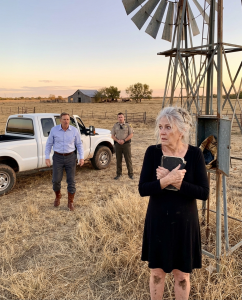
The windmill stood beyond the south pasture, rusted and leaning, blades frozen half-turned against the sky. It hadn’t pumped water in years. Eli had refused to tear it down, though. Said some things deserved to stand even when they were done being useful. A week before he died, she’d found him out there at dusk, staring up at it with grease on his fingers and a look in his face she hadn’t understood.
Now she did.
That night Martha spread the county papers across the kitchen table and forced herself to read every line. The more she looked, the less sense they made. Dates of delivery when she and Eli had been out of town. Signatures that didn’t match. A notice marked hand-served on an afternoon the two of them had sat in the front row of their granddaughter’s school play.
Eli had seen it. He must have.
In the pantry she found the old cigar tin where he kept receipts, baling twine, spare screws, and the scraps of a practical life. Inside, under feed invoices and seed receipts, was a folded note in Eli’s handwriting.
If Cutter comes before I can prove it, don’t let them take the windmill.
Martha stared at the words until they blurred.
The next morning she went out before sunrise carrying Eli’s flashlight and a pry bar. The ranch was gray-blue in the dawn, fences silvered with dew. She passed the horse lot, the equipment shed, the cottonwood near the well. Memory followed her with every step. Eli on a chestnut gelding, Eli lifting hay bales as if his back would never fail him, Eli grinning the day they paid off the east field after ten hard years.
The windmill creaked softly when she reached it.
At first she found nothing. Rust. Dust. Dead wasp nests. Then she noticed newer wire twisted around one narrow panel of the support tower. Eli had hidden it in plain sight. She unwound the wire, pried open the panel, and reached into the hollow metal column.
Her hand touched oilcloth.
Inside the bundle were copies of deeds, land maps, tax records, photographs of county files, and a black notebook. There was also a flash drive sealed in a sandwich bag, wrapped twice with electrical tape.
Martha opened the notebook first.
It was Eli’s handwriting, all right. Short lines. Dates. Dollar amounts. Parcel numbers. Notes about reclassified agricultural exemptions and valuation changes. The same names appeared across multiple entries—older ranchers, widows, absentee owners, families forced into rushed sales after paperwork “mistakes.”
Then the pattern became impossible to ignore.
Properties were being flagged for taxes the owners did not owe. Notices were being marked delivered when they never arrived. Foreclosure proceedings began quietly. Then, after the land was stripped cheap, a private entity called Red Mesa Holdings bought it through intermediaries and resold it to development partners for enormous profit.
Next to several entries, Eli had written one name: Cutter.
On the last pages he had written more fully, as if he finally realized rough notes weren’t enough.
They changed our status after I refused to sell the south acreage.
Clerk’s office involved.
Cutter is coordinating.
Rains may be helping cover after notices are filed.
Taking this to state investigator if I can confirm transfer chain.
If something happens, give to Sheriff Vale, not Rains.
Martha lowered the notebook slowly.
Eli’s death had been ruled a tractor accident. Brake failure on the north ridge. He had been found at the bottom of a slope, the tractor overturned, one tire still turning when the neighbor reached him. The county had called it tragic and unfortunate. Martha had been too shocked to question the speed of the conclusion.
Now every memory rearranged itself.
His late nights. His secrecy. The way he’d started carrying a small camera. The bruised look on his face when he came home from town one afternoon and claimed he’d walked into a fence post. The missing file folder she had once seen under his truck seat.
A crunch of tires on dry ground snapped her head up.
Deputy Lyle Rains drove across the pasture in his cruiser and stepped out before the dust had settled. He was broad, sunburned, and perpetually squinting, a man who always seemed one bad sentence away from anger.
“Miz Bell,” he said. “County reported possible trespass and interference with condemned property.”
She almost laughed at the absurdity. “It’s my land.”
His eyes dropped to the open oilcloth bundle. When he saw the notebook, he froze just long enough for guilt to show itself.
“Best hand that over,” he said. “Could be evidence.”
Evidence for whom? she wondered.
She stood, notebook clutched against her chest. “My husband wrote not to trust you.”
That landed hard. The deputy’s jaw flexed. For a moment she thought he might grab it anyway.
Instead he looked past her toward the county road, and his face changed. Alarm. Then irritation.
Another truck was approaching.
Dwayne Cutter got out before the engine was fully off. Gone was the smooth official mask. He marched toward them, eyes locked on the bundle.
“Take it,” he barked at Rains.
The command was so naked it stunned them all into stillness.
Rains didn’t move. “You shouldn’t have come out here,” he muttered.
Dwayne stopped. “What did you say?”
What happened next told Martha more than the notebook had. There was no partnership left here, only panic and blame.
Rains kept his voice low. “You said she didn’t know.”
“She didn’t,” Dwayne snapped. “Until your office failed to keep Bell out of places he didn’t belong.”
Martha felt her throat go dry. They were talking about Eli as if he had been an obstacle, not a dead man.
Dwayne seemed to realize too late how much he had revealed. He shifted back to official language, but the damage was done. “Mrs. Bell, those materials concern an ongoing county matter. You are obstructing—”
“You forged notices,” she said. “You stole land from people who couldn’t fight back.”
His face hardened. “Do you know how many ranchers around here sit on acreage they can’t manage? We brought value into this county. Roads. Jobs. Development.”
“You brought thieves in polished trucks.”
Rains glanced between them, sweating now. “Dwayne, it’s over.”
“No,” Dwayne said. “It’s over when I say it’s over.”
Then his gaze dropped to the flash drive in Martha’s hand.
Everything changed in that instant.
He lunged.
Martha stumbled backward, but age had not erased reflex born from ranch life. She swung the pry bar she still carried. It struck Dwayne’s forearm with a crack that made him curse and recoil. The flash drive nearly slipped from her fingers.
Rains grabbed Dwayne by the shoulder. “Stop!”
Dwayne wheeled on him. “You weak idiot. Do you know what’s on that?”
Martha used the second to run.
Not far. Not fast. But toward the one place on the property where she knew a signal sometimes came through strong enough to make a call—the rise near the water tank. She could hear boots behind her, one set heavier than the other, and pain sliced through her hip with every step. Still she ran with the notebook under one arm and the flash drive clenched so hard her nails dug crescents into her palm.
Halfway to the rise, she heard shouting behind her. Not at her.
Rains had tackled Dwayne.
The two men hit the ground hard in a spray of dust and curses. By the time Martha turned, they were grappling like desperate men who knew prison was closer than either had expected. Dwayne drove an elbow into the deputy’s throat. Rains answered with a punch that split Dwayne’s lip. Years of secret partnership dissolved into animal panic in the grass.
Martha kept moving.
At the top of the rise she pulled her phone from her pocket and prayed for a bar. One flickered, vanished, then returned. She called Sheriff Tom Vale, the elected sheriff in the next jurisdiction over, a man Eli trusted because he had once investigated county bid fraud and nearly lost his career for not dropping it.
He answered on the third ring.
“This is Martha Bell,” she said, breath tearing in her throat. “Eli was murdered, Cutter’s on my land, and I’ve got proof of county theft. Come now.”
To his credit, Vale did not waste time asking if she was confused from grief.
“I’m on my way,” he said. “Lock yourself where you can. Do not hand anything to anyone.”
By then the fight below had ended. Rains was on one knee, coughing. Dwayne was standing again, bloody-mouthed and wild-eyed.
He looked up and saw Martha with the phone.
The expression on his face was not rage now.
It was fear.
She understood why fifteen minutes later, when Sheriff Vale arrived with two state investigators and another unit. Eli, it turned out, had managed to contact one investigator weeks earlier. He had mailed copies of some records, but not enough to make the case. The investigator had been trying to reach him again when news came of the accident.
The flash drive supplied the missing link.
It held scanned tax records, internal emails, transaction chains, and photographs Eli had taken inside the county records office. It also held a voice recording. Grainy, but clear enough. Dwayne Cutter was on it. So was a clerk from the assessor’s office. They discussed “moving Bell after the appraisal shift” and “getting the brake issue handled if he keeps digging.”
The phrase landed like a stone in a pond.
Brake issue.
Martha sat in Sheriff Vale’s truck while investigators executed warrants that same afternoon. Dwayne was arrested before sunset. The clerk was picked up before midnight. Red Mesa Holdings turned out to be tied through layered LLCs to Cutter’s brother-in-law and two outside developers who had been buying up ranchland along the proposed bypass expansion.
Deputy Rains was arrested too, though his role proved murkier. He had signed off on reports, ignored discrepancies, and helped shield the fake notice trail. Later, through a lawyer, he claimed he never agreed to kill anyone and realized too late what Dwayne had set in motion. Martha did not know whether to believe him. Corruption always sounded more accidental after handcuffs were involved.
The deeper investigation lasted months.
Families across the county were contacted. Some had already lost land. Some had paid inflated taxes to stop foreclosures that should never have existed. One widower broke down in tears on television when told the sale of his pasture was likely fraudulent and might be reversed. Another woman, nearly eighty, said she had spent two years thinking her husband had failed to provide for her when in truth the county had trapped them with invented debt.
That hurt Martha in a way she had not expected.
The scheme had not just stolen land. It had stolen memory. It had poisoned the dead in the minds of the living.
In the end, the state voided the foreclosure orders attached to the fraud network. The Bell ranch remained in Martha’s name. Several neighboring parcels were restored to surviving owners or their heirs. Cutter took a plea after the homicide inquiry closed in on him; he did not confess cleanly, but enough evidence tied him to tampering with equipment used on the Bell property to support charges related to Eli’s death. He would spend the rest of his life in prison measuring power by concrete walls instead of acreage.
When the trial ended, people kept asking Martha whether justice felt satisfying.
She never knew quite how to answer.
Nothing returned Eli. Justice did not put his boots back by the door or his hand at the small of her back when storms rolled in. It did not erase the fact that he spent his final weeks afraid and chose to carry that fear mostly alone, perhaps to protect her, perhaps because men like Eli were raised to bear trouble in silence until the weight crushed them.
But one evening, months later, Martha walked out to the old windmill at sunset.
Sheriff Vale had offered to have it removed. She said no.
The structure still leaned. Rust still streaked its legs. Yet now when the wind stirred, one loosened blade moved with a small metallic sigh, as if the thing had finally decided it was allowed to rest.
Martha touched the support where Eli had hidden the bundle.
He had known he might not make it. He had known they were closing in. And even then, he found a way to leave her not just evidence, but a chance. He had trusted that when the moment came, she would not fold.
He had been right.
She stood there until the sky turned copper, then purple. The ranch stretched around her, bruised but still theirs, every fence line holding a history someone had tried to price and package and steal. In town, people now spoke of Eli Bell as a man who died uncovering corruption. They spoke of Martha as the widow who broke it open.
Maybe both were true.
But as she looked at the windmill, she thought the real red flag had appeared long before the forged notices and hidden files. It had been the first moment a public servant began speaking about neighbors like obstacles and land like prey. That was how theft always started—first in language, then in ink, then in the lives left wrecked afterward.
Some people in the county still said Deputy Rains deserved leniency because he eventually hesitated. Others said hesitation after helping ruin families was no virtue at all. Some said Eli should have gone to the state sooner. Others understood why a man raised to trust local institutions would struggle to believe how rotten they had become.
Martha only knew this: greed had asked everyone around it for one small compromise at a time, and almost all of them had found a reason to give one.
Until somebody didn’t.
And because Eli hid the truth where a crooked man looked without really seeing, the widow they expected to break became the one person who finally made the whole county look up.