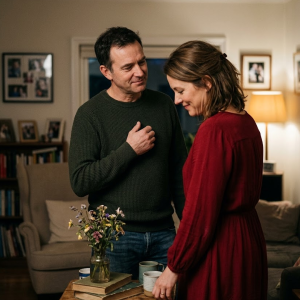
They threw Hermelinda Vázquez out with five children, an empty canteen, and the kind of certainty poor men and cruel women often share: that a woman without a husband was already half-defeated.
She did not scream when it happened. She did not throw herself at the doorway. She did not weep in the yard and ask for mercy from people who had already decided she was worth less than the dust on their shoes. She stood in the small house where she had cooked, washed, given birth, and buried her own exhaustion for years, and listened while her mother-in-law, Doña Eriberta, held up a paper Hermelinda could not read.
“This house belongs to my son’s family,” Eriberta said, her voice sharp with victory. “You have no right to stay here with those children.”
Those children.
As if they were not her own son’s blood.
Hermelinda looked once toward the room where the little ones were sitting silent and confused, sensing danger even if they did not understand it. Baby Eliseo was fussing. Bonifacio had his fingers in his mouth. The older three stood close together, the way children do when the ground under them starts to shift.
Saúl was gone by then. Gone with another woman, gone with the money hidden in the old lard tin, gone with every excuse a weak man can invent when he wants freedom without guilt. He had taken the family savings and left Hermelinda to face the wreckage alone. Eriberta arrived not with shame, but with a claim.
Hermelinda might not have known the law, but she knew humiliation when she saw it.
So she did the one thing no one expected. She packed.
A change of clothes. Her mother’s little remedy notebook. A holy card of the Virgin. A blanket. A tin cup. Nothing more than she could carry, because five children were heavier than any bundle. Then she walked out without giving Eriberta the satisfaction of seeing her break.
She did not look back.
Later, she would think that was the first moment she saved herself.
The road was worse than hunger because hunger at least moved inside the body. The road entered the mind. By the second day her feet were blistered and the children had grown quiet in that alarming way children do when they stop believing questions will bring useful answers. She gave them the last water from the canteen by careful mouthfuls. She lied about nearby towns and familiar relatives and good people who would surely help.
By the fourth day she had no more lies left.
That was when she saw the hill.
It rose beyond a stretch of brush and stone, dry and wind-beaten, with a crumbling adobe house near the crest. Hermelinda nearly passed it at first, thinking it was only another ruin among many, but then she heard a sound that did not belong to abandonment.
A hum.
Steady. Insistent. Alive.
She climbed the hill with Eliseo tied against her chest and Bonifacio holding her hand. The older children followed, stumbling with exhaustion. Up close, the place looked ruined enough to scare off anyone sane. Broken roof tiles. Grass up to her waist. A porch warped by weather. A front door hanging crooked on tired hinges. But behind the house, arranged in a row as if the years had forgotten to finish their work, stood eight beehives.
And the bees were alive.
Hermelinda had no reason to trust the place, but she had even less reason to keep walking.
“We’ll sleep here tonight,” she told the children.
That first night she swept a patch of floor clear with a branch, laid the children down on old blankets, and sat awake against the wall listening to wind and darkness. She expected trouble. Men, perhaps. Snakes. Drunks. Some rightful owner with a shotgun and no patience. Instead morning came with golden light through cracked adobe, the smell of dry earth, and an old woman climbing the hill carrying tortillas wrapped in cloth.
Her name was Doña Praxedis.
She did not ask the usual questions. Not at first. She looked at Hermelinda, then at the children, then at the hives.
“You planning to run?” she asked.
“No.”
“You know anything about bees?”
“Nothing.”
“Afraid of them?”
Hermelinda gave the only honest answer she had. “Yes.”
Praxedis smiled faintly. “Good. Bees punish arrogance.”
That was the closest thing to welcome Hermelinda received, but it was enough.
The days that followed were hard and simple. She cleaned what could be cleaned. She patched cracks with mud. She pulled weeds until her hands burned. Praxedis showed her how to move slowly near the hives, how smoke could calm a colony, how to respect the bees instead of fighting them. Hermelinda learned by necessity. Honey became food, then trade. One jar brought maize. Another brought beans. Another brought soap. Her children began to eat without panic. They slept more deeply. Even their faces changed, losing that hunted look that had clung to them on the road.
For the first time since Saúl left, Hermelinda let herself imagine staying somewhere long enough to stop calling it survival.
Then Anselmo Quintanilla arrived.
He came on horseback near midday, dressed too cleanly for the hill, wearing polished boots, a gray mustache, and the expression of a man who considered ownership part of his natural anatomy. He stopped at the gate and surveyed the place without dismounting, as if he did not want dust on himself.
“This land is mine,” he announced. “I’ll give you fifteen days to leave with your brood. And don’t touch my hives.”
Hermelinda felt the fear before she showed it. It went through her legs like cold water.
“Your hives?” she repeated.
His smile was thin. “Did I stutter?”
He turned his horse and rode away, leaving her with all the terror he had intended. Men like Anselmo knew how to threaten without shouting. They preferred to let women imagine the rest.
That night Hermelinda barely slept. She watched the moonlight through the broken roof and listened to her children breathing. Every plan she made ended the same way: with her back on the road and Bonifacio asking where they were going. By dawn she had a headache from fear.
She went down to the village anyway, because fear does not feed children.
At the general store she traded a jar of honey for maize. As she stepped behind the building to adjust the sack on her shoulder, voices stopped her. One belonged to Anselmo. The other was the town secretary.
“That widow can’t read a legal document,” Anselmo said with a laugh. “On Sunday I’ll tell the council she invaded private property. A woman with five hungry mouths doesn’t fight a man with receipts.”
The secretary gave a nervous chuckle.
Hermelinda stood still, hidden by the corner wall, every muscle rigid. Rage rose in her so quickly it made her hands shake. She wanted to confront him, to spit in his face, to call him a liar in front of everyone. But anger would not save the roof over her children.
So she said nothing.
She carried the maize back up the hill, found Doña Praxedis, and told her every word.
The old woman listened in silence. Then she turned toward the hives and studied them so long that Hermelinda began to feel the answer might be somewhere inside their humming. Finally Praxedis went into her own house and returned with a green tin box, old and dented, its paint scratched by time.
“Doña Tula left this with me,” she said. “She told me to give it to the woman who arrived with children and cared for the bees.”
Hermelinda stared at her. “She said that exactly?”
Praxedis nodded.
With trembling fingers, Hermelinda opened the box.
Inside were folded deeds, a will, and a yellow envelope sealed with the stamp of notary Hilarión Mendiola. Real papers. Serious papers. Not stories. Not village gossip. The farm, the hives, two hectares of land, all properly described. And in the will, written clearly enough for Praxedis to read aloud, was the strangest inheritance Hermelinda had ever heard.
The property was to pass to “the woman who arrives with her descendants and keeps the bees alive.”
Hermelinda sat down hard on the porch step. For a moment the whole hill tilted under her.
“Why would she write something like that?” she asked.
Praxedis’ eyes softened. “Because Doña Tula believed land should choose character, not just blood.”
Sunday morning arrived with a hard blue sky and a town eager for spectacle. Hermelinda washed the children’s faces, combed their hair, dressed them in the least-worn clothes she could salvage, and tucked the yellow envelope beneath her shawl. They walked together to the council house while villagers stared.
By the time she entered the square, she knew what many of them expected: the widow exposed, embarrassed, removed. That was entertainment in a place where poverty was common and compassion scarce.
Anselmo was already there, speaking comfortably to men with authority. He turned when he saw her and smiled with open contempt.
“There she is,” he declared loudly. “The squatter widow. Living off stolen land, stolen hives, and now bringing those children for pity.”
Somebody laughed.
Hermelinda’s mouth went dry. Her pulse pounded. But her hands did not tremble.
“Are you finished?” she asked.
The square quieted. No one had expected her to speak like that.
Anselmo frowned. “What did you say?”
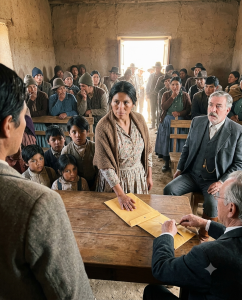
She walked to the council table, took the yellow envelope from beneath her shawl, and placed it before the secretary.
“I asked if you were finished telling your lie,” she said. “Now you may read the inheritance.”
The secretary opened the documents.
Silence spread slowly, then all at once.
He read the will. He read the property title. He read the description of the land, the hives, the boundaries. And finally he read the clause naming the heir: the woman who came with her children and cared for the bees.
The room changed with every sentence. First there was disbelief. Then murmuring. Then the sharp, bright silence of public embarrassment shifting from one victim to another.
Anselmo lost color.
He tried to grab the papers, but the councilman pulled them back and kept reading. Villagers who had arrived eager to see Hermelinda humbled now turned to stare at Anselmo. The women near the fountain exchanged glances. The men looked at one another with the discomfort of those who had supported the wrong bully too quickly.
Hermelinda took Bonifacio’s hand.
“My children are hungry,” she said into the stunned room. “And my house is waiting.”
Then she turned and left.
That was the moment the town finally understood that the widow they had dismissed as helpless had become owner of the very land a powerful man wanted.
The children were excited all the way home, though they did not fully understand what had happened. Bonifacio only knew his mother had stood straight in a room full of people and no one had pushed them out. The older ones sensed the change in the air and asked whether they were truly allowed to stay. Hermelinda told them yes, but part of her remained uneasy. Men like Anselmo did not surrender because paper embarrassed them.
Night proved her right.
The message came from the village store, where the wall telephone received calls for half the hill country. Don Liborio himself hurried up with it, his face pale and curious.
“It’s Anselmo,” he said. “He wants to speak to you.”
Hermelinda followed him back down, accepted the receiver, and waited.
Anselmo’s voice came rough with fury. “What did you put in that envelope, Hermelinda?”
She looked through the open doorway toward the dark slope where the hives rested beneath the moon. Their pale shapes gleamed like watchful eyes.
“What you could never buy, Don Anselmo,” she said. “Land that already knew my name.”
There was a long silence. Then his voice returned, quieter and somehow more dangerous.
“Ask the old woman why Tula never trusted me near those hives.”
The line went dead.
Hermelinda stood frozen. That was not the voice of a man angry only about losing property. That was the voice of someone frightened by what might still be hidden.
When she returned to the hill, Doña Praxedis was waiting on the porch in the dark.
“He called,” Hermelinda said.
“I know,” Praxedis replied, as though she had expected it.
When Hermelinda repeated his words, the old woman did not look shocked. She looked tired.
“Years ago, Tula caught him searching,” Praxedis admitted.
“Searching for what?”
Praxedis hesitated long enough to make the night feel colder. “For something he believed was buried there. Something he thought would make the land his no matter what any paper said.”
Hermelinda’s skin prickled. “Then why didn’t Tula expose him?”
“Because greed traps itself better than accusations do,” Praxedis answered. “Tula preferred patience.”
Then, from the pocket of her apron, she produced a second key—small, blackened, old.
“She told me there were two things to protect,” Praxedis said. “The papers, and what the papers were hiding.”
Hermelinda stared at the key in her palm. “Where?”
Praxedis lifted her chin toward the house. “Under the room where your children sleep.”
For a moment Hermelinda could not move. Her whole understanding of the place shifted. The farm was not only refuge. It was a secret someone had tried to steal.
She waited until the children were all on the porch with Praxedis before prying up a warped floor tile inside the main room. Under the adobe she found packed dirt, then a rotted board, then a narrow iron hatch nearly fused with rust. The old key fit.
When the hatch opened, stale air rose from a shallow cavity in the ground. Inside lay a cloth bundle, an oilskin packet, and a small wooden chest.
Hermelinda’s hands trembled as she lifted them out.
The cloth bundle held letters. Dozens of them, tied with blue ribbon so faded it looked gray. The oilskin packet protected account books and notarized pages that listed loans, boundary surveys, and payments made over years. The chest was heavier. Inside were silver coins, two gold pieces, and a ledger bearing names Hermelinda recognized from the village—men who had borrowed from Doña Tula in secret and repaid her in produce, labor, or land rights. At the back lay a folded confession signed by a former clerk, stating that Anselmo Quintanilla had once tried to alter a boundary record to absorb Tula’s land and hives into his own holdings.
Hermelinda understood at once why he had kept circling the farm.
He had not only wanted the property. He had wanted the proof of what he had done.
And the letters? Those made the truth even sharper. They were from Tula’s sister in another district, discussing the inheritance plan. Tula had no surviving children. Her blood relatives wanted the land sold to Anselmo years ago, but Tula refused. She wrote that land should go to someone who would work it, protect the bees, and raise life on it—not to a man who saw everything as spoil.
Hermelinda read until the words blurred. Then she sat back on her heels and laughed once, softly, almost in disbelief. All this time Anselmo had believed the hill concealed some treasure that could make him untouchable. In a way, he had been right. But the treasure was not only money. It was evidence. History. Intention. A dead woman’s refusal to let greed rewrite her life’s work.
By dawn, Hermelinda had decided what to do.
She did not hide the documents again.
Instead she took the confession, the ledgers, and the letters to the council with Doña Praxedis and Don Liborio as witnesses. The town secretary, who had been so ready to laugh with Anselmo days earlier, turned visibly sick as he read the pages. The councilman ordered a formal review of the boundary records. Two older men were called in to verify signatures. Every line pointed the same way.
Anselmo had tried, years earlier, to manipulate property records and then spent years hunting for the missing proof that could expose him.
By afternoon the story had spread through the village.
Men who had once tipped their hats to Anselmo avoided his eyes. Women who had pitied Hermelinda now looked at her with something closer to respect. Even Eriberta heard the news. She came to the hill a week later, not to apologize—some people would rather choke than do that—but to see with her own eyes whether the rumors were true. She stood at the gate, stiff and bitter, while Hermelinda’s children ran laughing between the hives and the porch.
“You got lucky,” Eriberta said.
Hermelinda met her gaze. “No. I kept walking.”
That was the only answer she gave.
The legal process took months, but the outcome was decisive. Anselmo was fined, publicly censured, and stripped of influence in local matters once the attempted fraud became undeniable. The town secretary survived by pretending he had known nothing, and perhaps he hadn’t known everything, but no one trusted his easy smile again. As for the hidden money, it was enough to repair the roof, buy seed, and build proper frames for the hives. Hermelinda did not become rich. She became secure, which for a woman who had once counted every bean before boiling supper felt more miraculous.
The farm changed with the seasons.
Grass was cut back. The porch was repaired. New whitewash brightened the walls. The children grew sturdy. Bonifacio learned to help with the smoker. Eliseo, once tied to her chest on the road, learned to toddle after the chickens. The honey gained a reputation in nearby markets for being clean and floral and somehow finer than any other. People started calling the place Tula’s Hill at first, then later simply Hermelinda’s farm.
Doña Praxedis remained part of it all, gruff and watchful, pretending not to enjoy the noise of children around her. Sometimes at dusk she and Hermelinda would sit on the porch while the bees settled in the fading light.
“She chose well,” Praxedis said one evening.
Hermelinda looked toward the hives. “Maybe she chose the children.”
Praxedis snorted. “Children come with noise, hunger, and broken things.”
Hermelinda smiled. “So does life.”
Years later, people still told the story in different ways. Some said it was about a widow who outsmarted a land thief. Some said it was about a dying woman who found a way to choose her heir from beyond the grave. Others said the bees knew before anyone else who belonged there.
Hermelinda never argued with any version. She only knew this much: the road that had seemed like her ruin had carried her to the one place where she was not an intruder, not a burden, not a woman waiting to be discarded again.
It is easy, afterward, to call that fate.
But fate alone does not climb hills with hungry children. Fate does not patch roofs, calm bees, swallow fear, or stand in a crowded council room while a powerful man lies. Whatever miracle touched that farm, it met Hermelinda halfway and found her already moving.
The hardest part to judge was not who won. That was clear enough in the end. The harder question was what should weigh more: blood, law, or character. Saúl had blood and abandoned it. Eriberta had law in her hand and used it like a knife. Anselmo had influence and nearly turned it into theft. But an old woman with no heirs and a widow with no shelter recognized something the others did not—that a home belongs most truthfully to the one willing to keep life alive inside it.
And maybe that was the real inheritance.
Not the silver, not the land, not even the hives.
The chance to prove that being thrown away is not the same thing as being finished.