When Mariela Cárdenas arrived at Rancho Los Encinos, nobody welcomed her.
They watched.
That was worse.
The truck that brought her from town rattled so violently over the last stretch of road that by the time it stopped at the ranch gate, her bones felt shaken loose. The evening sky above Lagos de Moreno had turned heavy and metallic, a storm color without the mercy of rain. Dust curled through the yard in restless spirals. Somewhere nearby, cattle shifted and snorted. The air smelled of manure, wet wood, and old labor.
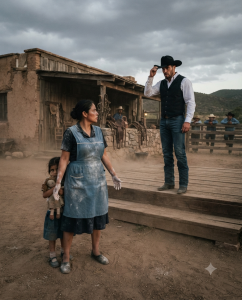
Mariela climbed down first, careful with her back, then turned and lifted her six-year-old daughter from the truck bed. Lucía was asleep, limp with exhaustion, one arm around a rag doll that had been sewn and resewn so many times it no longer looked like any animal or person in particular. It looked, Mariela often thought, exactly like survival.
From the corral, two cowboys stopped what they were doing to stare.
“That her?”
“The cook? No chance.”
Mariela pretended not to hear. She had become practiced at that. Grief had taught her many skills she never wanted. One of them was how to keep walking while men measured your worth out loud.
Then the front door of the main house opened, and the owner of the ranch stepped into view.
Don Santiago Arriaga carried himself like a man who had never needed to hurry toward anything. He was tall, broad through the shoulders, dressed in a black hat and a white shirt so clean it looked untouched by dust. His face was controlled, stern without strain. But his eyes were what people probably remembered most. They were the eyes of a man used to reading weakness before it spoke.
His gaze moved over Mariela in one sweep. Her face. Her dress. The child. Her boots. Her trunk.
She knew that look too.
It was the look that had turned cold in bus depots when she asked about work. The look from women who had once shared coffee with her and now lowered their voices when she approached. The look from employers who saw widowhood not as pain but as contamination. A woman with a dead husband and no protection was never simply unfortunate. To many people, she was suspicious by nature.
“You are Mariela Cárdenas?” Santiago asked.
“Yes, sir.”
“The notice said experience with a large ranch kitchen.”
“I cooked for road crews in Zacatecas for two years,” she replied. “Before that, I ran a diner in Aguascalientes with my husband. I know how to feed six people or sixty.”
His gaze shifted to Lucía.
“You didn’t mention a child.”
Mariela’s back straightened. “The notice didn’t say children were forbidden. If that’s a problem, say so now.”
Lucía opened one eye, looked directly at Santiago, and said, “You look angry even when you’re quiet.”
Mariela’s heart nearly stopped.
But Santiago’s mouth twitched.
“Come with me,” he said.
The kitchen he showed her sat behind the workers’ dining room and looked abandoned by care if not by use. Grease coated the wood stove. The chimney draft was clogged. The prep tables were stained. Bags of flour had been left open long enough for weevils to make a home in them. Pots and pans hung with a slick film that turned her stomach.
Still, she saw potential immediately. The stove was oversized and solid. The oven was worth saving. The pantry was cool. The windows would give good morning light.
Santiago stood in the doorway while she examined the room.
“Dinner is at six.”
Mariela touched the stove, checked the vents, and smelled the old soot in the pipe.
“Today it will be at six-thirty.”
He lifted an eyebrow. “My men work from before sunrise.”
“And if I light this kitchen in its current state, tomorrow you won’t have a kitchen,” she replied. “You’ll have a fire.”
Behind him, one of the ranch hands let out a laugh. Another muttered that she would be back on the road before the weekend. Nobody missed the fact that she had contradicted Santiago within ten minutes of arriving.
He looked at her for a long moment.
“Six-thirty,” he said.
Once he was gone, the amusement got louder.
Mariela ignored it and got to work.
She scrubbed the stove and cleaned the ash bed. She sorted usable flour from ruined flour. She hauled water, wiped surfaces, and sent Lucía to sit in the corner with paper and a pencil. She found beans, bacon, dried beef, chilies, rice, onion, cinnamon, piloncillo, and a bag of dried apples in the pantry. Not much, but enough if handled properly.
Her body ached with the kind of fatigue that never fully left anymore. Fourteen months earlier, her husband Julián had died in what the railway company called an accident on a construction site. After that, life had become a long negotiation between necessity and humiliation. She had sold furniture, dishes, jewelry, and finally the last small pride of her old life—the painted sign from their diner in Aguascalientes. Work was work. Pride was expensive.
But in a kitchen, at least, her hands still knew who she was.
She moved with purpose. Bacon into the pan until the fat ran clear. Onion into the drippings. Chilies toasted. Dried beef softened and simmered. Rice fried before broth touched it. Tortillas rolled and cooked fresh. Beans brought slowly to tenderness and then mashed. The apples she simmered in piloncillo and cinnamon because men working with horses and fences and weather needed sweetness more than they admitted.
By six-thirty, the kitchen smelled like order instead of neglect.
Thirteen men sat at the tables, prepared to mock the widow.
Instead, the first bite shut them up.
The room filled with the honest sounds of hunger being answered. Spoons scraping bowls. Tortillas tearing. Chairs shifting. A second serving requested without pride. Eusebio Meza, the foreman, gray-mustached and thin as a wire nail, said nothing but cleaned his plate fast and reached for more. A younger worker, Toño, muttered that the meal was better than what he got at home.
That earned a round of laughter.
And just like that, the edge in the room changed.
Not enough to trust her. But enough to respect the food.
Afterward, Mariela ate standing up by the stove with a plate balanced in one hand. The pain in her lower back pulsed with every breath. She barely noticed anymore. It was part of her now, like caution.
When she stepped into the hall later, Santiago was there, leaning against the wall as though he had been waiting.
“They ate well,” he said.
“I noticed.”
He took off his hat, turning it once in his hands. It was the first sign she had seen that something unsettled him.
“The way I received you—”
“It was clear enough.”
His expression tightened. “You can have the room beside the kitchen. It has a lock.”
“Then I want the key.”
That faint almost-smile appeared again. “You’ll have it.”
The room was small, but private. That mattered more than comfort. Mariela put Lucía to bed there that night and sat on the edge of the mattress staring at her boots.
She thought of Julián.
He had not been a saint. He had been loud, stubborn, occasionally foolish with money, and too quick to trust men with polished talk and smooth hands. But he had loved Lucía until it hurt to watch. He had loved Mariela too, in his own uneven, deeply human way. When he died, half the condolences she received had an ugly second meaning: pity that she was alone, and curiosity about what she would do now.
She had done what widows did when nobody stepped forward to save them.
She kept moving.
That night, voices drifted from outside near the corral.
Eusebio was speaking. “She can cook, yes. But women like that don’t last through a frost season. Don Santiago will regret it.”
Women like that.
Mariela extinguished the candle and lay down without undressing. Lucía turned in sleep and reached for her. Mariela placed a hand on the child’s back and stared into the dark.
By dawn, she was up before everyone else.
She lit the stove. Made coffee. Kneaded dough. Cooked eggs with onion and chile. Reheated beans and refried them until smooth. Wrapped stacks of tortillas in cloth to keep them warm. When the men filed in, they found breakfast ready and hot.
That mattered on a ranch.
The mockery eased after that.
Not all at once. Ranches had their own weather, and suspicion lifted slowly. But one man repaired a broken table leg. Another brought in wood. Toño carried water. A few stopped calling her “the widow” and began calling her Señora Mariela instead.
Only Eusebio remained openly resistant.
He stood in the kitchen doorway that morning with his plate in hand and said, “One decent dinner doesn’t prove much. Feeding a whole crew through hard season is another matter.”
Mariela didn’t look up from the dough she was working.
“Good thing I didn’t come for one dinner.”
Lucía, crouched nearby and braiding her doll’s hair, added, “Mama wins when people are rude before breakfast.”
Several men laughed before they could stop themselves.
And then Santiago entered, heard enough to understand the room, and looked around at what had changed in less than a day. The tables were cleaner. The stove was functioning correctly. Food was hot. The men were fed. The kitchen no longer felt neglected. It felt controlled.
He looked at Mariela and asked, in a tone that carried farther than he intended, “Can you cook for an entire ranch crew?”
Some of the men smirked, expecting her to stumble when the numbers became real.
“For how many?” she asked.
“Sixteen today,” Santiago said. “Twenty-two by Sunday. Thirty if the buyers stay.”
Mariela set down the dough and faced him fully.
“I can feed whoever walks through that door,” she replied. “The real question is whether your ranch is ready to stop acting like I’m the one who arrived here empty-handed.”
Silence.
Even Eusebio said nothing.
For one strange, electric moment, Santiago looked less like a ranch owner and more like a man who had just discovered he was standing in someone else’s territory. Not because she owned the land. Not because she owned him. But because in that kitchen, where competence could not be argued away, Mariela had done the one thing no outsider was supposed to do so quickly.
She had become necessary.
Then hooves thundered into the yard.
One of the younger workers rushed to the window. “Rider at the gate.”
The mood shifted instantly. Santiago went outside with two men behind him. Mariela followed to the porch, wiping flour from her hands onto her apron. Lucía slipped behind her legs.
A rider in a dust-caked coat pulled his horse hard and looked around with wild, searching eyes until he spotted her.
“There you are.”
Mariela’s stomach dropped before her mind caught up. She knew his face. Not well, but enough. He was from her old neighborhood in Aguascalientes. A man who worked deliveries around the market district and always seemed to know when something bad had happened before anyone else.
Santiago stepped down from the porch. “This is private land. Explain yourself.”
The rider swallowed hard and looked at Mariela. “They’re asking questions again.”
The blood seemed to drain from her hands.
He reached into his coat and pulled out a folded paper, damp from sweat and travel.
“About Julián,” he said. “About the railway job. About the money that vanished the week he died.”
The yard went silent.
Eusebio, who had followed everyone out, folded his arms with the ugly satisfaction of a man who thinks his suspicions have finally matured into proof. A few ranch hands shifted uncomfortably. Lucía looked up at Mariela without understanding.
Santiago’s voice turned colder. “What money?”
Mariela took the paper slowly, though she already understood before opening it that whatever had followed her to Los Encinos had finally caught up.
There had always been rumors after Julián’s death.
The company insisted a scaffold beam had failed and crushed him. Workers whispered that certain payroll ledgers had gone missing that same week. A supervisor had privately told Mariela to stop asking questions if she cared about her daughter. Then, two days after the funeral, a sealed note had appeared beneath her door telling her to leave the city and keep her mouth shut.
She had done exactly that.
Not because she was guilty.
Because Lucía was six.
Now, standing in the ranch yard with everyone watching, she broke the seal on the paper and saw a mark she recognized immediately. Not a government stamp. Not a company logo. A personal seal.
From the man who had come to Julián’s wake wearing polished boots and false sympathy.
The contractor who had leaned close enough for only her to hear and said, “Widows are safer when they are grateful, not curious.”
Her fingers tightened around the page.
Santiago noticed. “You know who sent it.”
Mariela did not answer right away. For fourteen months she had survived by saying less, not more. Truth had become a dangerous luxury. But there was something in Santiago’s expression now that stopped her from retreating completely. He was suspicious, yes, but alert in a different way. He was not merely judging. He was assessing danger.
Lucía tugged at her apron. “Mama?”
Mariela folded the letter once and forced her hand to stay steady.
“It’s from a man who should have left us alone.”
The rider cleared his throat. “People in town say the missing money was meant for wages. Men didn’t get paid. Somebody took it. Some are saying Julián found out. Some are saying he took it himself. Others say he was killed for seeing the wrong thing.”
Murmurs spread through the yard.
Eusebio took one step forward. “And which story is true?”
Mariela turned toward him so sharply he stopped where he was.
“The one that got my husband buried and left my daughter fatherless.”
That silenced him.
Santiago held out his hand. “Let me see the letter.”
For a moment Mariela considered refusing. Trust did not spring up just because a man had offered her a room with a lock. But if she hid the letter now, the ranch would become another place full of whispers. Lucía deserved at least one roof that did not shake with lies.
She handed it over.
Santiago read quickly, then again, slower. His jaw tightened. Without a word, he passed it to Eusebio, who read less well but enough to catch the meaning. The letter did not directly accuse Mariela. It did something more poisonous. It suggested that for everyone’s safety, those harboring her should send her away quietly and ask no more questions. It mentioned “unfinished matters.” It mentioned “stolen funds.” And worst of all, it mentioned Lucía by name.
That was the moment Santiago changed.
The coldness remained on his face, but it shifted direction.
He handed the letter back to Mariela. “How far behind this rider do you think the rest are?”
Her head came up. “What?”
“The men who sent this,” he said. “How far behind?”
She stared at him. “You still believe I could be the problem.”
“I believe men who threaten children in writing are usually cowards when they have to do their work in person. Which means if they sent a warning first, they may be sending something else after it.”
The yard was silent again, but not with suspicion now. With attention.
Toño looked toward the road. One of the older hands muttered a curse. Even Eusebio no longer looked triumphant. He looked uneasy.
Mariela felt something she had not let herself feel in months.
Not safety. That was too large a word.
But the possibility of standing still long enough to fight.
She looked at Santiago. “I left because they told me Lucía would pay for whatever I said.”
“And now?”
She swallowed. “Now they’ve found me anyway.”
Santiago turned to the men in the yard. “No one repeats what was in that letter outside this ranch. No one. Toño, close the south gate. Eusebio, put two men on the road and one near the back pasture. If strangers arrive, they report to me first.”
Eusebio hesitated only a fraction too long.
Santiago’s gaze landed on him. “Did I stutter?”
“No, patrón.”
Orders moved quickly after that. Men who had spent the previous day mocking Mariela now crossed the yard at a run because the threat had become legible to them. A woman with a story was one thing. A child named in a warning was another.
Lucía looked up at her mother. “Are we leaving again?”
The question hit harder than any accusation had.
Mariela crouched and cupped her daughter’s face. “No,” she said, though she had no right to promise it. “Not today.”
That evening, after the gates were checked and the horses settled, Mariela returned to the kitchen because work remained work, even when fear took a seat at the table. She chopped onions. Set beans to boil. Rolled dough. Routine steadied her breathing.
Santiago entered quietly.
“You should rest,” he said.
“If I stop moving, I’ll start thinking.”
He nodded as if he understood that too well.
After a moment, he asked, “Did your husband steal the money?”
Mariela kept her eyes on the dough.
“No.”
“Did he know who did?”
A pause. “Yes.”
Santiago waited.
Mariela dusted flour from her hands and finally looked at him. “He came home three nights before he died with blood on his sleeve and fear all over his face. He said he’d found books that didn’t match the payroll. He said men were being cheated and someone higher up was collecting the difference. He wanted to do the decent thing. He thought decent men were safe.”
“And then?”
“He was dead before the week ended.”
Santiago said nothing for several seconds.
When he did speak, his voice had lost its edge. “Why didn’t you go to the authorities?”
Mariela almost laughed.
“Because the man who threatened me was the one who donated to half the local campaigns and drank mezcal with the other half. Because poor widows don’t arrive with proof. Because I had a little girl and exactly enough money for bus fare if I sold my earrings.”
That answer seemed to settle somewhere deep in him.
He took off his hat and set it on the table beside the dough. “You should have told me the truth when you arrived.”
“You should have greeted me like a person when I arrived.”
For the first time, he accepted the blow without defending himself.
“That’s fair,” he said.
The next days changed the ranch in ways none of them expected. The crew watched the road. The kitchen became both refuge and nerve center. Lucía stayed close but laughed again when Toño carved a tiny wooden horse for her from a fence post shaving. Eusebio never apologized, but he stopped calling Mariela trouble. On some afternoons, she caught him standing outside the kitchen door pretending not to listen whenever she spoke.
And Santiago—Santiago began showing up for reasons that had less to do with food.
He asked practical questions first. What supplies were needed. Whether the pantry should be reorganized. Whether Lucía had enough blankets. Whether the lock on the room worked smoothly.
Then the questions became different. How long had she owned the diner. What kind of music her husband liked. Whether Lucía always spoke her mind.
“She got that from her father,” Mariela said once.
“And the stubbornness?” Santiago asked.
Mariela looked straight at him. “That one’s mine.”
He smiled openly then.
A week later, the danger finally arrived.
Not with shouting. Not with guns. Not with drama fit for gossip.
Two men came at dusk in decent coats and polished boots, the kind of men who wanted to look respectable while doing ugly work. They asked for water first. Then they asked whether a widow named Mariela Cárdenas worked there. They claimed concern. They said they represented interested parties from the railway company who wanted to settle unfinished matters compassionately.
But one of them looked too closely toward the kitchen window where Lucía’s shadow moved.
That was enough.
Santiago met them in the yard. Eusebio and three ranch hands stood behind him. Mariela watched from the porch, pulse hammering.
“She doesn’t wish to speak with you,” Santiago said.
One of the men smiled with all the warmth of a blade. “This does not concern ranch business.”
“You’re standing on ranch ground. So now it does.”
The man’s eyes hardened. “You may be protecting a thief.”
Mariela stepped forward then, before Santiago could answer. Fear had followed her too long already.
“My husband wasn’t a thief,” she said. “He was a witness.”
The men turned toward her.
The second one said, “Widows should be careful what they remember.”
Santiago moved one step closer to them. “And visitors should be careful how they speak under my roof.”
For a moment nobody moved. Then Eusebio, of all people, spat into the dirt and said, “You heard the patrón. Get off the property.”
The men left, but not before the first one looked at Mariela with open hatred.
That night Santiago posted guards.
The next morning Mariela made breakfast for the largest crew the ranch had seen in months because the cattle buyers had arrived after all. Thirty men sat at the tables. Thirty plates were filled. Nobody doubted her anymore.
After the meal, Santiago placed a ledger on the kitchen table.
“I had a friend in the district office send this,” he said. “Copies of payroll discrepancies from the rail job. Names. Dates. Amounts.”
Mariela stared at him.
“There’s enough here,” he continued, “to reopen what happened to Julián. Enough to make sure your daughter grows up knowing her father died because he refused to be bought.”
Her throat tightened so suddenly she could not speak.
They took the documents to authorities outside the contractor’s circle. Slowly, painfully, the truth came out. Wage theft. Falsified books. Intimidation. The contractor who had threatened her was charged—not only for embezzlement but in connection with the cover-up around Julián’s death. It wasn’t a miracle. It was work. Ugly, bureaucratic, dangerous work. But truth, once anchored by proof, stopped floating like rumor and began to weigh things down.
By the time the first frost reached the fields, Mariela was still at Rancho Los Encinos.
So was Lucía.
The kitchen ran like a proper kitchen. The pantry was organized. Supplies were tracked. Meals had rhythm, quality, dignity. Even Eusebio admitted—grudgingly, then honestly—that the ranch had never eaten better.
One evening, as cold pressed against the windows and supper simmered on the stove, Santiago stood in the doorway and watched Mariela move through the kitchen she had rebuilt.
“I judged you before I knew you,” he said.
Mariela tasted the stew, added salt, and set the spoon down. “So did everyone else.”
“I was worse because I should have known better.”
She turned to him. “And now?”
He looked at the room, then at Lucía asleep on a bench under a folded blanket, then back at Mariela.
“Now I know what arrived at my gate wasn’t trouble,” he said. “It was the bravest person on my property.”
She did not answer immediately. Some words required space.
Outside, the wind brushed the eaves. Inside, the stove glowed steady and warm.
In the end, what changed Mariela’s life was not pity, and it was not rescue. It was being believed at the exact moment the world expected her to disappear quietly. That did not erase what she had lost. Julián was still gone. The months of fear were still real. The years ahead would not become easy simply because the truth had finally stepped into daylight.
But there was a difference between a hard life and a hunted one.
And that winter, for the first time since the day her husband died, Mariela and Lucía slept behind a locked door that did not feel like hiding.
Some people at the ranch later swore the turning point came when the widow fed thirteen skeptical men and silenced them with one meal. Others said it began the moment she faced down Eusebio without blinking. A few believed it happened when Santiago realized the child at her side was watching every adult in the yard and learning, in real time, who was cruel and who was not.
Maybe they were all partly right.
But if anyone wanted the truth, the truth was simpler.
Everything changed when a woman everyone had already decided was weak answered a hard question without lowering her eyes.
Could she cook for the whole crew?
Yes.
Could she survive the gossip, the suspicion, the grief, the threats, and the men who thought fear would make her quiet?
Also yes.
And that second answer was the one no one on the ranch had been prepared for.
Even now, the hardest part of the story is deciding who should carry the most blame. The men who stole from workers and buried the truth. The ones who threatened a child to protect themselves. Or the ordinary people who saw a tired widow arrive at a gate and, before she had spoken ten words, decided they already knew exactly what kind of woman she was.