The town of San Jacinto de la Nieve sat so far up in the Chihuahua cold that winter seemed to arrive early just to settle in longer. Snow clung to the roofs, wind scraped through the alleys, and everyone learned to speak quickly before the air stole the warmth from their mouths. It was the kind of place where people knew one another’s histories better than their own prayers, and for eight years one name had traveled through those histories like a warning: Emiliano Rivas.
He had not always been a warning.
The older people still remembered the man before silence. Back then, Emiliano had been broad-shouldered, quick-smiling, impossible to ignore. He had worked hard, laughed harder, and carried himself with the easy confidence of someone who belonged both to his land and to his people. If a wheel broke, he helped fix it. If a family fell on hard days, he sent food without making a show of it. He was not soft. No one in those mountains could afford softness. But he had been open, and that counted for more than kindness in a place where winter measured everyone honestly.
Then his younger brother Tomás vanished after riding south on business tied to a cattle route dispute. Three days later, the horse returned without him. A week after that, men found blood near a ravine, scraps of torn cloth, and enough signs of violence to convince everyone that Tomás had died badly. They never found a body. Emiliano searched longer than anyone thought possible. When he finally came back to the ranch for good, something inside him had gone cold and stayed that way.
After that, he stopped laughing first, then stopped lingering, then stopped speaking except when he had to. The town tried to pull him back. Nothing worked. Not pity. Not friendship. Not female attention. In time, people left him alone and called it respect, though some of them suspected it was fear.
So when Valeria Montes walked into Don Lupillo’s cantina with two children and publicly asked him whether he wanted a wife or another season of loneliness, half the town thought she was foolish and the other half thought she was desperate.
She was both less and more than either.
Valeria had arrived the previous evening in a freight wagon, carrying one carpetbag, two exhausted children, and a story simple enough to satisfy strangers: her husband had died the year before, work had dried up, and she was looking for somewhere to start over. She did not mention that the husband had not died. She did not mention that she had spent eleven months pretending to be a widow because it was the only way to keep her son and daughter out of a man’s reach. She did not mention the packet of documents sewn inside her coat or the fact that, in another town two valleys away, a stable hand had quietly told her that if she wanted protection from dangerous men, there was only one rancher left who could not be bought.
That name had been Emiliano Rivas.
When she saw him in the cantina the next morning, she understood at once why the town spoke about him the way it did. He stood near the door like a man prepared to leave before anyone could touch him. But she also saw something the town no longer did. He paid attention to everything. The way the room moved. The way people watched him. The way children avoided his boots but not his shadow. That was not emptiness. That was a wound dressed up as discipline.
So she took her chance.
His reaction told her enough. He was offended, yes. Cornered, certainly. But not cruel. A cruel man would have humiliated her. A vain one would have played to the room. Emiliano only looked at her as if she had kicked open a locked gate inside him and he was angry she had found the hinges.
When the storm closed the road that night, Valeria chose his ranch deliberately. It was a risk, but every other option was worse. She had seen two riders in town before dark, men who asked no direct questions and looked too carefully at her children’s faces. Her husband’s reach had finally caught up with her.
By the time she stood at Emiliano’s door, snow on her shoulders and the children shivering beside her, she had already decided that being thrown out by him would still be safer than being found elsewhere.
Instead, he let her in—reluctantly, irritably, but he let her in.
Then the riders arrived.
The moment Valeria saw the silhouette beyond the window, her blood turned to ice. Rogelio Varela. That was the name she had known him by when she married him. Later she learned he had used others. To most people he was a traveling trader, sharp with numbers and sometimes gone for long stretches. To the men he dealt with in secret, he was an informant, courier, blackmailer, and occasional executioner by arrangement. He sold routes, names, livestock movements, and hideouts. He took money from one side and information from the other. If people died from what he shared, he never considered it his burden.
Valeria had discovered the truth by accident.
One rainy night months earlier, Rogelio had come home drunk and furious after losing money in a bargain gone wrong. He had fallen asleep without locking his strongbox. Valeria had gone to hide the household cash before he drank that away too. Inside the box she found ledgers, folded letters, and a list of names with dates beside them. Some names were marked with crosses. Others with amounts. One page held enough detail for her to understand that men had been betrayed after trusting him. Another page mentioned a payment related to “the Rivas matter,” followed by a note about “the younger brother disposed of before dawn.”
She had read that line three times before it made sense.
Tomás Rivas.
She knew the name from gossip. Everyone did. The missing brother. The blood by the ravine. The rancher who had gone silent after losing him.
Valeria had not confronted Rogelio. She knew better. She had seen what happened when he felt cornered. Instead she copied what she could, stole the rest, packed clothes for the children, and vanished before sunrise. Then she began the long, frightened work of staying one step ahead of him.
Now he had found her.
Inside Emiliano’s cabin, with the storm raging around them, Valeria confessed just enough. She showed him the packet. She said there were names inside. She said one of those names belonged to a man in town. Then, when Rogelio taunted Emiliano from outside by mentioning his brother, the rancher’s face changed.
Not into rage.
Into certainty.
Emiliano knew the name Rogelio had used before marriage. He had heard it once, years ago, from a mule driver who bragged about a man paid to make problems disappear along the winter routes. Back then it had been only a rumor attached to too many shadows. Now the shadow was pounding on his front door.
“Take the children to the back room,” Emiliano said.
Valeria did not move. “If he gets inside—”
“He won’t.”
Something in his voice made her obey.
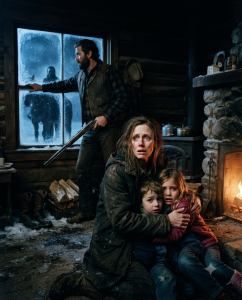
Mateo, the boy, clung to his sister Inés as Valeria guided them into the narrow room behind the kitchen. Emiliano barred the front door, banked the lamps lower, and moved to the side window rather than standing where a bullet might expect him.
“You always hide behind women and weather?” he called into the dark.
Rogelio laughed. “You always take in other men’s wives?”
“She stopped being yours when you started hunting her.”
A pause followed. Snow hissed against the walls. Horses shifted outside.
Then Rogelio said, “Give me the packet and I leave.”
“That simple?”
“It can be.”
Emiliano glanced toward the back room. “No. Men like you always come back.”
For the first time, Rogelio’s voice sharpened. “Then this ends badly.”
“It already did,” Emiliano answered.
The first shot shattered the window on the east side.
Glass rained across the floor. Inés screamed. Emiliano fired back once, not to kill but to force the men outside to cover. He moved fast, with the practised economy of someone who had spent years alone doing every difficult thing himself. Valeria, watching from the doorway despite his order, saw that he never wasted a motion or a breath.
The standoff might have lasted until dawn if not for Mateo.
The boy, terrified but alert, whispered that there was someone moving behind the barn. Not one of the men at the front. Someone sneaking around toward the back entrance. Emiliano believed him instantly. He pushed the children beneath the heavy kitchen table, handed Valeria a revolver from a drawer, and told her only one thing.
“If anyone comes through that back door who isn’t me, shoot low first, then higher.”
She stared at him. “I’ve never fired a gun.”
“Tonight you learn.”
He slipped out through a side hatch into the storm.
Valeria’s hands shook around the revolver. The cabin seemed to breathe with every blast of wind. Then footsteps approached the rear wall. A hand tested the latch.
She fired.
The shot went wide but close enough to draw a curse. A man stumbled away from the door. Seconds later another gunshot cracked outside, followed by a cry cut short. Then silence, except for the wind.
When Emiliano returned, snow streaked his shoulders and there was blood on his sleeve—not his. “One down,” he said. “Two left.”
“Rogelio?”
“Still moving.”
He looked at the packet on the table. “We don’t survive this by hiding in here until sunrise. We finish it.”
Valeria understood before he said more. The documents alone would not save them if Rogelio killed them all before morning. They needed witnesses. They needed the town. They needed daylight on secrets men preferred buried.
“There’s a bell at the chapel,” she said.
“And Don Lupillo keeps lantern oil stacked by the hitching rail,” Emiliano replied.
They looked at each other and reached the same conclusion.
He would draw the riders toward town. She would follow behind with the children once the path opened enough. It was madness. It was also the only move left.
What Rogelio did not know was that he had already lost one advantage: surprise. He expected panic. He expected flight. He did not expect Emiliano Rivas to saddle up in the middle of a storm and ride straight at him.
The clash in the yard was brutal and fast. Emiliano burst from the stable on horseback, firing once into the snow near Rogelio’s men and forcing their mounts sideways. One rider peeled off after him. The other stayed near the cabin. Rogelio shouted, trying to split control between pursuit and capture. It was the kind of confusion predators hated.
Valeria seized it.
She bundled Mateo and Inés into blankets, dragged them to the small storage sled behind the cabin, and hauled them toward the tree line where the wind broke just enough to breathe. The revolver rode heavy in her coat pocket. The packet of proof sat against her ribs like another heartbeat.
By the time they reached town, the storm had thinned from blinding to vicious. Chapel bells were not supposed to ring at that hour, and when Valeria seized the rope with both hands and sent the sound crashing over San Jacinto, doors flew open all along the square.
People emerged with lanterns, shawls, rifles, questions.
Then Emiliano came riding in, one of Rogelio’s men disarmed behind him and tied to the saddle horn.
Everything changed.
Rogelio arrived moments later, snow-caked and furious, expecting fear and finding a full square of witnesses instead. Don Lupillo stood on the cantina steps with a shotgun. The blacksmith came bareheaded with a hammer in one hand. Even the priest was there in his winter cloak, pale but steady.
Valeria stepped forward before doubt could spread.
“This man is not my dead husband,” she said, loud enough for the whole square. “He faked his death, hunted my children, and kept records of the men he betrayed.”
Rogelio smiled, trying charm first. “My poor wife is confused. She’s frightened. That rancher filled her head with stories.”
Valeria pulled the packet free and handed the ledgers to the priest, then to Don Lupillo, then to the alcalde who had just arrived tying his coat. Pages turned. Lantern light jumped across ink. Names were read aloud. Payments. Dates. Routes.
Then someone in the crowd said, “Read that one.”
The alcalde did.
It was the line naming Tomás Rivas.
A hush rolled through the square so complete that the horses stamped louder than the people breathed.
Emiliano did not move. His face had become unreadable in the way only true pain can make a face unreadable.
The alcalde continued. The entry described money taken to lure Tomás to a false meeting, men hired to ambush him, and extra pay issued when “the brother was removed and the body carried off to avoid claims.”
Carried off.
Not buried.
Not found.
Rogelio saw the danger too late. He lunged for the papers, but Don Lupillo leveled the shotgun under his chin and stopped him cold.
“You’ll stay exactly there,” the old cantinero said.
What happened next broke the story open wider than anyone expected.
The captured rider, shivering and bleeding from a wound in his shoulder, looked around the square, looked at Rogelio, and realized no one was rescuing him. “It wasn’t supposed to go that far,” he blurted. “The brother didn’t die there. We sold him.”
The crowd erupted.
Emiliano stepped forward at last. “Sold him to who?”
The man swallowed hard. “Mine overseers south of the state line. They paid for strong backs and no questions. Rogelio said a dead man is searched for. A vanished one is forgotten.”
Emiliano’s whole body went rigid.
Tomás had not died by the ravine. He had been trafficked, hidden, erased.
For a second Valeria thought Emiliano might kill Rogelio where he stood. Everyone seemed to think the same thing. But Emiliano’s grief had done something strange over the years: it had burned away recklessness and left only purpose.
“Take them both alive,” he said.
It was the clearest sentence anyone in town had heard from him in years.
The alcalde obeyed. By dawn, riders had been sent with the ledgers to district authorities. Within a week, two more names in the papers led to arrests along the route. Within a month, a chain of bribery, extortion, and forced labor camps began to unravel. And six weeks after the storm, a letter came from a mission near the border.
A man named Tomás Rivas had been found there recovering from fever.
Thin. Scarred. Alive.
When Emiliano rode out to bring his brother home, San Jacinto watched him leave in the first real sunlight they had seen since the storm. He came back twelve days later with Tomás beside him and half the town crying openly in the road.
Tomás was changed, of course. Men do not vanish into cruelty and return untouched. But he was alive, and that was enough to remake a family from the ashes of one.
As for Rogelio, the ledgers destroyed him more thoroughly than any bullet could have. He was tried on charges tied to fraud, conspiracy, extortion, kidnapping, and multiple deaths connected to his information. Men who once paid him now swore against him to save themselves. His names had bought him power. In the end, names buried him.
Valeria did not celebrate. Relief came to her slowly, like warmth returning to fingers after frostbite. She had lived so long in fear that safety felt unreal at first. Mateo stopped waking at every sound. Inés started laughing again, shyly at first and then with her whole face. They stayed in San Jacinto because there was nowhere else they wanted to be.
And Emiliano?
He did not become talkative overnight. Men like that do not thaw all at once. But he began showing up in town longer than necessary. He repaired the chapel gate without being asked. He stayed for coffee at Don Lupillo’s counter. He let Mateo trail him around the stable and answered Inés when she asked impossible questions with full, serious patience.
Valeria noticed before anyone else that loneliness had not made him stronger. It had only made him easier to mistake for stone.
One evening in early spring, after Tomás had regained enough strength to help with the fencing and the valley finally smelled more of dirt than snow, Emiliano found Valeria outside the cabin watching the children chase each other along the fence line.
“You asked me a question in the cantina,” he said.
She looked at him with the same steady eyes that had first unsettled him.
“I did.”
He shifted, almost uncomfortable. “I never answered.”
“No,” she said. “You didn’t.”
He glanced toward the children, toward the ranch, toward the life that had somehow returned to a place built for silence. “Turns out I was tired of the cold.”
Valeria smiled then—not because she had won, not because life had become easy, but because she heard in that sentence all the things he still could not say plainly.
People in town later called it a love story, but that was too neat for what it really was.
It was a story about a woman who refused to hand her children back to fear.
A story about a man who learned that grief and isolation were not the same thing as loyalty to the dead.
A story about proof hidden in a coat lining, a storm that forced every truth into the open, and one terrible night that dragged buried names into the light.
Valeria had gone looking for a man brave enough to stand between her family and danger. She found one.
Emiliano had spent years believing that opening his door again would only invite pain back in. Instead, when he opened it, life entered behind the storm.
And maybe that was the part that stayed with San Jacinto longest: not that Rogelio was caught, or that Tomás was found, or even that the coldest man in town finally stopped living like a ghost.
It was the smaller, harder question left behind after everything settled.
How many people had mistaken pride for strength?
How many silences had been called dignity when they were really just fear in a better coat?
And if Valeria had not walked into that cantina and asked the one question nobody else dared to ask, how many lives would have stayed frozen forever?