Mirabelle had stopped expecting mercy from the world a long time ago.
That was why, when she opened the door during the storm and found a man the size of a mountain dropping to his knees in the mud, her first instinct was not compassion. It was calculation. How fast could she shut the door? How long would the latch hold? If he forced his way in, where was the nearest knife?
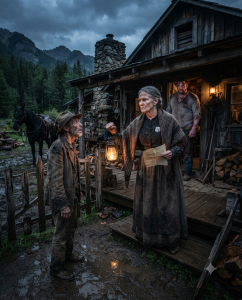
The thunder cracked behind him so hard the ravine seemed to answer. Cold rain whipped through the narrow pass, bringing with it dead leaves, grit, and the smell of split pine. The man on her doorstep bowed his head beneath it all and pressed his hat against his chest like a church boy confessing a sin.
“Ma’am,” he said, voice low and rough with exhaustion, “I’m not looking for trouble. Just somewhere dry till the storm passes.”
Mirabelle stared at him.
He was enormous. His shoulders nearly filled the doorway. Water streamed from his coat in sheets. Mud soaked the knees of his trousers. But it wasn’t his size that unsettled her most. It was the tears.
No one that large should have looked that ashamed of needing help.
Mirabelle’s shack leaned slightly to one side, as if years of hard weather and harder living had finally worn its spirit down. The roof had been patched with whatever materials she could afford or steal from abandonment. The stove smoked when the wind came wrong. The table limped on one shortened leg. A single bed sat in the corner beneath a small window that rattled all winter.
Cass had left her there years ago, bruised, thin, and quieter than she’d been as a girl.
Not dead, though maybe he’d expected that.
He had broken bones. Broken dishes. Broken the little flower wall her mother once built around the garden. Broken every easy instinct she had toward trust. By the time he was gone, Mirabelle had learned the one skill that mattered most in a place like theirs: how to sense danger before it crossed the threshold.
And danger was now kneeling in her yard.
“You’re bigger than my house,” she said, because fear sometimes came out sounding like wit.
To her surprise, the giant didn’t force a laugh. Didn’t bristle. He only lowered his eyes farther.
“No one’s ever let me in,” he said softly, “without first looking at me like I was the threat.”
Something old and tender shifted inside her.
Mirabelle knew that look. She knew the neighbors giving her careful smiles while Cass stood behind her with a hand too tight on her shoulder. She knew the doctor looking at her purple ribs and accepting her lie about the stairs. She knew the preacher’s wife telling her to endure with grace. She even knew the look from her own daughter, Lea, who had left at seventeen with a suitcase and a silence so deep it sounded like blame.
Mirabelle stepped aside.
“Come in,” she said. “The soup is thin, but it’s hot.”
The stranger ducked under the lintel. He moved with astonishing care, despite his size. He avoided the hanging pan by inches. Sat where she pointed. Kept his hands visible, spread over his knees like a man trying not to alarm a skittish animal. It was then she saw the rip in his sleeve, the dried blood along his forearm, and the bruise darkening one cheekbone.
“Who did that?”
He looked at the stove before answering. “Men from Elkridge.”
Mirabelle had heard of Elkridge. A settlement north of the ridge line. Proud people. Suspicious people.
“A little girl disappeared three days ago,” he said. “I was seen coming through the forest. That was enough for them.”
“And you didn’t fight?”
“Not until they said they’d fetch another child to frighten a confession out of me.”
He said it without drama. Without self-pity. That, more than anything, made Mirabelle believe him.
She set water to boil and found the cleanest rag she owned. When she approached, he tensed—not like a man ready to strike, but like a wounded animal unaccustomed to kindness. She washed the blood from his arm and found a split in the skin from what looked like the butt of a rifle.
“What’s your name?” she asked.
“Alder.”
“Mirabelle.”
He watched her wring out the cloth. “Thank you, Mirabelle.”
The words landed awkwardly, as though gratitude was not something he had often been allowed to speak.
Over the next hour, she learned pieces. Alder traveled alone. He worked where he could, mostly framing houses, lifting beams, fixing roofs. His size frightened people before his voice ever had a chance to reassure them. He’d grown used to leaving before suspicion became anger.
“I learned how to build houses,” he said. “Never learned how to stay in one.”
Mirabelle surprised herself by answering honestly. “I learned how to survive in one. Never learned how to call one home.”
Outside, the storm roared. Inside, two strangers shared weak soup and a silence that somehow felt less lonely than most conversations.
By dawn the rain had softened to a slow drip. Mirabelle woke to hammering.
She sat bolt upright, heart slamming, before realizing the blows were measured, purposeful, not violent. She pulled on her boots and stepped outside.
Alder stood on the roof as though it were no steeper than a road. He’d already replaced two warped shingles with spare boards stacked by the shed. Later he straightened the kitchen table, fixed the door so it no longer dragged, and climbed into the chimney with a brush made from birch twigs. By noon he had uncovered half the buried garden path beneath years of weeds and fallen stone.
Mirabelle stood with her hands wrapped around a mug she had long since forgotten to drink from.
“You don’t have to do all this,” she called.
Alder climbed down and wiped sweat from his brow with the back of one hand. “I know.”
“Then why?”
He looked around the yard. At the broken fence. The collapsed garden wall. The roofline sagging in the middle. His gaze held no pity, only recognition.
“Because this place isn’t ruined,” he said. “It’s wounded.”
No one had ever said anything so accurate about her home.
As he worked, memories rose like disturbed dust. Her mother kneeling beside the flowerbeds. Her father laying stones one by one into a neat path. The scent of marigolds. The sound of laughter before Cass had entered her life and taught her how quickly beauty could be punished.
One drunken night, after accusing her of thinking herself better than him, Cass had kicked through the garden wall and stamped flowers into the mud. “Women get proud when they think they’ve got something of their own,” he’d said.
Mirabelle had never rebuilt it.
Alder did not rebuild the wall either. Instead, he reset the old stones into a path leading from the front door out into the garden patch.
“Walls hide things,” he said. “Paths invite things back.”
Something in her chest twisted unexpectedly.
She was still looking at the stones when she heard horse hooves.
The sound reached her body before her mind. Her shoulders locked. Her breath shortened. The mug almost slipped from her hand.
A thin man rode up by the broken fence with the easy arrogance of someone who had never once doubted his right to trespass. He wore a crooked smile and a rifle across his back. The years had sharpened his face but not improved it. Cass still looked like a knife pretending to be charming.
“Well now,” he called. “Would you look at this.”
Mirabelle went cold.
Cass swung down from the saddle and swept his gaze over the yard, lingering on Alder with open contempt. “I leave behind a broken widow and come back to find a mountain squatting in my house.”
Mirabelle hated that her hands shook. Hated more that he noticed.
“It isn’t your house,” she said.
Cass’s smile widened. “Still trying that story?”
Alder stepped away from the path and came to stand several feet behind her—not in front of her, not taking over, simply there.
Cass noticed the black mare tied under the trees. His eyes lit with greed. “That horse yours?”
Alder’s face changed very little, but the temperature in the yard seemed to drop.
“She is.”
“Mighty fine animal.” Cass spat into the dirt. “Maybe I’ll take her. Since the widow’s been living on my land all this time, seems fair I collect something.”
Mirabelle felt a familiar dizziness, that awful old sensation of reality being rewritten in front of her. Cass had always done that. Claim a lie loudly enough, often enough, until people stopped arguing.
“Nothing here belongs to you,” she said.
He ignored her.
Alder took one step forward. “Touch that mare and you’ll understand why I stopped running.”
The words were quiet, but even Cass’s horse sidestepped.
Cass looked between them and laughed, though some of the confidence in it sounded forced. “I’ll come back tonight,” he said. “And this time I won’t knock.”
Then he mounted and rode off.
The yard stayed silent for several moments after he vanished down the trail. Mirabelle stood rigid, listening for the last of the hoofbeats. Fear spread through her with cruel familiarity. She knew what a threat meant in Cass’s mouth. It meant not only violence, but performance. Witnesses. Smirks. Denial. It meant waking the next morning and being asked what she had done to provoke him.
She went inside automatically and reached for the door bar.
Then she stopped.
Alder had followed, but he did not tell her what to do. He did not say she should flee, or stand, or trust him, or stay behind him. He simply waited.
That waiting gave her something she had not realized she’d been missing all her life: room.
Mirabelle looked around the shack. The repaired table. The warm stove. The roof patched against the weather. The old path outside, visible through the window, leading not into confinement but toward open ground.
“What are you thinking?” Alder asked.
She did not answer at first. Her gaze had fallen on the loose floorboard beneath the bed.
For years, beneath that board, she had kept a small wooden box wrapped in cloth. Cass had never found it because he had never considered she might have hidden something from him successfully. The secret had survived because his arrogance had been larger than his curiosity.
Mirabelle knelt and pulled the box free.
Inside lay a folded deed, yellowed at the edges, and beneath it a sheriff’s badge wrapped in faded linen.
Alder looked from the papers to her face. “What is it?”
“My father’s badge,” she said. Her voice sounded steadier than she felt. “And the deed to this land.”
Alder frowned. “Then Cass lied.”
“Yes.”
The word carried years inside it.
Her father had served as county sheriff before illness took him. He had been stern, decent, and not blind to the kind of man Cass was becoming. In the final weeks before his death, he’d called Mirabelle to his bedside and pressed the deed into her hands.
“He’ll try to take what he didn’t build,” he had told her. “Men like that always do. Keep this hidden until you’re safe enough to use it.”
But safety had never come. Her father died. Cass moved in harder than ever. Documents disappeared from drawers. Neighbors repeated whatever Cass told them. And Mirabelle, battered into smallness, learned that proof meant nothing if the wrong man controlled the room.
“Why didn’t you use it before?” Alder asked gently.
She met his eyes. “Because proof only matters if you survive long enough to show it.”
By dusk, the answer to whether Cass would come back had arrived in the black mare’s behavior. She paced and snorted, ears pinned toward the trees. Alder stood by the window.
“He brought others,” he said.
Mirabelle felt fear rise again, but it no longer filled every inch of her. There was something else now. Anger, old and clarified. Not the hot, reckless kind. The cold kind. The kind that could hold a lantern steady.
“How many?”
“Three. Maybe four.”
Then Cass’s voice rang out from the dark beyond the yard. Light, mocking, performative. He wanted an audience.
“Mirabelle!” he called. “Open up. I brought witnesses this time.”
Of course he had. Witnesses to confirm whatever story he planned to tell. Men willing to nod along while he seized the mare, bullied the widow, and perhaps dragged the giant away under some invented accusation.
Mirabelle looked down at the badge in her hand. Silver, dulled with age. Her father’s name was still engraved on the back. For a moment she remembered being small and standing in his shadow while townsfolk nodded respectfully as he passed. She remembered what it felt like to belong to a truth bigger than fear.
Then she took a lantern, lit it, and placed it in the front window for everyone outside to see.
Alder turned toward her. “Mirabelle—”
“No more hiding,” she said.
She tucked the deed inside her apron and pinned the badge to her dress.
Then she lifted the bar and opened the door herself.
Cass stood just beyond the porch with three men from the valley and another she recognized from Elkridge. Their expressions were smug, uncertain, amused. The kind of faces men wore when they expected a woman to tremble and a larger man to become the obvious villain.
Instead they found Mirabelle stepping onto the porch with her back straight and a lantern casting hard gold across her face.
Cass blinked first.
“What’s this?” he said, eyes flicking to the badge.
“My father’s,” Mirabelle replied. “You remember him, don’t you, Cass? The man who knew exactly what you were before I did.”
Something in the yard shifted. One of the men glanced at another.
Cass recovered quickly. “Put on all the metal you like. This is still my property.”
Mirabelle unfolded the deed and held it where the lantern light could catch the county seal.
“No,” she said. “It never was.”
For the first time that night, Cass’s smile faltered.
He stepped toward the porch. Alder moved into the doorway behind her, silent and immense. The men Cass had brought noticed him fully then—not as rumor, but as fact. Huge, bruised, calm, and very much not afraid.
Cass pointed at Alder. “He’s the trespasser. And maybe worse than that. Elkridge is looking for—”
“The missing girl was found this afternoon,” said the man from Elkridge abruptly.
Everyone turned.
He cleared his throat, uncomfortable under the sudden attention. “She was hiding in her aunt’s root cellar. Came out on her own. Said she ran because she was afraid of being sent away.”
The yard went still.
Cass’s jaw tightened. “What?”
The Elkridge man looked embarrassed. “Word spread late.”
Alder said nothing. He didn’t need to.
Every bruise on his face now had a witness attached to it. Every assumption in the yard became visible all at once, ugly and cheap in the lantern glow.
Mirabelle took one step down from the porch. “So let us be clear,” she said, voice carrying farther than she thought it could. “This land is mine. That man behind me did nothing except survive being blamed by cowards. And you”—she fixed her eyes on Cass—“have been using my fear as your deed for years.”
Cass lunged for the paper.
He never reached it.
Alder moved so fast the motion barely seemed possible in a man his size. He caught Cass by the wrist, twisted just enough to stop him, and held him there—not striking, not raging, simply ending the performance. Cass gasped and dropped to one knee in the dirt.
“You don’t get to touch her again,” Alder said.
One of the valley men muttered, “That’s enough, Cass.”
Another stepped back entirely.
Cass looked around for support and found almost none. His power had always depended on a crowd willing to mistake loudness for authority. Tonight, under lamplight and paper and truth, the illusion thinned.
“Get off me!” he snapped.
Alder released him instantly.
Cass staggered up, clutching his wrist, humiliated more than hurt. That was when Mirabelle saw the deeper wound land: not pain, but disbelief. He could not understand why the room—why the world—was not obeying him this time.
She descended the final step and stood directly in front of him.
For years she had imagined this moment as rage. Shouting. Trembling revenge. Instead it came with eerie calm.
“You said this house was yours,” she told him. “But all you ever did was damage what other people built.”
Cass’s mouth opened, searching for the old script. Liar. Hysterical. Ungrateful. Weak.
She did not let him begin.
“You broke my garden because you hated that it was beautiful. You beat me because you hated that I might outlast you. You told everyone I was nothing so often you started believing it yourself.” She touched the badge pinned to her dress. “But I was never nothing. And you were never owner, husband, protector, or king. Just a coward who needed a frightened woman to feel tall.”
None of the men behind him laughed. None spoke at all.
That silence finished what her words had started.
Cass took a step back.
Then another.
He looked at the deed, at the badge, at Alder, at the witnesses who were no longer his, and finally at Mirabelle. Really looked at her. Perhaps for the first time. Not broken widow. Not property. Not a place to leave his anger.
A person who was done.
He spat in the dirt once more, but now it looked less like contempt and more like defeat. “This isn’t over.”
Mirabelle met his gaze. “For you, maybe not. For me, it is.”
Cass mounted his horse badly and rode off without another word. One of the valley men followed. Then another. The Elkridge man lingered long enough to mutter an apology toward Alder before disappearing into the dark.
When the yard emptied, Mirabelle realized her knees were shaking.
Alder stepped beside her but did not touch her until she leaned, just slightly, into his arm. The black mare had gone still. Somewhere in the garden, crickets resumed their song as if the whole valley had been holding its breath and had finally let it go.
In the days that followed, word traveled fast.
The widow had produced a deed. The sheriff’s daughter had worn her father’s badge. The giant from the woods had been innocent. Cass had been driven off his own lie.
Some neighbors came with awkward offers to help mend the fence. Some came with apologies too late to be useful but perhaps not entirely worthless. Mirabelle accepted what was sincere and turned away what wasn’t. That surprised people most of all.
Lea returned before the first frost.
Mirabelle saw her at the end of the stone path Alder had repaired, standing with a travel bag in one hand and tears in both eyes. Mother and daughter held each other in the yard where fear had ruled for too many years, and neither spoke for a long time. Some griefs were too old for quick language.
Alder stayed on through the season, first to finish repairs, then because no one asked him to leave, and then because one evening Mirabelle set an extra bowl on the table without thinking and realized the house no longer felt crowded by his presence. It felt steadier.
Home, perhaps, arrived that way. Not all at once. Not with declarations. Through small permissions. Through safe silence. Through a path restored stone by stone.
By spring, flowers had returned to the garden where the wall had once stood. Mirabelle never rebuilt that wall. Alder was right. Walls hid things. Paths invited things back.
Sometimes, on cold mornings, she would touch her father’s badge where it hung by the hearth and think about the strange shape justice had taken in the end. It had not arrived wearing a hero’s grin or carrying perfect timing. It had come as a storm, a weeping giant, an old deed, and a woman finally deciding that survival was no longer enough.
People in the valley argued for months over the story. Some said Mirabelle should have fought back years earlier, as though fear were a choice and not a cage built one day at a time. Others said Alder should have broken Cass’s jaw and been done with it. A few insisted the biggest red flag had always been how quickly the town believed a gentle stranger was a monster and a cruel familiar man was respectable.
Mirabelle had her own answer.
The worst danger, she learned, was never the storm you could see coming over the ridge.
It was the person who taught you to doubt your right to stand in your own doorway—until the day you finally did, and they discovered the house had never belonged to them at all.