By the time Clara Whitmore stepped down from the stagecoach, Georgetown had already decided what kind of woman she was.
Not by her voice. Not by her manners. Not by the grief she carried or the courage it had taken to leave Cincinnati and travel two thousand miles into the mountain cold to marry a man she knew only through letters. They decided by the sight of her. By the shape of her body. By the way her dress sat on her hips. By the fact that Ethan Callaway, a quiet rancher with no wife and too much loneliness in his eyes, had sent away for someone the town did not consider worthy of a storybook arrival.
So when the chain snapped, the whole street reacted as if judgment itself had been proven right.
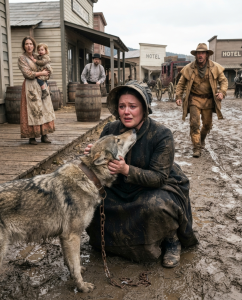
The sound came sharp and sudden. Clara had just steadied her travel bag when a gray blur launched from the edge of the yard across from the station house. Women screamed. A little boy cried. A teamster cursed and nearly dropped his reins. Shadow, Ethan Callaway’s wolfdog, tore toward the crowd with such force that even the men who liked to boast about not fearing beasts took two panicked steps back.
Clara barely had time to turn.
Then the animal hit her.
Her feet slid in the wet street and she crashed into the mud on both knees, one gloved hand sinking deep as cold filth splashed up her sleeves. The crowd gasped as if they had just watched a death begin.
Instead, the massive creature shoved his head beneath her chin and made a low, ragged sound that didn’t belong to rage at all.
It sounded like recognition.
It sounded like relief.
Clara froze. Not because she feared him, but because she understood something no one else there did. Animals did not lie the way people did. They did not flatter or judge or perform. They knew what hurt felt like. They knew fear. They knew kindness. Whatever this dog was, whatever blood made people call him half wild, he was not trying to harm her.
So Clara did the one thing the whole town would later call absurd.
She wrapped her arms around him.
The crowd fell into stunned silence before the whispers began.
“Mercy, look at that.”
“Ethan brought home a mail-order bride and the first thing she does is roll around with his dog.”
“Poor fool must’ve been desperate.”
Clara stood slowly, skirts dripping mud, Shadow pressed to her side, and kept her face calm while their laughter scraped against old scars. She had survived this kind of cruelty too many times to mistake it for surprise. People always dressed contempt as amusement. They said terrible things and expected her to absorb them quietly. She had been doing that since childhood.
She remembered being nine years old, holding out her lunch tin in a schoolroom while her teacher told her mother, in front of everyone, that a girl of Clara’s size had no business asking for more bread. Clara remembered the hot sting behind her eyes. Her mother’s embarrassed silence. The way shame could crawl into a child and take up residence so deeply that years later she would still feel it in rooms full of strangers.
But Clara had buried her shame with her mother six months earlier.
What remained was harder.
When Ethan Callaway finally reached her, he looked less embarrassed than bewildered. He was taller than she expected, his face weathered by wind and altitude, his mouth set in the cautious line of a man who had spent too much time alone. Yet his eyes were not cruel. They were tired, observant, and deeply troubled as he stared at Shadow.
“Miss Whitmore,” he said, breathing hard, “I owe you an apology. He’s never done that before. Not with anyone.”
Clara brushed mud from her sleeve. “He didn’t frighten me.”
Ethan looked at the dog sitting squarely against her boot as if guarding her from the town itself.
“No,” he said after a moment. “It appears he didn’t.”
That should have been the end of the spectacle. Instead, it marked the beginning.
As Ethan carried her larger suitcase toward Mrs. Aldridge’s boardinghouse, Georgetown watched them like theater patrons unwilling to miss the next embarrassing scene. A woman in a fashionable blue dress said, loud enough for three storefronts to hear, “When a man is lonely enough, he lowers his standards.”
Ethan stopped so abruptly that Clara nearly walked into him.
The muscles in his jaw tightened. He was ready to answer, and not politely. Clara could feel it.
“No,” she said under her breath.
He turned. “That woman had no right.”
“She wanted a reaction,” Clara replied. “People like that feed on one.”
His expression shifted then, anger giving way to something more vulnerable. “How long have you been expected to endure that?”
Clara met his eyes. “Long enough to know it never satisfies them.”
That answer stayed with him. She could see it.
Mrs. Aldridge proved to be a blessing. A widow with practical hands and a voice worn smooth by years of running a boardinghouse, she showed Clara to a clean room overlooking the mountain and commented only on which side of the house kept warmer in the evenings. No pity. No suspicion. No false sweetness. Clara almost could have cried from gratitude.
At the stairs, Ethan paused. Shadow lingered beside him, though the dog’s attention remained fixed on Clara.
“I read every one of your letters,” Ethan said. “More than once.”
Clara felt suddenly defenseless in a way the town’s cruelty had not managed.
“And?” she asked.
“And none of them made me expect less of you.”
He said it plainly, which made it powerful. No attempt to rescue her feelings. No romantic flourish. Just respect.
After he left, Shadow ignored all boundaries, entered Clara’s room, and settled himself beside the bed like a soldier taking his watch. Clara touched the rough fur at his neck. Up close, she noticed scars beneath the thick coat. Old ones. He had fought before.
“Did you choose me,” she murmured, “or are you trying to tell me something?”
Shadow opened one amber eye, then let it drift shut again.
By dawn, Clara understood that first day in Georgetown was not merely unpleasant. It was charged. Something in the town had shifted the moment she arrived. She could feel it the way some people feel weather pressure before a storm.
The name she heard most often before noon the next day was Silas Mercer.
She learned it from Mrs. Aldridge over breakfast and from the hushed way other boarders lowered their voices when he passed the window. Silas owned the mercantile, held several mortgages, had influence over the mining routes, and, according to nearly everyone, had a hand in every important decision Georgetown made. Men deferred to him. Women smiled too carefully around him. He was wealthy, polished, generous in public, and feared in ways no one spelled out directly.
“He likes to be useful,” Mrs. Aldridge said dryly while pouring coffee.
That was all. But the look she gave Clara said more.
Ethan arrived just after sunrise carrying a torn strip of dark cloth and a mood darker than that.
“Found this on my fence,” he said.
Clara took the fabric between her fingers. It was fine quality. Not something a ranch hand would wear. Caught among the threads were short gray hairs unmistakably belonging to Shadow.
“Someone came to your yard?”
“In the night.” Ethan glanced at the dog. “Shadow nearly tore through the side gate trying to get at whoever it was.”
Before Clara could answer, Mrs. Aldridge called them downstairs.
A letter lay on the front table.
No envelope. No seal. Her name written across the front in a controlled, elegant hand that struck her like ice under the skin. She had seen writing like it once before, months ago, attached to papers that informed her her late mother’s small house in Cincinnati had been taken to settle an old debt Clara never knew existed.
She unfolded the page.
Leave Georgetown while you still can.
Next time the dog won’t reach you first.
The room turned thin and cold around her.
Ethan read the message over her shoulder, then looked across the street through the boardinghouse window. Clara followed his gaze.
A man was stepping out of Silas Mercer’s mercantile, adjusting the cuff of a dark coat with a fresh tear near the sleeve.
Clara saw the exact shape of the rip.
It matched the cloth in Ethan’s hand.
“That’s Deputy Ren Wick,” Ethan said, his voice flat.
The air changed. Clara understood immediately why that mattered. A stranger sneaking into Ethan’s yard was one problem. A lawman doing it at night was another altogether.
By noon, Silas Mercer himself appeared at the boardinghouse to welcome her.
He was handsome in the polished, expensive way men sometimes became when power protected them from consequence. Silver touched his temples. His coat was tailored. His smile arrived at the correct moment and not a second early. He bowed over Clara’s hand with practiced charm and said, “Miss Whitmore, Georgetown hopes you’ll forgive a rough first impression. Small towns can behave badly when they’re surprised.”
Clara withdrew her hand before he held it too long. “I’ve found that true of men as well.”
Something flickered in his eyes. Appreciation, perhaps. Or irritation disguised as it.
Silas offered assistance, an invitation to supper once she was settled, and a dozen smooth assurances that he considered himself a friend to Ethan’s household. Shadow, who had been dozing near the door, rose the instant Silas entered.
The dog did not bark.
He stood perfectly still, hackles high, lips peeled back just enough to show the edge of his teeth.
Silas noticed. “Still can’t abide me, can he?”
“He reacts to people for reasons,” Clara said.
Silas smiled. “Animals are sometimes wrong.”
Shadow growled then, low and absolute.
Silas laughed, but too quickly. “Or jealous.”
Once he left, Clara turned to Ethan. “How long has Shadow hated him?”
Ethan hesitated. “Since the night my brother died.”
That was the first true fracture in the story Georgetown had been telling.
Ethan’s younger brother, Thomas, had been killed six months earlier in what the town called a mining accident on Mercer land. Rocks gave way. A support beam failed. Tragic, unfortunate, unavoidable. Ethan did not speak of it much. But when he did, Clara saw the strain beneath his restraint.
“Thomas was careful,” Ethan said that evening as they walked the edge of the ranch. “He knew those tunnels. He said Silas had been cutting costs. Using bad timber. Ignoring water seepage. He was going to take his concerns to the county.”
“What happened?”
“He died before he could.”
Shadow paced ahead of them, nose low to the ground.
“Did your brother keep records?” Clara asked.
Ethan looked at her sharply. “Why?”
“Because men like Silas don’t send warnings unless they fear something.”
They searched Thomas’s old things that night in the loft above the barn. Most of it was ordinary—work shirts, ledgers for feed, a Bible, a few letters. Then Clara found a false bottom in a small cedar chest. Inside was a notebook wrapped in oilcloth.
Thomas’s handwriting filled the pages.
Dates. Supply counts. Beam measurements. Water damage reports. Payments made off ledger. Names of men pressured to stay silent. And one entry written three days before his death:
If anything happens to me, Mercer knew the north tunnel would fail. Ren saw the books. He’s taking Mercer’s money.
Ethan read the line twice, then sat down hard on an overturned crate as if his legs no longer trusted the floor.
Clara felt fury rise inside her with a clarity that almost steadied her.
This was why Shadow had run to her.
This was why someone had lurked outside her window.
Silas Mercer knew Ethan had brought home a stranger—someone he could not predict, someone not raised inside Georgetown’s frightened loyalties, someone who might see what the rest of the town had trained itself not to see. And the dog had sensed danger before Clara even understood the board she had stepped onto.
The next days tightened around them.
Word spread that Clara was meddling in matters above her understanding. Women who had mocked her on arrival now studied her with a more careful hostility, as if she had become inconvenient. Ren Wick lingered near the boardinghouse twice in one afternoon. A rock came through Clara’s window after dark with no note attached, which frightened her more than the first letter had. Anonymous cruelty often meant growing desperation.
Mrs. Aldridge, who missed very little, took to bolting the front door before sunset.
“You know what bothers bad men most?” she said while sweeping up broken glass. “A witness they don’t know how to shame into silence.”
Clara gave a bitter smile. “They’ve been trying all my life.”
“Yes,” Mrs. Aldridge said. “And yet here you are.”
They decided to take Thomas’s notebook to the county judge in Silver Bend, two days away by rail. Ethan wanted to leave at first light. Clara agreed.
Silas moved faster.
That night the barn was set ablaze.
Clara woke to shouting and the smell of smoke so thick it scorched her throat. Ethan was already outside hauling buckets while flames clawed up the dry wood. Horses screamed in their stalls. Clara ran barefoot into the yard before anyone could stop her. Shadow shot past her through sparks and heat, disappearing into the side entrance.
“Shadow!” Ethan shouted.
A moment later the dog emerged dragging a canvas satchel in his jaws.
Thomas’s notebook was inside.
Then the roof groaned, and the whole front side of the barn collapsed.
By dawn, half the structure was gone.
So was any remaining doubt.
Mercer could no longer rely on gossip and warning letters. He was trying to destroy evidence before it reached Silver Bend.
That afternoon Clara did something Georgetown did not expect from women like her. She walked straight into Mercer’s mercantile.
Conversations died around her.
Silas stood behind the polished counter, immaculate as ever, as if fire and threats and corruption were all stories beneath him. “Miss Whitmore,” he said warmly. “How may I help you?”
Clara placed the torn fabric on the counter.
Then the threatening letter.
Then Thomas’s notebook.
The room went so quiet she could hear someone breathing in the back.
Silas’s smile thinned. “You should be careful what accusations you imply.”
“You should be careful where your deputy catches his sleeve,” Clara replied.
His eyes hardened. “You are not from here. You don’t understand how things work.”
“No,” Clara said. “That’s the problem for you. I understand exactly enough.”
He lowered his voice. “Ethan Callaway is not a powerful man. He cannot protect you.”
Clara leaned closer. “Neither can fear, apparently.”
For the first time, his mask slipped.
Not much. Just enough.
Enough for the men nearby to see a flash of the temper beneath the polish.
Enough for Mrs. Aldridge—who had followed Clara in without being noticed—to say loudly, “Interesting. Innocent men don’t usually look angry at records.”
Others murmured. Then one miner at the back cleared his throat and said, “Thomas warned me too.”
Another spoke up. Then another.
That was the thing Silas Mercer had forgotten: silence looks solid until one voice cracks it.
Ren Wick tried to seize the notebook. Shadow, who had appeared in the doorway like judgment itself, lunged with a snarl so fierce the deputy stumbled backward into a display of lantern glass. No blood was drawn. None needed to be. The whole store saw whom the dog chose.
Saw whom he would not let near the evidence.
Saw fear on the wrong faces.
By evening, the county marshal had been summoned from Silver Bend by telegraph. He arrived with two men and none of Mercer’s local loyalties. Thomas’s records, the torn cloth, witness statements, and the deputy’s shifting answers did the rest. Under pressure, Ren Wick broke first. He admitted Mercer had ordered him to search Ethan’s property for Thomas’s notebook after hearing Ethan was bringing a bride from Cincinnati who had “book-learning and a dangerous habit of asking plain questions.”
Mercer had not expected Clara to stay.
He had counted on humiliation doing what threats later could not.
He had assumed the town’s laughter would drive her back the way cruelty had probably driven other women from other places before.
Instead, it hardened her resolve.
Mercer was arrested before midnight. Ren Wick went with him. More charges followed in the weeks after—fraud, coercion, falsified safety records, intimidation, arson, conspiracy in connection with the tunnel collapse that killed Thomas Callaway and two miners whose widows had been paid to keep quiet. Georgetown had not merely lived under one corrupt man. It had learned itself around him.
When the dust settled, people behaved differently around Clara.
Some apologized awkwardly. Some avoided her, ashamed. Some never changed at all. Cruel people rarely become kind just because they’ve been proven wrong. But their certainty had been broken, and that mattered.
One afternoon outside the post office, the woman in the blue dress who had insulted Clara on her first day approached her with reddened cheeks and said, “I misjudged you.”
Clara considered her for a long moment. “No,” she said calmly. “You judged me exactly as you wished. You were simply mistaken.”
Then she walked on.
Ethan laughed when she told him later, the first unguarded laugh she had heard from him. It changed his whole face.
What began between them after that was not sudden and not decorative. It was built carefully, like something both had reasons to respect. He never treated her gratitude as obligation. She never mistook his steadiness for emptiness. They talked on the porch after supper. They argued gently about practical things. They grieved Thomas together. And all the while Shadow stayed close, especially when either of them fell silent too long.
Months later, when Ethan asked Clara whether she regretted coming to Georgetown, she looked out over the yard where the rebuilt barn stood stronger than the first and thought about the answer.
“I regret what brought me here,” she said. “Not that I came.”
He nodded as if that made perfect sense.
It did.
Because Clara had not found a fairy tale in Georgetown. She had found something harder, and maybe more valuable. She had found proof that the voices which tried to shrink her had never been evidence of her worth. They were evidence of other people’s cowardice.
And the strangest, sharpest truth of all was that the first soul in Georgetown to recognize her clearly had been the one everyone called a beast.
In the end, Shadow had not only exposed the men trying to ruin Ethan’s life and erase Thomas’s death. He had revealed something else the town did not want to admit: sometimes the wildest thing in a place is not the animal baring its teeth, but the respectable man smiling while he destroys people behind closed doors.
Some in Georgetown said Clara saved Ethan.
Others said Ethan saved Clara.
Mrs. Aldridge, when asked, only snorted and said they were both fools until the dog intervened.
Maybe she was right.
But years later, whenever anyone told the story of the mail-order bride who landed in the mud on her first day in town, they always began the same way—with laughter, fear, a broken chain, and a wolfdog running straight past everyone else to the one person worth trusting.
And perhaps that was the part that stayed with people longest.
Not that Clara proved the town wrong.
But that the creature they feared saw the truth first—and chose her before she had any reason to believe she should choose herself.