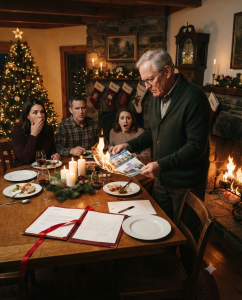
At Christmas, Martin’s children gave him a retirement home brochure wrapped in gold paper.
At first glance, it might have passed for an awkward family joke. The wrapping paper shimmered under the tree lights. The brochure itself was glossy and expensive-looking, the kind printed to make old age seem like an extended stay at a country inn. There were smiling seniors in bright cardigans, polished hallways, fresh flowers at the reception desk, and tidy little captions about comfort, community, and peace of mind.
His children laughed when he opened it.
That was what made it sting before he even understood the full shape of it. Laughter has a way of disguising cruelty. It gives people somewhere to hide.
Martin sat at the head of the dining room table with the brochure in his hands and looked from one face to the next. His oldest daughter wore the expression she always used when she was about to tell someone a hard truth she thought made her superior. His son had that false patience people borrow when they expect resistance. His youngest daughter leaned back with one ankle crossed over the other, eyes bright with the kind of confidence that came from assuming the evening would go exactly as planned.
The fire burned low in the stone fireplace. The Christmas tree glowed in the corner. A platter of ham cooled between bowls of potatoes and green beans no one seemed interested in anymore. Outside, snow had started falling in slow, loose flakes that blurred the dark windowpanes. Inside, the air smelled like cloves, pine, and the pie his wife used to make every year until illness had taken too much from her hands.
Three winters gone, and still every Christmas in that room began with her absence.
Martin lowered his eyes to the brochure again.
A retirement home.
Wrapped like a present.
He felt something sink heavily inside him, not because he was surprised that his children worried about his age, but because he immediately recognized the care that had gone into arranging the moment. They had not stumbled into this conversation. They had prepared it. Chosen the day. Chosen the packaging. Chosen the time when he would be sitting under his own roof, surrounded by symbols of family, assuming himself safe.
His oldest daughter set down her glass and spoke first.
“Dad,” she said, voice gentle in that overly managed way that meant she had practiced it, “this house is too big for you now.”
His son added, “And those stairs really are dangerous. You almost slipped last winter.”
His youngest nodded toward the papers in his hand. “Honestly, selling the property would help everyone move forward.”
Everyone.
Martin repeated that word silently as he looked around the dining room he had built with his own hands. He had framed those walls himself. Sanded those floors. Laid the stone around the fireplace in the July heat while his son, still a boy then, ran through piles of lumber with a plastic hammer tucked into the back of his shorts. The table where his children now sat had once been covered with coloring books, school forms, birthday candles, and later unpaid bills hidden under placemats so their mother would not worry.
On the mantel still hung four stockings: the three embroidered ones for the children, and the fourth with his wife’s name, untouched since the year she died. He had thought about putting it away after the funeral. He had even taken it down once. But he could not bear to fold it into a box and call that healing.
The room carried her everywhere.
In the lace runner she brought out every December.
In the chipped gravy boat she refused to throw away.
In the paper angel on the tree with one bent wing, made by the youngest when she was seven and furious that glue would not dry fast enough.
The house was not merely a place where Martin lived. It was the visible shape of everything he and his wife had built out of work, patience, sacrifice, and years no one ever got back.
His son pulled a leather folder closer and took out a document.
Then he slid a pen across the table.
“Just sign the listing agreement, Dad.”
The pen stopped near Martin’s plate with a tiny click.
Silence fell so quickly it felt arranged too.
Martin looked at the pen. Then at the agreement. Then at his children.
He waited for someone to break, to admit the cruelty of it, to say they had gone too far. Instead, he saw only impatience beginning to show through the polished concern. His youngest daughter’s mouth tightened. His son looked ready to explain market conditions. His oldest daughter stared at him with the strained expression of someone who believed moral authority belonged to whoever spoke calmly enough.
The hurt that rose in Martin was sharp, but beneath it was something steadier. Not shock. Recognition.
People revealed themselves slowly for years and then all at once in one conversation.
He smiled, and the smile unsettled them immediately.
“You always did open presents too early,” he said.
His son frowned. “What?”
Martin pushed back his chair and stood.
The old floor creaked beneath his weight as he crossed the room toward the grandfather clock in the corner. It had belonged to his wife’s parents and had always chimed five minutes late. Every visitor had eventually commented on it. Every visitor had asked why Martin never fixed it.
Because she had forbidden him to.
“It reminds me of me,” she used to say, laughing while searching for a glove or pinning up her hair with one hand. “Always late, always forgiven.”
He had loved that about her. He had loved a hundred impossible little things like that.
Now, under the gaze of his children, he reached behind the clock face and opened the small panel in the back.
His youngest daughter sat forward. “Dad?”
From the hidden compartment he withdrew a folder tied with a red ribbon. He held it a moment longer than necessary, feeling the weight of old paper and old promises. His wife had placed it there herself in the final months of her illness, when her body had weakened but her mind had sharpened into something nearly prophetic.
“Keep it hidden,” she had told him from the hospital bed they eventually brought into the downstairs study. “Maybe you’ll never need it. I hope you never need it. But if they ever mistake your softness for permission, you show them.”
He had promised.
Then he had spent three years hoping the promise would remain unnecessary.
Back at the table, he set the folder down and untied the ribbon.
Inside were three documents: a trust agreement, a handwritten letter, and a final amendment page notarized and dated just weeks before his wife’s death.
His oldest daughter’s composure slipped first. “What is that?”
Martin adjusted his glasses. “Your mother and I changed the estate plans after her diagnosis.”
His son gave a quick dismissive laugh. “Dad, nobody’s fighting over your estate.”
Martin looked at him until the laugh faded by itself.
He slid the trust agreement across the table.
At first they read with the confidence of people expecting a technicality. Martin retained lifetime occupancy. Yes, fine. His care preferences. Fine. The property held in trust rather than passing immediately. Mildly inconvenient perhaps, but manageable.
Then they found the clause.
The house could not be sold, transferred, leveraged, or partitioned by any child who attempted to coerce, pressure, manipulate, or remove their father from the home against his will.
Any child who did so would lose all claim to the property and any proceeds related to it.
Not delayed.
Not disputed.
Forfeited.
His son read it twice. His oldest daughter took the page and scanned it line by line as if legal language might turn merciful through repetition. His youngest daughter leaned in, then froze.
“That can’t be real,” she said.
“It is,” Martin replied.
“That’s extreme,” his son snapped.
Martin said nothing.
Extreme.
He thought of sitting up through entire nights while his wife coughed blood into folded towels because she did not want the children to see how bad it had become. He thought of lifting her in and out of bed after she could no longer manage the stairs. He thought of promising her that as long as he could stand, no one would move him out of the house where she wanted to die.
He thought of the way she had gripped his wrist and said, with startling clarity, “They love you. But love and greed can sit at the same table and wear the same face.”
He had hated hearing it then.
He hated remembering it now.
He reached for the second document. The letter.
He had never opened it. She had sealed it herself with trembling fingers and written on the front, For the children, but only if they force your hand.
His oldest daughter opened it carefully. Her voice shook as she began to read.
“My dear children,
If you are reading this, it means you have mistaken your father’s kindness for weakness.”
The sentence landed like a door slamming shut.
No one interrupted. Even the youngest went still.
The letter continued in the same firm, painfully familiar voice.
She wrote that the house was not just an asset. It was Martin’s labor made visible. It was the place where he had come home after double shifts and still found the strength to repair a leak, coach a team, comfort a child, or sit quietly at the table until someone was ready to confess what they had broken. It was the place where she had been carried when walking became too painful. Where he had slept in a chair beside her final bed because he would not leave her alone at night.
Then came the part that made his son’s jaw harden and his daughters lose all color.
“If any of you ever tries to take this home from him for convenience, profit, or impatience, then you have already chosen what matters more to you. And you should not be rewarded for it.”
His youngest daughter stood so abruptly her chair legs scraped the floor.
“That’s not what this is,” she said. “We were trying to help.”
“With a listing agreement?” Martin asked.
No one answered.
The oldest daughter, who had always hidden behind reason, tried next. “Dad, we’re talking about the future. Maintenance. Liability. What happens if you fall and no one knows?”
Martin looked at her with something quieter and more devastating than anger.
“You could have brought me a medical alert system,” he said. “You brought me a brochure.”
That broke whatever was left of the room’s pretense.
His son shoved back from the table. “You’re twisting this.”
“Am I?”
“Yes. We’re being practical.”
“Practical,” Martin repeated. “That seems to be the family word for abandoning something inconvenient.”
His son opened his mouth, then closed it again.
The youngest daughter crossed her arms. “So what, now? We make one mistake and Mom cuts us all out forever?”
Martin’s gaze dropped to the final page still resting beneath the others.
“Not all,” he said.
The room sharpened around that answer.
He slid the amendment page into the center of the table.
At the top, in his wife’s unmistakable hand, was an added directive: Martin alone retained the right to determine whether coercion came from malice, weakness, or influence. One child, she wrote, had always followed stronger personalities. One had learned to dress self-interest as concern. One had a habit of turning family pain into opportunity.
Her final instruction was devastating in its clarity. Forgiveness, if any was granted, was his to decide. But the child who initiated the effort to remove him from the home should receive none.
The youngest daughter grabbed the page first.
By the time she reached the bottom, her face had gone white.
“She means me?” she said.
Martin did not answer immediately, because the truth had been settling into place for longer than just that evening. He remembered the phone calls from her over the past month. Questions about the market. Casual mentions of developers buying in the area. Her oddly specific curiosity about whether the house was held jointly, whether there was still a mortgage, whether he had ever had the property appraised. The way she had said, “You don’t need all that space, Dad,” with her voice half pity, half calculation.
His son looked at her then with sudden suspicion. “You told us it was just about safety.”
She turned on him instantly. “Because that’s how you get him to listen.”
The oldest daughter stared at her. “What do you mean, that’s how you get him to listen?”
No one moved.
And suddenly the polished family intervention cracked open into what it had always been: not a united concern, but a coordinated push led by one person who had counted on the others to soften the blow.
His son’s face changed first from anger to realization. “You already talked to a realtor, didn’t you?”
She said nothing.
“You did,” he said.
The oldest daughter reached across the table and snatched the leather folder he had brought. She flipped it open and found the business card clipped inside. Not his. Not hers. The youngest daughter’s.
The room changed again.
This time the silence was ugly.
“I was exploring options,” the youngest said at last, but even she could hear how weak it sounded.
“Before asking Dad?” the oldest said.
“We all knew he’d never agree.”
Martin almost laughed at the honesty of that.
His son rounded on his sister. “You told us the trust stuff was probably simple. You said if he listed now, we could avoid a mess later.”
She shot back, “Don’t act innocent. You asked what the place might be worth split three ways.”
The words hit and stayed there.
Martin watched his children turn on one another over the same table where they had once built gingerbread houses with sticky fingers and crooked smiles. He did not interrupt. Sometimes the truth came out only when people forgot to keep themselves tidy.
His oldest daughter lowered herself slowly back into her chair. “Oh my God,” she whispered. “Mom knew.”
Martin looked at the letter. “Your mother knew people better than any of us wanted to admit.”
The youngest daughter’s eyes filled, but her anger held. “So this is it? You humiliate us and burn the brochure and now what? We just leave?”
Martin stood and picked up the retirement home brochure again. The glossy paper reflected the firelight in soft orange flashes. Somewhere in that building, he imagined, there were likely kind nurses and lonely residents and decent people doing difficult work. His contempt was not for the place. It was for the use of it. For the insult dressed up as concern.
He opened the fireplace screen and placed the brochure on the flames.
The paper darkened, curled, and caught.
Gold wrapping twisted into black ash.
His children watched without speaking.
“Merry Christmas,” he said.
No one answered.
For a few seconds all they could hear was the crackle of burning paper and the faint ticking of the late clock.
Then his oldest daughter began to cry. Not loudly. Not dramatically. Just the kind of stunned, private crying that happens when a person realizes she had been standing on the wrong side of a line without noticing when she crossed it.
“I didn’t know,” she said. “I swear I didn’t know she’d talked to a realtor.”
Martin believed her. That was the problem with families: the guilty were not always equally guilty. Weakness had its own damage. Silence could wound almost as deeply as greed.
His son sank back into his chair and rubbed both hands over his face. “I thought…” He stopped and tried again. “I thought maybe it was time. That’s all.”
Martin looked at him. “Time for what?”
His son stared at the table. “I don’t know.”
But Martin did know.
Time to stop seeing their father as a man with a life and start seeing him as a problem to solve.
Time to translate memory into market value.
Time to divide what was not yet theirs.
He returned to his seat but did not pick up his fork.
“Listen to me,” he said, and the steadiness in his voice drew all three of them back to him. “One day this house will be empty. One day none of this will belong to me. That day comes for everyone. But it does not come because my children decide I have become inconvenient.”
No one spoke.
“I buried your mother,” he continued. “I sat with her when she was afraid. I promised her she would leave this world from her own home, and she did. I will not be pushed out of it while I am still alive by people who learned love in these walls and still forgot what it cost.”
The youngest daughter looked down first.
Then his son.
Finally the oldest.
It was not absolution. Not even close. But shame had entered the room, and shame, Martin knew, was at least closer to truth than entitlement.
Dinner ended without dessert. The ham dried on the platter. Wine sat unfinished in glasses. One by one the children gathered coats, gifts, and keys with the clumsy, brittle movements of people who had arrived for a performance and found themselves in a confession instead.
At the door, his oldest daughter paused and turned back. “Dad,” she said, voice broken, “I’m sorry.”
He nodded once.
His son lingered longer, as if wanting to say something meaningful and discovering too late that meaningful things should have been said before legal consequences entered the room. In the end he only muttered goodnight.
The youngest was the last to leave. Her eyes flicked once toward the windows, toward the roofline, toward the shape of the house as if she still saw its value first and its history second. When she met Martin’s gaze, there was anger there, but also fear. She knew now that her mother had understood her in a way she had never imagined.
She opened the door, cold air pouring in around her, and stepped out into the falling snow.
Martin locked the door after her.
Then he stood in the quiet house and listened.
To the fire.
To the clock chiming five minutes late.
To the emptiness left behind when a family reveals itself and the room must learn how to hold that truth.
He went back to the table and picked up his wife’s letter once more. This time he read it silently to himself from beginning to end.
At the bottom, below everything intended for the children, there was one final line written only for him.
You will know who is sorry and who is sorry they failed.
Martin folded the letter carefully and held it against his chest for a moment.
Outside, snow kept falling over the roof he had built, the windows she had once decorated, the porch where their children had lined up boots every winter of their childhood. Inside, the fire burned lower, and the house settled around him with its old familiar sounds.
He was alone.
But he was not displaced.
Not erased.
Not yet turned into a signature at the bottom of someone else’s plan.
He looked at the grandfather clock and could almost hear her voice again, lightly teasing, always a little late, always expecting grace.
This time he smiled for real.
Because the house had not protected him.
She had.
And the worst thing about the evening was not that his children had tried to force him out.
It was that the woman they thought was gone had been waiting for them all along, in ink, in memory, and in one clause sharp enough to reveal exactly who they had become.
Whether any of them deserved forgiveness after that was another question entirely.
And Martin suspected that anyone reading their mother’s letter would answer it differently.