They auctioned Lucía Mendoza for 700 pesos in front of the whole town, and by sunset she understood that the humiliation in the square had only been the beginning.
By noon the municipal plaza of San Jacinto de los Llanos was packed with the kind of people who pretended they had only come to witness legal business. Men leaned in the shade with their hats tipped low. Women whispered behind embroidered fans. Boys hovered near the gazebo, pretending to chase one another while listening to every word. The priest did not appear, but the mayor did, which was worse. He stood near the clerk’s table with the stiff importance of a man who knew shame could be made respectable if it was stamped, signed, and spoken in official language.
Lucía stood on the platform with her cloth bag tucked under her arm and her back straight.
Her dismissal from Doña Carmela’s inn had been swift and final. The innkeeper’s married son had cornered her in the pantry, and when Lucía slapped him hard enough to split his lip, she had been the one thrown out before sunset. She had no parents to return to, no husband, no brother, and no savings worth naming. In San Jacinto, a woman without money was treated like a loose board in a storm: everyone agreed she was a problem, and no one cared who got hurt fixing it.
The paper the clerk waved before the crowd called her employable. Useful. Suitable for labor, washing, cooking, and childcare. It listed her age, her health, her ability to read and write a little. It never said what everyone understood: a poor woman could be placed wherever a man with money wanted her.
The bidding started at three hundred pesos.
Lucía heard the laughter, the muttering, the mocking question about obedience. She stared past all of them at the road leading out of town. She would not cry there. She would not let them see the wound.
Then Mateo Alcázar bid five hundred.
Another man, puffed up with drink and pride, pushed it to five fifty.
Mateo said seven hundred, and the square went dead quiet.
Everyone knew him. That was what made it worse. He was not a swaggering brute or a smiling predator. He was the widower from Rancho El Mezquite. The man whose wife Teresa had died of fever. The man left with eight children and debts too large for a ranch already failing. He looked tired enough to collapse where he stood, but there was something unbending in his face.
The clerk brought down the hammer.
Lucía belonged, on paper, to his household for twelve months.
The ride to the ranch passed in long, hot silence broken only by the wheels grinding through dust. When Lucía asked the children’s names, Mateo answered without embellishment. Marina. Tomás. Iván. Raúl. Diego. Emiliano. Perlita. Beto.
When he spoke the youngest boy’s name, his throat tightened.
That told her more than his silence had.
Rancho El Mezquite sat low and tired against the land, as if the wind had been trying to erase it for years. The porch posts were cracked. The limewash flaked from the walls. The yard was swept, but not well, and not recently. A place cared for by children, Lucía thought at once. A place surviving on effort alone.
The eldest girl, Marina, met them at the door. She was seventeen with the exhausted authority of someone who had spent too long putting out every fire. She examined Lucía’s face as though searching for insult, weakness, or vanity.
“You’re the woman from the square.”
“I’m Lucía.”
“The kitchen is in back. We eat at six. Beto doesn’t like strangers.”
“Neither do I,” Lucía almost said, but she softened it. “Most children don’t.”
That earned her a blink, then a tight step aside.
Inside, the house told its story plainly. Teresa had once kept order there. Lucía could see it in the shelves lined with old care, the folded linens gone slightly uneven, the jars labeled in neat handwriting, the mended curtains that had once been chosen with taste. But grief had settled in after her, thick and slow. Nothing was ruined beyond saving, yet everything wore neglect like dust.
Lucía cooked because the kitchen was the only room where work made sense. She made tortillas, beans, eggs with chile, and stretched flavor where there was almost none. The children gathered by degrees, each one showing himself through appetite and silence.
Tomás watched with guarded suspicion but thanked her under his breath when no one heard. Raúl had restless eyes and a quick, nervous smile. Diego and Emiliano hovered near each other like a pair that had learned not to take up much space. Perlita stared openly, thumb in her mouth, her little dress patched at both knees. Iván entered last, angry before a word had been spoken. He had Teresa’s eyes and Mateo’s jaw, and loss sat on him like a challenge to the world.
Little Beto stood in the doorway, mute and solemn, until Lucía set a plate where he could choose it himself.
When he did, something in the room shifted.
Mateo saw it too.
Later, when Lucía had washed the dishes and stepped outside, he gave her the key to the room beside the kitchen and told her to lock it from the inside. It was the first moment she understood that whatever else this arrangement was, he had at least thought about her safety.
She made herself clear anyway.
“I’ll work. I’ll help your children. But I am not yours.”
His gaze dropped, not with offense but with something closer to shame.
Then the crash came from upstairs.
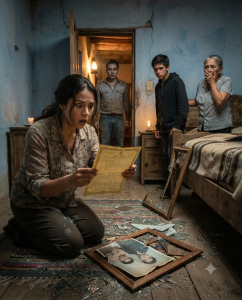
Lucía reached Teresa’s room just as Marina cried out. Iván stood shaking beside the smashed portrait of his mother. The glass had burst across the floor. The younger children crowded the doorway. Mateo appeared behind Lucía, his face tightening with dread.
Lucía bent instinctively to keep the smaller children from stepping on the glass. That was when she saw the torn backing on the frame and the folded paper hidden inside.
She pulled it free.
Mateo said, “Give me that,” too quickly.
Lucía unfolded just enough to see the seal and the words declaration of marital nullity pending review.
She looked up.
“This isn’t a death record.”
Marina’s face emptied. “What are you talking about?”
No one answered.
Then Beto rubbed his eyes and whispered, in the tiny voice of a child saying something he had held alone for too long, “Mama wasn’t dead.”
The room froze.
Iván spun toward him. “What?”
Beto pointed at the cedar wardrobe.
“I heard her,” he said. “At night. In there.”
A knock came from inside it.
Perlita screamed. Diego started crying. Tomás lunged forward, but Lucía caught his sleeve before he reached the glass. Mateo stood absolutely still, as though his body had forgotten how to move.
Lucía opened the wardrobe doors.
A woman collapsed forward into her arms.
She was thin, fever-pale, with tangled dark hair and a face that must once have been beautiful because even in ruin it held fierce traces of itself. Teresa.
Alive.
Marina made a sound Lucía would remember all her life, not exactly a sob and not exactly a scream, but the breaking of a person’s last certainty. She dropped to her knees beside her mother. Iván stumbled backward until he hit the wall. Perlita wailed and tried to throw herself into the crowd around Teresa. Mateo took one step forward and then stopped again, his mouth open, his guilt so plain it was almost another person standing in the room.
Teresa blinked up at the ceiling as if light itself hurt.
“Water,” Lucía said sharply. “Now.”
That command saved them. It gave everybody something to do besides fall apart. Tomás ran downstairs. Marina held her mother’s head. Lucía checked Teresa’s pulse. Weak, but there. Her wrists were thin as kindling. Her ankles showed chafed marks that made Lucía’s stomach turn. Not chains, but ropes. Or restraints. Not recent. Healed badly.
“Since when?” Lucía asked without looking up.
Mateo said nothing.
Lucía lifted her head. “Since when?”
“Three weeks before the fever story,” Marina said faintly, staring at the paper in Lucía’s hand as if the answer might be hiding in it. “That date… it’s before Mama was supposed to die.”
Mateo sat down heavily on the bed as if his knees had given way. “I never said she died that day.”
All eight children turned toward him.
“No,” Lucía said coldly. “You let the town say it. You let them bury her with words, and you never corrected them.”
He dragged a hand over his face. “You don’t understand.”
“Then explain,” Marina said, and the fury in her voice was so sharp Mateo flinched. “Explain why my mother was in a wardrobe.”
Teresa stirred, lips moving. Lucía bent closer.
“He came back,” Teresa whispered.
Mateo’s head jerked up.
Lucía saw it then. Not just guilt. Fear.
“Who came back?” she asked softly.
Teresa’s eyes rolled toward the door. “Anselmo.”
The name seemed to pass through the room like a current.
Tomás muttered a curse. Iván looked blank. The younger children were too frightened to understand. Marina stared at her father with dawning horror.
“Your first husband?” Lucía asked.
Teresa’s lashes trembled. A single tear slid toward her hairline.
Before Mateo could speak, the story ripped out of him in pieces.
Years before Teresa married Mateo, she had been wed in the church to Anselmo Rivas, a violent man from another district. He beat her, vanished for months, returned drunk, and finally disappeared altogether after a knife fight in Tepatitlán. Everyone assumed he was dead. With no body and no official record, Teresa petitioned the diocese for annulment on grounds of abandonment and brutality. The process dragged on for years. Eventually, word came unofficially that Anselmo had likely died near the state line. Mateo and Teresa, believing themselves free enough in all ways that mattered, began living as husband and wife, then married quietly before a priest willing to look the other way while paperwork was “pending.”
It was a sin of desperation and love, but in the countryside that was not uncommon.
Then, fourteen months earlier, when fever spread through the district, Teresa fell sick. She survived, barely. The same week, Anselmo came back.
Alive.
He arrived at the ranch at night with the annulment papers that had never been completed and the threat that could destroy them all. If he denounced Teresa’s marriage as invalid, every title, debt, inheritance claim, and church record tied to the Alcázar family could be challenged. More dangerously, he knew Mateo had renewed the ranch mortgage using marital documents signed in Teresa’s name. Fraud, the lender would call it. Seizure, the court would order. The ranch gone. The children scattered among relatives and labor camps. Marina likely sent into service. The boys hired out before they were grown. Perlita and Beto carried off to whoever would take them.
Anselmo wanted money first.
When Mateo couldn’t pay enough, he wanted Teresa back.
Teresa refused.
“He tried to take Beto,” she whispered, fingers clutching weakly at Marina’s sleeve. “He said if I didn’t go with him, he’d tell the court, the lender, the priest… all of it.”
Mateo’s voice cracked. “I fought him.”
Lucía looked at the healed marks on Teresa’s ankles.
“And then?”
Mateo shut his eyes. “He said if the town believed Teresa dead, he’d have no leverage. No wife to claim. No scandal to sell. No living proof of the marriage.” He swallowed. “I thought… if everyone believed she’d died in the fever, I could move the mortgage, hold the ranch together, protect the children, buy time.”
“By hiding her?” Marina said, horrified.
“By hiding all of us,” Mateo shot back, then seemed to hear himself and faltered. “I only meant for a few days. Until I found a way to get money and send Anselmo away.”
“But fourteen months passed,” Lucía said.
His silence answered.
Teresa turned her face toward Lucía and spoke with more strength than before. “He didn’t lock me there all that time.”
Everyone stared at her.
“There’s a room beneath the granary,” she whispered. “I stayed there. Sometimes in the wardrobe when strangers came. The children were told I was gone. Beto saw me once. Then again. He was too little to understand, so they said he dreamed.” Her eyes closed. “Mateo wanted to tell them. I wouldn’t let him. Anselmo watched the road. Twice he came to the ranch at night. Twice he took money. He said next time he’d take Marina.”
Mateo lunged to his feet. “I would have killed him first.”
“And then who would raise them?” Teresa asked.
That silenced him more completely than anything else.
Lucía sat back on her heels, the whole ugly shape of it forming at last. Mateo had lied to the town. He had let people think Teresa was dead. He had hidden his wife, forged normalcy, and finally gone to the municipal office for “temporary placement” because the house was collapsing without another pair of hands. It was monstrous. It was desperate. It was also not the whole story.
“Where is Anselmo now?” she asked.
No one answered because at that exact moment a horse whinnied in the yard.
Tomás rushed to the window.
“There’s a rider at the gate.”
Mateo’s face hardened in an instant. “Take the children downstairs.”
Lucía stood. “No. Enough secrets.”
She crossed the room, looked through the curtain, and saw a lean man on a dark horse sitting with the lazy confidence of someone who believed he owned fear itself. He wore a black hat, a dusty coat, and a smile that reached nowhere near his eyes.
Anselmo.
He had come at the worst possible moment and somehow also exactly on time.
Mateo reached for the old shotgun mounted over the hallway chest, but Lucía stepped in front of him.
“Put it down,” she said.
“He’ll take her.”
“Not if you stop behaving like the criminal he wants you to become.”
For the first time since she had arrived, Mateo obeyed her without hesitation.
Lucía turned to Marina. “Can you manage your mother and the little ones?”
Marina wiped her face and nodded, though her hands shook.
“To the kitchen,” Lucía said. “Lock the back door. Tomás, keep the younger boys with you. Iván, if you want to be useful, sweep that glass before Perlita cuts herself.”
The order in her tone snapped them into motion.
Then she went downstairs with Mateo.
Anselmo did not bother knocking. He strolled onto the porch and leaned against a post like a man visiting property already promised to him.
“I heard,” he said, glancing at Lucía with open insolence, “that the widower bought himself help.”
Lucía held his gaze until he looked back at Mateo.
“You owe me,” Anselmo went on. “And I’m done waiting.”
“She’s not going with you,” Mateo said.
Anselmo laughed. “She’s my lawful wife.”
That was when Lucía saw the flaw in him: arrogance. Men like Anselmo mistook terror for power and never noticed when a room stopped fearing them.
Lucía stepped forward. “You’re the one named in these papers?”
He squinted. “Who are you?”
“The woman from the auction,” she said. “The one who can read.”
The smile twitched.
She unfolded the nullity declaration just enough for him to see the seal. “Pending review, yes. But not final. Which means if you publicly claim a living wife you abandoned years ago, you also reopen the assault petition that accompanied her first filing.”
Anselmo’s expression shifted, just a little.
Mateo stared at her. Teresa had not told him that part. Maybe she had been too ashamed. Maybe he had never asked enough.
Lucía kept going. “There were witnesses to her bruises. Parish notes. A prior complaint before she disappeared from your district. If this goes before a civil judge and the lender at the same time, you don’t just threaten this family. You put your own name on record.”
“You think these people care?” he sneered.
“No,” Lucía said. “But I think the lender cares about extortion. And I think the priest cares about a man who used sacramental law to traffic in fear. And I know the mayor cares when a public scandal reaches the district capital and his signature is already on enough disgrace for one year.”
She let that last line land.
Anselmo’s eyes narrowed. “You talk too much for a servant.”
“I’m not a servant,” she said. “And you’ve made one mistake.”
He shifted his weight. “Which one?”
“You came here in daylight.”
Behind her, Mateo understood. So did Tomás, who had edged onto the porch despite instructions. So did Marina from the doorway, pale but upright.
Witnesses.
Children old enough to speak. A woman alive and visible. A stranger with no blood loyalty to the family. Whatever this had been in the shadows could not survive the open air so easily.
Lucía raised her voice. “Marina, bring your mother.”
Mateo turned sharply. “She’s too weak.”
“She only needs to be seen.”
Marina appeared in the doorway supporting Teresa, who trembled but stood. The sight of her struck Anselmo clean through his smugness. For the first time, he looked uncertain.
Teresa lifted her head.
“You will not take one more thing from me,” she said.
Her voice was weak, but every child heard it.
Every child.
Iván began to cry then, not angrily, but openly, like a boy who had just been told grief and hope could occupy the same body. Perlita clung to Marina’s skirt. Little Beto stared with his mouth open and then whispered, “Mama,” with the astonishment of prayer.
The sound broke the last of Anselmo’s composure.
He swore, grabbed at Mateo’s shirt, and swung.
Mateo staggered, but Tomás and Iván were already there. Lucía shouted for them to stand back. Marina dragged Teresa inside. Raúl ran to the road yelling for neighbors. Within minutes men from the nearest fields came at a sprint, not from courage at first but from curiosity. Then they saw Teresa alive, saw Anselmo raging, heard fragments of the truth, and curiosity became the kind of public witness that cowards fear most.
Anselmo tried to mount his horse.
He never made it.
By sundown he was tied to the same hitching post where he had leaned so smugly, cursing everyone in reach while the clerk from town was sent for and the priest arrived white-faced and sweating. The mayor came later, angry less at the crime than at the possibility of blame, but by then it was too late to smother anything.
The statements were taken one by one.
Teresa spoke.
Marina spoke.
Tomás spoke.
Even Beto, with Lucía crouched beside him, said, “Mama was hiding. I heard her.”
In the days that followed, the scandal cracked open the whole district. The church records confirmed Teresa’s first petition against Anselmo had included abuse allegations. The lender, eager to protect himself, agreed to restructure the ranch debt rather than pursue a public fraud case that would expose how carelessly he had handled the documents. The mayor quietly dissolved the so-called placement program before anyone above him started asking questions about women being auctioned in public squares.
Anselmo was charged with extortion, intimidation, and assault tied to the prior complaint. Whether justice came from conscience or embarrassment, no one in San Jacinto cared. What mattered was that he no longer came up the road.
For the Alcázar family, the harder work began after the danger passed.
The children had to learn their mother was alive and still not exactly the mother they remembered. Teresa had to learn her children had grown without her in ways that could not be undone. Marina had to lay down the burden of being everyone’s second mother without knowing who she was when she wasn’t saving someone. Iván had to forgive a father who had turned grief into a lie. Mateo had to face the truth that desperate love was not the same as righteous love, and protection without honesty had nearly destroyed the very people he wanted to save.
And Lucía, who had arrived through the ugliest door possible, found herself woven into the household not by contract but by choice.
A week after Anselmo was taken away, Mateo came to the kitchen where she was rolling tortillas.
“The paper from the municipality,” he said, placing it on the table. “I had it voided.”
Lucía looked up.
“You’re free to leave.”
She wiped flour from her hands and studied him. He seemed older than the man in the square, but steadier too.
“And if I stay?”
“Then you stay because you decide to. You’ll be paid wages. Fair ones. And no one in this house will ever speak of ownership again.”
Lucía let the silence stretch.
From the yard came the sound of Beto laughing for the first time, truly laughing, while Diego chased him around the water trough. Perlita was braiding Teresa’s hair on the porch. Marina, half smiling despite herself, was arguing with Tomás over whether the goats had broken the fence or he had simply forgotten to latch it.
Lucía folded the voided contract in half and set it beside the stove.
“I’ll stay through harvest,” she said.
Mateo nodded, accepting the limit as if it were all he deserved.
She stayed longer than that.
Not because the family owed her gratitude and not because she mistook rescue for love, but because in that battered house she had found something rarer than romance: a place where truth had finally broken open, and everyone left standing had chosen to face it.
Years later, people in San Jacinto still remembered the scandal in fragments. Some said Mateo was a fool. Some said Teresa was reckless to hide. Some said Lucía had saved them all. The truth was less tidy and more human than any of that.
Mateo had done something unforgivable and understandable at once.
Teresa had chosen silence to protect her children and nearly lost them by it.
Lucía, who had been reduced to a price in the square, had been the only one in that house clear-eyed enough to see that secrets kept for survival eventually become another kind of prison.
The biggest red flag had not been the poverty, the broken ranch, or even the auction.
It had been the lie everyone accepted because it was convenient.
And once that lie shattered—like glass on a bedroom floor—every person in that house had to decide whether love meant possession, sacrifice, obedience, or the far harder thing:
the truth.