They found a photograph of me under a dead man’s pillow.
Taken last Tuesday.
In my own front yard.
But let me back up — because the story doesn’t start there. It starts the way most of the hardest stories do: with a phone call I almost didn’t answer.
—
My name is Marlene Thibodaux, and I have spent forty years appraising estates across Louisiana. I have walked through the homes of oil men and schoolteachers, through antebellum parlors that smelled like cedar and old grief. I thought I had seen everything a house could hold.
Then I got the call about the Arceneaux estate.
Henri Arceneaux III. Sugar cane money, fourth generation. Died alone at eighty-one in a house outside Breaux Bridge, no wife, no children listed in the obituary. The law firm handling the estate wanted an independent appraiser. They chose me.
I didn’t know why then.
I do now.
—
I drove out on a Tuesday morning in October, when the cane fields were still tall and the light came sideways through the live oaks like it was apologizing for something.
The house was enormous. White columns, gallery on three sides, original cypress floors so old they barely creaked. A serious house. A house that had been *kept.*
The estate attorney, a young man named Fontenot, handed me the room inventory and said, “Take your time, Ms. Thibodaux. Mr. Arceneaux was… particular.”
That word.
*Particular.*
I didn’t understand it until I opened the first door off the main hall.
—
It was a study. Floor to ceiling bookshelves, a partner’s desk, leather chairs. Normal enough.
Except on the desk, set apart from everything else like it had been placed there deliberately, was a brass compass.
Small. Tarnished around the edges but clearly loved — the kind of object a person handles every day, not one they display.
I picked it up.
Engraved on the back, in letters so fine I had to tilt it toward the window light:
*M.B. + H.A. — October 14, 1974.*
I put it down.
My hands were not quite steady.
October 14, 1974 was the day they told me my baby was stillborn.
—
I told myself it was coincidence.
*M.B.* are common initials. *H.A.* — Henri Arceneaux. Of course his initials were on a compass in his own house.
But *M.B.* was me. Marlene Broussard, before I married. And that date — that date lived in my body the way only certain dates do. The ones that rewrote you.
I was nineteen years old. Unmarried. The father was a boy from a cane family my people had no business knowing. His family sent a woman to the hospital. They handled things. They told me the baby didn’t survive.
I never held her. They said it was better that way.
I had not spoken that boy’s name aloud in fifty years.
Henri Arceneaux.
—
I kept working. What else do you do?
Room by room, I catalogued that house, and room by room, the house catalogued *me.*
A framed print in the second parlor — the exact print that had hung in my grandmother’s home in Opelousas. I had mentioned that print once, in an interview with a local paper, fifteen years ago.
In the library, a first edition of a novel I had publicly called my favorite book, in an interview, twenty-two years ago.
In the upstairs hallway, a photograph of Breaux Bridge in 1987 — the year I moved back to Louisiana after my divorce, a fact that appeared nowhere public that I could remember.
He had been *watching.*
Not cruelly — or at least, not only cruelly.
The attorney had called him *particular.*
I was beginning to understand that Henri Arceneaux III had spent fifty years constructing a house around a woman he was not allowed to know. A woman his family had told him, I now suspected, something very different from what they had told her.
The compass was in my coat pocket.
I don’t know when I put it there.
—
I saved his bedroom for last.
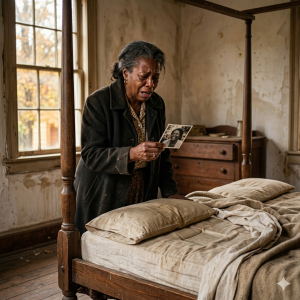
The bed was made. The room was sparse — a man who had stopped accumulating things. On the nightstand, a glass of water someone had never removed, a book turned face-down, and the indentation in the pillow where a head had rested for the last time.
I stood in the doorway for a long moment.
Then I stepped inside.
The pillow had been pushed slightly to one side, the way it sometimes happens when someone is moved in the night, or perhaps when something had been placed beneath it and not quite smoothed over after.
I reached down.
And there, tucked beneath the dead man’s pillow, still caught in a hand that hadn’t quite let go —
Was a photograph.
Of me.
Taken last Tuesday.
In my own front yard.
—
I sat down on the edge of a dead man’s bed and I held that photograph in both hands.
It was a good photograph. Clear, unhurried. I was standing on my front steps in the morning, checking my mailbox the way I do every day before I leave for work. I was wearing my blue cardigan. My reading glasses were pushed up on my head.
I looked like a woman who had no idea she was being watched.
Because I hadn’t.
I turned it over.
On the back, in the handwriting of an old man who had known he was running out of time, were seven words.
*She doesn’t know. She needs to know.*
—
Fontenot was waiting for me downstairs, going through papers at the kitchen table. He stood up when he heard me on the stairs. I think my face told him something, because he pulled out a chair before I even asked.
I set the photograph on the table between us.
He looked at it for a long moment.
Then he looked at me.
And he said, “Ms. Thibodaux, there’s a reason the firm selected you for this appraisal.”
I told him to explain.
He did.
—
Henri Arceneaux had not chosen me at random.
Three months before he died, he had come to the firm with a document — not a standard will revision, but a separate letter of instruction, sealed, to be opened only after an appraiser was retained. The letter specified, by name, that the appraiser should be Marlene Broussard Thibodaux of Baton Rouge.
The firm had been uncomfortable. Fontenot told me this carefully, the way young lawyers learn to deliver things that might become somebody’s problem. They had debated whether to honor the instruction or simply find someone else.
In the end, they honored it.
Because the sealed letter had also contained, as Fontenot put it, significant context.
He slid a folder across the table.
I opened it.
—
Inside was a birth certificate.
A real one. Official. Louisiana Department of Health, dated November 3, 1974.
The mother listed was Marlene Broussard.
The father listed was Henri Arceneaux III.
And the child — a girl, seven pounds four ounces, born alive — was named Cecile.
She had not been stillborn.
She had been taken.
—
I have to stop here for just a moment, because I want you to understand what it is to read something like that at sixty-nine years old, sitting in a dead man’s kitchen in the middle of a cane field while the October light comes through the window.
You go very still.
The room doesn’t change. The chair under you is still solid. The folder is still paper. Everything is exactly what it is.
But you are not the same person you were sixty seconds ago.
I had grieved that baby for fifty years.
She had been alive for fifty years.
—
Henri had not known either. Not at first.
The folder contained his accounting of it — not a formal document, just pages in that same cramped handwriting, dated across decades. He had written it down the way people do when they are afraid of forgetting, or afraid no one will believe them if they don’t.
His family had told him the baby died. His aunt, specifically — a woman named Odette who had managed the Arceneaux affairs with the quiet authority of someone who believed she was protecting the bloodline. Odette had arranged everything. The woman at the hospital. The papers. The placement.
Henri was nineteen. He was told to grieve privately and move on.
He moved on.
But he never quite got there.
—
He found out the truth in 2019.
His aunt Odette died at ninety-three, and among her papers — because people like Odette always keep papers, proof of what they have managed — he found the original documentation. The real birth certificate. The name and address of the couple in New Iberia who had taken the baby.
He hired an investigator.
He found Cecile.
She was forty-four years old. She lived in Lafayette. She taught high school French. She was married, had two boys, and she had known she was adopted since she was eight.
She had never searched for her birth parents.
She had her reasons.
Henri respected them.
But he spent the last four years of his life trying to decide what she deserved to know. Whether the truth was a gift or a weight he had no right to hand to her. Whether a dying old man’s need for resolution was worth disrupting a life that had, by all evidence, been a good one.
He wrote to her once.
He never sent it.
—
Instead, he turned his attention to me.
Because here is what Henri Arceneaux had understood, reading his aunt’s papers in the terrible silence of a house he had lived in alone for decades: I had never been told either.
They had told me my baby died.
I had carried that.
He had carried his own version.
We had both been handed a lie and left alone with it.
He couldn’t make it right. He was eighty years old and sick and he knew it. He couldn’t restore fifty years. He couldn’t give me back what Odette had taken.
But he could make sure I knew the truth before he died.
And he could leave me the only real compass he had — the one with both our initials on it, from the year we were nineteen and didn’t yet know what was coming.
The photograph was taken by his investigator, who had been hired not to watch me in any threatening sense, but simply to confirm I was still alive, still well, still findable, before Henri put the letter of instruction together.
*She doesn’t know. She needs to know.*
That was all.
That was everything.
—
I sat in that kitchen for a long time after Fontenot finished explaining.
He had the grace to leave me alone. He went out to his car and made phone calls and gave me the room.
I looked at the photograph of myself on my own front steps.
I looked like a woman going about her ordinary life.
I had been, that Tuesday morning. Just Marlene, checking the mail, thinking about the day ahead, already running slightly late the way I always am. Nothing extraordinary.
And somewhere not far from me, an old man had been looking at this photograph and thinking: *she still doesn’t know.*
He had died four days later.
He almost didn’t get it done.
—
When Fontenot came back in, I had two questions.
The first was about the estate.
Henri had left the house and most of its contents to a preservation society, which was standard enough. But a separate trust — substantial, carefully structured — had been established for a specific purpose.
It was for Cecile.
Not left to her outright. Left in trust, to be explained to her and offered to her, along with the full truth, by whatever means she chose to receive it. If she wanted nothing to do with it, it would go to a scholarship fund in her name at the school where she taught.
Henri had also left her a letter. Sealed. Hers alone if she wanted it.
He had thought of everything a dying man could think of.
My second question was whether she knew yet.
Fontenot shook his head.
The plan had been to approach me first. To give me the choice of whether I wanted to be part of how the truth reached her, or whether I needed time, or whether I wanted no involvement at all.
He said it very gently.
He said, “Mr. Arceneaux wanted you to have a say. He felt you’d had enough things decided for you.”
I had to press my hand against my mouth for a moment.
Then I told Fontenot that I would need a week.
—
I drove home through those cane fields in the long afternoon. The light was still sideways through the oaks, still apologetic. Nothing looked different. The world had not reorganized itself to reflect what had happened to me.
I called my sister from the car. She didn’t answer. I called my friend Deloris, who has known me for thirty years and has the specific gift of going quiet when quiet is what’s needed.
I told her the outline.
She was quiet for a long time.
Then she said, “Marlene. Are you going to call her?”
I said I didn’t know yet.
That was true then.
—
It isn’t true anymore.
I called Cecile on a Thursday morning, eleven days after I found that photograph. I had asked Fontenot to reach out first, just to prepare the ground, and he had — carefully, professionally, with as much gentleness as a legal notification can carry. He told her that her birth mother was living, had been located, and had requested permission to make contact.
Cecile said yes.
She said it the same day he asked.
She had her reasons for not searching, she told him. Mostly fear. Mostly the particular fear of finding out you were not wanted, which is the cruelest thing adoption can do to a person even when everything else about it is good and right and full of love.
She had been loved. Her parents in New Iberia had been good people. She did not need rescuing from her history.
But she had always wanted to know.
—
We talked for two hours the first time.
I will not put that conversation here, because it belongs to us.
What I will tell you is that her voice is low and a little bit wry, the voice of someone who has spent years in a classroom that will not behave. She laughs quickly and recovers herself quickly, the way people do when they’ve learned that feelings don’t have to be events.
She looks like her father. I found this out later, from a photograph. The eyes especially.
She has two boys, fourteen and eleven. Their names are Marcus and Jules.
She knew she was from cane country. She’d always had a feeling.
—
We have met in person twice now.
The first time was in Lafayette, on neutral ground, a coffee shop she chose because she knew the owner and felt safe there. I brought her the compass. I didn’t know if I should, but I brought it.
She held it for a long time.
She said, “He carried this every day?”
I said I believed so, based on the wear.
She turned it over and read the inscription and then she set it down on the table very carefully, like it was something that could break, and then she put her face in her hands and cried in a way that had nothing messy or embarrassing about it.
It was just grief, honest grief, for a father she never got to know, who had loved her from a distance because he hadn’t known how to do anything else.
I reached across and put my hand over hers.
She let me.
—
The second time we met, she brought the boys.
Marcus is the serious one. Jules wanted to know if I appraised things like swords and old guns, and when I said sometimes, he decided I was acceptable.
We had lunch at a place on the bayou. We talked about everything and nothing. We talked about her classroom and my work and the heat and whether the boudin was better here or closer to Breaux Bridge.
At one point she caught me looking at her and she said, “What?”
I said, “Nothing. I’m sorry.”
She said, “You don’t have to keep apologizing for looking at me.”
I said I wasn’t apologizing. I was just still getting used to it.
She understood what I meant.
—
I have thought about Henri a great deal these past weeks.
I did not love him. I want to be clear about that, because grief has a way of rewriting things and I won’t let it. We were nineteen years old. We were a summer. What happened to us was not a love story — it was something that happened before we were fully formed, and then it was taken from us in the worst possible way, and we each survived it alone.
But I think he became someone worth knowing.
I think he spent fifty years in that house trying to become someone who deserved to be forgiven, even though he had never known what he’d done.
The house full of things that were mine — my grandmother’s print, my favorite book — I understand it differently now than I did the day I found it. It was not surveillance. It was not obsession in the threatening sense.
It was a man building a room in his life for a woman he had wronged without knowing it, keeping a door open in