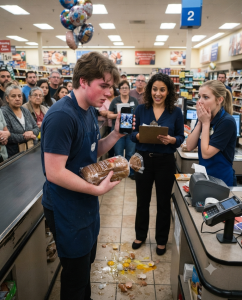
They made the shy grocery bagger clean up the broken eggs while everyone else blamed him for the missing cash.
By the time Ethan realized the accusation was serious, every eye in Greenridge Market was already on him.
It started just after five in the afternoon, the worst possible time for a problem. The dinner rush had begun. Shopping carts jammed the front lanes. One cashier was trying to ring up a customer with a screaming toddler in the cart seat, another was waving frantically for a price check on chicken breasts, and the self-checkout machine had been beeping nonstop for almost a minute because someone had scanned a birthday card twice.
Ethan was bagging at register three, trying to keep pace with a woman who had bought enough groceries to feed a soccer team, when the cashier at register two suddenly stopped mid-transaction.
“Wait,” she said, staring into her drawer.
At first nobody paid attention. Drawers came up short sometimes. A bill would stick together. Change would get dropped. A receipt would be wedged somewhere strange.
But then the cashier counted again.
And again.
Her face turned pale. “Mr. Donnelly!”
That got people’s attention fast.
The store manager emerged from the office with the heavy, tired look of a man who had already decided everyone around him was incompetent. Behind him came Melissa Harper, the assistant manager, in a navy blouse and sharp heels that clicked against the tile like warning shots. Melissa always moved through the store with the energy of someone performing authority rather than actually having it. She was loud when customers were watching, harsher when they weren’t, and strangely defensive whenever anyone asked specific questions about paperwork.
Ethan knew that because Ethan noticed everything.
Most people in the store didn’t realize that.
To them, Ethan was just the quiet kid with the awkward posture and nervous smile. Nineteen years old. Too skinny. Brown hair that needed cutting. Eyes that dropped to the floor whenever someone spoke too quickly. He had been working at Greenridge for almost eight months, long enough for people to decide they understood him.
They didn’t.
Ethan wasn’t stupid. He wasn’t lazy. He wasn’t sneaky.
He was just shy, and in a place full of loud people, that was often enough to make others uncomfortable.
He stuttered when someone raised their voice. He apologized when customers bumped their carts into him. He had a habit of pressing his thumb against his palm to steady himself before speaking. Every shift, he counted down the hours until he could catch the bus home, hand part of his paycheck to his mother, and help his little sister Mia with homework at the kitchen table.
Greenridge Market was not his future. It was survival.
So when Melissa looked from the register to Ethan and said, “He was standing near the drawers,” the words landed harder than they should have.
It wasn’t just an observation. It was a selection.
A decision.
The cashier at register two looked startled. “I didn’t say—”
Melissa cut her off. “He’s always hanging around here. And look at him.”
Ethan felt heat crawl up his neck. “I-I was b-bagging—”
“And he looks guilty,” Melissa said.
That was the thing about public accusations. Once the first one is spoken, everyone starts searching for signs they missed. Ethan’s red face, his stutter, the way he clenched and unclenched his hands when nervous—all of it suddenly became “proof” to people who wanted the story simple.
Mr. Donnelly stepped closer. “Three hundred dollars is missing from this drawer.”
Ethan’s mouth went dry. Three hundred dollars was more money than he usually had left after helping his mother with rent and buying bus fare for the week.
“I d-didn’t t-take—”
“Then empty your pockets,” Donnelly said.
The words hit like a slap.
Right there in front of everyone.
A woman in line with frozen pizzas stared openly. An older man folded his arms and leaned on his cart. A teenager near the magazine rack pulled one earbud out so he could listen.
Ethan wanted to disappear. But disappearing was never an option people like him were given. They had to stand there and be examined.
Slowly, with shaking fingers, he reached into his apron and his pockets.
He set a bus pass on the counter first.
Then a folded photograph of Mia on school picture day, grinning with two missing front teeth and a crooked barrette in her hair.
Then a worn grocery list: eggs, rice, apples. The apples had been crossed out because even the cheapest bag was more than he could manage until Friday.
Nothing else.
No cash.
No stolen bills.
No hidden envelope.
The silence that followed should have been enough. It should have shifted something in the room. But shame is a weak force when pride is stronger.
Melissa gave a tight little smile. “Money doesn’t just disappear.”
Before Ethan could answer, a customer clipped a nearby display with her cart. Two cartons of eggs tumbled off the edge and burst on the floor with a wet crack. Yolk spread in bright yellow streaks over the tile.
Melissa didn’t hesitate.
“Clean that up.”
Ethan stared at her.
It wasn’t just the order. It was the certainty behind it. As if she still had the right to command him after what she had done. As if humiliation came with extra duties.
He knelt to clean the mess, hands trembling as he pressed paper towels over the broken shells. Shoes moved around him. Someone sighed theatrically because the aisle was blocked. Another customer whispered, not quietly enough, “That’s probably him.”
The words should have broken him.
Instead, something inside him settled.
Because Ethan had spent months being underestimated. Months being the person others overlooked while they talked too much, moved too fast, or assumed no one quiet could possibly be paying attention.
But Ethan watched.
He had always watched.
He watched because speaking was difficult and listening was safer. Because silence gave him time to notice the little things other people dismissed. He knew which cashiers counted change twice when nervous. Which regular customers flirted for discounts. Which delivery driver left the cooler open too long. Which shift supervisor drank from the same “confidential” coffee mug every day while gossiping loudly about staff.
And he had noticed Melissa.
At first it was just small things. Promotional balloons tied near the customer service desk in odd places, blocking the angle of the security camera during shift change. Refund slips printing after the customer had already walked away. Melissa insisting on reconciling certain registers personally. A duplicate receipt number discarded in the trash.
Then more.
A customer complaining that a refund hadn’t shown up. Melissa brushing it off with forced laughter. A cashier saying Melissa had told her to sign off on paperwork she didn’t understand. Another shift where Melissa seemed jumpy whenever anyone lingered near register two after close.
Ethan had tried to tell himself there was probably an explanation. People like Ethan learned early not to trust their own instincts over louder people’s confidence.
But the pattern kept repeating.
And once he saw a pattern, he couldn’t stop seeing it.
A week before the accusation, he was stocking reusable bags near customer service when Melissa began shift change again. Balloons were tied high in a cluster near the camera. She glanced around, stepped behind register two when no customer was there, printed a refund slip, opened the drawer, and moved with practiced speed.
Ethan’s heart hammered.
He should have looked away.
Instead, he slid his phone from his pocket and recorded from waist level, pretending to check messages.
The video caught enough.
Not everything. But enough.
The next night he recorded another clip, this time from farther back. Then he started taking photos of duplicate receipt numbers whenever he found them discarded. He saved timestamps. Not because he thought he would need them. Because some part of him already knew one day he might.
Now that day had arrived.
Ethan rose slowly from the egg spill, paper towels still in his hand. Melissa frowned. “I said clean it.”
He set the towels down.
Then he turned and walked toward the customer service desk.
“Ethan,” Mr. Donnelly barked. “Where are you going?”
For a split second Ethan almost stopped. Years of habit pulled at him: apologize, retreat, survive. But the image of Mia’s photo lying on the counter beside that wrinkled grocery list flashed in his mind. The humiliation. The eyes. The certainty with which Melissa had chosen him.
He kept walking.
At the desk, his fingers shook so hard he nearly dropped his phone. He unlocked it, opened the hidden album where he had saved the clips, and turned back.
Melissa laughed once, brittle and dismissive. “What is this? A distraction?”
Ethan didn’t answer.
He pressed play.
The store seemed to hold its breath.
The first video showed customer service during shift change. Balloons blocking part of the security camera. Melissa stepping into the blind spot. A refund slip printing. No customer in sight. Melissa glancing over her shoulder, opening the register, folding bills, then printing a second slip with the same sequence number visible on the edge.
The clip ended.
Nobody moved.
Ethan played the next one.
Another day. Same camera obstruction. Same area. Same pattern.
By the time the third clip started, Melissa’s face had lost all color.
“That doesn’t prove anything,” she snapped, too fast. “You were spying on me?”
Ethan tapped his screen again and opened the photos.
Duplicate receipt numbers. Timestamps. A frame from the security camera angle showing balloons blocking the exact corner where her hands would have been visible. A refund log photo he had taken when discarded paperwork sat too long near the printer.
“I s-saw it h-happening,” Ethan said, voice shaking but steady enough to be heard. “M-more than once.”
The cashier from register two stared at Melissa. “You told me the system duplicated receipts by itself.”
Melissa whipped around. “Because it does sometimes.”
“Not like that,” another cashier said quietly.
The shift in the room was immediate and almost physical. Suspicion had been a spotlight on Ethan. Now it swung toward Melissa, and suddenly all the little things people had ignored started clicking into place.
The older customer near the tabloids spoke first. “Looks like you searched the wrong person.”
No one argued.
Mr. Donnelly took Ethan’s phone and watched the first clip again, closer this time. His jaw tightened. He was a flawed manager, lazy in the ways that mattered most, but even he couldn’t explain away what was on-screen.
Melissa tried.
“She’s obsessed with me,” she blurted, pointing at Ethan by mistake in her panic before correcting herself. “He’s obsessed. This is edited. He hates me because I manage him.”
Ethan almost laughed at the absurdity, but the sound died before it formed.
He didn’t hate Melissa.
Until that moment, he had mostly feared her.
Then one of the cashiers said, “She made me sign two refund slips last Thursday.”
Another added, “And she told me not to worry when the totals didn’t match.”
Melissa turned on them with wild eyes. “You don’t know what you’re talking about.”
But the room was no longer hers to control.
Customers were filming now. Mr. Donnelly noticed and swore under his breath, suddenly aware this wasn’t staying internal. He handed Ethan’s phone back and demanded, “Is there anything else?”
Ethan looked at Melissa.
She wasn’t watching him. She kept glancing toward the office hallway.
That’s when he knew the missing three hundred dollars was only part of it.
Ethan swallowed. “C-check the d-drawer logs,” he said. Then, after a beat, “And the black tote in the supply closet.”
Melissa’s body went still.
It was brief. Tiny. Easy to miss.
Ethan didn’t miss it.
Mr. Donnelly’s expression changed. “What tote?”
Instead of answering directly, Ethan opened another video.
This clip was shorter and blurrier, recorded two nights earlier. Melissa leaving the office after close with a black tote bag she hadn’t brought onto the floor at the start of her shift. She walked into the supply closet, came out less than ten seconds later empty-handed, then locked up and left.
Donnelly looked at Melissa. Melissa looked at the hallway.
That was answer enough.
He strode to the back with Melissa following, protesting now in a voice gone shrill and ugly. The employees and several customers trailed after them at a distance, not wanting to miss what came next. Ethan stayed where he was for half a second, suddenly weak with adrenaline. Then he followed too.
At the supply closet, Donnelly shoved aside a mop bucket and reached to the top shelf.
His hand closed around the black tote.
Melissa’s composure finally cracked. “You can’t just go through my things!”
“Watch me,” Donnelly said.
He yanked it down and unzipped it.
Inside were envelopes of cash.
Refund slips.
Store deposit bands.
And, tucked into the side pocket, several gift cards that should have been in a locked drawer.
A cashier gasped. Someone behind Ethan whispered, “Oh my God.”
Donnelly turned to Melissa slowly. “How long?”
She opened her mouth, but no sound came out.
The answer arrived a different way. Beneath the cash envelopes lay a small notebook. Donnelly flipped it open and found dates, amounts, register numbers, initials beside certain entries. More than one register had been hit. More than one week. More than one person had probably been blamed or suspected without proof.
The missing three hundred dollars was just the amount she hadn’t had time to move yet.
Donnelly called the police.
The next fifteen minutes felt unreal. Customers were asked to return to the front. Employees huddled in tense clusters whispering. Melissa alternated between denial and rage. She said Ethan had trapped her. She said everyone was overreacting. She said she had planned to “fix the numbers later.” Then she cried. Then she got angry again when no one comforted her.
When the officers arrived, Ethan’s stomach dropped. Even with the evidence, authority figures still made him nervous. One officer asked for his phone. Another questioned Melissa. Donnelly handed over the tote and the notebook with a face like stone.
Ethan stood near the endcap of canned beans, rubbing his thumb into his palm, while one officer watched the videos twice and asked careful follow-up questions.
“Did anyone tell you to record this?” the officer asked.
Ethan shook his head. “N-no.”
“Why did you?”
He looked down. The answer was embarrassingly simple.
“B-because I knew n-no one would b-believe me if I j-just said it.”
The officer’s expression softened in a way Ethan hadn’t expected. “That was smart.”
Nobody had ever used that word for him at work before.
Melissa was escorted out a little after six-thirty. She didn’t go quietly. On her way past Ethan, she hissed, “You think this makes you special?”
Ethan didn’t answer.
For the first time, he didn’t feel the need to.
After she was gone, the store settled into the strange, shaky silence that follows public disaster. Customers wanted reassurance. Employees wanted answers. Mr. Donnelly wanted the entire thing to disappear before corporate found out exactly how much he had failed to notice.
But some things couldn’t be hidden once they were dragged into fluorescent light.
He approached Ethan near the front end.
For a moment Ethan braced for another order, another criticism, another attempt to smooth things over without admitting fault. Instead Donnelly cleared his throat.
“I shouldn’t have searched you in front of everyone,” he said stiffly.
It was not a warm apology. It was not enough. But it was the first honest sentence Ethan had ever heard him say.
“No,” Ethan replied quietly. “You shouldn’t have.”
Donnelly looked surprised, as though the shy bagger was not supposed to answer back with plain truth.
The cashiers heard him. So did the older customer still lingering by the tabloids. A few of them exchanged looks—not pity this time, but something closer to respect.
By closing time, corporate had been informed. The officers had taken statements. Several employees admitted they had seen odd things but hadn’t spoken up because Melissa intimidated them. One cashier cried in the break room because she realized she might have been blamed next.
Ethan sat alone for a minute on an overturned milk crate near the loading area, exhausted. His phone battery was nearly dead. His hands had finally stopped shaking.
When he got home, his mother opened the door with concern already on her face. He must have looked wrecked. Mia came running from the kitchen asking why he was late.
Ethan crouched and handed her the folded photo he had carried in his pocket all day.
She frowned. “Why do you have my school picture?”
He smiled for what felt like the first time in hours. “Lucky charm.”
Later, after dinner, his mother listened while he told the whole story. She went pale at the part where they searched him in public and furious at the part where he had been blamed first. Mia, not fully understanding the theft but understanding injustice perfectly well, declared Melissa “the worst person alive.”
Ethan laughed then. Really laughed.
The next week, corporate representatives came to the store. They reviewed footage, logs, and the stolen funds found in the tote. More discrepancies surfaced. Melissa had been skimming through fake refunds and manipulated deposits for months. She was terminated, charged, and publicly unavailable for comment in the bland corporate statement that followed.
Mr. Donnelly was written up and transferred after an internal review concluded that his oversight had been “insufficient.” Employees called it what it really was: he had ignored obvious red flags because blaming quieter workers was easier than managing properly.
A different manager took over temporarily. She spoke to Ethan like a person. She asked if he wanted to train on customer service or inventory since he had “an eye for details most people miss.” The compliment embarrassed him, but in a new way.
For the first time, people at Greenridge didn’t lower their voices around him like he was fragile or suspicious. They asked his opinion. They thanked him. One cashier brought him coffee on a hard shift. Another said, “I should’ve backed you up sooner,” and Ethan believed she meant it.
He still stuttered sometimes. He still hated being stared at. He still rehearsed simple phrases before speaking to customers.
But something had changed.
He no longer mistook quiet for weakness.
And neither did anyone else.
Months later, a customer recognized him and said, “You’re the one who caught that manager, right?” Ethan felt his ears go red, but he nodded. The customer smiled and said, “Good for you,” as if bravery had always been visible on him.
It hadn’t.
That was the point.
Courage hadn’t arrived as confidence or perfect words or a dramatic speech. It had arrived as attention. Patience. A phone held steady by trembling hands. Proof gathered by someone everyone assumed was too timid to matter.
In the end, that was what stayed with the people who witnessed it.
Not just that Melissa stole.
Not just that Ethan exposed her.
But that a room full of adults had looked at the shyest person there and decided he was the easiest one to blame. They saw his nervousness and called it guilt. They saw his silence and called it weakness. They saw his poverty and almost treated it like motive.
And they were wrong about every single part of him that mattered.
The truth is, Ethan was never the kind of person who could win a shouting match.
He was the kind who noticed the balloons tied too carefully, the receipts printed twice, the drawer opened when no customer was there.
The kind who kept watching when everyone else looked away.
The kind who still shook while doing the right thing.
Maybe that was why the story traveled. Not because the ending was neat—it wasn’t. A theft ring in a grocery store doesn’t erase the humiliation of being accused in public. An apology doesn’t restore what suspicion takes from you in an instant. And proof doesn’t make people forget that for a few terrible minutes, they believed the quiet kid must have done it.
But it does leave one question hanging in the air long after the money is recovered and the guilty person is gone:
When the pressure is on and something goes wrong, who do people blame first?
And what does that say about them?