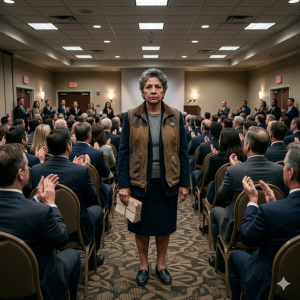
They gave him a standing ovation.
And she just stood there in the back of that room, holding her dead husband’s index cards, waiting for it to die down.
—
My name is Loretta Crane. I’m fifty-eight years old. I run four hundred acres outside of Billings, Montana, by myself, because my husband Ray died twenty-two months ago and the land doesn’t stop needing you just because your heart does.
I want to tell you about the eight quietest months of my life.
And the one morning that made them worth it.
—
Ray was a planner. Not a talker — a planner.
He kept everything in his truck. Tools in the bed, receipts in the visor, and in the glove box, a worn stack of index cards held together with a rubber band that had seen so many Montana winters it had gone stiff as jerky.
I’d seen him pull those cards out a hundred times. Writing something, checking something, tucking them back. He never explained them and I never asked. That was just Ray.
After the funeral, I put the cards in my coat pocket.
I don’t know why. I just wasn’t ready to leave them in an empty truck.
—
My uncle Dale showed up six weeks after we buried Ray.
Now, Dale Hargrove is the kind of man who could sell a drowning woman a glass of water and make her feel grateful. Silver hair, warm handshake, always smells like good cologne. He’d been on the edges of our family my whole life — charming, helpful, *just* present enough to seem trustworthy.
He brought a casserole and a folder of papers.
“Just a paperwork update,” he told me, sitting at my kitchen table. “The county changed how they register grazing rights after a deed transfer. Ray’s name needs to come off and the rights need to be re-filed under an active entity. Standard stuff, Loretta. I already talked to a guy at the courthouse.”
I was fifty-eight days into grief. I signed.
—
It took me four months to understand what I had signed.
The grazing rights to the federal allotment land Ray had worked for thirty-one years — land I needed for summer pasture, land tied directly to a federal lease renewal coming up in the spring — had been quietly transferred to something called Hargrove Land Holdings LLC.
Dale’s LLC.
I found out because a woman at the county assessor’s office made an offhand comment about the new filing and assumed I knew.
I sat in my truck in that parking lot for forty-five minutes.
Then I reached into my coat pocket and held Ray’s index cards without taking the rubber band off.
I didn’t cry. I got cold and clear the way you do when something shifts in you that doesn’t shift back.
—
Eight months.
I want you to understand what eight quiet months looks like.
It looks like hiring a water rights attorney in Missoula without telling anyone. It looks like pulling every document Ray ever filed and finding a handwritten addendum buried in a 2019 lease renewal that Dale had missed. It looks like calling the federal land office and asking very specific questions about fraudulent transfers and what documentation triggers a hold on a public bid.
It looks like keeping Ray’s index cards in your vest pocket every single day, taking them out sometimes at the kitchen table, reading through them — and putting them back before anyone else can see what’s written there.
My attorney asked me twice what was on those cards. I told her they were personal.
My daughter asked me when I started carrying them everywhere. I said it helped me think.
The notary I hired for that final morning — a woman named Patrice who drove two hours from Great Falls and waited in the parking lot from 6 a.m. onward in a Subaru with the heat running — she saw me looking at them before I went inside.
“You ready?” she asked.
I tucked them into my vest pocket.
“Ray was,” I said.
—
The federal grazing rights bid ceremony for the Yellowstone Valley allotment district was held in a conference room at the Billings Holiday Inn.
Sixty-some people. Ranchers, attorneys, land agents.
Dale was already at the front of the room when I walked in. He saw me. He smiled and waved, warm as summer, because Dale Hargrove never imagined in his life that a grieving widow who signed papers at her own kitchen table had spent eight months learning every mistake he’d made.
I sat in the back row.
I held the cards.
The auctioneer called through the preliminary parcels. The room was warm and unhurried and full of the sound of folding chairs and coffee cups.
Then they called the Yellowstone Valley allotment.
They called Dale Hargrove’s name.
The room burst into applause.
And I stood up.
I smoothed my vest. I picked up the index cards. I looked at what was holding them together — the thing that Dale, across the room, had just noticed for the very first time.
The color left his face so fast it was like watching a window go dark.
No one stopped me as I walked to the microphone.
No one even thought to.
—
The rubber band wasn’t a rubber band.
That’s what he saw. That’s what made the blood leave his face in a single quiet rush.
It was a zip tie. A white federal-issue zip tie, the kind that comes on sealed government documents when they’re filed as evidence of an active legal proceeding.
Ray hadn’t just kept notes on those cards.
Ray had known.
—
I need to back up, because this part matters.
About a month after I started meeting with my attorney — a woman named Carol Steeves who has the posture of a fence post and the patience of a long winter — she asked me to describe the index cards one more time. Not what they said. What they looked like. The physical object.
I told her about the rubber band. How stiff it had gone.
She got very still.
“Loretta,” she said, “rubber bands don’t go stiff from cold. They go brittle and crack. What you’re describing sounds like it might be a document seal.”
I drove home that night and took the cards out under the kitchen light for the first time since I’d put them in my pocket at Ray’s truck.
She was right.
It wasn’t a rubber band at all. It had the texture of one, the color of one, but it was a thin strip of laminated federal filing tape — the kind the Bureau of Land Management uses to bundle documents submitted as part of a formal complaint. Ray had wrapped it so many times and so tightly it had taken on the shape of a rubber band over years of sitting in a warm glove box.
I turned the cards over.
On the back of the last card, in Ray’s handwriting — that careful, cramped print he used when something needed to be exact — was a case number.
And a date.
The date was fourteen months before he died.
—
Ray had filed a complaint with the federal land office fourteen months before he died.
He had documented what he believed Dale was planning. Recorded phone calls — legal in Montana if one party consents, and Ray was always the one party — in which Dale discussed the mechanics of a rights transfer, the window of vulnerability after a primary leaseholder’s death, the LLC he’d already set up and was waiting to activate.
Ray had a bad heart. He knew he had a bad heart. And he had known, for over a year, that Dale had been watching the horizon the way a scavenger watches something stumble.
He filed the complaint. He bundled his documentation. And then he put the case number on the back of his index cards, wrapped them in the evidence seal, and put them in his glove box.
And he never told me.
Because Ray wasn’t a talker. He was a planner.
He planned for a world in which he wasn’t in it. He planned for the possibility that Dale would move fast and that I might sign something before I understood. He planned for the federal case to exist on record before the land ever changed hands, which meant that any subsequent transfer would be flagged as potentially fraudulent by the very agency that managed the allotment.
He planned for me to find the cards.
He planned for me to be the kind of woman who would put them in her pocket and not leave them behind.
He was right about that.
He was right about all of it.
—
Carol had contacted the BLM field office in Billings eight weeks before the bid ceremony.
The case Ray opened had been sitting in a low-priority queue for fourteen months, underfunded and understaffed the way federal complaints usually are. But the moment Carol called with new documentation — the signed transfer paperwork, the LLC formation date, the recorded calls that Ray had logged — it jumped the queue.
What it triggered was not an arrest. Not yet. What it triggered was a hold.
A formal notice, delivered to the bid administrator at the Holiday Inn conference room two days before the ceremony, that the Yellowstone Valley allotment could not be awarded to Hargrove Land Holdings LLC pending a federal review of the transfer chain.
The administrator hadn’t announced it. He was waiting to see if Dale would withdraw voluntarily. That’s the way these things sometimes go — the notice goes out, the party reads the writing on the wall, and they don’t show up.
Dale showed up.
Dale had not read the writing on the wall because Dale did not know the wall existed. Because the notice had gone to his LLC’s registered address, which was a P.O. box in Billings that he checked approximately never.
—
So when they called his name, he stood up and smiled like a man who had won.
And when the room applauded, he accepted it like a man who deserved it.
And I walked to the microphone and asked the administrator, in front of sixty ranchers and their attorneys and the land agents who would report this to their offices by end of day, whether he would like to read the hold notice into the record.
The administrator was a man named Gerald Fitch who had the tired eyes of someone who had been in county government long enough to have seen most things. He reached into his folder. He unfolded the paper. He looked at Dale. He looked at me. He made a calculation.
He read it into the record.
The room got very quiet.
Dale said, “Now hold on just a minute—”
Carol stepped in from the side of the room. She had been sitting in the third row the entire time in a gray blazer, waiting. She handed Gerald Fitch a second document — the original lease addendum from Ray’s 2019 filing, the one that explicitly named the Crane family operation as the continuous leaseholder regardless of deed changes, the one Dale had missed because he’d been looking at the top copy and Ray had always done his most important work at the bottom of the stack.
Gerald Fitch read that one too.
Dale sat down.
He sat down the way a man sits down when he finally understands that the game ended before he ever thought it started.
—
The allotment was not awarded that day. It was pulled from the bid cycle pending the federal review, which is the outcome Carol had told me to hope for, not to expect.
The review took four more months.
At the end of it, Hargrove Land Holdings LLC was dissolved under a consent order. Dale did not face criminal charges — the federal prosecutor determined that while the transfer was fraudulent, Ray’s complaint had been filed before the transfer completed, which created enough ambiguity about intent to make prosecution difficult. That part was hard to hear. I won’t pretend otherwise.
What was not ambiguous was the civil finding.
The grazing rights were restored to the Crane family operation in full. The federal lease was renewed in my name. The court ordered Dale to pay Carol’s legal fees, which were substantial, plus damages calculated from twenty-two months of impaired land use.
He sold his cabin on the Stillwater River to cover it.
I have not spoken to him since the Holiday Inn.
—
The standing ovation is the part that stays with me.
Not because it was for him. I knew, watching it, that it wasn’t really for him — it was for what people thought was a clean ending, a winner declared, the familiar relief of a thing being settled.
I stood there in the back of that room holding Ray’s index cards and I let that applause run its course, because I had learned, in eight very quiet months, that patience is not the same as powerlessness. It just looks that way from the outside.
When the room was quiet and Gerald Fitch had finished reading and Dale was sitting down, a rancher I didn’t know — older man, Custer County, I found out later — turned around in his seat and looked at me for a long moment.
Then he started clapping.
Just him, at first.
Then the row around him.
Then most of the room.
I didn’t cry then either. I was all cried out, I think. Twenty-two months of it had wrung me clean.
But I took the index cards out of my vest pocket and I held them up, just once, just briefly, before I put them back.
It was the only thing I could think to do that Ray would have understood.
—
I still carry the cards.
The federal seal is starting to show its age now. The laminate is peeling at one corner. I should probably put them somewhere safe, somewhere they won’t deteriorate, but I can’t bring myself to do it yet.
Maybe next spring.
The land still needs me. Four hundred acres doesn’t care about your grief or your vindication or the four months you spent waiting for a federal review to go your way. It just needs the next thing done.
Ray knew that too, I think.
He just made sure, before he went, that the land would still be there for me to tend.
That’s the most Ray thing I can imagine.
That’s the most love I’ve ever been shown in my life.