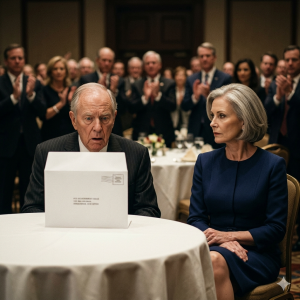
They gave my husband Citizen of the Year.
I sat in the third row and watched him shake the mayor’s hand, and I thought about the white envelope sitting in my purse.
But I’m getting ahead of myself.
Let me tell you about Gerald Ray Combs first.
—
Gerald Ray was the kind of man who carried breath mints to church. Who held doors open for strangers. Who led the First Baptist choir for twenty-two years and could make “Amazing Grace” sound like it was written just for him.
Everyone in Harlan County loved Gerald Ray.
I loved him too.
For forty years, I was Dorothy Jean Combs — née Pruitt — and I sorted mail for the U.S. Postal Service five days a week while Gerald Ray taught music lessons and managed our joint retirement account.
I wasn’t worried.
I trusted him the way you trust the floor under your feet.
—
It was a water bill that started it.
A piece of mail that came back as undeliverable, addressed to a Gerald R. Combs at a house in Bledsoe County — three counties east of ours.
I almost threw it away.
I’m a retired postal worker. I notice these things.
That night, I opened a plain white #10 envelope — the same kind I’d sorted by the thousands for thirty years — and I wrote down the address.
Just to have it.
—
What I found over the next eight months, I won’t put all of it here.
But I’ll tell you this.
There was a woman named Cheryl. There were two children, ages nine and eleven. There was a house with Gerald Ray’s truck in the driveway on Tuesday and Thursday afternoons, regular as a postal route.
And there was our retirement account.
Twelve years of deposits.
Gone.
Not stolen exactly — his name was on it too. Gerald Ray had simply been… redirecting.
Building a life for someone else. With money we both put away. While I worked overtime during the holidays and brought home my government pension and thought we were saving for a little place near Gatlinburg someday.
I sat at my kitchen table for a long time after I understood what I was looking at.
Then I got up, made myself a cup of Sanka, and started making calls.
—
A lawyer named Patrice in Cookeville. A certified forensic accountant. The county clerk’s office. The deed records. The tax filings.
Every time I left the house for one of those appointments, I slipped one thing into my purse.
A plain white #10 envelope.
Sealed.
I don’t know why I started doing it. Habit, maybe. Thirty years of handling those envelopes makes them feel like something official. Something final.
My neighbor Barbara asked me once what was in it.
I just smiled and said, “Everything that needs to be.”
—
The Citizen of the Year banquet was held at the Elks Lodge on a Friday night in October.
White tablecloths. A chicken dinner. Half the county dressed in their good clothes, talking about Gerald Ray like he’d hung the moon.
I wore my navy blue dress. The good one, with the pearl buttons.
I sat at his table, right beside him, the way I always did.
I smiled when people stopped by. I laughed at the right moments. I ate my green beans.
And in my purse, underneath the table, was the envelope.
—
The mayor tapped his glass right before dessert.
He talked about service. About integrity. About what it means to be a pillar of a community.
He talked about Gerald Ray Combs like he was reading a man’s eulogy — except the man was sitting right there, grinning, dabbing the corner of his mouth with a cloth napkin.
I watched Gerald Ray’s face while the mayor spoke.
I had watched that face for forty years.
I knew every expression it made.
So I knew the exact moment he saw me reach into my purse.
—
I set the envelope on the table in front of him.
Quietly. No drama.
Just placed it there, the way you’d set down a bill that’s come due.
The mayor was still talking.
The room was still clapping.
But Gerald Ray wasn’t listening anymore.
He looked down at that plain white envelope.
Then he looked up at me.
And I saw something I had never — not in forty years of marriage — seen on Gerald Ray Combs’ face.
He didn’t reach for it.
He didn’t speak.
For the first time in forty years, my husband had absolutely nothing to say.
—
The mayor did eventually stop talking.
But not because of Gerald Ray.
He stopped because Patrice walked in.
Patrice, my lawyer from Cookeville, who is five foot two and wears reading glasses on a beaded chain and looks like somebody’s church secretary right up until she doesn’t. She came through the side door of the Elks Lodge in a gray blazer, and behind her came a man I recognized from our meetings — the forensic accountant, whose name is David Ely — and behind him came a woman I had never met in person but had seen in a photograph taken from a public road in Bledsoe County.
The woman’s name was Cheryl Faye Dunnigan.
She had driven herself.
That had not been part of any plan I made. I want to be clear about that. I had not contacted Cheryl. I had not known she was coming.
But here is what I have come to understand about the kind of secret Gerald Ray was keeping: it has two sides. And the woman on the other side had spent nine years believing she was the real wife.
She had found Patrice on her own. Three weeks before the banquet. Had walked into that same office in Cookeville and sat down in that same chair across from that same desk and started telling a story that Patrice recognized immediately, because she had already heard half of it from me.
Patrice had called me that same evening.
We had decided together not to tell each other what to do.
—
Gerald Ray saw Cheryl the same moment I did.
The color left his face so fast it was like watching a blind come down.
He pushed his chair back maybe two inches. No more than that. His hands went flat on the tablecloth, on either side of his untouched banana pudding.
The mayor had gone quiet now. Everyone had, the way a room goes quiet when something shifts that you can’t name yet but can feel.
Patrice walked to our table and stood on the other side of Gerald Ray, which put him between us, and she set down her own envelope — thicker than mine, full of the documents that took David Ely four months to compile — and she said, in her normal speaking voice, which carries without her ever raising it:
“Mr. Combs, you’ve been served.”
—
I had not planned for it to happen at the banquet.
I want people to understand that.
I had planned to be at the banquet because I had been invited, and because I was still, at that moment, Dorothy Jean Combs, and because I had spent forty years showing up to things and I was not about to stop. The envelope I brought was not legal paperwork. It was not a court summons or a process server’s document.
The envelope I set down in front of Gerald Ray contained one single sheet of paper.
A letter I had written myself, at my kitchen table, on a Thursday night, with a cup of Sanka going cold beside me.
I told him in that letter what I knew and when I had known it. I told him what I had done with those eight months. I told him that Patrice had filed the divorce petition that morning, which meant it was already done — already moving — before he ever stood up to shake the mayor’s hand.
And I told him one more thing.
I told him I forgave him.
Not for his sake. I was very clear about that in the letter. I told him that forgiveness was the only thing left in our forty years together that was still entirely mine to give or not give, and that I was choosing to give it, and that it had nothing to do with what happened next, which was going to happen regardless.
I had practiced writing that part many times before I got it right.
—
Gerald Ray did not read the letter that night.
He sat very still while the room reorganized itself around what had just happened. His brother Dale came over and put a hand on his shoulder and Gerald Ray did not seem to notice. Someone turned the overhead lights up brighter, the way they do when an event is clearly over and the staff wants to start on the chairs.
Cheryl sat down at a table near the door. A woman I didn’t recognize — a friend of hers, I think, someone who had driven with her — put a glass of water in front of her.
I watched Cheryl for a moment. She looked tired in a way that had nothing to do with the drive.
I thought about going over to her.
I didn’t. It wasn’t the right time, and we are not friends, and I don’t know that we ever will be. But her children are nine and eleven years old and they did not ask for any of this, and that is something I think about.
—
The mayor found me by the coatrack.
He’s a decent man, Mayor Prichard. He looked genuinely stricken, the way people do when something they said twenty minutes ago in complete sincerity has become, through no fault of their own, a little absurd.
He said, “Dorothy Jean, I am so sorry.”
I said, “Don’t be. You didn’t know.”
He said he wished there was something he could do.
I said there wasn’t, but I appreciated him saying so.
Then I got my coat, and I said good night to Barbara, who had been sitting two tables over and had watched the whole thing happen with her hand pressed to her mouth, and I walked out to my car.
—
The divorce was final the following April.
Patrice is as good as advertised. The forensic accountant’s report gave us the full picture of where the money had gone and over what period, and the court agreed that what had been redirected was marital property, and the settlement reflected that.
I am not going to say what I received because it is not anyone’s business, but I will say that the little place near Gatlinburg is no longer a someday thing.
I close on it in November.
Two bedrooms, a covered porch, a view of the ridge that changes color four times a year. There is a wood stove in the front room that the previous owners left behind, and on the afternoon I walked through it the second time, I stood in front of that stove and felt something I hadn’t felt in so long I’d almost stopped expecting it.
Like the floor was solid under my feet again.
—
People have asked me, since the story got around, whether I regret doing it the way I did it. Whether I should have handled it privately. Whether the banquet was too much.
I have thought about this honestly.
Here is what I think.
I did not go to that banquet to humiliate Gerald Ray. I went because my name was on the invitation and I had done nothing wrong. The envelope I brought was a letter, not a weapon. Patrice arriving when she did was her own judgment call, and it was the right one legally, and I am not going to pretend I wasn’t glad to see her walk through that door.
But I also think this: when a man accepts a public honor for integrity, in a room full of people who trust him, the truth has a way of wanting to be in that room too.
I didn’t bring the truth there.
He did. He brought it the moment he walked up to shake the mayor’s hand.
I just didn’t leave it at home.
—
The choir at First Baptist has a new director now. A young woman named Sonya who studied at Belmont and who is, by all accounts, wonderful.
I haven’t been back to that church.
I’ve been going to a smaller one, out on Route 66, that meets in what used to be a hardware store. The congregation is about forty people. Nobody there knew Gerald Ray. They just know me as Dorothy, the woman who brings the good potato salad to fellowship lunch.
That suits me fine.
Last Sunday the congregation sang “Amazing Grace” and I stood there in that old hardware store with the November light coming through the windows and I sang every word.
It did not sound like it was written just for one person.
It sounded like it was written for anyone who needed it.
I needed it.
And I sang.