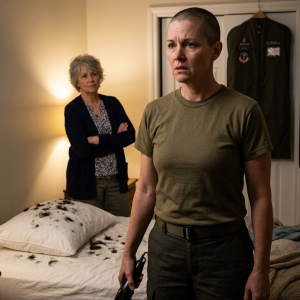
They handed her grandmother’s recipe cards back like they were coupons past their expiration date.
That’s the moment Gail Turrentine decided to disappear.
—
You have to understand what the Turrentine Apple Butter Festival meant in Gatlinburg.
It wasn’t just a fall event with hayrides and cider and little kids in pumpkin shirts. It was *the* event. Started by Gail’s grandmother, Loretta, back in 1971, in the backyard of a farmhouse that still smelled like woodsmoke and cinnamon every October. Loretta’s hand-painted recipe cards — the ones with the tiny red apples in the corners and her cramped, careful handwriting — had been framed and hung in the festival tent for as long as anyone could remember.
Gail had run the festival for twenty-two years.
Raised money for the fire department. Organized the judging. Made the apple butter herself, every single batch, in a copper pot her grandmother had brought from Virginia.
Then the divorce happened.
And then Darla happened.
—
Nobody quite remembers who made the phone call or how the vote went. What they remember is the meeting in the fellowship hall of First Baptist, and Gail walking in thinking she was there to plan this year’s schedule, and walking out forty minutes later carrying a cardboard box.
Inside: those recipe cards.
The ones with the tiny red apples in the corners.
Gail put them in her car. She drove the forty minutes home to her house off Highway 321. She didn’t cry, as far as anyone could tell. She didn’t make a scene.
She just went quiet.
—
For three years, Gail Turrentine was a ghost.
She still bought her groceries at Food City. Still waved at her neighbors. Went to her daughter’s choir concerts, sat in the back, left before the lights came up.
But she didn’t talk about the festival. Didn’t go near it. Didn’t explain anything to anybody.
The one strange thing — and people did talk about it, in the way small towns talk about the things they can’t explain — was the jar.
A mason jar. Small, the old-fashioned quilted kind. Filled with apple butter so dark it was almost the color of bourbon, that deep amber that means the apples have cooked down past sweetness into something richer and stranger.
No label. Just a strip of masking tape with a date written on it in black marker.
People first noticed it at Gail’s cousin’s birthday supper. It was just sitting there on the table beside Gail’s elbow. Nobody asked about it. It felt like the kind of thing you didn’t ask about.
But then it appeared at Thanksgiving. Then at the church Christmas potluck, tucked beside Gail’s green bean casserole. Always the same jar — or one just like it. Always that same deep amber. Always the masking tape with a date.
A different date each time.
Her neighbor Linda finally asked, point-blank, at a baby shower in February: “Gail, honey, what *is* that jar?”
Gail just smiled — that small, private smile she’d developed since the divorce, the one that didn’t let you in so much as acknowledge you were standing at the door.
“Just keeping track of something,” she said.
—
The festival’s third year without Gail, Darla McAllister-Booth was named head of the organizing committee.
Darla had moved to Gatlinburg from Knoxville. She was enthusiastic. She had a good Instagram presence. She’d taken an online canning course and had very strong opinions about the ratio of cider vinegar to sugar.
She did not have a copper pot from Virginia.
But none of that mattered when the Grand Champion ribbon went up, because Darla held it over her head like she’d won something that had always been hers to win.
—
And that’s when Gail came back.
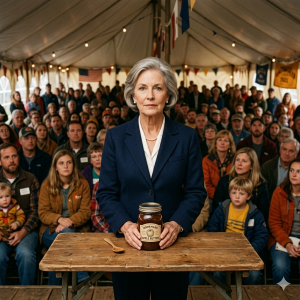
Nobody knew she was going to be there. She didn’t announce it. She just appeared at the edge of the tent on a cool Saturday morning in October, wearing a neat navy blazer and her mother’s pearl earrings, and she sat down at one of the public tables near the back like she was anyone.
She set the jar on the table in front of her.
Deep amber. Old quilted mason jar.
But this time there was no masking tape.
This time there was a label — a real one, cream-colored, printed, with a logo and a name that nobody in that crowd had ever seen before.
Up front, Darla had just finished her speech. She was holding her apple butter above her head, ribbon pinned to the lid, when the emcee tapped the microphone twice and said, in a careful voice:
“Folks, I’m sorry to interrupt — we actually need to make a correction on the Grand Champion announcement.”
The tent went still.
“The winning entry was submitted under a different name.”
Every head turned.
Every single one.
Toward the back of the tent.
Where Gail Turrentine was already standing up, smoothing the front of her jacket, her chin level, her eyes calm.
And the jar on the table in front of her had a label on it now that nobody could quite read from where they were standing — but two people in the front row would later say they saw Gail’s grandmother’s name on it.
*Loretta.*
—
The label read: Loretta’s Original, Gatlinburg, Tennessee. Est. 1971.
Below that, in small clean type: Small-Batch Apple Butter. Copper Kettle Method. A Family Recipe.
Gail had started the company nine months earlier. She’d registered the name in January, filed the trademark in March, and spent the better part of the spring and summer working with a food business consultant out of Asheville to get her commercial kitchen certified. Her daughter, Brianna, who everyone remembered as the quiet girl sitting in the back row at choir concerts, had designed the label. She was twenty-three and studying graphic design at UT Knoxville, and she had drawn tiny red apples in the corners, just like her great-grandmother’s recipe cards.
Nobody had known any of this. That was the point.
—
The masking tape dates, it turned out, were batch numbers.
Each time Gail had brought a jar somewhere — the birthday supper, the potluck, the baby shower — she had been testing a recipe. Not guessing. Not cooking from memory. Testing. Adjusting. Documenting. She had her grandmother’s recipe cards spread across her kitchen table for two years, and she had cooked that apple butter thirty-seven times before she felt it was right.
Thirty-seven batches.
Each one dated. Each one recorded in a spiral notebook she kept in the kitchen drawer.
She had been building something. Quietly, deliberately, in the way her grandmother had always told her a thing worth doing deserved to be built.
—
The festival’s rules allowed open entry. Always had. It said so right there on the registration form, the same form that had been used since 1984, that you could enter under a business name or a personal name, that entries were judged blind, that the judges did not know whose apple butter they were tasting.
Gail had submitted her jar the morning of the festival. She had driven it to the registration table herself, handed it to a teenager with a clipboard who had given it a number and set it in the judging row without looking at it twice.
The judges — three of them, including a woman who ran a bed and breakfast in Pigeon Forge and a retired home economics teacher from Sevierville — had tasted twenty-two entries that morning.
Entry number fourteen had stopped them.
One of the judges, the home economics teacher, whose name was Roberta Faye Alcorn and who had been tasting apple butter at this festival since before Darla McAllister-Booth had ever set foot in Sevier County, had set down her spoon and said, quietly, that she needed a moment.
She said it tasted like something she remembered.
She couldn’t explain it better than that.
—
When the emcee read out the correction and every head in the tent turned toward the back, Darla McAllister-Booth stood at the front with the ribbon still in her hand. To her credit, she didn’t argue. Whatever she was feeling — and her face went through several things in quick succession — she folded the ribbon carefully and set it on the table beside her.
She would tell people later that she’d known something was different about entry fourteen. She’d been one of the first people to buy a jar at the end of the day and she’d taken it home and eaten it on toast and sat at her kitchen table for a long time afterward.
People believed her. Darla was a lot of things, but she wasn’t a liar about food.
—
Gail walked to the front of the tent carrying the jar.
She shook hands with the emcee. She accepted the ribbon. She thanked the judges by name, which she knew because she had looked them up, because that was the kind of person Gail Turrentine had always been and would always be.
Then she turned and faced the tent, and for a long moment she just stood there in her navy blazer with her mother’s pearl earrings and the Grand Champion ribbon in one hand and her grandmother’s jar in the other, and she didn’t say anything at all.
Someone in the crowd started clapping. It spread fast, the way things spread when a crowd has been waiting to feel something, and by the time it reached the back of the tent it wasn’t polite applause anymore, it was the real kind, the kind that surprises people a little, that makes them clap harder than they planned.
Gail Turrentine smiled.
Not the small private smile. The other one. The one from before.
—
She spoke for about four minutes. Nobody recorded it, which is a shame, but three or four people wrote down what they remembered afterward and the accounts are close enough to trust.
She said she had not come back to settle anything.
She said the festival belonged to Gatlinburg, same as it always had, and she was glad it had kept going, and she meant that.
She said her grandmother had always told her that apple butter was patient food. That you couldn’t rush it. That you had to stay with it, keep stirring, pay attention, and trust that what was good would eventually come through.
She held up the jar.
She said: “I’ve been stirring for three years. I think she’d be satisfied with how it turned out.”
—
Loretta’s Original launched at a farmers market in Gatlinburg six weeks after the festival. By December they were in four specialty grocery stores in East Tennessee. By the following spring, a food writer from a regional magazine had come out to profile Gail’s kitchen and the story ran with a photograph of the copper pot her grandmother had brought from Virginia.
Brianna came home that summer and helped her mother redesign the website.
They still use the same recipe. The one from the cards with the tiny red apples in the corners.
Gail keeps the originals framed in her kitchen now, not the festival tent. She figured her grandmother would prefer it that way. Closer to the stove. Where they always belonged.
—
The masking tape jar — the last test batch, number thirty-seven, the one Gail decided was finally right — sits on a shelf above her kitchen window. It’s not for sale. It’s not for eating.
It has a strip of masking tape on it, same as always.
The date written on it is the day Gail walked out of the fellowship hall of First Baptist carrying a cardboard box.
She’s never explained that to anybody either.
She doesn’t need to.