They told the heavyset woman at the gym she should use the side entrance until she “looked like she belonged.”
The sentence landed with such casual cruelty that, for a second, Danielle thought she had heard it wrong.
She stood at the front entrance just before dawn, her hand still on the metal bar of the glass door, a thin blast of cold morning air brushing the back of her neck. The employee at the desk did not look embarrassed. He looked bored. Like he was repeating a policy about parking validation or shoe covers, not directing a grown woman to enter a building through the service corridor because her body offended someone’s idea of fitness.
Across the lobby, the gym owner’s girlfriend let out a soft laugh and looked down into her coffee cup.
Danielle swallowed, nodded once, and stepped back outside.
She told herself she was there for her health, not her pride. She told herself she had already survived worse than strangers. She told herself that if using the side entrance got her inside, then fine. She would use the side entrance.
That was how it started.
Every weekday, Danielle arrived before sunrise, when the streetlights were still on and the parking lot looked washed in blue-gray. She parked near the dumpsters because it was closer to the side door anyway. She wore the same oversized sweatshirt most mornings, black leggings, and a pair of running shoes she had found on clearance at the back of a discount store. She was always careful to move quietly, as if taking up less sound might somehow make her take up less space.
Her doctor had not framed exercise as self-improvement. He had framed it as survival.
At her last checkup, he had gone through the numbers without softening them. Her blood pressure was too high. Her sleep was disordered. Her stress markers were alarming. She carried grief in her body the way some people carried old injuries—tender, hidden, easily aggravated. If she did not start moving regularly, if she did not lower the pressure somehow, everything else would keep getting worse.
So Danielle joined the gym not because she believed she belonged there, but because her body was sending distress signals she could no longer ignore.
She stayed to the edges. She used the treadmill in the back row, the old one with the slightly sticky incline button and the left handle wrapped in black repair tape. She set the speed low. She walked steadily. Some mornings she made it thirty minutes. Some mornings forty-five. The small progress mattered more to her than anyone knew.
Around her, the gym moved like a performance.
Influencers set up phones on tiny tripods and filmed warm-ups from three angles. Men flexed at mirrored columns between sets. Women in coordinated activewear paused under the brightest lights to capture the perfect post-workout shot. Music pounded from hidden speakers. Smoothies blended behind the front counter. The place smelled like lemon disinfectant, artificial fruit, and competition.
Danielle kept her eyes forward and walked.
The mockery began almost immediately.
The gym owner’s girlfriend, Kendra, floated around the place like she was inspecting a private club. She wore expensive sets in pale colors that somehow never showed sweat. She greeted the photogenic members by name and ignored almost everyone else. The first time Danielle caught her making fun of her, it was indirect enough to leave room for denial.
“Some people really do treat January like a personality,” Kendra said to a trainer while glancing Danielle’s way.
The trainer smirked.
Another morning, as Danielle stepped off the treadmill to wipe the console, Kendra passed by with two women carrying yoga mats.
“Motivation poster before picture,” she murmured.
All three laughed.
Danielle heard it clearly.
She felt the sting in the same place old wounds always landed. Not on the surface. Deeper. In the part of her that had once been articulate and quick and almost impossible to intimidate.
That woman still existed. Danielle knew she did.
She had just been buried for a while.
Before grief changed the shape of her life, she had been a forensic accountant. Not a generic accountant who shuffled invoices into files, but the kind companies hired when something smelled wrong and they needed someone patient enough, sharp enough, and relentless enough to find it. Danielle had spent years tracing missing funds through shell vendors, altered receipts, split transfers, fake reimbursements, and clean-looking reports that turned rotten under scrutiny. She loved the work. Loved the logic of it. Loved the moment a mess of figures stopped being random and started telling the truth.
Then her husband died.
It was sudden. It was unfair. It split her life into before and after so violently that everything she once relied on lost shape. She withdrew from friends. She stopped answering messages. She let contracts lapse. She forgot meals, then ate whatever was easiest, then gained weight so quickly that even running errands began to feel like moving through judgment. Work dried up. Confidence followed. What stayed was grief, fatigue, and a quiet belief that maybe the world had already moved on without her.
By the time she joined the gym, she was not rebuilding her old life. She was trying to stop the collapse from becoming permanent.
That was why the fundraiser board first caught her attention.
It stood near the front desk inside a polished wooden frame decorated with bright markers and laminated photos. COMMUNITY STRONG, it read in large cheerful letters. Below that were several ongoing campaigns: veterans’ support, pediatric cancer assistance, local school lunch debt, temporary housing relief. Members were encouraged to donate through QR codes, cash boxes, or rounded-up purchases at the smoothie register. Every few days the handwritten totals were updated, and the gym posted photos online praising the generosity of its members.
The owner, Brent, loved making speeches about it.
“We’re family here,” he told people one Saturday, clapping a regular on the shoulder. “We lift each other up.”
Danielle was filling her water bottle nearby when she heard him announce that the veterans fund had just crossed twelve thousand dollars.
The number stuck in her head because two days earlier she had noticed the board listed it at 10,450. A jump that large in forty-eight hours would have made sense if there had been a major event. But there hadn’t been one.
She told herself not to overthink it.
Then, one morning, she found herself waiting at the front desk while the employee looked for a replacement scan tag. On the counter beside the register sat a small stack of printed receipts, one of them clearly marked as a donation transfer summary. Danielle did not pick it up. She did not need to. Years of reading columns at a glance had trained her eyes to catch shapes fast.
The amount on top did not align with the total displayed on the charity board three feet away.
It was a small discrepancy.
Too small, probably, for most people to notice.
Too precise for Danielle to forget.
Over the next week, she noticed more. The pediatric cancer line item climbed by round numbers that did not match the uneven donation amounts posted online by members who tagged the gym. The school lunch debt campaign supposedly doubled in one stretch where the grand total barely moved. A holiday toy drive was announced as “fully funded” before the local nonprofit thanked donors publicly for receiving a much lower amount.
The inconsistencies bothered her more than the insults ever had.
Because insults were cruelty.
This was theft wearing a smile.
Danielle started tracking what she could. Public campaign posts. Photos where the board appeared in the background. visible totals in stories before they were updated. Receipt dates she glimpsed while checking in. Staff comments overheard in passing. She built a spreadsheet at home at her kitchen table, her old laptop humming while rain tapped against the window. She color-coded figures. Separated confirmed data from likely estimates. Marked every mismatch.
The longer she worked, the more familiar she felt.
Like grief had not killed the part of her that could see patterns. It had only forced it into hiding.
What she found was not messy bookkeeping.
It was cleaner than that.
Too clean.
The public-facing numbers created the impression of generosity and growth. But the trails that could be verified suggested donations were being diverted, delayed, or underreported before reaching the intended causes. Some totals seemed inflated for publicity. Others shrank before transfer. In one campaign, nearly a third of what was publicly claimed had no clear endpoint at all.
She stared at the screen long after midnight that night, pulse quickening.
Maybe there was an explanation.
Maybe there was paperwork she had not seen.
But if there wasn’t, then the gym wasn’t merely humiliating vulnerable people. It was using sick children, struggling families, and veterans to polish its brand while siphoning off money in the background.
Danielle knew she could walk away.
She knew exactly how people like Brent reacted when cornered.
Still, the next Saturday, she brought a single printed page with a small sample of discrepancies. Nothing dramatic. Just enough to ask a direct question.
The gym was crowded. Music thudded from the speakers. Kendra was perched on a stool by the smoothie counter scrolling through comments on a promotional post. Brent stood near the front desk talking to a member about a transformation challenge.
Danielle waited until there was a break.
Then she stepped forward and placed the page on the counter.
“I think your fundraiser totals are off,” she said.
Brent glanced at the paper without really reading it. “Excuse me?”
“The posted numbers don’t match across dates,” Danielle said calmly. “Some receipts and public totals conflict. I thought maybe you’d want to review it.”
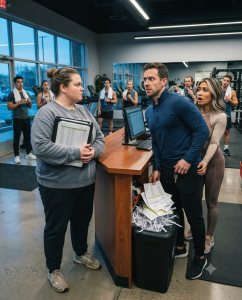
Kendra slid off the stool and leaned in. “Oh my God. Are you auditing the donation board now?”
A few people nearby looked over.
Danielle kept her voice level. “People donated for specific causes. They deserve accurate totals.”
Brent’s face changed.
Danielle recognized that expression instantly. She had seen it in boardrooms, conference calls, and investigation meetings. The moment a person stopped hearing a question and started hearing a threat.
“You accusing me of stealing?” he asked, louder than necessary.
“I’m asking why the numbers don’t match.”
Kendra laughed, but there was an edge in it now. “This is unbelievable.”
Brent grabbed the paper, glanced at two lines, and crumpled it in his fist. “You know what? No. I’m not doing this. My staff doesn’t need harassment from people making up conspiracies.”
Danielle stared at him.
He pointed toward the door. “Membership canceled. Effective immediately.”
The room went strangely still.
Danielle heard someone lower the volume on their phone. Heard a barbell settle into its rack. Heard the little whir of the smoothie blender winding down.
“You’re canceling my membership,” she said carefully, “because I asked about charity money.”
“I’m canceling it because this is a private business, and I decide who trains here.”
Kendra folded her arms. “Maybe there’s a gym that’s a better fit.”
It was the kind of line designed to shrink a person in public. To make her retreat before she thought to push back.
Brent tossed Danielle’s key tag onto the counter.
She looked at it. Then at the crumpled paper in his hand. Then at the people all around them—some uncomfortable, some curious, some pretending not to listen.
For one brief, humiliating instant, she felt exactly how they wanted her to feel: too exposed, too tired, too ashamed to keep going.
Then another feeling rose beneath it.
Clarity.
Danielle picked up the key tag, smoothed the page where it had dropped to the floor, and met Brent’s eyes.
“Okay,” she said.
She walked out through the front entrance.
That evening she called three people.
The first was Carl Mendoza, a retired Marine who had publicly donated several times to the veterans campaign after Brent had told him the gym was partnering directly with support services for wounded veterans.
The second was Teresa Bell, a mother whose daughter had spent months in pediatric oncology and who had cried on camera during one of the gym’s charity livestreams after being told funds were helping families like hers.
The third was Leah Watson, a local elementary school teacher who had rallied parents and neighborhood businesses to contribute to the school lunch debt drive.
Danielle did not dramatize anything. She sent each of them a clear summary and a few images of the discrepancies. She said she could be wrong. She said she hoped she was. But if they wanted answers, she was willing to show them the full file.
All three agreed to meet her the next morning.
Sunday dawned hot and bright. Danielle parked in the same far corner spot she always used. But this time she stepped out of the car carrying a three-ring binder thick with printed spreadsheets, timeline notes, screenshots, and transaction comparisons. Carl arrived in a pickup truck. Teresa came with tired eyes and a jaw set hard. Leah carried a folder of campaign flyers from the school’s fundraiser week.
They entered through the front door.
At first Brent seemed merely irritated to see Danielle back.
Then he saw who was with her.
Carl wasted no time. “You told us over twelve grand went to veterans’ services,” he said, slapping printed screenshots onto the counter. “Why does the nonprofit acknowledgment show less than eight?”
Teresa’s voice was quiet, but it cut deeper than shouting. “You used sick children in your videos. Where did the rest of that money go?”
Leah opened her folder and laid out school emails, donation receipts, and public campaign posts side by side. “Parents trusted you.”
Danielle opened the binder.
Page by page, the polished image cracked.
She showed how public totals shifted inconsistently. How campaign balances exceeded verified transfers. How certain deposits appeared delayed long enough to cloud the reporting. How one account number on a visible bank screenshot failed to match any registered nonprofit connection. Staff started whispering. Members stopped workouts and drifted toward the lobby. Phones came out, but now they were recording something real.
Brent tried every tactic in order.
Charm first. “Guys, there’s probably just a bookkeeping lag.”
Then confusion. “I’d have to check with our payment processor.”
Then offense. “This is a smear campaign.”
Then intimidation. “I can call my lawyer right now.”
But Danielle’s evidence did not care about tone.
Kendra stepped in with practiced confidence, insisting that all charitable funds were handled responsibly and any temporary discrepancies were due to administrative timing. She smiled too much. Moved too fast. Tried to block certain papers from view.
Then Carl asked the question that changed everything.
“Open the office,” he said. “Show us the records.”
Brent’s entire posture tightened. “You can’t go in there without a warrant.”
That one sentence sucked the air out of the room.
Danielle saw it before anyone else: the mistake.
You do not jump to warrants over routine donation records unless the records themselves are dangerous.
Leah turned and pointed toward the wall. “Where’s the board?”
Everyone looked.
The charity board had been removed.
A pale square marked where it had hung. Beneath the counter, a shredder bin bulged with torn strips of colored paper and receipt fragments. Kendra moved in front of it too quickly, but not before Danielle spotted a deposit slip half-hidden under the scraps.
She leaned in.
The account number was unfamiliar.
The name on it was not a charity.
It was personal.
A gasp moved through the crowd in a ripple.
One of the front desk employees, a college kid Danielle had seen scanning memberships for months, suddenly blurted, “Don’t look at me. She told me to change the totals after New Year’s.”
Kendra spun toward him. “Shut up.”
Brent snapped, “Stop talking.”
Too late.
Danielle stepped around the counter before anyone could stop her and pulled the shredder bin into the open. Torn paper spilled across the floor. Carl grabbed the visible deposit slip. Teresa found part of a ledger sheet. Leah picked up a strip of the fundraiser board with one total written over another in different handwriting.
Brent lunged forward, then stopped when he realized half the lobby was filming.
“Everybody back away,” he shouted, but the authority in his voice had evaporated.
Danielle looked at the front desk employee. “What did she tell you to change?”
His face had gone white. “The board totals. Sometimes the category amounts. She said Brent would handle transfers later.”
“Did he?”
The employee hesitated, then shook his head once.
Another staff member spoke up from behind the smoothie bar. “I asked once why cash was getting counted in the office instead of logged up front. He told me it wasn’t my business.”
That was enough.
Carl called the nonprofit associated with the veterans campaign on speaker. A board representative confirmed the amount they had actually received.
It was far below what Brent had publicly claimed.
Leah contacted the school principal, who confirmed the lunch debt donation had covered less than half the amount the gym had promoted online.
Teresa, hands shaking now with anger more than fear, pulled up an old livestream where Brent had promised “every dollar” from that month’s challenge would go to pediatric support. Danielle compared the posted amount from that date against the transfer confirmation in her binder.
A gap sat between them like an accusation no one could talk their way around.
At last Brent tried to shift all blame onto Kendra. Said she handled marketing. Said she updated boards. Said she must have made mistakes.
Kendra stared at him in disbelief. “You signed off on the transfers.”
“Oh, now it’s me?”
“It was your account!”
The room exploded into overlapping voices.
There it was. The truth, dragged into the light not by a dramatic confession but by panic.
Danielle felt something strange then—not triumph exactly, but release. The same sharp calm she used to feel when a hidden ledger finally aligned and the last lie had nowhere left to hide. She wasn’t shaking anymore. She wasn’t embarrassed. She wasn’t the woman being tolerated through a side entrance.
She was the most dangerous kind of witness for people like Brent.
The kind who understood the evidence.
Police were called. So was the local news, though by then several members had already started posting clips. Brent and Kendra stopped talking to each other and started talking over one another, each trying to establish innocence at the other’s expense. Staff were separated for statements. The office, when opened under pressure, revealed bank printouts, envelopes of cash, and a second ledger that made the situation worse instead of better. Donations had not only been misreported. Some had been redirected repeatedly, moved through personal accounts, and used to patch business expenses when the gym’s cash flow dipped.
The community reaction was swift.
Members demanded canceled contracts and refunds. Donors asked for formal accounting. Nonprofits distanced themselves publicly. By evening, the gym’s social pages had disabled comments after a flood of questions and accusations. Within days, an investigation expanded beyond the fundraiser campaigns into payroll irregularities and vendor payments.
Danielle did not stay for the chaos after the first formal statements were taken.
She slipped out the same front entrance where she had once been told she did not belong. The sun was high now. Her sweatshirt stuck lightly to her back. Her legs ached from standing for hours, and her chest felt hollowed out in that strange way it does after adrenaline leaves.
Teresa caught up with her in the parking lot.
“You didn’t have to do this,” she said, eyes wet. “Most people would have just left.”
Danielle looked back at the building. At the polished glass. At the branding. At the fake promises that had finally cracked.
“I almost did,” she admitted.
Carl joined them, his voice rough. “Good thing you didn’t.”
A few weeks later, the gym closed “temporarily” and never reopened. Formal financial reviews continued. Some of the missing funds were recovered. Not all of them. The nonprofits involved issued careful statements. Community members organized direct giving campaigns to replace what had been lost. Ironically, once the gym’s fraud was exposed, more honest money reached the intended causes than had during months of staged generosity.
As for Danielle, she didn’t become famous. She didn’t want to.
But something in her life shifted.
A local nonprofit board asked if she would consult on donation oversight. Then a small law firm reached out about freelance forensic accounting support. She started taking work again—slowly, cautiously, but with a steadiness she had not felt in years. Her doctor noticed her blood pressure improving. She found a different gym, a plain one with worn equipment and zero mirrors on the walls near the entrance. No one there cared what she wore. No one filmed anything. She walked on the treadmill, then longer, then faster.
Sometimes healing looked dramatic from the outside.
For Danielle, it looked more like this: showing up, breathing through discomfort, remembering what she knew, and refusing to let cruel people define her usefulness.
They had looked at her body and decided they understood her.
They saw size and assumed failure. They saw quiet and assumed weakness. They saw grief and mistook it for emptiness.
What they missed was the thing that mattered most.
Danielle had not gone to that gym to impress anyone. She had gone there because she was trying to survive.
In the end, that was exactly why she was the one who noticed what everyone else missed.
And maybe that is what lingered after everything was exposed. Not just the fraud, not just the humiliation, not even the public collapse of two people who had built their image on cruelty and performance. It was the uncomfortable question left behind for everyone who had laughed, looked away, or decided Danielle didn’t belong.
How often do people ignore the strongest person in the room just because she doesn’t look the way they expected?