The day after her husband’s funeral, Margaret returned home with two exhausted children, a casserole dish she had forgotten to leave behind at the church hall, and the numb, drifting feeling of someone whose body was moving hours after her mind had stopped making sense of the world.
Everything around her seemed wrong in ordinary ways.
The sky was too bright for a burial week. The grocery store had its sale signs out. A dog barked two houses down. Somewhere a lawn mower started and stopped. Margaret remembered thinking, absurdly, that the world should have known Daniel was dead. It should have gone quiet out of respect.
Instead, the neighborhood looked exactly the way it always did.
Until she turned into the driveway.
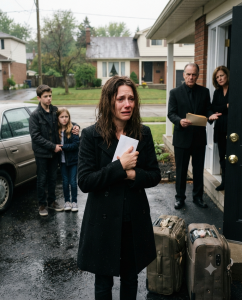
Her suitcases were already outside.
Two large ones and one small floral bag she used for weekend trips sat on the wet concrete near the garage. A trash bag full of children’s clothes leaned against them, half tied. Her winter boots had been tossed beside a planter. One of Elise’s stuffed rabbits was lying face-down in a puddle.
Margaret didn’t understand what she was seeing at first. She slowed the car, then stopped without fully pulling in.
Owen looked up from the back seat. “Mom?”
Then she saw the front door.
The lock was new. Bright brass. Untouched by weather, impossible to miss.
Something cold passed through her body.
She got out of the car slowly, as if moving too quickly would make the scene sharpen into something even worse. Her funeral shoes sank into the edge of the grass. Elise climbed out behind her, clutching the stuffed program from Daniel’s service.
On the porch stood Harold and Lorraine, Daniel’s parents.
Harold wore the same black suit he had worn the day before, though now it looked less like mourning and more like costume. Lorraine stood just behind him in a dark coat with a silk scarf knotted neatly at her throat. Her face was dry. Composed. Almost irritated.
Margaret climbed the first step. “What is this?”
Harold did not answer immediately. He adjusted the folder under his arm and held out his hand.
Margaret stared.
Resting in his palm was her wedding ring.
Not Daniel’s ring. Hers. The slim gold band he had slipped on her finger when they were both twenty-two and so nervous they had fumbled their vows. She had left it by the sink the night before because her hands were swollen from crying.
Harold extended it a little farther, as though he were completing a polite errand.
“This house was always ours,” he said. “Daniel was too soft to tell you.”
Margaret blinked at him.
Rainwater slid from the porch gutter in a steady drip, drip, drip.
Sixteen years. Sixteen years in that house. She had stripped wallpaper in the downstairs hall while eight months pregnant. She had painted the kitchen cabinets herself when they couldn’t afford replacements. She had picked tile, refinished floors, planted hydrangeas along the walk, and sat up through entire nights at the dining room table paying bills, moving numbers around until they fit.
She and Daniel had built a life there the hard way, paycheck by paycheck.
Lorraine folded her arms. “It’s unfortunate this had to happen today, but dragging things out would only make it uglier.”
“Ug—” Margaret stopped, because her voice cracked open on the word. She tried again. “Daniel was buried yesterday.”
Harold’s expression did not change. “That doesn’t alter the facts.”
“What facts?” Owen burst out from behind her. “This is our house.”
Harold looked at him, then away, the way people look at a child interrupting adult business. “Your father understood the arrangement.”
Margaret’s skin went cold.
Arrangement.
It was such a careful word. So smooth. As if eviction was a misunderstanding and cruelty merely paperwork arriving on schedule.
“Where is my key?” she asked.
“There is no point in that now,” Lorraine said.
Margaret looked from one to the other. “Open the door.”
Neither moved.
Across the street, a curtain shifted. Mrs. Delaney from next door stood in her window pretending to water a plant. Margaret saw her mouth something to her husband. No one came out.
“Open. The door,” Margaret repeated.
Harold’s jaw tightened. “The property is reverting to the family.”
“What family?” Margaret asked.
That was when Lorraine came down one step, lowering her voice just enough to make the words intimate and poisonous.
“You were never family,” she said. “You were just the woman he felt sorry for.”
The sentence struck harder than the lock change.
Not because Margaret believed it. Somewhere deep beneath the shock and grief, she knew it was a lie. Daniel had loved her with a steadiness so ordinary and real that it never needed performance. He packed her lunches when she worked double shifts. He learned how to braid Elise’s hair from online videos because Margaret’s wrist had been in a brace. He kissed the back of her neck whenever he passed her at the stove. He still called her Maggie in that low teasing voice when he wanted her to stop worrying.
But grief makes cruelty echo.
For one dangerous second, Lorraine’s words found every insecurity Margaret had ever hidden: that Daniel had come from money and she had not, that his parents had always treated her like a temporary guest who had somehow stayed too long, that every holiday meal with them had carried some subtle reminder she had not been what they envisioned for their son.
She could have shouted. She could have lunged forward, demanded neighbors witness this, made a scene big enough to shame them.
Instead, a strange calm took hold.
She stepped off the porch.
“Owen,” she said, and her voice was steady enough that both children looked at her immediately. “Get your sister in the car.”
“Mom—”
“Now.”
He obeyed.
Margaret bent, picked up the two largest suitcases, and carried them to the trunk. She moved with deliberate care, refusing to hurry for their satisfaction. Harold said nothing. Lorraine watched with a tiny crease between her brows, disappointed perhaps that Margaret was not giving them the collapse they had planned for.
When Margaret reached for the floral bag, she saw Elise’s stuffed rabbit in the puddle. She picked it up, wiped it gently on her coat sleeve, and placed it on the back seat beside her daughter.
Then she drove away.
No destination. Just away.
For several miles, nobody spoke. Elise eventually asked in a small voice, “Are we going home?”
Margaret gripped the wheel until her fingers hurt. She could not answer.
Owen answered for her. “We’ll figure it out.”
It was exactly what Daniel would have said.
At the first red light, Margaret nearly broke. She bowed over the steering wheel and let one sob escape before forcing herself upright again. She had no room to fall apart. Not yet. The children were watching. Everything depended on the next hour, then the next.
Without fully deciding, she turned toward the old diner at the edge of town.
It had once been the center of their beginning.
She met Daniel there at nineteen, when she worked mornings at the pharmacy and he was taking community college classes he hated because Harold insisted he join the family business. Daniel had come in every Thursday for coffee and always left a dollar more tip than he should have. One night she admitted she had never tasted pecan pie. He ordered a slice, asked for two forks, and sat with her through the end of her shift.
Years later, after they married, they still went back. On good days for milkshakes. On bad days because the booth in the rear corner somehow made every problem easier to say aloud.
When Margaret pushed through the diner door, a bell chimed overhead. The room smelled like coffee, bacon grease, and rain-damp coats. Mr. Larkin looked up from behind the register.
He took one look at her face and said, “Come sit.”
No questions. No pitying performance. Just kindness, plain and immediate.
He led them to the back booth.
He brought hot chocolate for the children and a pot of coffee for Margaret. He slid a plate of fries toward Owen, who looked too old for his age and too hungry to refuse. Elise leaned against the vinyl seat and clutched the rabbit Margaret had rescued from the puddle.
For an hour, Margaret said almost nothing.
Finally, when the dinner rush had thinned and the windows had gone black with evening, Mr. Larkin came by with a fresh pot. “You want to tell me,” he asked quietly, “or you want me to just keep refilling this cup?”
Something in his tone undid her.
She told him.
Not elegantly. Not in order. She described the suitcases, the lock, Harold on the porch, Lorraine’s whisper, Owen standing there trying not to cry. Halfway through she had to stop because anger was beginning to rise beneath the grief, and anger, unlike sorrow, gave her enough strength to keep going.
Mr. Larkin listened without interrupting. His lined face grew still in a way that made Margaret notice him differently.
When she finished, he looked toward the office in the back.
Then he said, “Wait here.”
He returned holding a small envelope.
Margaret’s name was written across the front in Daniel’s handwriting.
Her breath caught so sharply it hurt.
Mr. Larkin set the envelope down between the sugar dispenser and the ketchup bottle. “He left this here three weeks before he died,” he said. “Told me not to give it to you until they showed their real faces.”
Margaret stared at the envelope as if it might vanish.
Three weeks earlier, Daniel had still been able to sit up some days. Still able to joke. Still telling her not to fuss over him when she tucked blankets around his legs. Three weeks earlier, he had asked to be driven to town once, saying he wanted one last slice of pie from the diner because hospital food had ruined his standards.
She had waited in the car that day with Elise.
He had come back pale, tired, smiling faintly.
She had never asked if there was another reason.
Now her fingers trembled as she broke the seal.
Inside was a small brass key, a folded letter, and a stamped document clipped to several pages behind it.
The letter began:
My Maggie, if you are reading this, then they did exactly what I prayed they would not.
Margaret made a sound that was almost a laugh and almost a cry.
The children were watching her now. Owen quietly slid the fries away and sat straighter. Elise climbed closer.
Margaret read.
Daniel wrote that he had seen the change in his parents months earlier. Illness had stripped away whatever restraint they once maintained. Harold had begun speaking openly about property, inheritance, “keeping things in the blood.” Lorraine had stopped pretending affection when they were alone. Daniel had overheard enough, and later endured enough direct pressure, to understand that once he was gone, Margaret and the children would be vulnerable.
So he had prepared.
The pages behind the letter were copies.
A deed transfer. A purchase agreement. Records from an attorney. Bank statements. Notes.
The brass key belonged to a farmhouse twenty minutes outside town, purchased quietly and titled solely in Margaret’s name. Daniel had paid for it using money from an investment account Harold did not know existed. The house was fully legal, fully recorded, and beyond his parents’ reach.
Margaret felt the diner tilt around her.
There was more.
The old family house—the one Harold had seized so quickly—was far less secure than he believed. Daniel explained in precise detail that his father’s confidence rested on outdated assumptions and selective paperwork. The property was tied to debts Harold had helped create through careless business guarantees years earlier. Daniel had separated his own interests, protected Margaret’s savings, and left instructions with his attorney to trigger immediate review if his parents attempted to force her out.
At the bottom of one page was Daniel’s note in the margin:
If they move too fast, they expose themselves.
Margaret looked up, tears blurring the diner lights. “He knew.”
Mr. Larkin nodded once. “He hoped he was wrong. But he wasn’t a fool.”
Owen asked, “What does it mean?”
Margaret swallowed hard. For the first time all day, her answer held certainty.
“It means your father took care of us.”
They left the diner after midnight.
Before Margaret reached the door, Mr. Larkin called her back and handed her a second envelope. Smaller. Unmarked except for one line in Daniel’s handwriting:
Only open if they come begging.
She tucked it into her bag without opening it.
The road to the farmhouse wound through dark trees and mist. By the time they reached it, dawn was just beginning to thin the sky. The house stood white and quiet at the end of a gravel drive, with blue shutters and a porch wide enough for a swing.
Elise gasped softly. Owen whispered, “Dad bought this?”
Margaret could barely speak.
She fitted the brass key into the lock.
Inside, the rooms smelled of fresh paint and cedar. The floors gleamed softly in the first light. There were curtains already hung in the bedrooms. Basic furniture. Dishes in the cabinets. Blankets folded at the foot of each bed. Daniel had thought of everything.
On the kitchen counter sat a single note.
For the peace they never deserved to take from you.
Margaret pressed the note to her chest and cried harder than she had at the cemetery.
Not because she missed him less, but because she felt his love in action, tangible and strategic and astonishingly calm. Even while dying, Daniel had spent his remaining strength securing a future no one else believed Margaret would need protection from.
They slept a few hours in borrowed peace.
At eight in the morning, gravel spat under tires outside.
Margaret looked out the window and saw Harold’s car.
He got out first, face ashen, folder gone. Lorraine followed, no scarf now, no careful poise, just panic sharpened into anger. They strode up the walk and stopped at the porch steps when they realized Margaret was standing inside, not alone and not cornered.
Harold knocked once, then pounded.
“Margaret!” he shouted. “Open this door.”
She didn’t.
Owen came to stand beside her. Elise peered from the hallway.
“What happened?” Owen asked.
Margaret understood before Harold spoke again.
“Daniel made a mistake,” Harold said, voice cracking. “There are documents we need to discuss.”
Translation: they had learned the papers they relied on were useless against the real filings. Maybe the lawyer had contacted them. Maybe the bank had frozen access. Maybe they had discovered too late that by moving against Margaret, they had triggered exactly the legal scrutiny Daniel intended.
Lorraine leaned toward the glass. “You don’t know what he signed. He was sick. He wasn’t thinking clearly.”
Margaret almost smiled. Daniel had anticipated that line too.
She opened the second envelope.
Inside were copies of text messages and email printouts from Harold to Daniel, escalating over months from pressure to threats. One message read: Once she’s out, things can be put back where they belong. Another: Don’t leave my grandson under that woman’s control. A notarized statement from Daniel’s attorney confirmed Daniel had reported concerns about coercion while fully competent and had requested that all protective transfers be completed immediately.
There was also a voicemail transcript so chilling Margaret had to read it twice.
Harold had told his dying son, If you don’t settle this now, I will when you’re gone.
Daniel had kept everything.
Outside, Harold’s pounding stopped.
His next words came lower, more desperate. “We can settle this privately.”
Lorraine’s eyes moved past Margaret, scanning the room, still searching for advantage. “Think about the children,” she snapped. “Do you really want this ugliness around them?”
At that, Margaret opened the door.
Not wide. Just enough to step onto the porch and close it behind her.
Harold immediately tried to recover his old authority. “Good. Now listen carefully—”
“No,” Margaret said.
The single word stunned him silent.
Rain-washed morning light fell across the yard. Birds chattered in the hedges. Somewhere inside the house, Elise laughed faintly at something Owen said, the sound so small and normal it made Lorraine flinch.
Margaret held the envelope at her side.
“You put my children out of their home the day after their father’s funeral,” she said. “You stood on a porch I cleaned with my own hands and told me I was nothing. You returned my wedding ring like I was some tenant whose lease had expired.”
Harold’s mouth tightened. “This can still be corrected.”
“It already has been.”
Lorraine stepped forward. “Whatever Daniel told you, he was manipulated—”
Margaret lifted the papers. “By whom? You?”
Neither answered.
She saw it then, fully and without grief softening the edges: these were not wounded parents acting out of loss. These were people who believed blood excused cruelty, that status could replace decency, that Daniel’s death had left behind an opening they were entitled to exploit.
Harold’s face hardened. “If you turn this into a legal fight, the children will hear things about their father you don’t want repeated.”
The threat landed, but not the way he intended.
Because Daniel had predicted that too.
In the final page of the second envelope, he had written a brief instruction in his own hand:
If he threatens my name, give everything to the police and tell the children the truth only when they’re old enough to understand courage.
Margaret looked directly at Harold.
“For a long time,” she said, “I thought Daniel kept peace with you because he still hoped you would become the people he needed. I was wrong.”
Harold took one step back.
“He kept peace,” Margaret continued, “because he knew exactly what you were, and he wanted enough time to protect us first.”
Lorraine’s face drained of color.
Margaret handed Harold a business card from Daniel’s attorney through the narrow gap in the screen door. “You can speak to him. You can speak to the bank. And if either of you come near my children again without permission, you can speak to the police.”
Harold did not take the card at first. His hand shook when he finally did.
For one suspended moment, none of them moved.
Then Margaret slid her wedding ring back onto her finger.
It was a small act. Quiet. But it landed with more force than any scream could have carried. Lorraine saw it and looked away first.
Margaret stepped back inside and locked the door.
This time, the click sounded different.
Not like loss.
Like an ending.
Through the window, she watched them remain on the porch for another minute, then two. Harold arguing in harsh bursts. Lorraine staring toward the fields as though the morning itself had betrayed her. Eventually they went down the steps and returned to the car with the stiff, stunned movements of people who had finally met a consequence that could not be manipulated.
When they drove away, the gravel settled slowly behind them.
Inside, Owen stood in the kitchen with Daniel’s note still in his hand. “Did Dad really know they’d do this?”
Margaret thought about the envelope in the diner, the legal papers, the second letter, the measured foresight of a man who had loved her enough to prepare for betrayal while pretending hope for her sake.
“Yes,” she said softly. “I think he did.”
Elise came around the corner carrying the stuffed rabbit and asked the most eight-year-old question possible.
“Can this be home now?”
Margaret looked around the kitchen. At the soft light on the table. At the unopened boxes Daniel must have arranged. At her children, no longer standing on a driveway with nowhere to go.
“Yes,” she said.
And it was.
In the weeks that followed, lawyers did what lawyers do. Paperwork surfaced. Claims collapsed. Harold’s attempt to seize control of the old property opened a line of financial scrutiny that exposed debts he had hoped to shift elsewhere. Daniel’s records made it impossible for anyone to argue confusion or incompetence. The harassment stopped quickly once formal consequences entered the conversation.
People in town heard versions of the story. Most were incomplete. Some were wrong. Margaret stopped trying to correct every whisper. Truth did not need neighborhood approval to remain true.
What mattered was simpler.
Owen began sleeping through the night again. Elise stopped asking when they were going back to the old house. The porch at the farmhouse filled with potted herbs and muddy shoes and the sound of children racing in and out. Margaret planted hydrangeas by the walk the following spring.
Sometimes she still missed Daniel so suddenly it felt like a hand closing around her heart.
But now, alongside the grief, there was something steadier: the knowledge that his final act had not been surrender to illness, but love sharpened into protection.
He had not left her powerless.
He had left her warned, sheltered, and seen.
And on certain quiet mornings, when the light came through the kitchen window just so, Margaret would touch the ring on her finger and think about that day on the porch. About Harold’s certainty. Lorraine’s whisper. The lock clicking shut behind them.
Then she would remember the sound of her own door locking at the farmhouse, with her children safe inside and Daniel’s truth in her hands.
She never decided whether the deepest wound had been the cruelty itself or the speed of it. Perhaps that was the real revelation—that some people don’t become monsters under pressure; pressure simply gives them permission to stop pretending.
Daniel had known.
The harder question was whether Margaret should have known sooner too.
And if love asks you to keep giving people chances, at what point does mercy become the first red flag you were taught to ignore?