They lost everything to a woman they’d spent twenty years trying to erase.
And the last thing she set on that conference room table before it all fell apart?
A mason jar full of sawdust.
But I’m getting ahead of myself.
—
Loretta Fenn was forty-one years old the morning her brothers walked her off the property.
Not escorted. *Marched.*
Dale on one side, Bobby Ray on the other, hands on her elbows like she was something that needed managing. The whole thing took less than ten minutes. The paperwork, they told her, was already filed. The deed, they said, had always only ever had two names on it. Their father, God rest him, had made his wishes clear.
She knew that was a lie.
She’d *signed* that deed. Stood right there in her daddy’s office, ink still wet, the smell of pine and motor oil thick in the air. She had signed it. All three of them had.
But a forged signature looks enough like the real thing when the man doing the forging is also the man paying the notary.
The county believed Dale and Bobby Ray. Of course they did. The brothers were loud and back-slapping and bought rounds at the VFW on Fridays. Loretta was quiet. Loretta had *opinions.* And when a quiet woman with opinions starts talking about documents being falsified, well — some folks find it easier to decide she’s simply not well.
*Poor thing,* they said. *Always was a little high-strung.*
She walked out of Fenn Family Lumber with the clothes on her back, her daddy’s old work gloves — the leather ones, creased soft as skin from thirty years of use — and one thing she’d grabbed off the mill floor on her way out the door.
A mason jar.
She’d bent down, right there on the sawdust-covered ground, and scooped up a handful. Screwed the lid on tight. Tucked it under her arm like it was something precious.
Dale had laughed. Bobby Ray looked away.
Neither of them asked why.
That was their first mistake.
—
Twenty-two years is a long time to be underestimated.
Loretta moved to Lexington. Got her GED, then a paralegal certificate, then a business degree she paid for herself, one semester at a time, while working at a title company where she learned — *intimately* — how money moves, how debt works, and how a patient person with the right information can position themselves in ways that take decades to pay off.
She never talked about the mill. Never posted about it, never brought it up at Christmas, never let on to a single soul what she was building or why.
She kept that mason jar on her desk the entire time. Every apartment, every office, every fresh start.
People asked about it occasionally. She’d just smile and say her daddy was a sawmill man.
She wasn’t lying.
—
Dale and Bobby Ray ran Fenn Family Lumber into the ground the way some men do — loudly, confidently, and blaming everyone else the whole way down. Bad contracts. Overextended credit. A lawsuit from a logging supplier they’d stiffed two years running.
By the time they filed for Chapter 11, they owed money to eleven different creditors.
The one they couldn’t identify — the silent one, the LLC with the quiet paper trail — held the note on the mill itself. The land. The equipment. The name.
*Everything.*
Their attorney had tried for weeks to get a name. The entity was perfectly legal, perfectly structured, and perfectly, maddeningly anonymous.
Until this morning.
—
Loretta drove three hours through the mountains to get there.
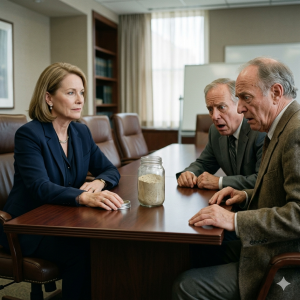
She wore her good navy blazer and her daddy’s work gloves tucked in her bag. She carried a leather portfolio and a cup of gas station coffee and that mason jar — the same one, the original one, the sawdust inside gone pale and fine after two decades.
She set it on the conference table the moment she sat down.
Across from her, Dale and Bobby Ray shuffled papers and didn’t look up. They didn’t recognize her yet. Twenty-two years and a life well-lived will change a woman in ways that shame never could.
The jar sat there between them. Quiet. Patient.
Dale glanced at it once. His brow furrowed. He looked away.
Bobby Ray’s eyes drifted to it twice. He couldn’t figure out why it made him uneasy.
Loretta looked at it and almost smiled.
The bankruptcy attorney cleared his throat.
He slid the folder across the table.
“Gentlemen,” he said, “your primary creditor has waived anonymity and would like to introduce herself.”
Loretta Fenn stood up.
She reached out and unscrewed the lid of that mason jar — slow and easy, like she had all the time in the world.
And she watched her brother Dale’s face go the color of old ash.
—
The smell hit him first.
That’s what she’d counted on. Pine dust and machine oil and the particular sweetness of fresh-cut lumber — a smell so specific to that mill, to that floor, to those thirty years of their father’s life, that no amount of time could make Dale Fenn mistake it for anything else.
His mouth opened. Nothing came out.
Bobby Ray was slower. He looked at the jar, looked at his sister, looked back at the jar. And then his face did something she hadn’t quite expected. It crumpled. Just for a second. Like a man who has been holding a door shut against something heavy for a very long time, and his arms have finally given out.
“Loretta,” he said. That was all. Just her name.
She let it sit there in the air.
Then she opened her leather portfolio, slid three documents across the table, and spoke for the first time since she’d walked into that room.
“The LLC is Millhand Holdings. I incorporated it in Delaware eleven years ago. The note on this property was acquired from First Community Bank when they sold their distressed debt portfolio in 2019. I paid sixty-one cents on the dollar.” She paused. “I want to make sure you understand what that means. I own the deed. I own the equipment liens. I own the name.”
She tapped the top document with one finger.
“Fenn Family Lumber. The name your grandfather gave this place. It belongs to me now.”
Dale had found his voice somewhere around sixty-one cents on the dollar. It came out ugly, the way his voice always did when he was cornered.
“You can’t just — this is — you don’t have any legal claim to —”
“Dale.” Her attorney, a compact woman named Sandra Okafor who charged four hundred dollars an hour and had never once raised her voice in a courtroom, said his name the way you say *sit* to a dog that already knows better. “Your counsel has reviewed the documentation. I’d encourage you to let him speak.”
Dale looked at his own attorney, a local man named Kevin who had the unfortunate look of someone who had not slept well and had been dreading this particular morning for going on three weeks. Kevin gave a small, pained nod.
Dale sat back.
Bobby Ray hadn’t moved. He was still looking at the mason jar.
—
What Loretta proposed was not revenge, exactly. Though she’d be lying if she said there wasn’t some satisfaction in the room that she had to work to keep off her face.
What she proposed was a buyout.
The mill would be sold — to her, at fair market value as assessed by an independent appraiser, minus the outstanding debt she held, which conveniently accounted for the bulk of that value. Dale and Bobby Ray would walk away with enough to pay their remaining creditors and clear roughly forty thousand dollars each.
Not nothing. But close.
The alternative — and Sandra laid this out with the quiet thoroughness of someone reading a weather report — was liquidation. In which case the brothers cleared considerably less, the county lost thirty jobs, and a mill that had operated continuously since 1961 got broken up and sold for parts.
“We’re not here to destroy anything,” Loretta said. “I want to be clear about that. This mill employed my grandfather. It employed my father. I grew up on this land.” She looked at Dale directly. “I am not interested in burning it down. I am interested in running it.”
Bobby Ray made a sound that might have been a laugh or might have been something else entirely. He pressed his hand over his mouth.
Dale stared at the table.
The clock on the wall ticked.
Kevin leaned over and murmured something in Dale’s ear. Dale’s jaw tightened. He stared at the documents for a long moment — long enough that the silence became its own kind of pressure — and then he picked up the pen.
He signed.
Bobby Ray signed without hesitating. His hand was shaking.
When it was done, he looked up at Loretta and said, quietly, “I should’ve said something. Back then. I should’ve — I knew it wasn’t right.”
Loretta studied him. Bobby Ray had always been the one who looked away. She’d spent a long time being angry at him for exactly that. At some point in the last decade it had softened into something more like pity, and at some point after that it had become something she didn’t have a clean name for.
“I know,” she said.
That was all she gave him. But she meant it.
—
She sat alone in the conference room after the others had filed out.
Sandra had gone to make copies. Dale had left without another word, which was about what Loretta had expected. Bobby Ray had stood in the doorway for a moment like he wanted to say something more, then thought better of it and walked out into the parking lot where she watched him through the window sit in his truck for a very long time without starting it.
She picked up the mason jar.
The sawdust was so fine now it was almost powder. Twenty-two years of sitting still while she moved. While she built. While she waited.
She’d taken it that morning because she needed something to look at. Something that would remind her, on the bad days — and there had been genuinely bad days, years of them, stretches where the whole plan had felt like nothing but a story she was telling herself to get out of bed — that it had been real. That she hadn’t imagined it. That the floor of that mill existed, and her name had been on that deed, and what had been taken from her was a real and specific thing.
It had worked.
She set it back down on the table.
Then she pulled out her daddy’s work gloves — the leather ones, gone almost black with age now, the creases so deep they looked like a topographic map of all the years between — and she put them on.
They still fit.
—
Fenn Family Lumber reopened under new management in the spring. Same equipment, mostly. Same thirty employees, all of whom had been quietly terrified about their jobs until the new owner held a meeting in the break room and explained she’d grown up three miles from here and intended to be around for a while.
Nobody recognized her at first. She’d been gone a long time.
Old Dennis Crawley, who’d run the planer for twenty-seven years and knew her father better than most, was the one who finally put it together. He came up to her after that first meeting, squinting like he was working something out.
“You’re Hank Fenn’s girl,” he said. “The one who —” He stopped himself.
“Yes,” she said.
He nodded slowly. Looked around the mill. Looked back at her.
“Your daddy would’ve liked this,” he said.
She kept it together until she got back to the office.
The mason jar sat on the corner of the desk — her desk now, in the office that had been her father’s, in the building that had been her family’s, in the name that was finally, after twenty-two years, hers again.
She didn’t empty it.
She didn’t need to.
But she did unscrew the lid, one more time, and let the smell of the place come back to her the way it always had — full and sharp and permanent.
Then she screwed the lid back on, picked up the phone, and went to work.