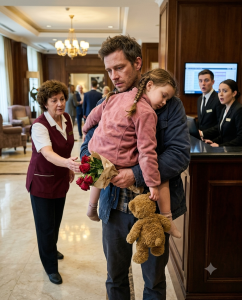
Marcus Whitfield entered the Aldridge Grand Hotel carrying two things that mattered more than sleep.
In one arm, he held his six-year-old daughter, Sophie, limp with exhaustion and wrapped in the full trust only children possess. In his other hand, he held a bouquet of red roses already showing signs of a rough journey—stems pinched too tightly, petals bruised, leaves bent where airport crowds and delayed boarding had pressed too close.
He had built hotels for eleven years. He had negotiated acquisitions across continents, calmed investors during recessions, inspected kitchens at dawn, memorized floor plans, and personally rewritten standards manuals when customer satisfaction slipped by a single percentage point. But none of that mattered in that moment.
That night he was not a founder, not a chairman, not a hotel owner.
He was just a tired father trying to keep a promise.
The next morning would mark three years since his wife Elena had died.
Not one year had passed without flowers.
On the first anniversary, Sophie had been too young to understand the permanence of loss. She had stood on a kitchen chair with serious eyes and chosen the biggest vase they owned because, in her words, “Mama liked when flowers looked happy.” Marcus had nearly broken in half watching those tiny hands arrange roses beside Elena’s framed photograph.
On the second anniversary, Sophie had asked whether heaven had windows and whether Elena could see the roses from there. Marcus had told her he hoped so. He had gone into the garage afterward and cried where no one could hear him.
By the third year, grief had changed shape. It no longer struck like lightning every hour. It moved differently now—quieter, deeper, settling into ordinary routines. But anniversaries still opened every wound as cleanly as the first day.
No matter what happened, Marcus always brought roses.
This year, timing betrayed him.
A meeting in Chicago had run late after one executive backed out of a deal at the last minute. A flight delay had stranded him and Sophie on a crowded concourse for nearly four extra hours. The weather had rerouted planes. Corporate assistants had booked them into the Aldridge Grand because it was closest to the airport and because Marcus was due to inspect two properties in the city the following week anyway.
He could have called ahead and announced himself. One message from his office would have lined the entrance with managers.
But Marcus hated that kind of arrival.
He had never liked seeing people perform kindness for a title. He preferred to watch how employees behaved when no one important was looking.
So he walked through the revolving doors just before midnight in a wrinkled travel coat, carrying a sleeping child and a half-crushed bouquet, and said nothing about who he was.
The lobby was as elegant as he remembered from the renovation plans—high ivory columns, polished marble floors, low amber lighting, fresh orchids near the seating area, and a piano in the lounge that no one was currently playing. It should have felt warm. Instead, it felt staged.
At the front desk stood two women who looked as though they belonged in a brochure.
The first, according to her name tag, was Clare. Blonde hair in a neat low bun. Navy blazer without a wrinkle. Perfect posture. Controlled smile. The second, Ranatada, wore a cream blazer and the kind of expression that suggested boredom had long ago hardened into contempt. She was glancing at her phone when Marcus approached and only lifted her head when his shadow reached the counter.
“Good evening,” Marcus said softly, not wanting to wake Sophie. “I have a reservation under Whitfield.”
Clare typed. Paused. Typed again.
“There’s nothing under that name.”
Marcus tightened his hold on Sophie as she shifted against his shoulder. Her cheek was warm. One braid had come loose, and her teddy bear hung from her hand by a frayed arm.
“It may have been booked through the corporate office,” he said. “Could you check again, please?”
Clare gave a thin sigh.
“Sir, even if there were an issue with the reservation, we’re fully booked. We have a corporate event in-house. No rooms are available.”
Marcus looked at her for a moment. Not challenging. Just measuring.
He had heard this tone before in places that sold service and practiced judgment. The voice that said policy while meaning appearance. The polite phrasing wrapped around a silent decision: not worth the effort.
“We’ve had a long flight,” he said. “My daughter needs a bed. I’m only asking you to verify the booking.”
Ranatada finally looked him over directly. Her eyes paused on the flowers, then on the overnight bag, then on his beard.
“At times like this, guests usually confirm ahead of arrival,” she said. “Unexpected problems aren’t always the hotel’s fault.”
It was such a smooth sentence that someone less tired might have missed the insult.
Marcus did not miss it.
Neither, perhaps, would Elena have.
Elena had always noticed tiny brutalities other people excused. She once left a luxury boutique without buying anything because a saleswoman greeted her warmly but ignored another woman dressed more simply. “The fastest way to learn what a place values,” she had told Marcus later, “is to watch who gets dignity for free.”
He almost heard her voice in the lobby.
“May I speak to the manager?” he asked.
Clare’s smile never warmed.
“The manager is occupied with the event. I can’t interrupt him over a room that doesn’t exist.”
That should have been the moment Marcus revealed himself. Anyone else in his position might have. One sentence. One name. One shift in power.
Instead he looked down at Sophie.
Her hand had tightened around the teddy bear. Her lashes trembled but she didn’t wake. He thought of the airport chairs, the cold fluorescent lights, the roses waiting to be placed somewhere meaningful before morning. He felt an exhaustion so complete it bordered on grief.
Then, from the side corridor near the concierge station, someone spoke.
“Excuse me, sir. Is everything all right?”
Marcus turned.
The woman pushing the housekeeping cart wore a burgundy service vest and comfortable shoes. Her name tag read Dolores. She appeared to be in her fifties, with silver threading through dark hair and the kind of alert, kind expression that instantly made people feel seen.
She was not glamorous. She was not polished. She was not performing hospitality.
She was simply paying attention.
“I have a reservation,” Marcus said. “They can’t seem to find it.”
Dolores looked at Clare. “Did you check the corporate block?”
Clare’s expression hardened. “I checked the system.”
“That isn’t what I asked,” Dolores said calmly. “Executive reservations don’t always show on the primary screen. Sometimes they’re in the secondary tab.”
Ranatada set down her phone. “Dolores, this is front desk.”
Dolores turned her head slightly. “And he is still a guest.”
Marcus saw the tension move through the space like a wire being pulled tight. Clare clicked back into the system with obvious annoyance. One tab. Another. A pause.
Then her face changed.
“Here it is,” she said quietly. “Whitfield. Ninth-floor suite. Executive category.”
There was no apology in her voice. Only discomfort at having been corrected.
Marcus would have taken the key and gone upstairs if Dolores had not then glanced at the roses.
“They’re damaged,” she said gently. “Are they for someone special?”
He looked down at them. The petals had bent inward at the edges. One stem had almost split where he’d gripped it too hard during the delay.
“For my wife,” he said. “Tomorrow is three years since she died.”
Dolores’ face softened.
She looked at sleeping Sophie, at the wilted bouquet, and then back at Marcus with something like understanding too deep for theatrics.
“Then those flowers shouldn’t arrive in your room like this,” she said. “Wait here. I’ll get you a vase.”
She took the bouquet from his hand with extraordinary care and wheeled her cart toward a service room.
And in that quiet pause, Clare looked again at the reservation details.
Marcus watched realization strike.
It started in the eyes. Then the blanching face. Then the tiny involuntary inhale. She leaned closer to the monitor. Ranatada frowned and glanced over.
On the screen, beneath the room category and booking source, the attached guest profile read:
Marcus Whitfield
Owner, Aldridge Hotel Group
Ranatada’s posture straightened instantly. Clare’s mouth parted.
The shift was almost violent.
“Mr. Whitfield,” Clare said, voice suddenly too bright, too careful. “I’m so sorry for the misunderstanding.”
Marcus said nothing.
Ranatada reached for a fresh key packet. “Had we known—”
“That’s the problem,” Marcus said quietly.
Both women froze.
He did not raise his voice. He did not need to.
“You had no idea,” he said. “So you told the truth.”
The lobby seemed to still around them.
Just then a man in a dark suit hurried in from the ballroom corridor, earpiece still attached, tie loosened from managing the upstairs event. Daniel Foster, general manager of the property. Marcus knew his name from reports. He had once praised him for reducing turnover rates and improving weekend occupancy.
Tonight Daniel took one look at the desk staff and immediately sensed disaster.
“Mr. Whitfield,” he said, face draining. “I wasn’t informed you were arriving.”
“No,” Marcus replied. “You weren’t.”
Daniel glanced from Marcus to Clare to Ranatada and understood the situation faster than either woman wanted him to.
“I apologize,” Daniel said. “This should never have happened.”
Marcus adjusted Sophie carefully as she stirred and buried her face deeper into his shoulder. Then he asked the question that changed the direction of the night.
“If Dolores had not come over,” he said, “would my daughter and I have been sent back out that door?”
No one answered.
Daniel looked at Clare. Clare looked down. Ranatada folded her hands but said nothing.
Marcus waited.
At last Daniel said, “That appears to be what would have happened.”
Dolores returned then with a clear glass vase filled with fresh water. She had trimmed the crushed ends of the stems and removed the torn leaves. The roses looked better, not perfect, but restored as much as possible. She placed them gently on the counter.
“There,” she said softly. “They’ll last the night now.”
Marcus looked at the arrangement, then at her.
“Thank you,” he said.
It was the first sincere warmth that had touched the desk area since he arrived.
Daniel cleared his throat. “Mr. Whitfield, let me personally escort you to your suite.”
“In a minute,” Marcus said.
Daniel went still.
“This isn’t just about me,” Marcus continued. “It’s about how your staff treat people when they think no one important is watching.”
Clare finally found her voice. “Sir, we made a mistake.”
“No,” Marcus said, turning to her. “A missing reservation is a mistake. Looking at a tired father with a sleeping child and deciding he is not worth basic effort is a choice.”
Her face flamed.
Ranatada opened her mouth, then closed it.
Marcus looked at Daniel. “I want the lobby security footage from the last twenty minutes preserved. I want the desk interaction reviewed. I want a full audit of guest complaints involving dismissive treatment or discriminatory conduct over the past twelve months. And I want to know how often Dolores has had to quietly fix problems created by people above her pay grade.”
Daniel swallowed. “Yes, sir.”
One of the bellmen standing nearby suddenly seemed very interested in the floor.
Clare’s composure cracked. “Please, Mr. Whitfield, this isn’t who I am—”
Marcus looked at her with tired, unblinking disappointment. “Tonight it was.”
Ranatada tried next. “We were under pressure with the event. We weren’t trying to—”
“Pressure,” Marcus said, “does not create character. It reveals it.”
No one spoke after that.
He finally let Daniel lead him and Sophie to the private elevator while a night supervisor delivered the vase and roses behind them. The ninth-floor suite had been prepared beautifully—soft lighting, turn-down service complete, bottled water chilled, blackout curtains drawn. It should have impressed him.
Instead, the first thing Marcus did was place the roses on the table by the window.
He laid Sophie carefully on the bed without waking her, removed her shoes, tucked the blanket around her, and set the teddy bear under her arm. Then he stood for a long moment in the dim room looking at Elena’s flowers in a borrowed vase in a hotel she had never seen.
The grief came then, silently and with no energy left to resist it.
He sat in the armchair and covered his face.
A soft knock at the door startled him. Daniel stood outside with a folder and, to Marcus’s surprise, Dolores beside him.
“I didn’t want to disturb your daughter,” Daniel said. “But there are matters requiring your direction.”
Marcus let them in.
Daniel handed him a printed incident report, still incomplete, and said, “I’ve already pulled the footage and reviewed the first pass. Their conduct was unacceptable from the moment you approached the desk.”
Dolores stood near the entry, hands folded, as if she were worried simply being present might overstep.
Marcus lowered the papers. “How long have you worked here?” he asked her.
“Nine years, sir.”
“And how often do you notice things like this?”
Daniel shifted uncomfortably before she answered.
Dolores chose honesty anyway. “More often than management hears about.”
Daniel shut his eyes briefly.
Marcus looked at him. “That answer should concern you more than tonight.”
“It does,” Daniel said.
“Good.”
He turned back to Dolores. “Why did you step in?”
She looked surprised by the question. “Because your little girl was asleep. Because you were exhausted. Because a guest needed help. I didn’t think it was complicated.”
Marcus almost laughed, though there was no humor in him. “No,” he said. “It shouldn’t have been.”
The next morning, before sunrise, Sophie woke and found the roses by the window.
“For Mama?” she whispered.
Marcus nodded.
She climbed into his lap, still wrapped in the blanket. Together they sat beside the vase in silence while morning slowly silvered the glass. Sophie touched one petal with a fingertip.
“They’re a little squished,” she said.
“They had a long trip,” Marcus answered.
She leaned against him. “Mama would still like them.”
He kissed the top of her head. “I think so too.”
Later that day, after the private memorial they kept between just the two of them, Marcus returned to business.
He did not make a scene in the lobby. He did not announce firings in front of guests. That was not his style.
Instead, he conducted interviews.
He reviewed the footage himself.
It showed exactly what he had felt but had been too tired to fully track in the moment: Clare’s dismissive posture before she even began searching. Ranatada’s contempt. The refusal to verify a reservation properly. The immediate shift in tone after his identity was revealed. And, cutting through it all, Dolores stepping forward with simple human decency while everyone else stood behind title and polish.
The complaint audit brought worse news. Not lawsuits, not scandals, but patterns. Notes from guests who felt brushed off, ignored, underestimated. Small incidents, individually survivable. Together, corrosive.
Marcus had learned years ago that organizations rarely collapse from one spectacular failure. They rot from tolerated habits.
By afternoon, Clare and Ranatada were terminated.
Daniel was not fired, but he was placed on a formal performance review and ordered to overhaul front-desk training, guest escalation procedures, and internal accountability. Mystery audits would begin immediately. Marcus assigned an independent team to assess service culture across all Aldridge properties.
And Dolores?
Marcus called her into the conference room later that evening.
She entered looking uneasy, probably expecting questioning, perhaps even blame for overstepping.
Instead Marcus stood when she walked in.
“I owe you thanks,” he said. “Not because you recognized me. You didn’t. Because you did the right thing when there was no advantage in doing it.”
Dolores looked down. “I was just helping.”
“Yes,” Marcus said. “Exactly.”
He slid an envelope across the table. Inside was a promotion offer: Guest Services Supervisor, with a significant raise, leadership training, and direct authority to report service failures without going through obstructive channels.
She stared at the paper for several seconds before looking up at him.
“Sir,” she said, voice shaking, “I’ve never worked front desk.”
“I know,” Marcus replied. “That’s why guests may finally be safe there.”
For the first time, she smiled fully.
Word of the incident spread quietly through internal channels, then less quietly through staff. Not every version was accurate, but one detail remained true in every retelling: the owner had come in carrying his daughter and flowers for his late wife, and the only person who treated him like a human being was a housekeeper.
Months later, Daniel’s property reports improved dramatically. Complaint rates fell. Staff retraining became a case study across the Aldridge chain. New hires were shown anonymized footage from the incident and asked the same question in orientation:
At what exact moment did service fail?
Most answered, “At the desk.”
Marcus always disagreed.
“It failed earlier,” he would say. “The moment they forgot dignity is not a premium amenity.”
As for Sophie, she remembered the hotel only for two things: the tall elevator and the lady who fixed Mama’s flowers. On the fourth anniversary, when Marcus brought roses home again, Sophie asked, “Can we send some to Dolores too?”
So they did.
A dozen red roses arrived at the Aldridge Grand with a note that simply read: Thank you for seeing people.
Dolores kept the note in her locker.
Marcus never forgot that night either. Not because he had been insulted. He had endured worse in business and life. Not because two employees lost their jobs. Their choices had written that ending long before he arrived.
He remembered it because grief had brought him into his own hotel at his most unguarded, and the evening had revealed something painfully simple: titles can command obedience, but only character gives kindness when there is nothing to gain.
And in the end, that was the part that lingered longest.
Not the firing.
Not the humiliation.
Not even the shock on Clare’s face when she saw his name.
It was the image of a housekeeping employee gently repairing a broken bouquet meant for a dead woman, while everyone with more status in the room had failed the living.
Maybe that was the real test all along.
Not who recognized power when it appeared.
But who offered grace before they knew it was watching.