The first thing Naomi Ashcroft noticed about Iron Hollow Ranch was the laughter.
It rose through the winter air before she ever reached the main gate, a rough burst of male amusement carried across the snow as if the land itself had decided she didn’t belong there.
She stopped only once, tightened her grip on the worn leather bag holding everything she owned, and kept walking.
The cold was vicious that morning, the kind that slipped through patched seams and broken boot leather and settled deep into the bones. Snow clung to her shoulders and the top of her hair. Her coat had been mended so many times the original fabric barely showed at the elbows. She knew how she looked. She knew what men saw first.
Too broad. Too heavy. Too poor. Too easy to dismiss.
What they never seemed to notice was that she had survived harder things than their laughter.
By the time she reached the yard, three ranch hands were standing near the bunkhouse porch watching her approach with open mockery. One was tall and sharp-faced with the lazy confidence of a man who had never been punished for cruelty. Another looked barely old enough to grow a proper beard. The third had the weak, eager expression of someone who borrowed his courage from other men.
Then the foreman stepped onto the porch.
He held a tin cup of coffee in one hand and wore suspicion like a second coat. Elias Grundy looked carved from rawhide and bad weather, fifty-five years of wind and labor etched into his face. He studied Naomi without any visible sympathy.
Before he could speak, the tallest hand called out, “Turn around. We don’t need a woman who’d fill half the kitchen.”
The youngest laughed too quickly. The third laughed because he was supposed to.
Naomi looked straight at them. She was tired, frozen, and down to her last thread of certainty, but she had not walked through snow and hunger just to flinch in front of strangers.
“I didn’t come for charity,” she said. “I came for work.”
That caught the foreman’s attention.
“What can you do?”
“Cook,” Naomi said. Then she glanced toward the cookhouse, wrinkled her nose slightly, and added, “And by the smell of this place, I’d say you’ve needed someone for months.”
For half a heartbeat, no one said anything.
Then Grundy turned and jerked his head toward the cookhouse. “Follow me.”
Inside, the place looked worse than she’d expected. The counters were slick with old grease. Soot had settled into every corner. The stove leaked heat. Flour sacks sat beside rusty tools and coils of rope. In the rear room, a bed frame stood bare except for frayed ticking, and a broken window had been stuffed with an old rag that did almost nothing to stop the draft.
“That’s the job,” Grundy said. “That’s the room. If you were hoping for comfort, you’re on the wrong property.”
Naomi set down her bag and crouched by the stove. She touched the iron door, studied the hinge, then the seal.
“The stove’s losing heat at the left seam,” she said. “You need a clay-and-ash patch. And your firewood’s too wet. Whoever’s in charge of it is trying to save wood and wasting more than he saves.”
Grundy said nothing at first.
Something shifted in his face, not warmth exactly, but recognition. “That’s what Fergus used to say.”
“Then Fergus knew what he was doing.”
The ghost of an almost-smile touched the corner of Grundy’s mouth and vanished. “Two weeks. You last that long, we talk about winter.”
Naomi rose to her feet. “I last longer than I look like I should.”
That answer seemed to please him more than any plea would have.
When she was introduced to the men, the mocking continued. Clyde was the tall one, and he muttered a comment about a mountain in an apron. Dutch snorted. Patch stared at the floor after laughing, already embarrassed. Arlo said little but didn’t hide his contempt.
Only one man did not join them.
He stood apart from the others, leaning against the bunkhouse wall with his hat brim low and his hands in his pockets. He was lean where most of the others were built thick by labor, and his stillness was so complete that he seemed almost outside the scene altogether.
“Gideon Hail,” Grundy said when Naomi’s glance shifted toward him.
Gideon gave the slightest nod.
He didn’t smile. Didn’t smirk. Didn’t inspect her body with that familiar mix of judgment and appetite. He simply looked at her with an expression she couldn’t place.
Not pity.
Not curiosity.
Recognition, maybe. Or memory.
It unsettled her more than the laughter.
The next days were brutal. Naomi rose before dawn in a room so cold she could see her breath while buttoning her sleeves. She repaired the stove with clay and ash. She scrubbed grease until her knuckles split. She sorted stores that should have been organized months ago. She boiled water, washed pans, aired blankets, patched shelves, and forced order onto a kitchen that had been half-abandoned since the previous cook broke his leg and left.
By six-thirty every morning, breakfast was ready.
Strong coffee. Skillet biscuits. Bacon cooked properly. Thick gravy. Potatoes when there were enough. Eggs when they could be spared.
The first morning the men sat down suspiciously. By the third morning, they were eating too fast to insult her properly.
“These biscuits are heavy,” Clyde complained.
“The altitude does that,” Naomi replied. “Tomorrow they’ll be better.”
“Fergus soaked the bacon first.”
“Then tonight I’ll soak the bacon.”
She never begged for approval. That, more than anything, forced them to recalculate her.
At the end of the first breakfast, one man remained behind while the others clattered out.
Gideon rose, carried his own plate to the washbasin, and said quietly, “The stove draws better now.”
Naomi looked up from the counter. “I fixed the seal.”
“It shows.”
Then he walked out.
No swagger. No coyness. No hint that he expected gratitude for noticing her work.
Later that week, she found a stack of dry hardwood piled beside the cookhouse door. The weather had been damp enough that dry wood meant effort—extra time, extra hauling, and likely a trip into the barn loft where the better-sheltered stock was kept.
Nobody claimed it.
That evening, as twilight bled blue over the yard, she saw Gideon coming from the barn with splinters in his gloves.
“Did you leave that wood?” she asked.
He paused. “The stove needs hardwood.”
“You didn’t have to.”
“I know.”
It should have been a small thing. Yet the clean simplicity of it struck her strangely. Most kindness from men came with spectators or strings. Gideon’s help came like a fact, no louder than breathing.
Naomi found herself watching him after that.
He worked hard and spoke little. The other men didn’t mock him, but they kept a subtle distance from him too, as though they respected him and were wary of him in equal measure. Grundy treated him with more caution than authority. Even Clyde, who insulted everyone eventually, never seemed eager to push Gideon too far.
Naomi noticed those things because she noticed everything.
What she did not know was why.
Trouble arrived in the form of a temporary hand named Boon Cutter.
He rode in after a snow squall with two other men, Decker and Silas, and from the first moment he swung off his horse, Naomi disliked him. He was broad-shouldered, red-faced, loud in the way weak men often are when they think volume can replace substance. He mocked the coffee before he finished his first cup and started crowding her space before the end of the day.
At first it was words.
“What’s for supper, sweetheart?”
“You got enough flour left for the whole county?”
“You always breathe that hard, or am I making you nervous?”
Naomi ignored him. She had spent too much of her life feeding men like Boon with reactions. Silence often starved them faster.
But some men didn’t lose interest when denied attention. They escalated.
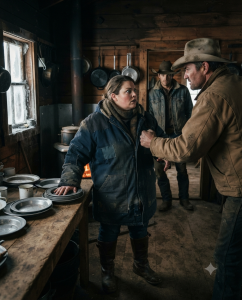
Three mornings after Boon arrived, most of the hands had already gone out. Naomi was carrying a stack of washed tin plates when he stepped into her path.
“Don’t rush off, cook.”
She shifted left. He shifted too.
“Move.”
Instead, he grabbed her arm.
The plates rattled against her chest. His fingers sank hard into the thick fabric of her sleeve and the flesh beneath it. Naomi felt old fury rise fast and hot, but her voice stayed level.
“Let go.”
Boon smiled. “A woman like you ought to be thankful anyone’s touching you at all.”
Her face went still. “Last warning.”
He tightened his grip.
The doorway darkened.
“Take your hand off her,” a man said.
Gideon.
Boon turned with a sneer. “Or what?”
Naomi expected shouting. Maybe posturing. What she did not expect was the complete absence of it.
Gideon stepped into the room with the same calm he brought to everything, but something in his face had changed. It wasn’t rage exactly. It was colder than rage.
Boon released Naomi only to square up and throw the first punch.
He missed.
Gideon moved with a precision so fast it was almost difficult to follow. He slipped the blow, turned his shoulder, caught Boon’s wrist, and used the bigger man’s weight against him. Boon hit the floor hard enough to shake the room. He lurched up with a curse, swung again, and this time Gideon struck him clean in the ribs before twisting him off balance. Seconds later Boon was down again, gasping and red with humiliation.
Naomi stood rooted to the spot, heart pounding.
This was no ordinary ranch scuffle. Gideon fought like a man who had been trained not merely to win, but to end things efficiently.
That realization landed just as Grundy strode in.
He took in the overturned chair, Naomi’s flushed face, Boon on the floor, Gideon standing over him.
“Boon leaves,” Gideon said.
Not “should leave.”
Leaves.
Grundy’s eyes narrowed, but not in disagreement. More like resignation.
“Get your gear,” the foreman told Boon.
Boon stared, stunned. “He attacked me.”
“You should’ve kept your hands to yourself,” Grundy said. “Get out.”
It was the first time Naomi had seen one of these men protected so quickly. She should have felt relieved. Instead she felt something else creeping under her skin.
Questions.
That night Grundy came to the cookhouse after supper and told her she had the job for the winter if she wanted it. Naomi accepted, though she barely heard herself do it.
As he turned to leave, he stopped.
“There’ll be a meeting in the yard tomorrow,” he said. “Owner’s coming in.”
“So?”
His gaze moved toward the bunkhouse. “It may concern you.”
“Why would the owner care about me?”
Grundy hesitated, and in that hesitation Naomi felt the shape of something hidden. “Listen first,” he said. “Then decide what you think.”
She slept badly. Every creak of the cookhouse sounded loaded with meaning. Every remembered glance from Gideon played differently in her mind now. She woke before dawn with a sick feeling she could not name.
The yard was crowded by midmorning. The men stood in a rough line, hats in hand as a rider approached from the south trail. The man who dismounted was older, thin-faced, dressed with the kind of quiet expense that never needed explaining.
The owner.
Every hand took off his hat.
Every hand except Gideon.
Naomi noticed that before she noticed anything else.
The owner noticed it too.
His gaze went straight to Gideon, and in that instant the silence in the yard sharpened. Clyde dropped his eyes. Patch shifted uncomfortably. Grundy looked grim.
Then the owner asked, “How long has she been here?”
Not Who is she?
Not Is she doing the job?
How long has she been here?
“Ten days,” Grundy answered.
The owner’s expression hardened. He kept looking at Gideon. “And you said nothing?”
Gideon’s reply came flat and low. “I wanted to be sure.”
Naomi felt the air leave her lungs. “Sure of what?”
No one answered.
At last the owner looked at her. Whatever she expected to see in his face, it wasn’t that. Not contempt. Not annoyance. Something much worse.
Recognition tangled with guilt.
“You should have been told sooner,” he said.
“Told what?”
Before he could answer, hoofbeats crashed into the yard.
Boon Cutter rode back in with two strangers at his side, one carrying himself like hired trouble, the other like a deputy too lazy to ask questions before acting. Boon swung down from his horse and pointed directly at Gideon.
“There he is,” Boon snapped. “Ask him his real name.”
The yard went silent again.
Naomi turned toward Gideon slowly. He stood exactly as he had before—still, unreadable, impossible to rattle.
The owner closed his eyes briefly, as if an unavoidable moment had finally arrived.
“Enough,” he said.
But Boon was drunk on vindication now. “Tell her who he is. Tell her the ranch hand’s a lie.”
Naomi’s heart slammed against her ribs. “Gideon?”
He lifted his eyes to hers. “My name is Gideon,” he said. Then after a pause: “But not just Gideon Hail.”
No one moved.
Snow hissed lightly across the yard.
The owner spoke with visible reluctance. “He’s my son.”
The words didn’t make sense at first. Naomi heard them, but they seemed to hang in the air without attaching to anything real.
Iron Hollow’s owner had a son.
His son was not in town managing books or riding inspection once a season.
His son had been here all along, dressed like a common hand, sleeping in the bunkhouse, carrying feed, mending fence, and knocking larger men flat when necessary.
Naomi stared at Gideon. “You lied to me.”
“Yes.”
The honesty of it hit harder than denial would have.
“Why?”
Gideon glanced toward Boon, then the deputy, then back at her. “Because when people know who I am, they stop being honest. And because my father and I haven’t agreed in years about what this ranch is becoming.”
That explanation only answered part of it.
The owner drew a slow breath. “His full name is Gideon Vale. He’s heir to Iron Hollow.”
Clyde looked as though he might faint. Patch stared openly. Dutch seemed insulted on a spiritual level.
Naomi should have felt foolish. Instead she felt furious.
“All of you knew?” she asked.
Grundy answered. “Most of us.”
“And no one thought I deserved the truth?”
Gideon took a step toward her. “I wanted to tell you.”
“But you didn’t.”
Before he could answer, Boon cut in. “He didn’t tell you because he was waiting to see if you were the right one.”
Naomi turned. “What are you talking about?”
Boon grinned through his bruised anger. “Ask them why the owner’s been looking for a housekeeper-cook who can also keep accounts. Ask why every woman sent here gets watched. Ask why the quiet prince spends months pretending to be a hand.”
A hot, ugly understanding began to form.
The owner’s face darkened. “That is enough.”
But Boon had already done the damage. “You think you got hired because they needed biscuits? They’ve been searching for a woman to manage the main house after Mrs. Vale died. Someone respectable. Hardworking. Someone my lord heir might finally agree to speak to.”
Naomi’s stomach turned.
She looked at Grundy. He looked away.
“Is that true?” she asked.
The owner answered instead. “Partly.”
“Partly?”
“We needed a cook,” he said stiffly. “And yes, we needed help in the house. But no decision had been made about anything else.”
Naomi laughed once, sharp and joyless. “So I came here to be weighed like livestock for a job nobody bothered to name honestly.”
“That wasn’t my intention,” the owner said.
She looked at Gideon. “What was yours?”
His face tightened for the first time. “To see who you were when no one was performing.”
“And what gave you the right?”
Nothing in the yard moved. Even Boon had gone quiet now, sensing the true fight had shifted beyond him.
Gideon answered with painful care. “Nothing gave me the right.”
Naomi believed that he meant it. The worst part was that she believed him.
The owner took a step forward. “Miss Ashcroft, whatever was mishandled here, you were not brought to be humiliated. My son has made a habit of working under a false name because he wanted to understand the ranch from the ground up, not from the porch. He was supposed to tell me at once if someone suited the house position. He delayed.”
Gideon said, “Because she was not a position.”
That landed in the yard like a struck bell.
Naomi looked at him, and for one dangerous second the anger inside her shifted shape.
Then she remembered the laughter at the gate. The secrets. The test she never agreed to take.
“You let me stand here while they mocked me,” she said quietly. “You let me scrub that kitchen, sleep in the cold, and think I had to prove I deserved floorboards under my feet.”
His voice dropped lower. “I watched because I wanted to know whether this place deserved you.”
It was the wrong answer and somehow the most revealing one.
Boon scoffed. “Pretty words now.”
Gideon turned toward him, and the deputy beside Boon finally seemed to grasp he had attached himself to the wrong man. The owner’s patience snapped.
“Take Cutter off my land,” he ordered. “And if he returns, I’ll press charges for laying hands on one of my employees.”
The deputy hesitated only a second before grabbing Boon by the elbow. Boon cursed, fought just enough to embarrass himself, then was hauled back toward the horses.
The yard slowly exhaled.
But Naomi’s anger remained, clean and sharp.
“I’m leaving,” she said.
The words hit harder than anyone seemed prepared for.
Grundy spoke first. “Naomi—”
“No.”
She looked at the owner. “You may be rich enough to call deceit management strategy. I’m not poor enough to call it kindness.”
Then she looked at Gideon.
He had taken punches without blinking, but those words struck home.
“You defended me,” she said. “I won’t forget that. But you don’t get to protect someone while standing inside the lie that put her in danger.”
She turned and walked back toward the cookhouse with every eye on her.
By dusk, her bag was packed.
She had just tied the final knot when a knock sounded at the door frame. Gideon stood there alone, hat in hand for the first time since she’d known him.
“May I speak?”
Naomi did not invite him in, but neither did she shut the door.
He remained outside, shoulders dusted with snow. “My mother used to run this ranch better than any of us,” he said. “After she died, my father tried to fill the space with efficiency instead of honesty. We started hiring people for roles without naming all the expectations because good workers were hard to keep and harder to trust. I hated it. So I began coming back under another name, working beside the hands, seeing what was broken.”
Naomi folded her arms. “And people became lessons.”
His jaw tightened. “Sometimes, yes. I’m not defending that.”
“No. You’re explaining it.”
A faint wince crossed his face. “Fair.”
He took a breath. “When you arrived, I expected you to leave by noon. Not because of your body. Because Iron Hollow had become meaner than I realized. Then you stayed. You repaired things no one else even noticed. You fed men who didn’t deserve your effort. You stood your ground with men who wanted to make you small. And every hour I waited to tell you the truth, it got harder, because the longer I waited, the less I deserved your trust.”
That, finally, sounded like the truth in full.
Naomi was quiet for a long moment.
“Do you want me to stay for the house position?” she asked.
“No,” Gideon said immediately. “I want you to stay only if the work offered is the work named. And only if you set the terms.”
The owner appeared the next morning before sunrise, which told Naomi he had probably slept no better than she had. He came alone, without authority draped around him, and asked if he might enter.
Inside the cookhouse, with the stove throwing steady warmth at last, he apologized plainly. Not elegantly. Not perfectly. Plainly.
He admitted they had blurred roles to keep options open. He admitted that letting her arrive without the full truth had been disrespectful. He admitted that men on his ranch had behaved shamefully under his watch.
Then he offered terms.
If Naomi stayed, she would stay as head cook for the winter under a written wage agreement, with a proper room in the main house until the cookhouse window and bedding were replaced. No hidden duties. No unspoken expectations. If, later, she wished to discuss managing the main house, the position would be named clearly and offered separately. If not, it would never be mentioned again.
Naomi listened.
Then she named her own conditions.
Boon was never to return.
Any hand who mocked or harassed her would be gone without debate.
Her pay would start immediately, not after another “trial.”
And the back room of the cookhouse would be repaired anyway, because no worker should be asked to live like that.
The owner agreed to every point.
When he left, Naomi sat for a long while at the rough table, staring at her packed bag.
By noon, she unpacked it.
Word spread quickly. Clyde stopped making jokes around her, whether from shame or fear. Patch apologized in a voice so earnest she almost smiled. Dutch avoided her. Arlo began bringing in water without being asked. Grundy had the cookhouse window repaired and a real mattress delivered by evening.
As for Gideon, he kept his distance.
Not coldly. Respectfully.
He no longer lingered in doorways or brought wood without warning. If he spoke, he spoke plainly. If he helped, he asked first. It was infuriatingly decent.
Weeks passed. Winter deepened. The ranch changed in small, visible ways. Meals improved morale. Repairs multiplied. Men grumbled less and worked better. Even Grundy admitted one night that a warm kitchen could hold a ranch together more firmly than half the fences on the property.
One evening after supper, Naomi found Gideon outside the cookhouse chopping kindling.
“You could have asked someone else to do that,” she said.
“I was already here.”
She leaned against the door frame. “You’re trying very hard not to make me angry.”
A small, tired smile touched his mouth. “Is it working?”
“Not completely.”
“I’ll take partial success.”
For the first time since the truth came out, she laughed.
It didn’t fix everything. But it changed something.
By the time spring hinted at the edges of the snow, Naomi had become more than tolerated at Iron Hollow. She had become necessary. More importantly, she knew it.
One afternoon, the owner asked whether she would consider taking charge of the main house accounts and kitchen stores in addition to cooking, with extra pay and authority to hire help. This time the offer came in full daylight, with exact terms and no hidden motives.
Naomi said she would consider it.
Then she made them wait three days for her answer.
When she accepted, she did it on her own terms.
Months later, people in town still told the story wrong. They said the owner’s son had fallen for the new cook. They said she’d been chosen. They said luck had smiled on her.
Naomi knew better.
She had not been chosen like a trinket from a shelf. She had walked into a place that underestimated her and forced it to show its true face. She had named the insult, survived the test she never agreed to take, and made the men around her learn the price of dishonesty.
As for Gideon, trust returned slowly, built not by speeches but by consistency. A chair repaired before she asked. A ledger balanced correctly. A disagreement handled openly instead of buried in silence. He never again hid the truth from her to “protect” a larger purpose, and she never again mistook quiet for harmlessness.
By the first warm week of spring, when the mud began replacing snow in the yard, Naomi stood on the porch of the main house watching the men move cattle through the lower field. Gideon came up beside her, not too close.
“Do you ever wish you’d left that first day?” he asked.
She thought about the laughter at the gate, the freezing room, Boon’s hand on her arm, the humiliation of learning she had been judged in ways she never consented to.
Then she thought about the kitchen she had rebuilt, the authority she had claimed, and the man beside her who had once hidden behind silence and now offered her the truth even when it cost him.
“No,” she said. “But I do wish some of you had learned sooner that dignity doesn’t come in one shape.”
Gideon lowered his head once. “So do I.”
Naomi looked out over Iron Hollow—the fences, the bunkhouse, the cookhouse chimney sending up a steady thread of smoke, the land that had first greeted her with mockery and now answered to some measure of her order.
In the end, that was the part no one in town understood.
The biggest red flag had never been the laughter. Men laughed out of ignorance every day. The real danger was the polished lie told in the name of good intentions, the belief that someone could be tested, measured, and maneuvered for their own benefit.
Whether Gideon deserved forgiveness depended on who was telling the story.
But no one could deny this much:
Naomi Ashcroft did not save Iron Hollow by being chosen.
She saved it by refusing to be handled.