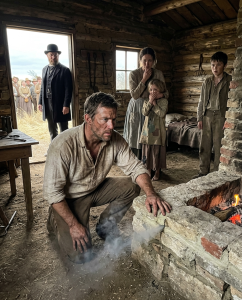
Everyone mocked Kalin Voss’s backwards fireplace long before a single flame ever touched it.
By the time he was halfway through the trench running down the middle of his cabin floor, people in Ash Hollow had already settled on what he was: stubborn, reckless, and maybe even dangerous. In a place where winter punished mistakes without mercy, a man who played games with fire was treated like a threat.
Silas Boon made sure of that.
“That’s not a fireplace,” he shouted one dry afternoon, standing over the open cut in the dirt floor while half the settlement watched. “That’s a grave lined with bricks.”
The laughter came quickly. It rolled through the yard and bounced off the unfinished cabin walls. Some people smirked like they were witnessing a fool embarrass himself. Others laughed harder because Silas had started it, and in Ash Hollow, men tended to follow the loudest voice in the room.
Kalin didn’t answer.
He just kept digging.
His hands were split, his shoulders tight with strain, and dirt streaked his shirt all the way down to the waist. Near him, his son Elias clutched a bucket of stones and stared at the trench with the uneasy expression of a boy old enough to understand shame, but young enough to hope his father might still prove everyone wrong.
The trench did look wrong.
That was the problem.
A proper chimney rose. Everyone knew that. It carried smoke upward and out. But Kalin’s design began at the firebox and then dropped beneath the floor, where smoke and heat would be pulled through a long winding passage built from brick, clay, and limestone before finally reaching an outlet farther down the structure. Along that buried route, the heat would be absorbed into the masonry itself and slowly released back into the cabin for hours after the fire died.
To Kalin, it was common sense.
To everyone else, it looked insane.
“He’s trying to teach smoke to crawl,” Orin Pike joked from the doorway of the store later that day, and the phrase spread so quickly that by sundown children were repeating it in the road.
But Miriam never laughed.
She stood at the edge of the yard with Nora in her arms, and every time the girl’s breath caught, Miriam’s mouth tightened. Nora was only six, all sharp shoulders and pale cheeks, and the effort of breathing seemed to wear her down more every month. Even with autumn barely settled over the prairie, her lungs already sounded fragile.
The winter before had nearly killed her.
Ash Hollow had seen hard winters before, but that one had cut deep. Wind forced itself through every crack in the Voss cabin. Ice formed inside the windows. Elias slept so near the stove that one night the sole of his boot blackened against the iron, yet he still woke shivering. Miriam draped blankets over doors, packed gaps with rags, burned broken chairs, scrap lumber, even empty flour crates. The fire never seemed to last. The moment they fed it, the heat fled upward and vanished.
What Kalin noticed that winter was not the fire itself, but the loss.
Every flame cost them something. Chopped wood. Sore backs. Cold fingers. Time. Fear. And still, most of the warmth escaped straight up the chimney and into the dark, leaving them to begin again before dawn. One night, while Nora burned with fever and coughed weakly under damp blankets, Kalin stepped outside into the yard and watched the smoke pour into the sky like he was watching his own labor drift away.
“We don’t lack fire,” he murmured. “We’re letting it escape.”
From that moment, the idea lodged in him like a nail.
Kalin had spent years repairing lime kilns and helping masons set brick. He understood draft better than most, and he understood thermal mass in the practical way men learn things when their living depends on it. Heat could be stored. Stone could be made to work. Smoke could be forced to travel farther before leaving. Not forever. Just long enough to surrender more of its warmth.
He began drawing on a pine board with charcoal.
A small, efficient firebox. A long buried channel. Almost nineteen feet of travel through stone and brick. A bench running alongside the channel where the family could sit or sleep and soak up stored warmth deep into the night. He adjusted the route over and over, studying every bend, every rise, every place a draft might fail.
When Silas Boon saw the drawing, he laughed first, then grew offended.
Silas was the settlement’s best-known chimney builder, a broad man with a quick tongue and the kind of certainty people trusted because it came wrapped in confidence. He had built flues in half the homes in Ash Hollow. People called for him when smoke backed into a room, when brick split, when winter winds reversed a draft. His word carried weight.
“Smoke rises, Kalin,” Silas said, tapping the board. “Any child knows that.”
Kalin didn’t raise his voice. “So does fire. But before it rises, it can do more work.”
The answer irritated Silas more than an insult would have. A loud argument he could crush. Calm conviction was harder. By evening, the story had spread across the settlement, and with each retelling, the design grew more reckless. By the next day some claimed Kalin planned to run smoke under his children’s beds. Others said Miriam ought to take the children and leave before he suffocated them all.
Only Reverend Abel Hart approached the matter with care.
He arrived one evening, hat in hand, and stood over the trench for a long time. He asked questions quietly. How would Kalin clean the channel? What if soot gathered? What if a bend clogged? What if the smoke rolled backward while the family slept?
Then he looked toward Nora, who was crouched in the grass, and asked the one question that mattered.
“If it fails in the night,” Abel said, “will you know before it’s too late?”
Miriam’s face tightened. Kalin stood very still.
That question changed the project.
He spent the next hours redrawing the system. Three clean-out doors. Wider, easier curves. Better inspection access. Stronger seals. Slightly altered dimensions in the feed and draft. He reworked the angles by lamplight until Elias fell asleep beside the table.
Miriam watched him without speaking for a long time. Finally she said, “Do you still believe in it?”
He looked at Nora curled on a blanket by the wall. “I believe I can’t watch another winter steal heat from us and do nothing.”
That was the truth of it. This was not pride. Not really. It was fear with a plan.
For three weeks, the Voss family built as if winter were already visible on the horizon.
Kalin and Elias hauled limestone from a dry creek bed beyond town. The stones were rough and heavy, and many had to be dragged rather than carried. Elias slipped more than once. Sometimes he dropped to one knee, breathing hard, fingers bleeding where the edges cut into his skin.
“I can keep going, Pa,” he said each time.
Kalin would look at him a moment before answering. “I don’t need you broken. I need you learning.”
Miriam worked clay, ash, and dry grass fibers together into a thick sealing mix. Nora gathered the grass in tiny bundles, proud whenever her mother used what she’d brought. The whole yard filled with materials: nearly nineteen hundred damaged bricks salvaged from a collapsed kiln, barrels of sifted ash, stacks of limestone, and heaps of clay under damp cloth.
The work changed the way people looked at the project.
At first the town had laughed because it seemed foolish. Then the quantity of stone and brick made it look dangerous. By the second week, it began to look serious. Men who had mocked Kalin now slowed when passing the cabin. A few stood and watched in silence. Some were still waiting for failure. Others were starting to wonder whether madness and ingenuity sometimes wore the same face.
Silas continued to scoff.
He made remarks in the store, in the road, outside Sunday service. “All that labor to outsmart smoke,” he said once. “Winter will teach him humility.”
But even he started coming by more often, unable to resist checking the progress.
By the time the system was finished, the cabin had been transformed. A small firebox stood near one side of the room. Beneath a broad masonry bench, hidden channels bent through brick and limestone packed in clay. Farther away, a final rise climbed toward the roof. It was strange looking, yes, but solid. Purposeful.
The first burn drew half the settlement.
People lined the yard and crowded the doorway. Children climbed fence rails. Orin Pike leaned in so far Abel had to pull him back by the sleeve. Miriam stood with Nora close against her side, one hand on the girl’s shoulder. Elias was nearly vibrating with nervous energy.
Kalin knelt by the firebox and arranged the kindling carefully: dry cotton, split corn cobs, buffalo grass. He lit the match and held it to the tinder.
The flames sprang to life.
For one perfect second, hope flashed through the room.
Then a thin gray line slipped from a seam near the floor.
Nora coughed.
Miriam snatched her up.
Silas drew in a sharp breath and said quietly, almost with satisfaction, “There it is.”
The smoke did not rush. That would have been easier. It crept, low and deliberate, threading along the edge of the masonry where Kalin himself had made the seal two nights before. Elias turned to his father, waiting for certainty.
Instead, he saw fear.
Kalin dropped to his knees and pressed a hand to the stone, then another. He moved to the clean-out door, opened it, watched the pull. Not enough. He closed it and listened, forehead nearly touching the warm masonry. The crowd outside had gone utterly silent.
Miriam stood frozen in the center of the room, torn between running outside and trusting the man she had followed this far.
“Kalin,” she whispered.
He looked up once, fast, then said, “Open the back vent.”
Elias moved instantly.
Kalin pried loose a brick from an inspection point and shoved his bare hand into the channel. He hissed but kept reaching until his fingers closed around a heavy clump of wet clay that had slumped inward during the first heating and narrowed the passage.
He yanked it free.
“Again,” he said.
He reset the brick, packed the seam with fresh mortar, and changed the burn. Instead of feeding larger fuel, he added only thin sticks, letting the draft build slower and steadier.
Everyone waited.
The fire caught.
The smoke dipped.
This time, instead of pushing into the room, it was drawn downward into the feed, through the hidden channel, and away.
A beat of silence passed. Then another.
The room held.
No smoke emerged from the seam.
Elias stared at the floor like he expected it to betray them again. Miriam didn’t move. Neither did Silas. Outside, a few men shifted their weight but said nothing.
Then the bench began to warm.
Not just near the firebox. Farther along. Then farther still. Heat traveled through the stone like a quiet pulse, spreading into the room in a way no one there had ever experienced. This wasn’t the sharp, wasteful blast of sitting near open flame. It was dense, steady warmth, rising from the very structure of the cabin.
Miriam lowered Nora carefully onto the bench.
The girl blinked in surprise. Her tight little shoulders eased. A full minute passed without a cough.
That was when the mood changed.
It didn’t happen all at once. No one admitted anything immediately. But faces shifted. Men glanced at each other. Women leaned closer. The bench kept warming, and the smoke that finally emerged from the chimney outside did so late and faintly, a thin pale stream instead of a black rush.
Silas saw it. His expression hardened.
Because he understood before anyone else what it meant.
If the Voss cabin could stay warm all night with less wood, if a sick child could sleep without coughing herself raw, then people would want one. And if people wanted one, the settlement’s most trusted chimney builder had been standing in front of the whole town calling it a grave.
He left before the fire went out.
That night, the Voss family slept against the warm masonry bench. Miriam woke twice out of habit, expecting cold. Each time she found the room still comfortable. By morning the bench still held heat deep within it. Nora’s breathing sounded looser. Elias woke grinning and put his cheek against the stone just to feel it again.
Word moved faster than wind after that.
Within days, people who had laughed at Kalin were asking questions. How long was the channel? How thick were the walls around it? What kind of clay had he used? Did it always need that slow start? Could it be cleaned? Would it work in a bigger house? Men came pretending curiosity while protecting their pride. Women came openly because they cared less about appearances and more about surviving January.
Kalin answered carefully. He was not boastful. If anything, he was cautious. He explained the failure on the first burn and the fix. He warned about draft, moisture, maintenance, and careless sealing. He insisted the build had to be done properly or not at all.
Silas watched all this like a man slowly losing ground under his feet.
He built one more traditional chimney that autumn for the Pruitt family and spoke louder than necessary about reliability. But when the first brutal wave of winter hit Ash Hollow in early December, reliability looked different than it had in October.
The cold came hard and stayed. Wind knifed through the settlement for days. Snow drove sideways and packed itself against doors. Wood piles shrank. Chimneys smoked heavily in the still air. Families huddled close to flames, feeding them constantly just to keep rooms bearable.
But the Voss cabin remained warm long after each fire burned down.
People noticed.
Miriam no longer looked pinched and exhausted every morning. Elias stopped sleeping in his coat. Nora, though still delicate, sat on the warm bench wrapped in a blanket and colored with bits of charcoal instead of coughing through the night. When women visited, they lingered with their palms pressed to the masonry and stared with a kind of stunned hunger.
Then January turned savage.
Three nights of killing cold fell over Ash Hollow. One family lost half its woodpile when their shed roof collapsed under ice. Another had a chimney crack and begin leaking smoke back inside. A widow on the north side of the settlement was found near frozen by dawn after her fire died at midnight. Men spent whole days cutting wood and whole nights burning it.
Kalin’s system didn’t make his family rich. It didn’t make winter gentle. But it changed the margin between coping and breaking. A shorter, hotter burn kept the bench warm for hours. Less fuel vanished up the flue. Even when outside air turned vicious, the cabin held.
On the second of those deadly nights, Reverend Abel came pounding on the Voss door with two men behind him and a child wrapped in quilts.
The Harlan boy could barely stop shaking.
“Their chimney cracked,” Abel said. “The room won’t stay warm.”
Miriam moved at once, clearing the bench. Elias added wood to the firebox under Kalin’s direction. The boy was laid against the warm stone, and little by little the violent trembling eased.
By dawn, two more people had been brought to the cabin.
By the third night, there were eight.
The room was crowded, noisy, and heavy with wet wool, worry, and exhaustion, but it was warm. Truly warm. The kind of warmth that softened faces and slowed panic. Miriam brewed broth. Elias carried split wood from the lean-to. Nora, wrapped in blankets, handed cups to people with solemn concentration.
At some point during that third night, the door opened again.
Silas Boon stood there with frost in his beard and his youngest daughter in his arms.
No one spoke.
The child’s lips were pale. Behind Silas, the wind screamed across the yard.
For a moment he could not step over the threshold. Pride held him outside even then. Then his daughter gave a weak cough, and whatever was left of his dignity bent under something older and stronger.
“Please,” he said.
It was the first time anyone in Ash Hollow had heard that word in his mouth without anger in it.
Kalin crossed the room and pulled the door wider.
“Bring her in.”
Silas obeyed.
He laid the girl on the warm bench beside Nora, and his eyes followed every movement Kalin made after that: the way he fed the fire small and hot, the way he checked the channels, the way he managed the heat like a man tending not just flame, but stored time itself.
Near dawn, when the worst of the cold finally loosened, Silas stood in the center of the room staring at the masonry bench where his daughter slept with color returning to her face.
“I called it a grave,” he said hoarsely.
Kalin, exhausted, leaned against the wall. “You weren’t the only one.”
Silas shook his head. “I should have known better than to laugh at what I didn’t understand.”
The room was too tired for ceremony. No one clapped. No one smiled. But people heard it. And in a town like Ash Hollow, that mattered.
When winter finally broke months later, the settlement looked different.
Not because suffering had vanished. It hadn’t. Families still counted what they’d lost in wood, livestock, health, and sleep. But several homes now had new masonry benches built under Kalin’s guidance. Others were planned for the next season. People spoke about draft, stored heat, clean-out doors, and thermal mass with the rough practical respect reserved for anything that proved itself under pressure.
Kalin never became the kind of man who loved attention.
He kept working. Kept teaching Elias. Kept refining the design. Miriam still watched every build with the same quiet tension she had the day of the first burn. Nora grew stronger slowly, not through miracle, but through fewer long nights of coughing in a freezing room.
As for Silas, he changed in a way that surprised everyone, perhaps even himself. He began sending people to Kalin when they asked for the “backwards fireplace.” Later, he began helping on some of the builds. He was still proud, still blunt, but not in the same careless way. The winter had stripped something from him and left something better in its place.
Years later, people in Ash Hollow would tell the story differently depending on what they valued most.
Some said it was about invention.
Some said it was about survival.
Some said it was about a father who was willing to look foolish if that was the price of keeping his children alive.
But the part they all remembered was this: the town mocked the backwards fireplace right up until the winter that filled Kalin’s cabin with the very people who had laughed at him.
And maybe that was the truest measure of the thing.
Not that it proved he was smarter than everyone else.
But that when the worst came, the warmth he built was big enough to make room for them too.
Even then, some people argued about who had been right and who had been wrong. Was Silas cruel, or just convinced by what he had always known? Was Kalin brave, or merely desperate enough to risk everything? Should Miriam have stopped him sooner, or was her faith the very thing that made the difference?
Maybe the real red flag was how quickly a crowd can turn caution into mockery. Or maybe the deeper question was simpler: when something unfamiliar might save lives, how many people dismiss it first just because it doesn’t look the way they were taught it should?