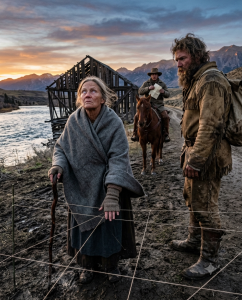
By the time the laughter started in Elias Cobb’s store, Clara Jensen had already learned the difference between shame and endurance.
Shame made people look down.
Endurance made them stand still while the whole town watched.
She stood with her shoulders straight, a faded gray shawl wrapped tightly around her, her walnut cane planted beside her boot. The room smelled of flour dust, tobacco, lamp oil, and winter coats damp from the cold. Every creak of leather, every muffled chuckle, every shifting foot on the plank floor reached her with painful clarity. Since darkness had taken her sight three years earlier, sound had become its own kind of map. And that morning, the map told her one thing clearly.
Pine Bluffs had come to enjoy this.
Hiram Gable stood in front of her with a paper in his hand. He knew she couldn’t see it, but he still gave it a theatrical shake, because humiliation worked better with an audience.
“It’s over, Clara,” he said. “You owe sixty dollars. At noon, I file the seizure.”
Somewhere to the left, a man near the cracker barrel let out a soft laugh. A woman near the window sucked in a breath, then did the polite little movement people made when they wanted to look cruel without seeming cruel. Clara had heard that movement many times. Hats adjusting. Gloves smoothing. Skirts straightening. People arranging themselves to witness someone else’s collapse.
She tightened her fingers around the cane.
“I have twenty,” she said. “I sold the last hens. Give me one month.”
Gable answered with the same smooth voice he used in church and funerals.
“And how will you earn the rest? By sewing? By mending? You can’t see the needle. You can’t see the cloth. The church has room in the basement. A widow’s cot. You’ll be more comfortable there than on land you can’t keep.”
A few more laughs.
Not loud. Pine Bluffs preferred its cruelty dressed in manners.
Clara felt the humiliation burn through her, but she refused to bow her head. Once, before the darkness, she had been known as Thomas Jensen’s wife. Then she became Thomas Jensen’s widow. After that she became blind Clara. Then debt Clara. Then poor Clara. Every year the town stripped another layer from her until she was no longer a person to them, just a cautionary tale wrapped in a shawl.
Then the store door opened, and everything shifted.
Heavy boots crossed the threshold.
No one had to say his name. Boone Jessup carried weather in with him. Cold air. Mud. Pine sap. Tanned leather. He moved like a man who belonged to slopes and rivers, not counters and gossip. He was big enough that people always noticed him first for his size, then for the silence around him. Pine Bluffs traded with Boone, used Boone, and mocked Boone, but never forgot to fear him.
He dropped a bundle of furs on the counter.
Elias Cobb cleared his throat, counted quickly, and said, “Eighty-five dollars.”
Boone didn’t take the money.
Clara felt it before she heard it—the room tightening, the strange way a crowd goes still when attention turns in one direction all at once.
Then Boone’s boots stopped near Gable.
“Sixty pays the debt,” he said.
Gable tried to laugh, but it came out thin. “This doesn’t concern you, Jessup.”
“Write the receipt.”
“That land is worthless,” Gable snapped. “Rock, mud, and a half-rotted shack.”
Boone moved one step closer.
Clara had never seen him, not really. She had only heard descriptions. Huge. Rough. Dangerous. But the silence he created in that store told her more than any face could have. He was the kind of man who didn’t need to raise his voice because other men already imagined what would happen if he did.
“I didn’t ask your opinion,” Boone said. “Write.”
Gable wrote.
The banker’s pen scratched fast and angry. Coins clicked. Paper folded. Boone tucked the receipt into Clara’s shawl pocket with surprising care.
“Why?” she asked.
There was no gratitude in the question. Only suspicion.
“I need a place for winter,” Boone said.
She almost laughed at the lie. Even in humiliation, she knew when a man was covering mercy with pride.
“I don’t need saving.”
“Good,” he said. “I’m no savior. You need hands. I need a roof. I haul. I build. You keep your deed.”
The deal was struck with a handshake.
By sundown, Pine Bluffs had turned it into a scandal.
By the next day, the scandal became a sermon.
Reverend Miller, who believed sin was always most visible in other people’s houses, announced that no unmarried man and woman could live under the same roof without offending God and decency both. He called on Clara to reconsider. He called on Boone to repent before he had done anything worth repenting for. By the time Sunday ended, the gossip had ripened into a threat.
So they married on Friday in the church vestibule.
The air there was cold enough to bite. Twelve people came, not out of love or support, but because mockery counted as entertainment in a town with few diversions. Boone bought an iron ring for five cents. It was plain, dark, almost ugly. He slid it onto Clara’s finger with a rough hand made careful by intention.
Then Jeb Collins, the town drunk, laughed out loud.
Boone shifted.
Clara felt the movement and caught his wrist before trouble could start.
“Let them laugh,” she whispered. “Laughter doesn’t cut lumber.”
It was the first thing she said to him that made Boone Jessup look at her as if he had not merely rescued a widow but found a weapon no one else had recognized.
Her property lay a mile from town along the Snake River. The cabin sagged under years of neglect. The roof dipped inward. The door leaned in its frame. Wind moved through the gaps in the boards as if the place had already started giving itself back to the fields.
And near the bank stood the remains of Thomas Jensen’s failed dream.
A mill frame.
Or what was left of one.
Rotting beams. Listing posts. A wheel assembly too near the waterline. Timber split by bad placement and worse judgment. To Boone, it looked like exactly what Gable had called it: worthless.
“This is a wreck,” he said after they climbed down from the wagon.
“I know,” Clara answered.
She moved past him, tapped her cane once against the ground, then folded it and tucked it beneath her arm. Boone watched her cross the yard without help. She walked not like someone guessing, but like someone remembering. At the old structure, she rested her hand against a beam.
“Thomas was decent,” she said quietly. “He was honest, kind, hardworking. But he listened to men who mistook confidence for knowledge. He built too close to the river. Used the wrong load angles. Trusted the current instead of the bank.”
Boone frowned. “Then the whole thing’s useless.”
Instead of arguing, Clara reached into her pocket and pulled out a coil of string.
“Take one end. Walk fifteen paces inland until your boot hits granite.”
He did it because curiosity had started outrunning doubt.
When he felt stone beneath his heel, he stopped.
“Now what?”
“Hold.”
For the next hour, Boone Jessup watched a blind woman redraw the future.
Clara counted her steps. She listened to the river as if hearing hidden measurements in the current. She pressed fingers into dirt, felt slope and firmness, marked corners with stakes, tied lines with the precision of an engineer and the confidence of a person who had been building something in her mind for years. There was no fumbling. No hesitation. No reaching into emptiness. She knew where every line should go before her hands found it.
Boone had seen trappers track fresh prints through snow in darkness. He had seen men split logs clean by feel. He had seen old settlers judge coming weather from smell alone. But this was different.
This was design.
When the sun sank low, the muddy clearing was crossed with a perfect grid. Boone stood at the edge of it and slowly understood what he was seeing. Not random marks. Not grieving ritual. Not stubborn denial.
A foundation.
“What is this?” he asked.
Clara was breathing hard, but the defeated note had vanished from her voice.
“The new base.”
“For what?”
She turned her face toward him. Her eyes were pale, unfocused, touched by that fixed clouded stillness blindness had left behind. But nothing in her expression felt weak.
“For a sawmill,” she said. “The only one within fifty miles.”
Boone stared.
She continued, her voice growing steadier with each word. “Thomas failed because he measured wrong, trusted wrong, placed wrong. After I lost my sight, I had nothing but time and memory. I listened to every man who came to inspect the wreck and muttered what he thought was wrong with it. I replayed every creak in the old frame during storms. I remembered every conversation Thomas ever had about timber and water and weight. For three years, while this town pitied me, I was learning.”
Boone looked from the strings to the river and back again.
“They think you’re ruined,” he said.
“Let them.” Her chin lifted. “People show their true faces when they believe you can no longer challenge them.”
That line stayed with him.
Because she said it like a woman who had already been challenged by more than debt.
They began the next morning.
Boone felled timber in the higher ground and dragged it down by mule and brute force. Clara sorted by touch, guiding him through cuts and lengths with impossible accuracy. She knew where the load should shift, where the weight had to settle, which beams needed doubling. When Boone questioned her, she answered with reasons, not guesses. The granite shelf inland would hold. The wheel housing had to turn at a tighter angle. The support braces must be set higher than Thomas had planned. The river could power the mechanism if they respected it instead of trying to conquer it.
Days became a rhythm.
Chop. Haul. Measure. Dig. Brace. Lift.
The town kept watching.
At first they came only to laugh. Jeb Collins rode past twice in one week just to call the place “Jessup’s honeymoon shack.” Reverend Miller warned that pride would punish them. Elias Cobb remarked to anyone listening that even if they managed to build the thing, no one would trust lumber milled by a blind woman and a savage.
But the frame rose.
Then it rose correctly.
Men who had spent their whole lives around timber stopped laughing quite so quickly. One or two came close enough to inspect the joinery. One of them left without a word and looked unsettled doing it.
That should have been satisfying.
Instead, Clara grew tenser.
Boone noticed it on the fourth evening, when she stood near the half-built wheel base and fell quiet while the river moved under the fading light.
“What is it?” he asked.
She hesitated. “When men start losing their certainty, they get dangerous.”
He leaned on an axe handle. “You mean Gable.”
“I mean more than Gable.”
Boone waited.
Clara drew a slow breath. “Thomas owed money before he died. More than he admitted. I only learned pieces after the funeral. Gable always seemed to know more about my husband’s accounts than he should have. Too much. Enough to scare me.”
“You think he cheated you?”
“I think he was patient.”
That same week, Boone found cut traces near the mule harness. Not enough to break it yet. Enough to weaken it. Someone had done it cleanly with a sharp blade.
He told Clara that night.
She didn’t look surprised.
The next day, a board stack collapsed after someone loosened a support peg. Boone rebuilt it. Clara said nothing for almost an hour. Then she asked him whether the loosened peg had been on the side facing the road.
It had.
“Then they wanted us to know,” she said.
“Who?”
“The kind of people who smile in public and steal in private.”
Three days later came the rider.
Boone and Clara had just finished laying out the final support line for the main structure. The afternoon wind carried the smell of wet mud and pine sap. Clara’s hands were still on the string when a voice from the road called out.
“Jessup! Widow!”
Mocking. Nervous. Loud enough to be heard, not brave enough to come close.
Boone turned. A rider sat near the edge of the property, horse shifting under him. He kept one hand inside his coat.
“What do you want?” Boone called.
The man swallowed visibly. “I heard something. About Gable.”
Clara straightened. “Say it.”
The rider glanced toward town as if expecting someone to appear behind him.
“He’s got another paper,” he said. “Kept it hidden. Didn’t file it with the first debt.”
Boone took a step forward. “What kind of paper?”
“One tied to the land. The mill too.”
Clara’s hand slipped off the string.
For the first time since Boone had known her, she looked shaken enough to lose her balance.
“Whose name?” she asked.
The rider hesitated. “Thomas Jensen’s. And another.”
“That’s impossible,” Clara said sharply. “Thomas never took a partner on the mill.”
The rider pulled a folded document partway from his coat, then stopped as if remembering he enjoyed being alive.
“I shouldn’t have come,” he muttered. “But I heard Gable telling Cobb he’d wait. Said it’d be sweeter to take the property after you’d made it worth something.”
Boone’s face went hard. “Read the other name.”
The rider looked at Clara, then at the mill frame, then back at Boone.
“That man wasn’t meant to be mentioned,” he said quietly. “Folks in Pine Bluffs buried him years ago in every way except the ground.”
Clara went pale beneath the weather.
Boone turned toward her. “Who are you thinking of?”
Her lips parted.
Nothing came out.
But Boone saw the truth land in her before any name was spoken. Not certainty. Worse than certainty. Recognition.
Then the rider read the name.
Boone saw Clara flinch as if struck in the chest.
Later he would remember that moment more clearly than the wedding, the debt payment, even the first time he saw her strings spread across the mud. Because in that instant he understood two things at once.
The hidden paper was real.
And whatever name had been spoken belonged to a wound older than Thomas’s death.
“Who is he?” Boone demanded.
Clara’s voice came thin at first, then steadier. “A man who used to visit Thomas after dark. A man Thomas swore was helping him secure equipment. A man I once heard outside my bedroom door the night before my husband died.”
The rider backed his horse a step.
Boone reached for the paper.
The man jerked it away. “I’m not handing this over where anyone can see me.”
Boone’s patience frayed. “Then dismount.”
“No.”
Boone started toward him anyway.
Clara’s hand caught Boone’s sleeve. “Wait.”
He stopped.
Her head tilted, listening not to the rider now, but to the trembling in his voice, the shifting saddle leather, the nervous horse. She read fear the way other people read handwriting.
“You stole it,” she said.
The rider sucked in a breath.
“You didn’t just see it. You took it from Gable’s lockbox.”
Silence.
Then, grudgingly, “Borrowed it.”
“For money?” Boone asked.
“For proof,” the rider snapped. “And maybe for spite. Gable cheated my brother out of land too.”
Clara lifted her chin. “Then read every word.”
The rider unfolded the paper fully. His voice shook as he read the legal phrasing—joint interest, contingent claim, equipment financing, transfer rights upon completion of the mill structure. Boone caught fragments, but the only part that truly mattered was the name.
Silas Vane.
Boone had heard it once or twice. A drifter-merchant, sometimes a broker, sometimes something else depending on who was telling it. A man who had moved in and out of small towns leaving arguments behind him. Never rooted. Never trusted.
Clara whispered the name as if it had been waiting behind her teeth all along.
“He came to supper twice,” she said. “Thomas acted strange both times.”
“What kind of strange?” Boone asked.
“Proud. Then frightened.”
The rider lowered the document. “There’s more.”
Boone and Clara both looked at him.
He wet his lips. “There’s a note on the back. Not legal writing. Gable’s own hand, I think.”
“Read it,” Boone said.
The rider hesitated, then obeyed.
“Delay claim until structure completed or widow forced to default. Property value rises with labor. Witness not needed if widow remains blind and uninformed.”
The world went very still.
Boone’s hands curled into fists.
Clara didn’t move at all.
The insult was monstrous enough—her blindness noted not as tragedy, but as advantage. Yet beneath Boone’s anger he saw another realization passing over her face, slower and more devastating.
“Thomas didn’t know,” she said at last.
“You don’t know that,” Boone said, though his voice had softened.
“Yes, I do.” Her mouth tightened. “If Thomas had agreed to that, he would never have let me stay there after he died. He would have known they meant to strip everything from me.”
Boone looked toward town, where Hiram Gable sat in his office no doubt believing he still controlled every outcome.
“What happened to this Silas Vane?”
The rider gave a humorless laugh. “That’s the trouble. Depends who you ask. Some say he moved east. Some say he drowned. Some say Gable paid to make him disappear from people’s memory.”
Clara turned toward the unfinished mill, the strings, the braces, the frame Boone had built under her direction.
Then she said the words that changed the whole fight.
“He isn’t after land,” she said. “He’s after what’s under it.”
Boone frowned. “Under it?”
She nodded slowly. “Thomas once told me this granite shelf was worth more than the timber. Said a man from Cheyenne claimed the stone could anchor heavier machinery than anyone around here had. I thought it was one more dream. But if Silas Vane tied himself to the mill before it was built…” Her face hardened. “Then they always knew this place mattered.”
The rider stared. “You think Gable’s been sitting on valuable land and waiting for you to fail?”
“No,” Clara said. “I think he’s been waiting for me to make it profitable enough to steal cleanly.”
Boone looked at the rising mill frame, the river turning gold in the late light, the woman beside him with mud on her hem and iron in her voice.
The town had laughed at him for marrying a blind widow.
It had laughed at her for trying to keep broken land.
But now Boone could see the shape of the real story. Debt had only been the leash. Shame had only been the cover. What Gable wanted was control, and what Clara had built in darkness was the one thing that could expose exactly how long he’d been circling her like a patient scavenger.
“Then we finish it,” Boone said.
Clara turned toward him.
“And when it runs,” he added, “we drag every lie into daylight.”
For the first time since the rider arrived, Clara smiled. Not warmly. Not gently.
Like someone who had finally heard the right kind of answer.
They took the paper inside the cabin and read it again by lamplight, Boone sounding out the formal lines, Clara piecing together names, dates, and missing years from memory. By midnight they knew enough to understand the truth but not enough to prove all of it.
Thomas Jensen had made a mistake.
Hiram Gable had turned it into a trap.
And somewhere between them stood a vanished man whose name still had the power to make Clara shake.
Outside, the river kept moving past the half-finished mill.
Inside, Boone fed another piece of wood into the stove and looked at the woman the whole town had pitied.
She had lost her sight. Lost her husband. Lost her standing. Nearly lost her land.
And still she had built the one thing powerful enough to threaten every man who thought she was easy prey.
By morning, Pine Bluffs would think they were still just a joke in a falling-down shack.
By the end of the week, the town would learn what happened when the people it mocked stopped begging, started building, and came for the truth with both hands open.
And even after everything that followed, people in Pine Bluffs would argue for years over the same question:
Whether Boone Jessup saved Clara Jensen—
or whether Clara Jensen was the first one brave enough to show Boone Jessup what to fight for.