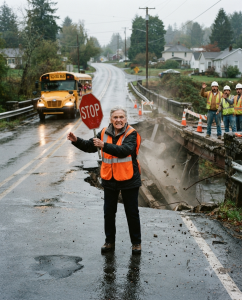
The construction crew laughed when the old woman in the orange vest told them the bridge was unsafe.
It was the kind of laughter that came easy to people who believed they already knew the whole story. They saw Hazel Mercer standing near the elementary school crossing in her reflective vest, silver hair pinned up against the morning damp, one hand wrapped around a stop sign and the other tucked into the pocket of her coat. To them, she was just the crossing guard. The sweet old woman who waved at children, handed out peppermints, and always seemed to know every family in town.
They did not see what she saw.
They did not know what she had spent thirty years learning.
It was a gray morning in late spring, the kind with low clouds and the smell of wet soil rising from the creek below the bridge. Rain had fallen two nights in a row, not enough to flood the waterway but enough to leave the ground heavy and the air cool. Hazel had arrived before sunrise, as she always did. She believed in routine. Children depended on adults who showed up the same way every day, who made the world feel predictable even when it wasn’t.
By seven fifteen she had already greeted three early walkers, helped one second grader retrieve a dropped mitten from the curb, and reminded a fourth-grade boy to zip his backpack before the papers inside flew into the street. She knew which children liked jokes before school and which ones needed quiet. She knew who was afraid of dogs, who hated math quizzes, who had divorced parents and two different houses and sometimes forgot where they were supposed to be.
That was what the town saw when they saw Hazel.
Not the woman she had been before.
Years earlier, before arthritis settled into her knees and before widowhood hollowed out the evenings in her small white house, Hazel had worked for the county roads department. Not in the office. Not behind a desk. On the ground. In boots and a hard hat and a weatherproof jacket with a county badge clipped to the chest. She had started young, when most men in that department assumed she would last six months. She stayed thirty years.
She inspected culverts, retaining walls, shoulders, drainage systems, and bridges. She learned how water found weakness long before the eye did. She learned to hear instability in sounds other people ignored. A bridge under stress had a language. Tiny shifts. Hairline fractures. Rust bleeding through fasteners. Pockets of hollow concrete where moisture had worked its damage from within. People called some of it instinct. Hazel hated that word. Instinct made it sound mystical, like luck. What she had was pattern recognition earned over decades of noticing what others overlooked.
Her husband, Warren, used to tease her about it.
“You don’t cross a bridge,” he’d say. “You interrogate it.”
Hazel would smile and answer, “And that’s why we make it home.”
Warren had been dead seven years now. Cancer. Fast and merciless once it was discovered. After he died, Hazel retired not because she wanted to, but because grief and age moved through the body in ways pride could not stop. The county replaced her. Then replaced the man who replaced her. Then budget cuts trimmed experience down to efficiency. By the time Hazel began working part-time as a crossing guard near the school, most of the younger families only knew her as the kind elderly woman at the roadside.
She let them think that.
Until the morning the bridge tried to warn her.
The bridge sat on the eastern edge of town, carrying two lanes over a shallow creek on the road that led straight to the elementary school. It wasn’t grand or old enough to feel historic. Just a practical slab-and-beam structure with concrete rails and patched shoulders, the kind people crossed without looking. A construction crew had arrived that week for what the town bulletin described as minor repairs. Surface patching. Rail touch-up. Nothing serious.
Hazel noticed the first odd thing before the crew did.
Standing at her usual post, she looked toward the bridge and saw a dark line beneath the outer rail. It was thin enough to disappear from some angles, but once she spotted it, she couldn’t unsee it. The crack ran along the edge where the top surface met the side face. Not a fresh line from a dropped tool or an impact. Something older. Weathered. Water-fed.
She crossed to the shoulder for a closer look.
The crack had a faint brown stain around it. Moisture had been getting in. She crouched slowly, ignoring the complaint in her knees, and leaned nearer. Part of the concrete edge had a slightly separated look, subtle but wrong. A drainage path below showed more spalling than she expected for “minor repairs.” She rose, listening.
There it was.
Not a sound exactly. More a feeling translated through memory. That peculiar hollowness some deteriorating structures carried, as if the surface was pretending to be solid over something already lost beneath it.
Hazel’s chest tightened.
She looked uphill.
The school bus route came that way. In less than ten minutes, the morning bus would crest the rise, pick up speed on the descent, and cross the bridge with thirty-two children aboard. She knew the number because she had watched those children all year. Little Clara with the rabbit keychain. Twins in red coats who traded lunches. A fourth grader named Eli who always sat left side, third row. Hazel knew where they would be when the bus rolled onto failing concrete.
She walked directly toward the foreman.
He was a thick-built man in a white hard hat with a trimmed beard and a clipboard under his arm. He looked busy in the self-important way some people do when being interrupted matters more to them than what is being said. Hazel waited until he looked up.
“That bridge needs to be shut down now,” she said.
He followed her pointing hand for half a second. “Why?”
“The support under that rail section is failing.”
He gave the crack another glance, then shrugged. “That’s cosmetic.”
“No,” Hazel said. “It isn’t.”
He gave a short laugh. “We’re literally here to repair the concrete.”
Hazel stepped closer. “I inspected county roads for thirty years. That’s not surface damage. You’ve got internal deterioration and probably washout under the edge. Stop traffic.”
A couple of workers turned to listen. One leaned on a shovel. Another smirked, already expecting entertainment.
The foreman’s expression flattened into condescension. “Ma’am, stick to stopping traffic. We handle concrete.”
The workers laughed.
Hazel felt the words hit something old. She had heard them in different forms for decades. Sweetheart, let the men take a look. Honey, that’s not how this works. You’re overreacting. You’re emotional. You’re seeing problems because that’s what inspectors do.
And then, years later, collapse reports would prove she had been right.
She tried once more. “The school bus is due any minute. Clear the bridge.”
The foreman did not even bother pretending to consider it. He turned to his crew and said, “Ignore her. We’ve got a schedule.”
That was the moment Hazel stopped asking.
There are people who mistake politeness for weakness. Hazel had learned long ago that when lives were at stake, deference became a kind of cowardice. She looked at the traffic approaching, then at the bridge, then back up the hill where the yellow bus would soon appear.
She stepped into the road.
Brakes squealed. A pickup stopped short. Then a sedan. Then an SUV behind it. Hazel raised her stop sign high and planted her feet in the center of the lane.
The foreman barked, “Move!”
She did not.
A man in a delivery van hit his horn. A mother rolled down her window and shouted that she was going to be late for work. Another driver demanded to know what the problem was. Hazel heard all of it, but the only sound she truly listened for was the bridge itself.
She could feel her pulse hammering in her throat. Her hands, already stiff from age, trembled around the stop sign. She hoped she was right.
No, she corrected herself.
She knew she was right. The fear was not about being wrong. The fear was about whether the structure would fail before everyone believed her.
The bus came into view at the crest of the hill.
Its yellow front appeared between the trees, and Hazel’s breath caught. She lifted the sign even higher. The line of stopped cars forced the driver to slow. The bus descended, then halted halfway down the grade, short of the bridge. Hazel saw shapes moving behind the glass. Children leaning toward the windows. Curious faces. One hand pressed against a pane.
The foreman strode toward her, furious now. “You can’t stop traffic like this!”
Hazel kept her eyes fixed ahead. “Watch the bridge.”
He opened his mouth again.
Then the sound came.
Deep. Violent. Internal.
It rolled out of the structure like thunder trapped inside concrete. Not the sharp crack of a snapped branch or the metallic ping of equipment. This was heavier. Final. A booming fracture from within the load path itself.
Every head turned.
The outer section of the bridge near the rail dropped away in a brutal lurch. Concrete sheared free and plunged into the creek below. Dust burst upward. Water exploded from the impact. A twisted scream of rebar and failing material echoed under the span.
Then came silence.
The kind that arrives when a crowd realizes, all at once, how close it has come to disaster.
The foreman stood frozen.
The workers who had laughed stared at the gap in the bridge, then at the school bus stopped safely up the hill. Drivers stepped out of their cars with stunned faces. One woman covered her mouth with both hands. A father in a pickup turned and looked toward the bus windows like he was counting invisible heads.
Hazel remained in the road, stop sign clutched in both hands.
Her whole body shook now that the moment had passed, but she did not lower the sign until she was certain nothing else was moving. The bus driver opened his door, stepped down, and looked from the collapsed section to Hazel, his expression drained of blood.
“How many?” Hazel asked quietly.
He blinked. “What?”
“How many children on board?”
“Thirty-two.”
She closed her eyes for one brief second.
Thirty-two.
The foreman approached her slowly, stripped now of every ounce of arrogance. He removed his hard hat before he reached her, as though some instinct told him respect was overdue and late. “I’m sorry,” he said. “I should’ve listened.”
Hazel looked at him, then at the broken concrete below. “Yes,” she said.
Nothing sharp in her tone. Nothing triumphant. Just truth.
The parents had begun clustering near the stopped cars by then. Some were crying from pure delayed terror. One mother hugged her own elbows and kept staring at the bus like she could still see what almost happened. Children inside pressed their faces to the windows, confused by the tension and the dust and the adults’ pale expressions.
Then one of the workers, a younger man with a mud streak on his sleeve, asked the question everyone else was thinking.
“How did you know?”
Hazel turned toward him. The creek churned below the broken edge, carrying bits of concrete away. “Because that crack wasn’t new,” she said. “And because bridges don’t fail without warning. People just ignore the warnings.”
A voice from the gathered parents spoke up. “Hazel Mercer?”
She looked over. A man in his forties stepped forward from beside an SUV. “My dad worked road maintenance,” he said. “He used to talk about you.”
Hazel searched his face and saw a resemblance to someone she had once known on county crews. “Tom Bennett’s boy?”
He gave a stunned little nod. “He always said if you flagged a bridge, nobody argued. Said you caught problems before the engineers even wrote the reports.”
The foreman’s face shifted again, shame deepening as the dimensions of his mistake became clearer.
Hazel didn’t say anything. She didn’t need to. The broken bridge had said enough.
Sirens began in the distance. Police first, then fire, then county emergency vehicles. The school principal came running from the direction of the building, coat half-buttoned, phone in hand. Someone ushered children off the bus one careful row at a time and led them back uphill away from the span. A few of the older kids had realized enough to start crying. The younger ones mostly looked confused, asking whether they were in trouble, whether school was canceled, whether the bridge was broken forever.
Hazel moved to the shoulder at last and sat down hard on a low concrete barrier, not trusting her knees anymore. The adrenaline was draining, leaving behind ache and shock. A little girl from the bus—a first grader with pink clips in her hair—broke from the teacher holding her hand and ran to Hazel.
“Miss Hazel,” she whispered, climbing into her arms without permission the way frightened children often did. “Were we gonna fall?”
Hazel swallowed.
“No,” she said, holding the child close. “You were never going to fall.”
It was not technically true. But it was the only answer a six-year-old should carry into the rest of her life.
By noon, county officials had arrived. Then a structural engineer. Then reporters from the local station. The bridge was sealed off, traffic rerouted, statements collected. Hazel spoke only when asked direct questions and even then kept her answers brief. She pointed out the crack, the drainage damage, the compromised edge. She mentioned the rain. She said the words she had told the foreman.
The support under that section was failing.
But the deeper story did not emerge until later that afternoon, when the first emergency assessment peeled back the broken edge and exposed corrosion far worse than anyone on site had admitted. The patch crew had been sent for cosmetic repair, but underneath, years of water intrusion had eaten at internal reinforcement and degraded load-bearing concrete. The deterioration had likely been developing for a long time. Maintenance records would later show a pattern of delayed reviews, downgraded severity notes, and postponed rehabilitation work due to budget pressures.
Minor repair, the notice had said.
Minor, until it nearly carried thirty-two children into the creek.
By evening, Hazel’s name had spread across town in a way it hadn’t for years. People who had passed her a thousand mornings without much thought now told the story in grocery aisles, in text chains, over dinner tables, in whispered phone calls to relatives. The crossing guard. Hazel Mercer. She stood in the road and stopped the bus. The bridge collapsed right after. She used to inspect roads. She knew.
The mayor called. The superintendent called. The county commissioner called.
Hazel answered some of the calls and ignored others. She went home instead, fed her cat, and stood at the kitchen sink looking out into the dark yard where Warren used to fuss over tomato plants every summer. The house felt strangely loud in its quiet. On the counter sat the peppermint tin she refilled once a week for the children.
She touched the lid and thought about the bus windows.
Thirty-two children.
The thought unsettled her more now than it had on the road. In the moment, action had taken over. At home, imagination did what imagination does. She saw alternate versions. The bus not stopping in time. The bridge giving way seconds later. Parents called to a school parking lot for reasons no parent should ever hear.
Her knees weakened. She sat at the table and finally let herself cry.
The next morning she considered staying home. Not because she was afraid, but because she was tired in the soul-deep way that follows shock. Yet habit and duty carried her back to the corner before sunrise. The route had been changed overnight. Temporary barriers blocked access to the bridge. The bus would now approach from the north detour and let children off a block farther away.
Hazel stood in her vest with the stop sign in hand.
One by one, cars slowed near her.
Not in annoyance this time.
In gratitude.
A father rolled down his window just to say thank you. A mother reached across the passenger seat to squeeze Hazel’s hand. Children climbed off the rerouted bus and ran toward her, some hugging her around the waist, others thrusting drawings into her hands. Stick-figure buses. Big orange stop signs. A bridge with a dramatic crack through it. One crayon picture showed Hazel wearing a superhero cape, which made her laugh through a fresh sting of tears.
Near eight o’clock, the foreman appeared.
He was not in work gear now. Just jeans and a flannel shirt, hard hat tucked under one arm. He looked uneasy, like a man approaching a truth he did not fully deserve. He stopped a few feet away.
“I came to apologize properly,” he said. “Not because people are talking. Because I was wrong.”
Hazel studied him.
“I looked you up last night,” he continued. “Your inspection record. You were the one who flagged Miller Road bridge in 2006. And Darnell culvert in ’98. And that retaining wall by Route 11.”
Hazel said nothing.
He exhaled. “I thought you were interfering. I saw a crossing guard, not an inspector. I saw your age before I saw your experience.”
There it was. Plain. Ugly. Honest.
Hazel appreciated honesty, even late honesty. “That happens,” she said.
“It shouldn’t.”
“No,” Hazel replied. “It shouldn’t.”
He held out the hard hat. For a moment she thought he was offering it to her, but instead he turned it in his hands and looked down. “My daughter rides that bus on Tuesdays and Thursdays. Yesterday was her day to stay with her mother. If schedules had been different…”
He didn’t finish.
He didn’t need to.
Hazel felt her anger soften, not because what he had done no longer mattered, but because consequences had reached him at last. True understanding often entered people only through a personal door.
“Then remember this feeling,” she said quietly. “The next time somebody with experience tells you to stop.”
He nodded.
Weeks later, the official report confirmed what Hazel had already known: advanced internal deterioration, worsened by water intrusion and neglected structural assessment. The town demanded answers. Meetings were held. Budgets were questioned. Some officials defended delays. Others did not survive the next election cycle. The bridge was demolished and rebuilt. New inspection protocols were announced with solemn language that sounded noble partly because disaster had been narrowly avoided.
Hazel attended none of the meetings.
She kept working the school crossing.
Children kept growing. Seasons changed. The rebuilt bridge opened months later with fresh concrete, new rails, and a weight rating sign no one had bothered to update on the old one. People drove across it carefully at first, then normally, as people always do when fear begins to fade.
But some things did not return to normal.
The town no longer looked at Hazel as background scenery. Parents asked her opinion when road crews appeared. Teachers introduced her to students as “the reason we all pay attention.” Once, during a career day at the school, the principal invited Hazel to speak to a class about safety. Hazel brought no dramatic story, no grand lesson. She simply told the children that structures tell the truth if you learn how to listen, and that people should never dismiss someone just because they look ordinary.
A little boy raised his hand and asked, “Did you feel scared?”
Hazel smiled. “Very.”
“Then why did you do it anyway?”
She thought of the bus. Of Warren. Of all the years she had spent being underestimated by men who mistook certainty for stubbornness. Of the morning air on her face and the stop sign shaking in her hands.
“Because being scared doesn’t matter as much as being right when someone’s life depends on it.”
That answer stayed with the teacher long after the lesson ended. It stayed with the students too.
And it stayed with Hazel.
Sometimes she still woke in the night hearing the sound of the bridge giving way. Sometimes she still pictured the bus rolling forward in another timeline she had cut off with one decision. She never glorified what happened. She never called herself a hero. To her, heroism sounded too clean, too cinematic, too detached from the simple truth that she had done what experience demanded while others mocked her for it.
Yet every now and then, standing at the crosswalk with children streaming around her and traffic waiting for her signal, Hazel would glance toward the rebuilt span and feel a quiet ache.
Not pride exactly.
Something more complicated.
She had spent years letting the world shrink her into something smaller than she was. A widow. An old woman. A crossing guard. Useful, perhaps, but ordinary. Safe to overlook. Easy to patronize. Easy to dismiss.
Then one rainy morning, a bridge cracked open and showed everyone the cost of that mistake.
The town praised Hazel afterward. Thanked her. Celebrated her. They were right to. But beneath all the admiration was a question that lingered long after the bridge was rebuilt and the headlines disappeared.
Why had she needed concrete falling into a creek before anyone believed her?
That was the part people carried with them. Not just the collapse. Not just the miracle that thirty-two children were spared. But the warning before it. The laugh. The wave of a hand. The lazy confidence of someone certain expertise had a younger face and a deeper voice.
Hazel never said whether she forgave the foreman completely. She accepted his apology. She treated him with the same measured civility she gave everyone else. But on certain cold mornings, when traffic backed up and an impatient driver leaned on the horn before seeing a child in the crosswalk, Hazel would tighten her grip on the stop sign and think the same thing she had thought her entire career:
The most dangerous failures are often the ones people are taught not to see.
And sometimes the biggest red flag is not the crack in the bridge.
It is the person who laughs when someone points to it.