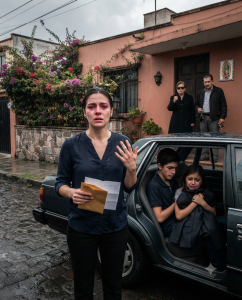
The rain had started just as the funeral ended.
By the time Julia Salcedo stood outside the gates of the cemetery, the sky over Mexico City had turned the color of wet ash, and a cold drizzle had begun to settle over the mourners like a second veil. People were already leaving in small clusters, folding umbrellas, kissing cheeks, offering the same soft words that sounded kind but empty after enough repetition.
He fought hard.
He’s at peace now.
You have to stay strong for the children.
Julia nodded through all of it because that was what people expected from widows. They expected tears, silence, gratitude, maybe a little trembling. They did not expect rage. They did not expect suspicion. They did not expect a woman so tired she had forgotten what it felt like not to be afraid.
Martín had been buried at 11:30 that morning in the black suit she had chosen herself from the closet because he had once worn it to Mateo’s middle school graduation and said it made him feel “almost elegant.” Even sick, he had smiled when he said things like that. Even when the second round of cancer had hollowed his face and taken his strength, he still tried to make the room easier for everyone else.
That was Martín. Gentle. Quiet. Watchful. The kind of man who remembered everyone’s birthday, who fixed things before anyone thought to ask, who pressed his hand over Julia’s at night as if he could keep the whole family anchored just by touching them.
By four in the afternoon, his parents had thrown his wife and children out of their house.
At first, Julia honestly thought she had misunderstood.
They had all driven back from the cemetery together in separate cars. The children were exhausted. Mateo sat rigid and silent, his jaw locked, staring out the window with red eyes he refused to wipe. Renata had cried herself into hiccupping silence and kept Martín’s jacket folded in her lap. Julia herself felt barely conscious. Her body moved because it had to move. Her mind lagged behind everything.
She parked in front of the house in Coyoacán and sat for a few seconds with both hands on the steering wheel, looking at the bougainvillea drooping over the wall. The house seemed exactly as it had that morning. The small statue of the Virgin of Guadalupe still watched over the front entrance. The brass handle on the door still had the scratch Mateo made years ago trying to unlock it with the wrong key. The curtains in the living room were still the cream-colored ones Julia had sewn by hand when they couldn’t afford new ones.
Nothing looked different.
That was the cruelest part.
Because the life inside that house had already been erased.
When they stepped out of the car, Don Ricardo and Doña Elena were already at the door. Ricardo had a ring of keys in one hand. Elena wore black sunglasses despite the dark weather, as if she needed something between her face and the rest of the world.
Julia led Renata up the path while Mateo carried a bag of flowers from the funeral.
Ricardo didn’t invite them in.
Instead, he blocked the doorway.
“This house belongs to the Salcedo family,” he said flatly. “You and the children should go stay with your sister for a few days.”
Julia frowned at him, rain collecting in her hair.
“What are you talking about?”
“We need time to decide what’s going to happen with everything,” he said. “The property, the belongings, the business matters.”
Julia let out a breath that almost became a laugh because the idea was so absurd her mind rejected it.
“Ricardo, this is our home.”
Elena lowered her glasses enough to look Julia over with quiet contempt. “Martín maintained this house. Martín paid for this life. You’ll have to understand things are different now.”
There were a thousand things Julia could have said. She could have reminded them that she had cared for their son through every stage of his illness. That she had slept upright in hospital chairs, sold jewelry to pay bills, learned the names of medications she could barely pronounce, and fed him soup one spoonful at a time when he was too weak to lift his hand. She could have listed every Christmas she hosted, every birthday cake she baked, every time she welcomed them into this house and let them criticize the food, the curtains, the children, her, while Martín begged her later to be patient because “they’re still my parents.”
But she said none of it.
Maybe because she still didn’t believe this was real.
Maybe because she still thought decency would return if she gave it a second.
Then Elena’s eyes moved from Julia to Renata’s shoes and the little girl’s wet socks.
“Martín carried you for years,” she said. “Now he’s gone.”
That was the moment Mateo stepped forward.
He was sixteen, all sharp shoulders and fresh grief, trying so hard to stand like a man when he was still a boy who had buried his father less than five hours earlier.
“Don’t talk to my mother like that.”
Ricardo turned his head slowly.
“Watch your mouth.”
“He just buried his dad,” Julia said, reaching out.
The slap came before she could finish.
It was so sudden and so vicious that for a second Julia didn’t process what she had seen. Mateo staggered sideways into a painted flowerpot, his hand flying to his cheek, shock flooding his face after the impact. Renata screamed. Julia lunged toward her son, something hot and animal tearing through the numbness.
“Don’t you touch him!”
But Elena was faster than grief should have allowed.
She seized Julia’s left hand, twisted the wedding ring from her finger, and ripped it away. The metal scraped skin. Julia gasped.
“This belonged to my mother,” Elena said. “It was never yours.”
For one suspended second, everyone was still.
Rain hissed against the pavement. Renata sobbed. Mateo stared at his grandfather with a look Julia had never seen before, not just pain but hatred forming for the first time. Julia looked down at the pale indentation where her ring had rested for years.
She had worn that ring in operating rooms, in hospital corridors, in pharmacy lines, in chapel pews. She had turned it round and round with her thumb during test results and prayer and sleepless nights. Once, during Martín’s second relapse, he had kissed her hand and whispered, “I’m sorry this isn’t the life I promised you.”
She had told him, “You are the life.”
And now his mother had torn the ring away from her like the marriage itself could be revoked.
Julia understood something then.
There would be no mercy here. No shame. No waiting for them to come to their senses.
So she did the only thing left that still protected her children: she stopped speaking.
She checked Mateo’s cheek with trembling fingers. She gathered Renata. She turned without another word and took both children back to the car.
Inside, the windows fogged almost immediately from their breath and crying. Renata curled against the seat clutching Martín’s jacket. Mateo kept wiping his face angrily, as if tears were insulting.
“Mom,” Renata asked between sobs, “why did Grandma take your ring?”
Julia looked at her daughter in the rearview mirror and had no answer a child should ever have to hear.
So she opened the glove compartment looking for tissues.
That was when she saw the brown envelope.
Her breath caught.
For weeks it had sat there untouched, exactly where Martín had told her to leave it. Two months before he died, when he could still sit outside for ten minutes at a time if the weather was cool, he had asked her to bring him tea to the patio. His hands shook when he took the cup. He waited until the children were inside.
“There’s something I need you to promise me,” he had said.
She had tried to smile. “That usually means I won’t like it.”
He had smiled back, tired but affectionate. “Probably not.”
Then he gave her the sealed envelope.
“Only open this if they really leave you alone,” he said.
She remembered frowning. “Who?”
He had looked toward the garden wall, not at her. “My parents.”
Even then she had resisted. Even then she had wanted to defend them for his sake. “Martín…”
“I know them,” he said quietly. “Better than you ever will.”
Now, with rain tapping the windshield and her children crying in the car, Julia tore the envelope open.
Inside was a handwritten letter and a business card.
The letter was in Martín’s unmistakable slanted script.
Julia, if my parents ever turn their backs on you, do not fight with them. Call Attorney Rebeca Hinojosa immediately. The house is yours. The cabin in Valle de Bravo is yours. My shares in the company are in a trust for you and the children. My parents know nothing about it.
He had underlined that last sentence.
My parents know nothing about it.
Julia read the lines twice, then a third time. The numbness inside her shifted into something steadier, sharper. Not relief exactly. Relief was too gentle a word. This felt like a hand taking hold of hers from beyond the grave.
She looked up.
Ricardo was still standing on the porch, smug and dry under the awning. Elena held the stolen ring in her fist.
For the first time that day, Julia saw them not as powerful people, but as people who had made a mistake.
She dialed the number on the card.
The call was answered on the third ring. “Rebeca Hinojosa.”
Julia explained what had happened, stumbling over her own breath, trying not to break apart in the middle of it. She described the house, the slap, the ring, the rain, the children.
The attorney let her finish.
Then she said, in a voice precise enough to cut glass, “Stay in the car. Lock the doors. Do not hand over that letter. I’m coming with certified copies, and I’m notifying the police.”
Julia whispered, “Thank you.”
When she lowered the phone, Ricardo was watching her.
“Who are you calling?” he shouted.
Julia rolled the window down a few inches.
“Martín’s lawyer.”
The change in his face was instant. Not dramatic, not loud, but undeniable. The superiority drained out of him first. Then the certainty. Elena glanced at the envelope and for the first time that entire day, her mouth tightened with something close to panic.
They knew their son had hidden something.
They just didn’t know how much.
The patrol car arrived first.
Two officers stepped out and approached the gate. Ricardo immediately changed tone, the way some people do when authority appears—suddenly reasonable, suddenly wounded.
“Officers, thank God you’re here,” he said. “This woman is upset. My son just died today. We’re trying to handle a delicate family matter.”
From inside the car, Julia almost laughed.
Delicate.
One officer spoke to her through the cracked window while the other remained near the porch. Mateo finally found his voice enough to tell them about the slap. He did it without tears, his face stiff with humiliation. Renata held up the jacket and said in a tiny voice, “Grandma stole Mommy’s ring.”
Children always have a way of cutting through performance.
Then a dark gray sedan pulled up behind the patrol car.
Attorney Rebeca Hinojosa stepped out carrying a leather folder.
She was in her fifties, composed, elegant, with silver streaks in her hair and the expression of someone who had spent years watching rich people lie badly. She didn’t run. She didn’t raise her voice. She simply crossed the wet pavement like she already knew exactly where everyone belonged.
She greeted Julia first.
“Mrs. Salcedo.”
No pity. No fuss. Just respect.
Then she looked at Mateo’s cheek, at Renata’s tear-stained face, at Elena’s clenched fist, and finally at Ricardo standing in the doorway as though the house were still his territory.
“Mr. and Mrs. Salcedo,” she said. “I was hoping your son had misjudged what kind of parents you were.”
Ricardo folded his arms. “I don’t know what nonsense he told you, but this is family property.”
Rebeca opened the folder.
“That is incorrect.”
She handed one set of papers to the officers, one to Julia, and kept one in her own hand.
“The property deed for this residence was transferred eighteen months ago into Martín Salcedo’s sole legal ownership after a restructuring of family assets,” she said. “Three weeks before his death, he executed a protected transfer placing the home in his wife’s name effective immediately upon filing of his death certificate.”
Ricardo stared at her.
“No.”
“Yes,” Rebeca replied. “And since the filing was processed this morning, this house is legally owned by Julia Salcedo.”
Elena actually took a step back.
Ricardo recovered first, his voice rising. “He would never do that without telling us.”
Rebeca’s gaze sharpened. “He didn’t tell you because he anticipated exactly this.”
Silence settled over the porch.
The rain had softened to a mist, but no one moved.
Then Rebeca pulled out a second document.
“This is the trust agreement covering Martín Salcedo’s shares in Salcedo Industrial Holdings. Beneficiaries: Julia Salcedo, Mateo Salcedo, and Renata Salcedo.”
Ricardo’s face lost color.
He grabbed the gate for support. “That company belongs to my family.”
“It belonged,” Rebeca corrected, “to your son in part. And he elected to place his holdings beyond your control.”
Elena found her voice. “He wouldn’t do this to us.”
Rebeca looked at the wedding ring in Elena’s hand. “He already did.”
One of the officers then asked the simplest question of the afternoon. “Ma’am, would you like to press charges for the assault and theft?”
The word theft landed heavily.
Elena opened her fingers reflexively, revealing the ring in her palm. For the first time, she seemed old rather than severe.
“It was my mother’s,” she said weakly.
Julia stepped out of the car at last.
The air was cold and smelled like rain and wet stone. Her legs shook, but she walked steadily to the gate. She stopped just far enough away to keep the distance she now understood they deserved.
“Elena,” she said, her voice low, “he put that ring on my hand when he asked me to build a life with him. I wore it while I cared for your son when you visited for an hour and left because hospitals depressed you. I wore it while your grandson learned to shave and your granddaughter learned to read and your son cried in my arms because he was afraid of dying. Don’t ever tell me it was never mine.”
Elena’s eyes flickered.
For one second, Julia saw something there—maybe shame, maybe only defeat.
Then Elena dropped the ring into Julia’s open palm.
It felt colder than it should have.
Ricardo tried one last time. “Julia, this is grief speaking. We can discuss all this privately.”
Julia slid the ring back onto her finger, ignoring the sting where it had scraped her skin.
“No,” she said. “What happened today was not grief. Grief is what my children are feeling. Grief is what I felt while I held your son through his last night. This”—she looked from one of them to the other—“this was greed.”
The officers took statements.
Mateo described the slap again, this time louder. Renata added that she had seen everything. Children were inconvenient witnesses for people who relied on appearances. The officers informed Ricardo and Elena that a formal report would be filed. Rebeca requested immediate documentation of the attempted unlawful eviction. Ricardo sputtered. Elena said nothing else.
At some point, neighbors began peeking from behind curtains and gates. The Salcedos had always cared deeply about reputation. Julia might once have been embarrassed by the scene. Now she found that she wasn’t. Truth had a strange way of making shame migrate to its rightful owner.
When Ricardo realized the officers were not taking his side, his anger finally cracked open into desperation.
“He poisoned our son against us,” he said hoarsely.
Rebeca answered before Julia could. “No. Your son simply knew you.”
That ended it.
The officers escorted Ricardo and Elena off the property for the evening pending further civil action. They left with no umbrella, no dignity, and no control. Ricardo did not look back. Elena did, once, from the sidewalk. Not at Julia. At the house.
At what she had lost.
Or thought she had lost.
Inside, the house smelled faintly of lilies from funeral arrangements and the cinnamon tea Martín used to drink when treatment made everything else taste metallic. Renata ran to the couch and buried her face in a pillow. Mateo stood in the middle of the living room looking like he didn’t know whether to punch a wall or collapse.
Julia locked the door and turned the deadbolt.
Then she leaned against it and finally cried.
Not the silent tears she had forced back all day. Real crying. The kind that leaves you shaking so hard your knees can’t hold. Mateo crossed the room first and wrapped his arms around her. Renata joined from the side, still clutching the jacket. The three of them stood there in the entryway where they had just nearly lost everything, and they clung to one another until crying turned into breathing again.
Rebeca waited respectfully in the dining room until Julia could sit down.
“There’s more,” the attorney said gently.
Julia looked up.
Martín, it turned out, had arranged not only the house transfer and the trust, but legal instructions preventing his parents from acting on behalf of the estate in any capacity. He had also left a recorded statement with Rebeca to be released only if his parents attempted to contest his wishes.
Julia closed her eyes.
Even dying, he had been protecting them.
“Did he know for sure they’d do this?” she asked.
Rebeca hesitated. “He said he prayed he was wrong.”
That hurt almost more than the betrayal itself.
Over the next weeks, the legal aftermath was ugly but brief. The documents were airtight. Ricardo tried to challenge the trust and failed. Elena sent messages through relatives asking for “understanding” and “respect for Martín’s memory.” Julia ignored them. A few family members quietly admitted they weren’t surprised. Apparently the Salcedos’ obsession with control had not begun with her.
The cabin in Valle de Bravo was real. So were the protected shares. For the first time in months, maybe years, Julia could look at the future without seeing only debt and fear. She enrolled Renata in grief counseling. She took Mateo to file the final statement about the assault and watched him stand taller with each practical step. Healing did not come all at once, but safety did, and safety changes everything.
A month later, Julia found one of Martín’s sweaters still draped over the back of a chair in their bedroom. She sat on the edge of the bed, pressed the fabric to her face, and let herself miss him without interruption.
There was another note in the sweater pocket.
Not legal. Not strategic. Just personal.
If you’re reading this, he had written, then you’re still moving forward, which means you kept your promise to me. Live. Even if it feels impossible at first. Especially then.
Julia laughed through tears because that sounded exactly like him—practical even in tenderness, loving even in fear.
She wore her ring again after that, not every day at first, but often. Not because she needed a symbol to prove what had been real. She no longer needed proof. She had lived it. She had earned it. She had defended it.
Months later, when bougainvillea bloomed over the wall again, Mateo repainted the scraped flowerpot by the door. Renata planted marigolds under the Virgin statue. Julia changed the locks, donated the old black funeral dress, and learned that some houses become homes twice—once when love builds them, and again when truth saves them.
People who heard the story usually asked the same question: how could parents do that to their dead son’s family on the day of his burial?
Julia never answered with anger anymore.
She would simply say, “Because death doesn’t create character. It reveals it.”
And that was the part that stayed with everyone who heard it.
Not just that Martín had protected his wife from beyond the grave.
Not just that greed had failed.
But that the biggest warning signs had always been there, dressed up as family pride, tradition, opinions, help, sacrifice. Things are easy to excuse while love is asking you to be patient.
The harder question was the one people asked themselves afterward:
At what point does loyalty stop being love and start becoming permission?