The rain began before sunrise and never really stopped. By noon, the Harrington estate looked less like a home and more like a fortress under siege, its stone walls dark with water, its towering windows flashing silver whenever lightning cracked across the sky.
Inside that mansion, Caleb Mercer was being erased.
Not loudly. Not dramatically. No screaming scene, no shattered glass, no public meltdown. The Harringtons were far too polished for that. They had money, reputation, and the kind of old-family cruelty that didn’t need volume to wound. They did it with clipped voices, tightened smiles, and words like arrangements and practicality and best for the children.
Caleb was kneeling on imported marble, packing his life into trash bags.
A small T-shirt. Two tiny pairs of jeans. A sock without its match. A plastic dinosaur. A cracked red fire truck Leo refused to sleep without. The black bag beside him was already half full, and still it looked impossible that everything he and his sons had left in that house could fit into two cheap plastic sacks.
His body ached in familiar places. The old injury in his back had flared up from the cold, sending a hot line of pain down his left leg. Titanium screws didn’t care whether the enemy was a roadside blast in Afghanistan or a damp marble floor in a South Carolina mansion. Pain was pain.
But this was worse.
He could endure broken bone and blood and surgery. He had done that. He could endure grief too, though barely. He had spent six months in hospital rooms watching his wife disappear one treatment at a time, learning the shape of helplessness while pretending to be strong for her. But humiliation—clean, elegant, deliberate humiliation in front of his children—cut in a different place.
At the bottom of the staircase, Margaret Harrington stood with her arms folded lightly across her cream sweater, her posture as precise as a portrait. Her silver-blonde hair was immaculate. Her makeup flawless. Her expression calm in the way only the truly merciless could manage.
Beside her, Richard Harrington swirled whiskey in a crystal glass, his eyes cloudy with impatience.
Neither grandparent was looking at the twins.
Leo and Sam pressed against Caleb’s legs. They were five years old, identical except to the people who truly knew them. Leo had a tiny scar near his eyebrow from running into a coffee table at age three. Sam’s left front tooth sat slightly crooked. Today both boys looked smaller than usual, their faces pale and confused, as if they sensed something terrible was happening but didn’t yet understand the rules of adult betrayal.
Brutus sat by the front door.
The retired Navy K9 shepherd was motionless except for his eyes. Big, scarred, disciplined, he had once worked explosive detection and tactical support. Caleb trusted that dog more than he trusted most men. Brutus didn’t waste energy. He watched. He measured. He knew.
And right now, he was watching Margaret.
“You can’t do this,” Caleb said at last, rising with the bag in one hand. His voice sounded rough even to him. “They’re your grandsons.”
Margaret’s chin lifted by a fraction. “They were our grandsons when Sarah was alive. Without her, this arrangement is no longer workable.”
Leo looked up at Caleb, not fully understanding the sentence but understanding the chill in it.
Caleb stared at Margaret. “Arrangement?”
Richard exhaled through his nose. “Don’t turn this into a scene.”
“A scene?” Caleb laughed once, but there was no humor in it. “Your daughter died six weeks ago. My sons still wake up crying for their mother. And today you’re throwing us out with garbage bags.”
Margaret’s eyes hardened. “What happened to Sarah was tragic. But tragedy doesn’t change reality. The house belongs to our family. You have no income worth speaking of. You’re physically compromised. The children require continuity, education, emotional support—”
“They require their father.”
“They require more than love,” she said.
That sentence landed with the force of a slap.
Caleb took one step toward her. Not threatening. Not even close. But Brutus rose instantly, sensing the shift, and Sam whimpered. Caleb stopped.
Richard set his glass down on an entry table. “You need to think rationally. Sarah is gone. The medical bills were substantial. Your savings are gone. The insurance disputes are still unresolved. You cannot provide the environment those boys deserve.”
“You mean the environment money buys.”
“I mean stability,” Richard said.
Caleb almost said something reckless then. Almost told Richard where stability could go. But he caught sight of the boys’ faces and forced the rage back down.
Margaret spoke next, each word clipped and dry. “And the dog goes too.”
Caleb turned slowly. “What?”
“That animal has frightened the staff repeatedly.”
“Brutus has never harmed anyone in this house.”
“He is a dangerous beast,” Margaret said, loud enough that both children heard it clearly. “He does not belong around traumatized minors.”
Leo’s grip tightened on the fire truck. Sam shrank against Caleb’s thigh.
Brutus did not move. But his ears tilted forward.
Caleb’s voice dropped lower. “That dog slept outside Sarah’s hospital room for nights at a time. He lay under the twins’ cribs when they had fevers. He protected your daughter.”
Margaret’s expression didn’t change. “You have until noon.”
“And at one?” Caleb asked.
“The guest wing will be sanitized.”
That word did it.
Sanitized. As if Caleb and his sons were contamination.
He looked at the foyer around him: the gleaming floor, the chandelier Sarah used to joke looked like frozen fireworks, the curved staircase where she once sat reading while the twins crawled over her lap. Every memory in that house now felt trapped behind glass, inaccessible and already being claimed by people who had loved appearances more than they had loved her.
“I want Sarah’s cedar chest,” he said. “The one in the attic.”
“No.”
“She told me what was in it.”
Margaret’s mouth flattened. “Everything that belonged to my daughter stays here.”
Caleb stepped closer, his eyes locked on hers. “Her wedding album? Her journals? Her children’s hospital bracelets? Those stay here too?”
A flicker. Tiny, but real.
Richard intervened. “This isn’t helping.”
“No,” Caleb said. “What isn’t helping is stealing from grieving children.”
Sam started crying then, the silent kind first, tears slipping down without sound. Caleb crouched immediately, his anger dissolving into something softer and more desperate.
“Hey,” he whispered, brushing Sam’s cheek. “It’s okay.”
“Are we bad?” Sam asked.
The question hollowed the room.
For the first time, even Richard looked briefly uncomfortable. Margaret did not.
Caleb kissed Sam’s forehead and looked at both boys. “You are never bad. Do you hear me? Never.”
Then he stood, took a steadying breath, and finished packing.
He found the old military rucksack he had stored in the attic months ago when Sarah was first admitted for long-term treatment. He barely remembered tossing it up there. He grabbed it without checking inside. Then he took the twins’ jackets, one framed picture of Sarah he’d hidden in a dresser drawer, and the broken fire truck.
That was all.
As he led the boys outside, the storm hit them full in the face. Rain soaked through their clothes instantly. Caleb carried both children one at a time through the downpour while Brutus trotted close, head up, scanning the grounds.
From the front window, Margaret watched.
She didn’t wave. Didn’t call after the boys. Didn’t even pretend regret.
Caleb buckled the twins into the cracked back seat of his old truck and climbed behind the wheel. He sat there for a second, staring through the blurred windshield.
“Daddy,” Leo whispered, clutching the red truck. “Is Mommy mad at us?”
Caleb turned so fast his shoulder hit the seat. “No. No, buddy. Never.”
“Then why did Grandma say we can’t stay?”
He had no answer a five-year-old could survive.
So he said the only thing he could. “Sometimes grown-ups do cruel things because they’re empty inside.”
Leo frowned like he was trying to solve it.
Caleb started the engine. As he drove past the iron gates, he didn’t allow himself to look back.
The Starlight Motel sat off the highway behind a flickering sign with two dead letters. Room 114 had stained carpet, a buzzing air conditioner, and curtains that smelled like old smoke. Caleb used the last of his cash for the room, a carton of milk, two hot dogs from the gas station, and a packet of crackers.
The boys fell asleep quickly from exhaustion, one curled around the other. Caleb sat on the bed and stared at the wall.
What now?
He had no apartment. No family close by. His military pension covered almost nothing after the treatment debt. He had applied for veterans’ assistance, but paperwork moved slowly even for men who weren’t grieving widowers with two small children. His truck needed brakes. His back was getting worse. And Sarah—the one person who had always been able to pull him back from the edge—was gone.
He lowered his face into his hands.
That was when Brutus made a strange sound.
Not a growl. Not a bark. A short, sharp whine.
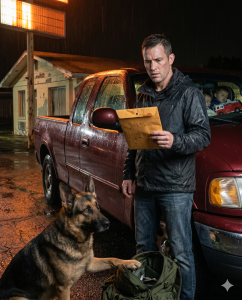
Caleb looked up. The dog was standing in front of the military rucksack, nose pressed to the side seam, body tense.
“Brutus,” Caleb said quietly. “Enough.”
The dog pawed at the bag.
Caleb rubbed his eyes. “Leave it.”
Brutus ignored him, hooked the zipper with his teeth, and tugged. A hidden side compartment split open.
Caleb frowned. He didn’t remember that pocket.
He slid off the bed and knelt, pushing Brutus gently aside. Inside, tucked flat beneath the lining, was a thick envelope sealed with red wax. Not new wax—old, cracked slightly at the edges, but intact.
The embossed seal read: Arthur Thomas Estate.
Caleb stared.
Arthur Thomas was Sarah’s maternal grandfather, though the Harringtons hardly ever spoke his name. From the little Caleb knew, Arthur had come from old money but not old manners. He had built and sold a company of his own, refused to bow to certain family expectations, and spent the last years of his life in an open feud with Margaret. Sarah once said he was the only person in her family who ever told the truth when it was inconvenient.
Caleb had met him once. The old man had looked at Caleb’s uniform, then at Margaret’s face, and laughed like he’d seen a private joke no one else understood.
Hands suddenly unsteady, Caleb broke the wax.
The first item inside was a letter in Sarah’s handwriting.
If anything happens to me before I can tell you, trust Brutus. Trust no one else in this house.
Caleb’s mouth went dry.
He unfolded the pages beneath it. There were trust documents, notarized copies, a death-contingency filing, and a safe-deposit authorization connected to a law firm in Charleston. He scanned the names once, then again because his eyes refused to process what they were seeing.
Arthur Thomas had established a protected estate decades earlier. It had grown quietly through investments, land leases, and the sale of his private business holdings. Margaret had no direct control over it. Richard had no direct control over it. And according to the legal language in Caleb’s hands, Sarah had inherited a protected beneficial line—which, upon her death, passed directly to her children.
Leo and Sam.
Their estate value, as last recorded in the file copy, exceeded two hundred million dollars.
Caleb sat back hard on the motel floor.
It made no sense. None. If this was real, why had Sarah never told him? Why had the Harringtons acted as if everything depended on their generosity? Why had Margaret kept such a grip on the house, the belongings, the narrative?
Then he saw another note in Sarah’s handwriting, squeezed into the margin beside the guardianship clause:
Mom was asking too many questions. If I die, she will try to control everything through the boys. Don’t let her.
Below that was a name.
Primary acting guardian and trust protector until beneficiaries reach legal age: Caleb Mercer.
Caleb felt cold all over.
He turned another page and found a memo from Arthur’s attorneys. It referenced concerns that certain members of the Harrington family might challenge the estate by asserting Caleb’s instability due to combat trauma and financial hardship. The memo recommended immediate legal counsel and physical possession of original trust records.
A smaller envelope slipped from the file and landed on the carpet. Caleb opened it with his thumb.
Inside was a brass key and a deposit box number.
Then came the sound outside the room.
A footstep.
Brutus’s head snapped toward the door.
Caleb froze.
The motel hallway was usually noisy—muffled TVs, ice buckets, doors slamming—but this was different. One deliberate creak. Then silence.
Caleb reached for the lamp and turned it off. The room dimmed to the orange pulse leaking through the curtains from the broken neon sign outside.
Another creak.
Someone stopped directly outside room 114.
The twins were still asleep. Caleb’s pulse pounded in his throat. He gathered the documents, shoved them back into the rucksack, and moved silently toward the bed. Brutus planted himself between Caleb and the door, body low, ears forward, no sound coming from him at all.
Then the handle moved.
Just a test. A careful push down and release.
Caleb’s entire body locked.
After a moment, a voice came through the wood. “Mr. Mercer?”
Male. Controlled. Not motel staff.
Caleb didn’t answer.
The voice returned. “My name is Daniel Reeves. I’m with Hollis, Bain & Mercer. Your wife left emergency instructions with our office. We’ve been trying to locate you for six weeks.”
Caleb didn’t move.
How had they found him here?
As if sensing the thought, the man added, “The dog registration from the veterinary file still listed your truck plate. We tracked a fuel purchase forty miles back. I’m alone, and I have identification under the door.”
A business card slid across the carpet.
Brutus sniffed it once but stayed tense.
Caleb crouched, keeping his weight balanced. Through the peephole he saw a man in his fifties in a soaked dark coat, hands visible, no one behind him.
“You have thirty seconds,” Caleb said through the door.
“That’s fair,” the man replied. “Your children are the legal heirs to Arthur Thomas’s estate. Mrs. Harrington’s attorneys filed an emergency petition this afternoon seeking temporary custodial review and estate supervision. They moved faster than we expected.”
Caleb’s grip tightened on the doorknob.
The lawyer continued, “If you still have the original packet, open the door. If you don’t, then we have a much bigger problem.”
Caleb opened it three inches, chain latched.
The lawyer held up his ID. Rainwater dripped from his sleeve. He looked tired, serious, and alarmed.
“Mr. Mercer,” he said quietly, “your wife believed this would happen. She left recorded statements, sealed instructions, and evidence that some of her personal property was taken without consent after her diagnosis worsened. We need to move tonight.”
That sentence hit Caleb like another blast.
“Taken?”
“Yes,” Reeves said. “Including journals, trust correspondence, and a cedar chest your mother-in-law was specifically forbidden to remove from your wife’s line of possession.”
Caleb thought of the attic. Of Margaret’s face when he’d asked for it.
Reeves looked over Caleb’s shoulder toward the sleeping boys and lowered his voice further. “I’m going to be direct. Once the Harringtons learn you found that packet, they will not treat this as a family disagreement. They will treat it as a war over two hundred million dollars.”
For the first time that day, Caleb felt something underneath the grief and humiliation.
Focus.
He unlatched the chain.
Within minutes Reeves was inside, reviewing the documents at the tiny motel table while Brutus watched him with unblinking suspicion. Reeves confirmed the seals, the signatures, the filing numbers. Real. All of it real.
Sarah had hidden the packet in Caleb’s old military bag because she knew he would never voluntarily leave it behind if he had to evacuate quickly. She had used Brutus as the backup plan because the dog had been trained to indicate hidden explosives and sealed storage. She trusted he would notice the compartment even if Caleb didn’t.
“She was trying to protect the boys,” Reeves said quietly.
“And she never told me because…?”
“Because,” Reeves replied, “she believed the fewer people who knew where the originals were, the harder they’d be to take.”
Caleb sat back, stunned by the scale of it. Sarah had been sick, terrified, fighting to live—and still planning for this possibility in secret.
Reeves made three calls from the parking lot and came back with a rapid plan. A judge-friendly emergency filing. Temporary secured housing through the estate. Immediate transfer to a protected residence. Motion to block any Harrington interference until probate verification. Retrieval of the safe-deposit box at opening.
At dawn, Caleb woke the boys and drove behind Reeves’s sedan into Charleston.
By ten that morning, they were in a private conference room above a law office overlooking the harbor. The boys colored on legal pads while Brutus lay beneath the table. Reeves opened the deposit box with Caleb present.
Inside were original trust documents, Arthur Thomas’s handwritten codicil, Sarah’s voice-recording instructions on a flash drive, and a sealed packet labeled FOR COURT IF MARGARET HARRINGTON CONTESTS.
“She contesting yet?” Caleb asked.
Reeves gave him a grim look. “Already did.”
The hearing came fast.
Margaret arrived in pearls and controlled sorrow, Richard at her side, both of them looking like grieving grandparents dragged into an unnecessary spectacle. Their attorney argued Caleb was financially unstable, emotionally compromised, and living in a motel with minor children. Margaret dabbed at dry eyes and said all she wanted was to protect her grandsons.
Then Reeves introduced Sarah’s recorded statement.
The courtroom went still as her voice filled the speakers—weak from illness, but unmistakably clear.
If you are hearing this, it means I was right to be afraid. My mother has been pressuring me about Grandpa Arthur’s estate for months. She believes Caleb is too damaged to stand against her if I’m gone. She is wrong. My husband is the safest place my children have. If my parents attempt to remove my sons from Caleb or control the trust through them, I want the court to know I do not consent to it in any form.
Margaret’s face lost color.
The second blow came from Arthur himself. His codicil named Margaret specifically and excluded her from any administrative authority due to what he called a documented history of coercion, financial manipulation, and self-dealing conduct within the family.
The third blow was the cedar chest.
Reeves had obtained an emergency order to inspect the attic storage at the Harrington estate. The chest was recovered intact, along with Sarah’s journals, medical folders, letters, and inventory records showing items removed after her death. Among those records were notes proving Margaret had already begun cataloging assets tied to the boys as if she expected to control them.
The judge’s expression hardened with every page.
By the end of the hearing, Caleb was affirmed as sole legal guardian and trust protector. The Harrington petition was denied in full. A separate inquiry was opened into attempted concealment of estate property.
Outside the courthouse, Margaret finally dropped the polished mask.
“This is theft,” she hissed.
Caleb faced her on the courthouse steps with Leo on one side, Sam on the other, and Brutus standing in front like a wall with fur.
“No,” Caleb said. “This is the first honest thing that’s happened since Sarah got sick.”
Richard tried a softer angle. “We can still work this out privately.”
Caleb looked at him for a long moment. “You watched them throw your grandsons out in the rain.”
Richard had no answer.
Temporary housing turned into a restored waterfront home held by the estate. Caleb fought the urge to feel guilty walking into a place that large. But Reeves reminded him often: the money didn’t belong to him. It belonged to Leo and Sam. His job was simply to protect it and raise them well.
That part, Caleb understood.
He hired grief counselors. Not the kind Margaret had weaponized in conversation, but gentle specialists who let the boys talk about their mother when they were ready and stay quiet when they weren’t. He found a physical therapist for his back. He repaired the truck instead of replacing it, which made Leo laugh and declare it part of the family. He moved Sarah’s cedar chest into his own room and went through it slowly, one evening at a time.
Inside were letters she had written to the boys for future birthdays. Notes to Caleb tucked into book pages. Hospital bracelets. Ultrasound photos. The knitted baby blanket Margaret had taken. And a final envelope addressed to him alone.
In it, Sarah apologized for the secrecy. She wrote that she had seen the change in her mother the moment Arthur’s attorneys contacted her. She knew Margaret was tracking every legal detail while pretending to focus on treatment. Sarah said she didn’t tell Caleb because she feared the stress would break him while he was already carrying her illness, the boys’ fear, the bills, and his own pain. So she hid the truth the only way she thought she could.
She ended the letter with one line that made him sit on the floor and cry for the first time since the funeral.
You were never the burden in my life. You were the shelter.
Months later, the Harringtons’ social circle learned more than they wanted to know. Quiet investigations led to louder consequences. Margaret’s reputation survived in the way wealthy reputations often do—technically, socially, selectively—but the shine never fully returned. Richard withdrew from public boards. They sent gifts twice. Caleb returned them unopened both times.
Leo and Sam eventually stopped asking whether Mommy was coming home and started asking different questions instead. Did she like thunderstorms? What was her favorite song? Did she know how much they loved her?
Caleb answered every one.
Sometimes at night, when the boys were asleep and the house finally settled, he would watch Brutus sprawled by the hallway and think about the motel room, the envelope, the impossible turn their lives had taken. One hidden pocket. One faithful dog. One last act of protection from a woman who had known exactly what kind of people her parents really were.
Money changed their circumstances, but it didn’t rewrite the truth.
The truth was that a pair of rich grandparents had looked at two grieving little boys and seen leverage. They had looked at a wounded widower and seen weakness. They had looked at loyalty and called it dangerous. They had mistaken grief for defeat.
What they never understood was that Caleb had already survived worse than losing a mansion. And love—real love—had left him something stronger than their money ever could.
It had left him proof.
And in the end, that was the part Margaret could never sanitize away.
Even years later, people who heard the story argued about what mattered most. Was it the inheritance? The courtroom defeat? The cruelty of throwing children out? Maybe. But Caleb always knew the real turning point had come earlier, in a cheap motel room that smelled like smoke and mildew, when a dog everyone else dismissed refused to walk away from the truth.
That was the moment everything changed.
Not because Caleb discovered he was standing between his sons and a fortune.
Because he discovered Sarah had still been fighting for them, even from the edge of death.
And for the rest of his life, he never forgot the question that lingered beneath everything that followed:
If Brutus hadn’t found that hidden pocket that night, how much of their future would Margaret Harrington have stolen before anyone realized who the real danger in that family had been?