At eleven o’clock at night, Martina stood outside the wrought-iron gates of her in-laws’ mansion with her newborn daughter pressed against her chest and an old German shepherd at her side.
The baby, Inés, was barely two months old. She was wrapped in a soft hospital blanket that still carried the faint scent of baby powder and milk. She slept without knowing that the world she had been born into had just shifted beneath her. The old dog, Trueno, stood close enough to brush Martina’s leg, his body rigid, a growl rumbling deep in his throat as he stared back toward the brightly lit doorway of the house.
A few seconds earlier, that door had closed in Martina’s face.
Not slammed. Not dramatically. Just shut with a cold, final precision that somehow felt crueler.
Martina had lived through things that should have broken her long before that night. She had served in naval special operations. She had spent nights in hostile zones where every dark window and every abandoned car could hide death. She knew what it meant to function on no sleep, to ignore fear, to keep moving when your body was screaming to stop.
But nothing in all her training had prepared her for being turned out into the cold with her husband’s child in her arms by the people who had smiled at her wedding.
“We have no obligation to carry you or that girl,” Rebeca had told her from the entrance hall.
Even now, standing outside, Martina could still see the woman exactly as she had been: elegant robe, perfect posture, expression untouched by pity. Arturo, Daniel’s father, had stood beside her with his hands in his pockets as though the removal of his widowed daughter-in-law and granddaughter were a simple matter of household management.
“Daniel is gone,” he had said. “And without Daniel, you are not part of this family.”
Lidia, Daniel’s younger sister, had tried to protest. Martina remembered the tremble in her voice.
“Mom, please. There’s a baby.”
But Rebeca had cut her off with a glance sharp enough to stop her cold.
“We don’t even know what that child carries in her blood,” she had said.
Martina had raised her head then and answered with all the control she had left.
“She is Daniel’s daughter.”
Arturo’s reply had come quick and hard. “Daniel made many mistakes because he was stubborn. Marrying you was one of them.”
Martina had not begged. She had not shouted. She had swallowed the blow because she had spent years learning how to stand still under impact. But something inside her had cracked anyway.
The house behind them was full of the kind of wealth that softened every edge of life. Marble stairs, old paintings, chandeliers, carved wood doors, silver polished so often it looked untouched by human hands. Martina had grown up in a world where every peso mattered. Her mother had worked double shifts in a little diner in Veracruz until illness took her when Martina was seventeen. There had been no inheritance, no safety net, no influential surname waiting to catch her when she fell.
Everything Martina had, she had earned.
Daniel had loved that about her.
She met him four years earlier in a café in Coyoacán during a short leave from service. He was an architect with calm eyes and an easy patience that made other people slow down around him. He had recognized discipline in her without being intimidated by it. He had seen the scars on her arms and never asked questions she did not want to answer.
Instead, he asked things no one else asked.
What made her laugh when she was alone?
What food reminded her of home?
What part of herself did she protect most fiercely?
Their love did not arrive like lightning. It arrived like trust. Quietly. Repeatedly. In small moments that became a life before either of them could name it.
Daniel’s family never hid their disapproval. Martina was not from their world. She was too direct, too self-contained, too working-class, too military. She did not know how to flatter. She did not pretend to admire things that meant nothing to her. She loved Daniel openly, but she never performed gratitude for being tolerated.
Daniel married her anyway.
When Martina became pregnant, he was overwhelmed with joy. He talked to the baby before she was born. Spent an entire weekend assembling a crib and repainting a wall because he said their daughter deserved a room made by her father’s own hands. He would rest his ear against Martina’s stomach and grin every time the baby kicked.
Then orders came.
A mission overseas. Time-sensitive. Mandatory.
Martina had argued privately, but there was no way out. She was six months pregnant and furious with herself for leaving, but Daniel had held her face between his hands and told her he would be waiting when she came back. Waiting with a crib, with bad coffee, with stories, with diapers stacked too high and all the chaos of first-time parenthood.
Inés was born in a military medical facility far from home. Daniel saw his daughter for the first time over a video call and cried so hard Martina had laughed through her own tears. He kept asking to see the baby’s face again, then her hands, then her face once more.
Three weeks before Martina’s scheduled return, her world shattered.
A highway crash.
A call in the middle of the night.
Daniel dead before he ever reached a hospital.
The days that followed were a blur of flights, uniforms, paperwork, condolences, and grief so violent she sometimes felt physically nauseated by it. At the airport, the Rivas family received her stiffly. Rebeca barely touched the baby. Arturo spoke in the clipped, practical language of legal affairs. Lidia cried. Really cried. Martina never forgot that.
Because Daniel had always insisted that his family would take care of her if anything happened to him, Martina moved into the mansion after the funeral.
At first, they wore politeness like a mask.
Rebeca made comments about routines, hygiene, “appropriate childcare standards.” Arturo asked probing questions about military benefits, insurance, and Daniel’s estate. Martina was too deep in grief to decode every glance and every unfinished sentence. She only knew the atmosphere grew colder by the day.
Then she noticed something else.
Daniel’s old study had been searched.
Not obviously. A drawer slightly misaligned. A folder replaced upside down. Dust disturbed around the lower shelf. Once, she found Arturo inside the room, standing beside Daniel’s desk with a neutral expression and no explanation worth believing.
“Just checking old property documents,” he had said.
Martina remembered thinking it was strange. Then Inés started crying, and life closed over the thought.
The expulsion came without warning.
That night, Arturo had her suitcases brought downstairs. Rebeca informed her she needed to leave immediately. No scenes, no arguments, no humiliation for the household staff. The driver would take her wherever she wanted for the night. After that, she could make her own arrangements.
Martina had one arm under the baby, one hand gripping the strap of a diaper bag, and Daniel’s old backpack hanging from her shoulder because it was among the things delivered with her luggage.
Then Trueno had come racing out from the back garden.
The old German shepherd had belonged to Daniel since he was a puppy. Since Daniel’s death, the dog had hardly eaten and often sat staring at the front gate for long stretches of time, as though waiting for someone who would never come home. That night, when the driver reached for his collar, Trueno bared his teeth and backed against Martina’s leg.
“Take him too,” Lidia had whispered through tears. “No one here wants him anymore.”
So Martina left with the baby, the dog, and nowhere to go.
The motel she found near Calzada Zaragoza was cheap and grim, but it had a lock on the door and hot water that turned cold after five minutes. It was enough for one night. She cleaned a section of the bed with bottled water and soap, spread a towel down for Inés, and sat beside her daughter until the baby fell asleep.
Trueno took position by the door.
Martina sat in the weak yellow light and let the silence settle. She thought about Daniel. About his laugh. About the way he would have reacted if he had seen his parents that night. About whether he had known, deep down, what they were capable of. She told herself she would figure things out in the morning. She would find legal help. Temporary housing. Something. She had rebuilt herself before. She could do it again.
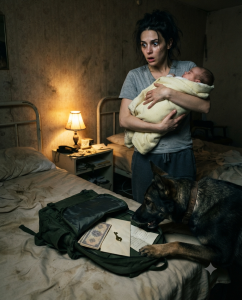
At three in the morning, Trueno sprang up and began scratching furiously at Daniel’s backpack.
At first Martina thought he wanted something trapped inside. Food, maybe. An old shirt. But there was a wild urgency in the way he pawed at the bottom seam and pushed his nose under the flap. He whined low in his throat and scratched again.
Martina stood at once, every instinct awake.
She took the bag onto the bed and opened every compartment. Spare clothes. A flashlight. Old receipts. A charger. A small folding knife. A notebook with a few measurements scribbled on the back pages. Nothing unusual.
Trueno shoved the bag with his snout so hard it nearly slid off the mattress.
Martina turned it over, ran her fingers across the lining, and found it.
A second seam hidden beneath the inner panel.
Very small. Almost invisible. Hand-stitched.
Her pulse jumped.
She grabbed the tiny motel sewing kit from the nightstand, slipped the scissors under the thread, and cut carefully through the seam. The false lining peeled back.
Inside was a plastic-wrapped bundle.
Martina opened it with controlled hands and felt the air leave her lungs.
There were cashier’s checks.
Bank certificates.
Property records.
Copies of transfer statements.
A key with no label.
A flash drive taped flat between two sheets of paper.
And a handwritten note from Daniel.
If my family ever throws you out, do not trust them. Do not let Arturo know you found this.
Martina stared at the sentence, then at the stack beneath it. The numbers were enormous. Not savings. Not an emergency fund. A fortune. More than enough to buy silence, or kill for it.
She forced herself to keep reading.
The papers showed money moving through shell companies tied to construction contracts. Properties had been acquired below market value through intermediaries, then transferred again and again until the trail blurred. There were signatures. Dates. Internal memos copied without authorization. One page carried Arturo’s signature. Another listed Daniel as a minority stakeholder in a firm Martina had never heard him mention.
A folded legal document near the bottom changed everything.
It was a draft statement prepared by Daniel.
In it, he described discovering financial fraud connected to his father’s development business. The statement accused Arturo of using front companies to conceal illegal transfers and pressure vulnerable owners into selling land. It also suggested that one fatal “traffic accident” involving a former accountant had not been accidental at all.
Martina read that page twice.
Then a knock sounded at the motel door.
Trueno was up instantly, snarling.
Martina killed the light, shoved the papers back into the backpack, and lifted Inés before the baby could wake fully and cry. She crossed the room in silence and looked through the peephole.
Lidia.
Daniel’s sister stood in the hallway in jeans and a sweater, hair tied back unevenly, face pale and wet with tears. She looked frightened in a way that made Martina open the door only an inch.
“I didn’t tell them where you were,” Lidia whispered. “I followed the driver’s GPS after he dropped your bags. I had to get here before my father.”
Martina said nothing.
Lidia’s eyes dropped to the backpack on the bed. The color drained from her face.
“He left it with you,” she said.
“You knew?” Martina asked.
Lidia swallowed hard. “Not everything. But I knew Daniel found something. He’d been fighting with my father for weeks before the crash. He told me if anything happened to him, you had to be warned.”
Martina felt the room tighten around her.
“Warned about what?”
Lidia stepped inside and shut the door gently behind her. Trueno kept growling, though quieter now.
“My father has been searching Daniel’s things since the funeral,” she said. “His office. His car. The study. Storage boxes. Even the dog’s kennel. Tonight wasn’t about grief. It was about forcing you out so he could search everything without you there.”
Martina looked at the backpack again.
“What’s in here?”
Lidia’s voice shook. “Proof. Enough to ruin him. Maybe enough to send him to prison.”
Martina studied her face. “Then why are you helping me?”
Lidia looked down for a second, then answered with a raw honesty Martina had not expected. “Because Daniel was the only decent person in that house. And because two years ago I heard my parents talking about an accountant who was becoming a problem. A week later that man died in a crash. Daniel heard the same conversation eventually. After that, he started copying files.”
A long silence followed.
The flickering lamp painted nervous shadows across the walls. Inés shifted against Martina’s shoulder and settled again.
“Daniel was going to take everything to a lawyer,” Lidia said. “Then maybe to the authorities. He told my father he wouldn’t let him destroy more people. After that…” She stopped.
“After that Daniel died,” Martina finished.
Lidia nodded, crying again.
Martina did not want to think the thought forming in her mind. But once it appeared, it would not leave. Had Daniel’s death really been an accident? Or had a man with enough money, influence, and desperation arranged something irreversible and called it fate?
Lidia glanced toward the window as if expecting headlights to sweep across the glass at any second.
“We can’t stay here,” she said. “If he tracked the driver once, he can do it again.”
Martina moved fast. Training returned with cold precision. She repacked the documents in order. Slid the flash drive into the hidden pocket of Inés’s diaper bag. Tucked the key into her boot. Kept the handwritten statement in the inner pocket of her jacket.
“Do you know what the key opens?” she asked.
Lidia nodded. “A safe deposit box. Daniel rented it six months ago under a business pretext. I only know because I accidentally saw the bank envelope and he told me not to mention it at home.”
That was enough.
By dawn, the three of them and the dog were in Lidia’s small apartment across the city, one Arturo had never visited because he disliked what he called “modest neighborhoods.” Martina locked the door, fed Inés, and finally went through the documents properly.
The flash drive held scanned contracts, voice recordings, email chains, and videos of Daniel speaking directly to camera on different dates. In the earliest recording, he looked tense. In the last, he looked exhausted but determined.
“If you’re seeing this,” he said in the final video, “it means something went wrong. My father has crossed lines he can’t uncross. I should have gone to the authorities sooner. If Martina has this, then she already knows I was right to be afraid.”
Martina had to pause the video because her vision blurred.
There was enough evidence there to destroy Arturo’s business empire, but only if it reached the right hands before it disappeared.
Lidia connected Martina with a lawyer Daniel had trusted in secret, an older woman named Gabriela Serrano who specialized in financial crime and had once helped a family friend through a corporate fraud case. Gabriela agreed to meet that afternoon in a small office with no external signage.
She spent three hours reviewing the material.
When she finally leaned back in her chair, her expression had hardened into something fierce.
“This is real,” she said. “And if even half of it checks out, your father-in-law isn’t just corrupt. He’s dangerous.”
“Can he take my daughter?” Martina asked.
Gabriela looked at her with steady eyes. “He can try. Men like him often use family court as a pressure tool. But if we move first, document everything, and place this evidence properly, we can make it much harder for him.”
They did not go to the police first. Gabriela was too experienced for that. Instead, she filed certified copies in multiple places, sent sealed packets to a federal prosecutor she trusted, and arranged for one investigative journalist to receive the material under strict conditions if anything happened to Martina or Lidia.
Then the safe deposit box was opened.
Inside was the rest.
Original deeds.
Audio backups.
A second signed statement from Daniel.
And one devastating envelope addressed in Daniel’s handwriting: In the event of my death.
That envelope contained a timeline of his final months. Meetings with his father. Hidden recordings. Dates when he noticed being followed. The name of the mechanic who had warned him someone tampered with his car once, weeks before the crash. Daniel had written that he no longer believed he was simply arguing with a corrupt businessman. He believed he was living beside a man capable of removing obstacles.
Martina read every word standing up because if she sat down she feared she might not stand again.
The investigation exploded quickly after that.
Once the prosecutor had enough documentation, bank accounts were frozen. Search warrants were issued. Journalists began asking questions Arturo could not silence. Former employees started talking when they realized someone powerful had finally turned on him. A land acquisition scandal surfaced first, then tax fraud, then coercion, then suspicious transfers to private security contractors who could not explain their invoices.
The biggest shock came when a reopened analysis of Daniel’s crash revealed evidence consistent with mechanical interference.
It was not enough, at first, to prove murder in court. But it was enough to turn suspicion into national attention.
Arturo was arrested on financial crime charges while cameras filmed him being led from his office. Rebeca, who had spent years protecting appearances, vanished from public view for days before surrendering for questioning regarding false statements and document destruction. Board members resigned. Partners claimed ignorance. Some were lying. Some may truly not have known. None of it mattered now.
Lidia gave testimony.
So did the former mechanic.
So did two ex-employees.
And eventually, so did Martina.
She sat in a formal room across from investigators and told the truth in a voice that never shook. About the expulsion. About the backpack. About Daniel’s fear. About the note. About the family’s desperate search for something they never expected her to find.
By then, public sympathy had shifted sharply in her favor. The image of a widow carrying her baby into the night while a powerful family tried to erase her was too stark to ignore. Yet what mattered to Martina was not public opinion. It was Daniel. It was the fact that he had tried, in the end, to protect her and their daughter even after realizing how dangerous the truth had become.
Months later, the case concluded in stages rather than one dramatic moment. Arturo was convicted on multiple counts of fraud, illegal financial transfers, and coercion. Separate proceedings related to Daniel’s death remained more complex, but the official ruling on the crash was changed from accidental pending criminal review, and the evidence permanently stained Arturo’s name whether the final charge could be made to stick or not.
The fortune hidden in the backpack was also explained.
It was not stolen money Daniel planned to keep. It was a protective reserve he had quietly secured by liquidating his legitimate share in the family business before his father could trap it. He had converted it into instruments Martina could access if she ever needed to flee or fight. It was his way of building an escape route without alerting the people watching him.
He had known the danger was real.
He just had not outrun it.
Martina never returned to the mansion.
With Gabriela’s help, she used part of the recovered money to establish a legal trust for Inés and moved into a modest, sunlit home where no one’s footsteps echoed like judgment down marble halls. Trueno slept by the front door every night. Lidia visited often. Their bond, born in fear and grief, became something like family built honestly for the first time.
Sometimes Martina would watch her daughter sleeping and think about how close she had come to losing everything in one night. House, security, dignity, truth. All of it nearly buried under wealth and influence.
Instead, the thing that saved her had been a dog who refused to forget and a husband who had hidden hope inside a backpack no one thought mattered.
In the end, the mansion had not protected the people inside it. The money had not saved Arturo. The family name had not purified cruelty.
What remained was simpler and harder.
A widow who did not break.
A sister who finally chose decency over fear.
A child who would grow up knowing her father had tried to protect her until his last days.
And one haunting question that never left anyone who heard the story:
What was the true red flag — the corruption Daniel uncovered, or the fact that the people closest to him had trained themselves to call cruelty normal until the night they threw a mother and her baby into the dark?