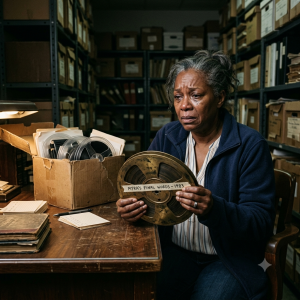
They told me the tape didn’t exist.
Thirty years I believed them.
I was wrong.
—
My name is Marguerite Fontenot, and I have spent most of my adult life trying to make peace with a story I was never allowed to finish telling.
I grew up outside Breaux Bridge, Louisiana — the kind of town where the Spanish moss hangs so low off the cypress trees it brushes your shoulders when you walk underneath. My family had land. Old land. The kind that gets passed down in whispers and wills and quiet arguments at Sunday dinner tables.
I was twenty-six years old the night everything changed.
I woke up to my parents standing in my doorway. Two men in white I didn’t recognize stood behind them. My sister Celeste was somewhere in the hall — I could hear her breathing but couldn’t see her face.
They said I was unwell.
They said I needed help.
They said it was for my own good.
By morning I was admitted to a private psychiatric facility two parishes away, and by the time I was released fourteen months later, the land had already been transferred. My name was nowhere on it. My father said I had agreed to relinquish my share before I left.
I had no memory of agreeing to anything.
I spent decades rebuilding. I moved to Baton Rouge. I made a life. I learned to stop asking questions that only made people uncomfortable.
Then, last spring, I answered a part-time job listing from the St. Martin Parish Historical Archive. They needed someone to transcribe oral histories — old recordings, local voices, family interviews going back fifty years or more. Quiet work. Careful work. The kind I’m good at.
The kind where you just listen.
—
They gave me a cardboard box on my third week. Twenty-something reels in no particular order, most of them labeled in pencil that had gone gray with age. Interview subjects. Dates. Family names I recognized from church directories and cemetery headstones.
And then I found it.
At the bottom of the box, wrapped in a square of old muslin cloth like someone had tucked it away deliberately, was a brass reel-to-reel spool unlike any of the others.
The others were plastic. Standard issue archival. This one was brass — heavier, older, the kind you’d find in a professional recording studio, not a parish clerk’s office.
And across the hub, someone had pressed a strip of white medical tape.
On it, four words written in handwriting I did not recognize:
*MF — Night of Admission.*
MF.
Marguerite Fontenot.
My hands were shaking so badly I had to set it down on the desk and walk to the window. I stood there for a full minute watching the parking lot like something out there might make sense of what I was holding.
They told me no recording was ever made that night.
My father said so. Celeste said so. The facility’s intake coordinator — a woman named Mrs. Tureaud who smelled of White Shoulders perfume — said so, twice, when my attorney asked in 1999.
*No recording exists.*
But I was holding it. Cold and brass and real, with someone else’s handwriting on a strip of medical tape telling me exactly what it was.
I went back to the desk.
I threaded it onto the machine with the kind of careful, slow movements you use when you’re afraid of what you’re about to do.
And then I pressed play.
And I heard my own voice.
Twenty-six years old. Frightened in a way I had forgotten I was capable of being. Saying things I had no memory of saying — but also things I remembered saying and was told I never said.
I listened to the whole reel without moving.
I sat in that archive room for a long time afterward.
When I finally looked back at the box, I saw I had missed something in my rush — a second spool, also brass, also wrapped in muslin. Smaller. Newer looking.
The strip of white medical tape across its hub read one word:
*Celeste.*
And below that, in the same handwriting I didn’t recognize:
A date.
Last Tuesday.
—
My sister lives alone now, outside Breaux Bridge, twenty minutes from where we grew up. I haven’t spoken to her in eleven years.
I don’t know who made that second recording.
I don’t know how it ended up in a parish archive box, underneath the first one, wrapped like it was waiting.
But I know I sat there at that desk with the machine in front of me, and I know I threaded the second reel with hands that had gone completely still — the way hands go still when the body decides the mind can’t be trusted to make decisions anymore.
I pressed play.
I heard breathing.
Then footsteps on wood.
Then, through whatever room that recording was made in —
I heard my own front door.
—
My front door has a specific sound. I know that’s a strange thing to say, but it’s true. The house I rent in Baton Rouge is a 1940s shotgun double on Choctaw Drive, and the front door sticks in its frame when the humidity is up, which in Louisiana means most of the time. When you open it from outside you have to lift the handle slightly and push left before it gives. It makes a sound like a sigh. Like the house exhaling.
I have never described that sound to anyone.
I heard it on the tape.
The recording was made in my house. In my house, last Tuesday, while I was at work.
Someone had been inside.
I sat with that for a moment — or what felt like a moment, though when I looked at the clock on the archive room wall, eleven minutes had passed. Just me and the hiss of the tape and the settling silence of a room full of other people’s preserved voices.
Then I kept listening.
After the door, there were more footsteps. Slow. Someone who knew the layout, who wasn’t feeling for furniture in an unfamiliar space. Whoever it was walked straight through my front room, turned left, and went down the hall toward my bedroom — I could tell by the change in the floor. The front room has tile. The hall has old pine boards that go higher in pitch the further toward the back you walk, a quirk I’ve lived with for six years.
Then a drawer. The sound of a drawer being opened and rifled through, gently, carefully.
Then silence for a long time.
Then a voice.
A woman’s voice, low and speaking like she was talking to herself, or to someone not in the room.
She said: *I found it. It’s still here. She kept it.*
Then the footsteps again, retreating. The front door. That sigh.
And then only the tape.
—
The handwriting on the medical tape was not Celeste’s. I know my sister’s handwriting the way you know a smell from childhood — the looping Cs, the way she crosses her sevens. This was someone else’s. Someone deliberate and careful, block letters pressed firmly like they wanted it to last.
But the voice on the second recording was my sister’s.
Older now, lower, worn around the edges the way voices get after decades of cigarettes and private grief. But hers.
I would know it anywhere.
I sat with my hands flat on the desk and I thought about what she had said.
*She kept it. It’s still here.*
I didn’t know what she was looking for. I didn’t know what she found. I went back through my apartment in my mind — every drawer, every shelf, every box I hadn’t unpacked since the move before last. I kept very little from before. Fourteen months in that facility and the land transfer and the years of trying to let go of things had stripped me down to almost nothing.
But almost nothing was not nothing.
I still had a lockbox in the back of my bedroom closet. Gray metal, the kind you can buy at any hardware store. Inside it: my birth certificate, some photographs, my grandmother Odette’s ring, and a manila envelope I had not opened in over twenty years.
The envelope had come to me in 1999, during the legal proceedings, in a plain parcel with no return address. My attorney at the time — a man named Broussard who did what he could and ran out of money before the case ran out of complexity — had looked at it and told me it wasn’t enough to move forward with. Too vague. Too easily discredited.
I had kept it anyway. The way you keep things you can’t afford to look at but can’t afford to lose.
I drove home from the archive that afternoon without remembering a single traffic light.
—
The lockbox was still there.
The envelope was still inside it.
And something else was there too, that I was almost certain had not been there before — though I cannot swear to it, and I want to be honest about that.
A second envelope, smaller, white, unsealed.
Inside it: a single index card, and on the index card, in those same careful block letters from the medical tape:
*You were not the only one they did this to. There are four others. I have been documenting since 1987. I left the tapes because you deserved to hear your own voice before I asked you to trust me. Call me when you’re ready.*
A phone number with a 337 area code.
That’s Acadiana. That’s home country.
—
I sat on the edge of my bed for a very long time.
My mind kept turning back to the first recording — my own voice at twenty-six, frightened, saying things I had been told I never said. I’ll tell you what was on it, because you deserve to know, and because I’ve spent thirty years being kept from knowing and I understand now what that cost me.
It was an intake interview. Someone — a man, professional voice, measured cadence — was asking me questions. Standard questions at first, orientation questions, name and date and what I understood about where I was. Then the questions shifted.
He asked me about the land.
He asked me if I understood that my father and mother were worried about my capacity to make responsible decisions.
He asked me if I would like to relieve them of the burden of worrying by signing a document that would place the land management temporarily in my father’s hands.
And on the tape, my twenty-six-year-old voice said: *I don’t want to sign anything. I want to talk to someone. I want to call someone first.*
He said: *We can discuss that after.*
I said: *I want to call my grandmother Odette. Can I use the phone?*
He said: *Of course. After.*
My grandmother Odette died while I was in that facility. Congestive heart failure, they told my parents. My parents told me after I was released. She had been trying to reach me. She had called the facility seven times over four months and was told, each time, that I was resting and couldn’t come to the phone.
She had land too. Her land, separate from my parents’ parcel. She left it to me. That was in her will — I found a copy years later, at the Assumption Parish courthouse, because she’d had the sense or the foresight to file it somewhere no one could misplace it.
By the time I was released, that land was gone too, absorbed into the same transfer through a clause my father’s attorney had attached like a barnacle in the paperwork.
It was all there on the first tape. The shape of it. The beginning of it. My voice saying *I don’t want to sign anything* and a man’s voice saying *after* and then the recording clicking off.
—
I called the number on the index card the next morning.
A woman answered on the second ring.
She said her name was Doris Arceneaux. She said she had been a licensed practical nurse at the facility from 1978 to 1991, when she left after a patient — not me, someone before me — died under circumstances she could not reconcile with the paperwork. She said she had spent the years since then the way some people spend years after they’ve seen something they can’t unsee: quietly, carefully, building a record.
She said the facility had admitted at least six women from old Acadiana families between 1979 and 1994. All of them with land. All of them young. All of them with family members who had something to gain.
She said she had kept a copy of my intake tape since the night it was made. She had been the one recording it — her job that night, equipment she was handed without explanation — and when she understood what she was hearing, she had taken the reel home in her coat pocket and prayed she’d never need it.
She said she hadn’t known what to do with it for thirty years.
She said she’d finally found out I worked at the archive when the listing went up, and she’d decided that if she was going to do something, she had to do it while she still could.
She said she was seventy-one years old and her knees were bad and she was tired of being the only person who knew.
I asked her about Celeste.
She was quiet for a moment.
Then she said: *Your sister has been coming to see me for about three months. She found me through one of the other women’s families. She’s the one who made the second recording — I asked her to, so you’d hear her voice and know she was real and not just a name I was handing you.*
I said: *Celeste went into my house.*
Doris said: *Yes. I asked her to retrieve something from your lockbox. The original envelope — the one from 1999. I needed to confirm it was the same documents I thought were sent to you. She put it back. She said she couldn’t take anything from you again.*
—
My sister came to Baton Rouge four days later.
She stood on my front porch and she looked older than I had been allowing myself to imagine, which is what happens when you stop looking at someone — you freeze them in the last moment you had them, and time does its work on the real person without your permission.
She had driven herself. She stood there with her hands in the pockets of a canvas jacket and she didn’t say anything for a moment.
Then she said: *I knew what they were planning to do. The night they came for you. I knew before.*
I said: *I know.*
She said: *I didn’t stop it.*
I said: *I know that too.*
She said: *I was twenty-two. I was scared of Papa. That’s not an excuse. I’ve had thirty years to figure out it’s not an excuse.*
I opened the door — the one that sticks, the one that sighs — and I let her in.
—
I want to be careful about what I claim here, because I have learned the hard way what happens to women like me when we make claims we can’t precisely prove in the ways that courts and lawyers and powerful old families require.
What I can tell you is this:
Doris Arceneaux has documentation — intake logs, a copy of my recording, handwritten notes she kept contemporaneously — covering three of the six women she identified. She has been working with a civil rights attorney in Lafayette named Celestine Thibodaux who specializes in exactly this kind of historical case. I have met with that attorney twice. Celeste has given a sworn statement.
Two of the other women are still living. One of them, a woman named Renata Brousseau, called me last week and talked to me for an hour and a half. She is eighty years old and she cried twice and laughed once and said that what she wanted most, more than money, more than land, was for someone to finally believe her out loud.
I believe her out loud.
The facility closed in 2003. The physicians involved are mostly dead. The land is complicated — some of it has changed hands several times, some of it sits in LLCs structured like Russian nesting dolls. Celestine Thibodaux says it will be a long road. She has said this with the particular expression of someone who means it and is telling you anyway because she thinks you can handle the truth.
I can handle it.
I’ve been handling it for thirty years without even knowing what it was.
—
I still work at the archive. I go in three days a week and I sit in a quiet room and I listen to the old voices on the old tapes — farmers and fishermen and women talking about their mothers’ recipes and the floods of 1927 and the way the town used to smell on cane-burning days. It is still quiet work. Still careful work.
But I hear it differently now.
I hear it the way Doris heard me — the way anyone hears a voice when they understand that someone in a position of power has decided that voice doesn’t count, doesn’t matter, maybe never existed at all.
Every voice on every one of those tapes counted.
Mine counted too.
I know that now because I heard it. Because someone with bad knees and a thirty-year conscience put a brass reel in a cardboard box and waited for me to find it.
Because my sister drove two hours and stood on my front porch with her hands in her pockets and told the truth.
Because the door sighed when I opened it, and I let her in.
—
I do not know how this ends. I mean that honestly, not as a cliffhanger, not to make you click anything. I don’t know. The law moves slowly, especially around old land and old money and old families who have had decades to build walls around what they did.
But I am fifty-six years old, and I have my grandmother Odette’s ring