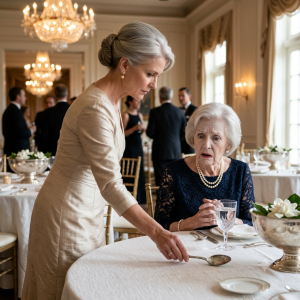
Thirty-two years ago, a woman threw a silver spoon at a nineteen-year-old girl and told her she’d never amount to anything.
Tonight, that girl just bought the room they’re both standing in.
—
Let me take you back to 1992.
Ruthanne Guidry was nobody’s idea of a debutante. She grew up in a double-wide outside Breaux Bridge, wore her mama’s altered dresses to church, and worked the breakfast shift at Fontenot’s Diner on Route 90 six days a week.
She was also, quietly, desperately, in love with Phillip Thibodaux.
Phillip was kind in the way that men from old money sometimes are — privately. He brought Ruthanne camellias. He held her hand under diner tables. He told her she was the smartest person he’d ever met, and she believed him, because it was true.
What he never quite managed to do was tell his mother.
Cecile Thibodaux.
Even the name had architecture to it.
—
The Azalea Charity Ball was the social event of the Thibodaux calendar. White tablecloths. Crystal. Gardenias floating in silver bowls.
Ruthanne had saved for three months to buy a dress.
She walked in on Phillip’s arm, chin up, heart hammering.
Cecile spotted her from across the room in under thirty seconds.
What happened next became the kind of story that gets told in hushed voices for decades. Cecile Thibodaux walked to the center of that ballroom — in front of two hundred of Louisiana’s finest — and announced, loud enough to carry over the string quartet, that her son’s companion was *”a diner waitress, not fit to carry the Thibodaux name.”*
The music didn’t stop. But it felt like it did.
And then Cecile reached across the nearest table, picked up a small silver coffee spoon, and pressed it into Ruthanne’s palm with a smile that didn’t reach her eyes.
*”Keep it, sweetheart. It’s probably the finest thing you’ll ever touch.”*
—
Ruthanne didn’t cry. Not there.
She set down her water glass. She excused herself. She drove home in her ’88 Civic with that little tarnished spoon on the passenger seat like it was something radioactive.
She didn’t throw it away.
She never threw it away.
—
Phillip married a Broussard girl the following spring. Ruthanne moved to Houston with forty dollars and a reference from her diner manager.
The rest of her story took thirty-two years to write.
She won’t tell you it was easy. She’ll tell you she worked in medical supply logistics, found she had a gift for it, built something small, then built something bigger. She married a good man named Dale who fixed motorcycles and made her laugh and never once made her feel small. She raised two daughters who know their own worth. She gave quietly to causes that helped women who reminded her of herself — single mamas, working girls, people who needed a door cracked open just a few inches.
She carried that coffee spoon the whole time.
In her work bag. In her purse. Eventually in a beaded evening clutch, because the years had been good to her, and she had learned to dress accordingly.
She never knew quite why she kept it.
She thought she did, tonight.
—
The Azalea Ball still runs every spring. Same ballroom. Different china.
Same Cecile Thibodaux, eighty-one years old now, still seated at the head table like she owns the place.
She nearly does. The Thibodaux family had underwritten this ball for forty years.
*Had.*
The announcement came during the champagne reception. An anonymous donor — a foundation no one in the room had heard of — had purchased the venue naming rights and funded the next decade of the charity with a single gift.
One million dollars.
The foundation’s name was engraved on a new brass plaque beside the entrance.
The Guidry Foundation.
A murmur moved through the room like a breeze through Spanish moss, slow and then all at once. Someone looked up the foundation on their phone. Someone else read the founder’s name aloud.
The string quartet kept playing.
Cecile Thibodaux did not.
She had gone very still in her chair.
And then the ballroom doors opened, and a woman walked in wearing a champagne-colored gown, silver hair swept up, posture like she’d been born to this room — because, it turns out, she had just bought it.
Ruthanne Guidry didn’t scan the faces looking for recognition.
She already knew exactly where Cecile was sitting.
She walked straight there.
The room understood something was happening before they knew what it was. Conversations died one table at a time. By the time Ruthanne reached the head table, you could hear the gardenias floating.
She opened her beaded clutch.
And then Ruthanne smiled, reached in, and set that small, tarnished silver coffee spoon down on the white linen tablecloth — directly in front of Cecile Thibodaux.
Cecile looked down at it.
She looked back up.
And she went the color of ash.
—
The two women held each other’s gaze for a long moment.
The whole room held its breath with them.
And then Ruthanne did something nobody expected.
She pulled out the chair beside Cecile and sat down in it.
Not across from her. Not standing over her. She sat down next to her, the way you’d sit next to someone you needed to have a real conversation with, and she folded her hands on the table, and she spoke quietly enough that only Cecile could hear.
People at the nearest tables would later say they couldn’t make out the words. They could only see Cecile’s face moving through expressions the way weather moves through a sky — resistance first, then something cracking open behind the eyes, then something that looked, from a distance, like an old woman getting very small.
What Ruthanne said was this.
She said she hadn’t come back to humiliate her.
She said she knew Cecile was old, and she knew Cecile’s family name didn’t carry what it once did — the Thibodaux finances had quietly unraveled over the past decade, which was part of why the ball needed saving in the first place — and she said she had not purchased this building and funded this charity to grind an eighty-one-year-old woman’s face into the marble floor of the room where she’d been publicly shamed.
She said she’d done it because the charity was real and the work was good and the women it helped deserved better than an uncertain future tied to a family that had lost its footing.
She said she’d done it because she needed Cecile to know what that spoon had actually cost.
Not Ruthanne. Cecile.
“Every year you sat at this head table,” Ruthanne said, “was a year that spoon stayed in my purse. Every single year. You never had to wonder about me, and I never stopped thinking about you. That’s not a fair trade, Cecile. And I need you to understand that before one of us dies.”
Cecile’s hand, thin now, the skin papery and spotted the way old hands get, moved across the tablecloth.
Her fingertips touched the spoon.
She didn’t pick it up.
She just touched it, the way you’d touch something you were trying to confirm was real.
When she finally spoke, her voice had lost its architecture entirely. It was just a voice. An old woman’s voice.
“I was afraid of you,” she said.
Ruthanne waited.
“You were nineteen years old and I was afraid of what you were. What you would make him want. What he would give up.”
“He gave up plenty on his own,” Ruthanne said. Not unkindly.
Cecile made a sound that might have been a laugh or might have been something else. “He did. He always was weak in the ways that mattered.”
The string quartet had shifted into something slow and undramatic, as if the musicians had been trained for exactly this kind of moment and were doing their professional best to paper over it with sound.
“I don’t need you to apologize,” Ruthanne said. “I’m past the point where that does me any good.”
“Then what do you need?”
Ruthanne thought about it. Genuinely considered it, sitting there in the ballroom she now owned.
“I need to go home tonight and not be carrying this anymore,” she said. “That’s all. I’ve carried that spoon for thirty-two years and I’d like to put it down.”
—
She left it on the table.
She did not hug Cecile Thibodaux. She did not shake her hand. She stood, smoothed her champagne gown, and she walked back toward the center of the room where the foundation’s program director was waiting to introduce her to the ball’s committee chairs.
She spent the next two hours doing what she’d actually come to do — meeting the women the charity served, hearing their stories, eating the decent but unremarkable chicken that ballrooms have served at charity events since approximately the dawn of time.
She danced once, a slow waltz with a retired judge named Arceneaux who’d known her late father, and she laughed at something he said, and it was real laughter, the easy unguarded kind.
Cecile Thibodaux left early. Quietly. Through a side door. The way you leave a room when you’ve understood something about yourself that you can’t un-understand.
She left the spoon on the table.
Ruthanne, passing that table later in the evening, noticed it sitting there on the white linen.
She picked it up.
Turned it over once in her hand, the tarnish familiar as a scar.
And then she walked to where a young woman — a scholarship recipient, maybe twenty, wearing a dress that was clearly her nicest — was standing alone near the windows looking like she wasn’t sure she belonged.
Ruthanne touched her elbow.
“First time at something like this?”
The girl nodded.
“It’s a lot,” Ruthanne said. “The crystal, the people, all of it. It’s supposed to make you feel small. Don’t let it.”
The girl smiled — uncertain, then less so.
Ruthanne pressed the spoon into her hand.
“Keep that,” she said. “Someday it’ll remind you of something.”
She didn’t explain. She didn’t need to.
She just smiled and moved back into the room, silver-haired and unhurried, carrying nothing in her clutch at all.
—
I know this story because that young woman at the window was my cousin. She still has the spoon. She’s twenty-three now and in her second year of nursing school and she keeps it on her desk next to her anatomy textbooks.
She doesn’t know the full history. She just knows that a woman in a beautiful dress told her not to let a room make her feel small.
I think that’s enough.
I think that’s actually the whole thing, right there.
Ruthanne Guidry carried a wound for thirty-two years and when she finally set it down, she didn’t leave it on a tablecloth for the staff to clear away in the morning.
She handed it to the next girl who needed it.
That’s not a revenge story.
It never was.