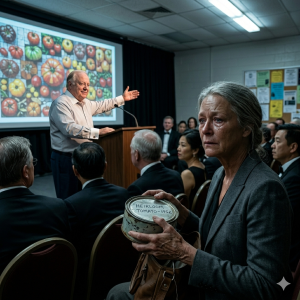
She walked into that boardroom with a battered tin of yellow paint and fifteen years of silence — and by the time she set it on the table, every person in that room had stopped breathing.
This is the story of how Nora Bidwell got her moment.
—
You need to understand something about Marfa first.
It’s a small town, genuinely small, the kind where the art world collides with the high desert in this strange, beautiful way — and where a single gallery curator can make or break a career before it even starts.
Nora had driven eight hours to get here back then. Twenty-three years old, a portfolio stuffed with paintings she’d worked on for two years, a scholarship jury waiting, and a dream she hadn’t told anyone about because dreams feel fragile when you’re still poor enough to name them.
She never made it past the opening presentation.
The curator — a man named Gerald Fitch, silver-haired and very important in his own estimation — had pulled one of her canvases out before she could speak.
Held it up.
And said, in front of eleven jurors and four other applicants, *”This looks like something a lonely housewife doodles to feel important.”*
The room went quiet the way rooms do when something cruel happens too fast for anyone to stop it.
Nora picked up her tin of cadmium yellow paint on her way out. The one she’d used for nearly every piece in that portfolio. It had a dent in the lid from where she’d dropped it on a parking lot in Lubbock, and her name written inside in black marker because art students label everything they can’t afford to lose.
She kept it.
She couldn’t tell you exactly why.
—
Fifteen years is a long time.
Long enough to go home, grieve quietly, and then — slowly, stubbornly — start over.
Long enough to get a fine arts degree in night school while working days. To build a foundation from a small inheritance and a very large amount of determination. To fund emerging artists quietly, anonymously, specifically the kind of artists who got doors slammed in their faces before they were finished knocking.
The foundation had no flashy name. Nora wanted it that way.
She liked that the grants just *arrived*, like a window opening when someone expected nothing but more walls.
—
The Marfa residency had been sending desperate letters for six months.
Budget collapse. Possible closure. Forty-two artists mid-program with nowhere to go.
Nora read every letter at her kitchen table in Houston, that battered tin sitting on the shelf behind her the way it always had. She agreed to attend the emergency board vote in person, review the books, and make the final call.
She did not look up who was still on staff.
Maybe she should have.
—
The boardroom was all bleached wood and afternoon light coming sideways through west-facing windows. Seven board members stood when she walked in. Handshakes. First names. The quiet, grateful energy of people who needed something and knew it.
And then she saw him.
Gerald Fitch.
Still silver-haired. Still carrying himself like a man accustomed to being listened to. His title on the agenda read *Senior Curatorial Director.*
He didn’t recognize her.
Why would he. She’d been twenty-three with paint-stained jeans and a rolled portfolio. She was forty-three now in a linen blazer, running a foundation whose name he’d probably cited in grant applications.
Nora sat down.
She set the tin of cadmium yellow paint on the table in front of her.
She didn’t explain it.
She watched Gerald Fitch’s eyes drop to it — just for a second — the way you glance at something out of place and can’t figure out why it bothers you.
—
The presentation took forty minutes. The finances were salvageable. The program was worth saving. Nora asked measured questions and took careful notes and gave nothing away.
Gerald Fitch spoke twice about *vision* and *legacy* and *what this residency means to artists who have no other door.*
Nora wrote down everything he said.
The tin sat on the table the whole time.
By the third time she saw his gaze drift toward it, she understood something: he couldn’t stop looking at it, and he didn’t know why, and that dented little lid was doing more work than anything else in that room.
—
At the end, the board chairwoman nodded at Nora.
“We’re ready to proceed whenever you are.”
Gerald Fitch stood. Extended his hand across the table. The handshake that would seal it. The signature that would save everything.
He was smiling the easy smile of a man who had never once considered that doors he closed might someday be held by the person he closed them on.
Nora looked at his hand.
Then she reached down, picked up the tin, and opened it.
Placed the lid face-up on the table so the whole room could read it.
Her name. Her handwriting. Fifteen years old and perfectly legible.
She looked up.
“Before I sign anything,” she said, her voice calm and clear and very deliberate, “I think the board deserves to hear how Gerald and I have met before.”
Every eye in the room moved from the tin to Gerald Fitch’s face.
And that’s when the color left it.
—
She told it plainly.
That was the thing people later remarked on, the ones who were in the room. She didn’t perform it. She didn’t let her voice shake with old hurt or harden with old anger. She told it the way you’d read minutes from a previous meeting — with the same careful, steady attention she’d given to every line of their budget report.
The scholarship jury. The rolled portfolio. Her name written in the back of a paint tin because she couldn’t afford to lose it.
The canvas Gerald Fitch had pulled out before she’d spoken a word.
What he said. Exactly what he said. She had never forgotten the precise phrasing, and she recited it without embellishment: *This looks like something a lonely housewife doodles to feel important.*
The boardroom was very still.
Gerald Fitch did not move. His hand had come back to his side somewhere around the third sentence, and he stood now with both hands at his sides and a fixed, careful expression that was no longer any kind of smile.
Nora gestured at the tin.
“I kept it because I didn’t know what else to do with what happened that day. And I’ve carried it a long time. Not as a grievance — I want to be clear about that. More as a reminder.”
The board chairwoman, a woman named Sylvie Tran with close-cropped silver hair and reading glasses pushed up on her forehead, was watching Nora very carefully.
“A reminder of what?” she asked.
Nora thought about it for a moment, genuinely thought about it, the way she always did when a question deserved a real answer.
“That the person deciding whether you have talent and the person who actually has it are sometimes two completely different people. And that a building full of emerging artists probably shouldn’t be left in the hands of someone who learned nothing from the difference.”
—
Gerald Fitch spoke.
To his credit, or perhaps just to the credit of a man who had survived long enough in rooms like this one to know when performance was his only option, he attempted something like an apology.
He didn’t remember the incident, he said. He’d reviewed hundreds of applicants over his career and he was sorry if something he’d said had been taken out of context.
*Taken out of context.*
There was a very quiet sound from somewhere to Nora’s left. Not quite a laugh. More like the sound a person makes when they are working very hard not to make a sound.
Nora looked at him for a long moment.
“Gerald,” she said, and it was the first time she’d used his name in the room, “I’m not here to take anything from you. I haven’t thought about you in years. I thought about what you said, but that’s different.”
She pulled her notepad toward her.
“What I’m here to do is make sure forty-two artists don’t lose their residency. And I’m going to do that. But the board asked me to come in person so I could evaluate not just the books but the program’s leadership going forward, and I’d be doing everyone in this room a disservice if I pretended I didn’t have relevant information about one of the people I’m being asked to evaluate.”
She looked at Sylvie Tran.
“That’s all I’m doing.”
—
There was a recess.
Nora stood by the west-facing windows and watched the light move across the desert scrub and didn’t check her phone. She’d said what she came to say. The rest was the board’s business, and she believed in letting things be what they were.
A younger board member — maybe thirty, with the sunburned look of someone who spent real time outside — came to stand beside her.
“I got a grant from your foundation three years ago,” he said. “I never knew it was you. I mean — I knew the foundation name. But I didn’t know.”
“That’s how it’s supposed to work,” Nora said.
“What you just did in there,” he started.
“Was just the truth,” she said. “Nothing more impressive than that.”
He nodded slowly. Looked out at the same desert.
“For what it’s worth, my application got rejected three times before the grant came through. Different programs. I almost quit.”
Nora turned to look at him.
“What made you not quit?”
He smiled a little. “A friend told me that the people doing the rejecting weren’t always the most qualified people in the room.”
Nora laughed — a real one, short and clean, the kind that surprises you.
“That’s good advice,” she said.
—
The recess lasted twenty-two minutes.
When they reconvened, Sylvie Tran thanked Nora for her candor and announced that the board would be accepting Gerald Fitch’s retirement, effective at the end of the current program cycle, a transition that Gerald himself — whether out of exhaustion or wisdom or simple reading of the room — confirmed he was prepared to make.
He left before the final vote.
The final vote was unanimous.
The residency would continue. The forty-two artists mid-program would finish their year. A new curatorial director would be appointed through an open search, with a selection committee that would — at Nora’s specific and quietly stated suggestion — include two program alumni who had applied and been rejected before eventually being accepted.
“People who’ve been on both sides of the door,” she said, “tend to hold it open more carefully.”
No one argued with that.
—
Nora drove back to Houston the next morning.
She stopped for coffee in a town so small it had exactly one stoplight and a gas station that also sold fishing licenses and handmade tamales. She sat on the tailgate of her truck in the early cold and watched the sun come up sideways over flat land and thought about the twenty-three-year-old who had driven eight hours in the other direction with a rolled portfolio and a dream she hadn’t told anyone about.
She thought about what she would say to that version of herself if she could.
She decided she wouldn’t say anything, actually. That girl didn’t need advice. She needed to be left alone to keep going, which she did, which was the whole point.
Nora finished her coffee.
She put the tin of cadmium yellow in the cupholder, where it rode the whole way home with the dent in the lid catching the light.
—
The foundation announced its next grant cycle two weeks later.
The application, as it had always been, was one page. It asked for a project description, a brief statement of need, and one question Nora had written herself and never changed in twelve years of grant-making.
*Describe a door that was closed to you, and what you did next.*
She read every answer herself.
She always had.