She walked into that auction wearing her dead mother’s pearls and a smile that didn’t reach her eyes.
Nobody in that room knew her name.
That was exactly how June Kell wanted it.
—
Rockport, Texas in August smells like salt water and diesel and the particular kind of heat that makes your hair curl before you even step out of your car. The old pier auction house sits right at the end of Fulton Beach Road, and on that Tuesday morning, every seat was taken.
Dock rights. Emergency auction. The kind that happens when someone’s finances go sideways in a very public, very embarrassing way.
June signed in at the back table under the company name — Tidewater Marine Salvage LLC — and took a seat in the third row. She set her things down carefully. Her handbag. A bottle of water.
And a brass compass.
It was old. The kind of old that means *generations*, not just years. The casing was worn smooth in places, dark green where the lacquer had gone, and the face was etched with wind roses and tide markings that nobody used anymore. Engraved on the back, in letters small enough that you had to lean in to read them, were three initials.
*R. M. C.*
Not her initials. Not anyone’s initials that the three women sitting near her could figure out, though they tried.
She set it on the table in front of her like a paperweight.
Like a warning.
—
She hadn’t planned to come back to Rockport.
Eleven years ago, June Kell had signed divorce papers in a lawyer’s office on Austin Street and walked out with her savings, her truck, and exactly zero of the pier rights she’d spent twelve years helping build. Dwayne Kell had a way with paperwork. With fine print. With making things look like generosity when they were anything but.
He’d sold her half of Pier 7 to a development group six weeks after the divorce was finalized.
She found out from her cousin. At a Whataburger.
What she did next, she did quietly.
June Kell had always been quiet.
People mistake that for weakness, especially men like Dwayne. They see a woman who doesn’t argue back and they think she isn’t paying attention.
She was always paying attention.
—
Three months ago, a 42-foot Contender went down in Aransas Bay under circumstances that made the Coast Guard raise their eyebrows and the insurance adjusters make some phone calls.
The boat was registered to a holding company.
The holding company traced back, after some creative paperwork unraveling, to Dwayne Kell.
The claim was filed before the hull had even stopped settling on the bottom.
The salvage company that pulled it up — carefully, documentedly, with three witnesses and a marine surveyor on board — was Tidewater Marine Salvage LLC.
Nobody thought to look up who owned Tidewater Marine Salvage LLC.
Nobody except the insurance investigator who, six weeks ago, had sat across from June in a Corpus Christi conference room and shaken her hand for a very long time.
—
Dwayne was at the head table.
Of course he was. He’d positioned himself there the way he positioned himself everywhere — like he’d always belonged, like the room had been arranged for him. He was heavier than he’d been. His boots were expensive. He was talking to the man next to him the way men talk when they want everyone around them to know they’re having an important conversation.
He hadn’t seen June yet.
She picked up the compass. Turned it over once in her hand. Set it back down.
*R. M. C.*
The woman to her left finally leaned over.
“Honey, I have to ask. That compass — is that an antique?”
“It belonged to someone who taught me that the best time to know where you’re going,” June said, “is before anyone else knows you’ve already left.”
The woman blinked.
June smiled and looked back at the front of the room.
—
The auctioneer called the room to order at nine o’clock sharp.
He went through the procedures the way they always do — brisk, professional, the kind of man who has done this a hundred times and has the cadence memorized. He explained the terms of the emergency dock-rights transfer. He explained the opening bid process.
Then he paused.
Shuffled his papers.
Cleared his throat.
He said that in this particular case, the opening bid had already been met.
By a sealed envelope.
Submitted three weeks ago.
The room went quiet in that particular way rooms go quiet when everyone senses that something is about to happen that they will be telling their families about at dinner.
The auctioneer picked up the envelope.
He read the name on the outside.
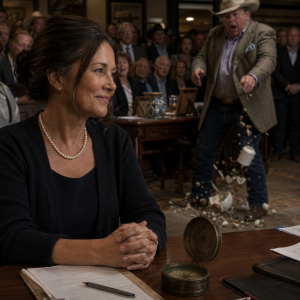
At the head table, Dwayne Kell’s ceramic coffee cup hit the hardwood floor and shattered, because the name on that envelope was a name he had spent eleven years believing was gone.
Not dead.
Not gone like *dead*.
Gone like he’d made sure of it.
June set the compass on the table one more time.
*R. M. C.*
And for the first time that morning, she let the smile reach her eyes.
—
The name on the envelope was Rosalind Marie Comeaux.
Her mother’s name.
—
Here is what Dwayne Kell had done, and what he had believed was buried with her.
Rosalind Comeaux had been a woman of very little formal education and very considerable intelligence, the kind of woman who came up in the shrimping trade in the 1970s when women weren’t supposed to be in the shrimping trade at all. She’d run her own boat out of Fulton Harbor by the time she was twenty-four. By the time she was thirty-five, she held partial rights to three separate dock leases on Pier 7 — not because anyone gave them to her, but because she’d outworked and outwaited every man who’d tried to squeeze her out.
When June was twelve, Rosalind sat her down at the kitchen table with a cup of chicory coffee and a brass compass and said, “Your grandfather gave me this the morning I took my first boat out alone. He said a compass doesn’t tell you where the wind’s blowing. It tells you where *north* is, and once you know that, you can find anything.”
June had carried that compass in her coat pocket for thirty years.
—
What Dwayne had known, and what he had not told June until after the divorce papers were signed, was that Rosalind Comeaux had transferred her dock rights to a family trust before she died.
That trust had a single beneficiary.
But Dwayne, through a series of legal maneuvers that his attorney had assured him were airtight, had managed to have the trust administratively dissolved during the eighteen months Rosalind spent in memory care, when June was working double shifts at the marine supply warehouse to cover the bills and Dwayne was handling the paperwork.
He’d told June the rights had expired with Rosalind’s business license.
He’d told her that in a Denny’s parking lot, three days after her mother’s funeral, while she was still wearing the same black dress she’d worn to the graveside service.
She had believed him.
For about eight months.
—
The thing about a man who lies carefully is that he has to maintain a lot of small, careful lies to keep the large one standing.
One of those small lies was a filing date.
When June finally sat down with a real estate attorney in San Antonio — eighteen months after the divorce, after she’d rebuilt enough to afford one — the attorney found it in forty minutes. A trust dissolution that had been backdated. Not by much. Not even by a year. But by enough.
The original filing stamp didn’t match the notarized date.
It was the kind of thing that could have been an error.
It was the kind of thing that, when you put it next to four other things, stopped looking like an error.
June had put it next to four other things.
Then she had gone home, looked at her mother’s compass, and begun to think about what Rosalind Comeaux would have done.
—
Rosalind would have been patient.
Rosalind would have waited until the ground was solid before she put any weight on it.
Rosalind would have found someone she trusted completely and told them exactly what she knew.
That person, in June’s case, was a woman named Darlene Arceneaux, who had been Rosalind’s bookkeeper for nineteen years and who had made, at Rosalind’s specific request, copies of certain documents and kept them in a fireproof lockbox in her garage in Portland, Texas, against the possibility that they might someday be needed.
Darlene had driven those copies to San Antonio in a Buick with a broken air conditioner and handed them to June across a Luby’s table without ever once asking for anything in return.
“Your mama told me to hold onto these,” Darlene had said. “She told me the day might come when you’d need them more than she did.”
June had not cried in that Luby’s.
She had cried in the parking lot for approximately twenty-five minutes.
Then she had driven back to San Antonio, scanned every page, and sent them to her attorney.
—
The legal process that followed took nine years.
Not because the case was weak.
Because the case had to be perfect.
Dwayne had resources and connections and a very good attorney and the kind of social standing in Rockport that makes judges take their time. June had documentation and patience and a salvage business that, it turned out, she was exceptionally good at — both the literal kind, pulling wrecked boats off the floor of Aransas Bay, and the figurative kind, recovering things that other people had declared lost.
She filed the trust challenge in civil court. She filed the fraud complaint with the state. She cooperated fully with the insurance investigation into the Contender, which had opened doors that led to other doors that led to a picture of Dwayne Kell’s finances that was considerably less impressive than his boots suggested.
She did not tell anyone in Rockport what she was doing.
She did not need to.
—
Pier 7 dock rights, when they finally came up for emergency auction — and they came up because Dwayne’s finances had collapsed in a way that the county could not ignore — were subject to a prior claim.
The prior claim had been filed by Tidewater Marine Salvage LLC on behalf of the estate of Rosalind Marie Comeaux, whose trust had been fraudulently dissolved and whose beneficiary was still very much alive.
The sealed bid wasn’t really a bid.
It was a notice.
The auctioneer, who had been briefed by the county’s legal office that morning before the doors opened, had known when he shuffled those papers exactly what he was about to read. He was a professional. He had done this a hundred times.
He had never done this particular thing before.
He read the name clearly, the way you read something when you want a room to hear it.
Rosalind Marie Comeaux.
And then: estate, beneficiary, June A. Kell.
—
Dwayne stood up.
He did it the way men stand up when they don’t actually have anything to say but need the room to see them standing. His face had gone a color that didn’t have a good name. He said something to the auctioneer. The auctioneer, with the polished calm of a man who had been told to expect exactly this, said that any objections would need to be directed to the county clerk’s office and that he was going to continue with the proceeding.
There were two men in the back of the room in button-down shirts who were not there to bid on anything.
Dwayne looked at them.
They looked at him.
He sat back down.
—
The woman to June’s left had been watching all of this with her hand pressed to her collarbone.
“Honey,” she said, very quietly, “did you just —”
“My mama’s rights,” June said. “That’s all. What was always hers.”
“And the compass,” the woman said. “Those initials.”
June picked it up one last time. Turned it over so the morning light coming through the pier house windows caught the engraving.
*R. M. C.*
Rosalind Marie Comeaux.
“She navigated by it her whole life,” June said. “I figured it was only right to bring her along.”
—
The proceeding concluded at ten forty-seven in the morning.
The dock rights reverted to the estate. The estate’s beneficiary signed the final paperwork at a folding table in the back of the room, with the same pen she’d signed her divorce papers with eleven years ago — she’d kept it specifically, because she’d known she would want it for something.
Outside, on the pier, the bay was doing what it does in August: glittering in a way that makes you forget, temporarily, the heat and the diesel smell and every hard thing that led you to the water’s edge.
June stood there for a while, just looking at it.
She thought about her mother running a boat out of this harbor at twenty-four years old, doing it alone, doing it right, leaving something worth leaving. She thought about patience. About the difference between quiet and defeated. About what it means to know where north is.
She put the compass in her coat pocket.
She drove to the Whataburger on Market Street — the same one where her cousin had told her, eleven years ago, over a honey butter chicken biscuit — and she sat in a booth by the window and ordered coffee, and she called Darlene Arceneaux in Portland, Texas.
Darlene picked up on the second ring.
“Well?” Darlene said.
“It’s done,” June said.
There was a long silence that wasn’t empty at all.
“Baby,” Darlene said finally, and her voice had something in it that June recognized because she’d heard it from Rosalind, the exact same way, more than once. “Your mama always said you were the one who’d figure out how to hold on.”
June looked out the window at the August light on the asphalt and the palm trees bending in the Gulf wind, at the town she’d left and come back to, at the ordinary, blazing, relentless Tuesday morning.
“She taught me,” June said. “She just didn’t know I was listening quite that closely.”
—
Dwayne Kell’s attorney filed two motions in the weeks that followed.
Both were denied.
The dock rights remain with Tidewater Marine Salvage LLC. Pier 7 is operational. The insurance fraud investigation concluded in the fall, and that story is longer and belongs to someone else to tell.
June still carries the compass.
North is exactly where it has always been.