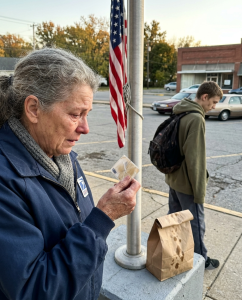
Every Thursday for six weeks, the boy was already there when Dot Calloway pulled into the post office lot.
He always sat in the same place, on the top concrete step beneath the flagpole, a faded backpack propped between his knees and both hands wrapped around the straps as if he expected someone to try to take it. He never looked up when customers passed. Never came inside. Never begged. Never caused trouble.
He just waited.
Dot noticed people for a living. After thirty-four years at the Medford post office, she could recognize half the county from the shape of their walk alone. She knew who came in on pension day, who mailed birthday cards early, who forgot zip codes every Christmas and swore the government used to make more sense.
She did not know this boy.
The first Thursday she saw him, she told herself he was probably waiting for a ride.
The second Thursday, she started watching.
He wasn’t waiting for anyone.
He sat there through the noon rush and the afternoon lull, eyes fixed on the flagpole with a strange, steady intensity. Not bored. Not distracted. Almost hopeful. The kind of hope people wore when they were trying not to let it die.
That afternoon Dot stopped at the diner on Oak Street before heading home and, on impulse she didn’t fully understand, ordered two chicken potpies instead of one.
The next Thursday, she carried one to work in a paper sack.
She didn’t offer it directly. She knew too much about pride for that. Hunger could be easier to bear than embarrassment. So during her break, she walked out to the lot, placed the sack at the base of the flagpole, and returned inside without glancing at him.
When she looked again later, the sack was gone.
That should have been the end of it, just one human being helping another in a small, quiet way.
But the following week she saw something odd.
Just before leaving, the boy crouched beside the flagpole for a few seconds. At first Dot thought he was tying his shoe. But after he disappeared, she went outside and found a library card tucked into a narrow gap in the concrete base.
It was old, older than the boy by decades. Cracked along one side, worn soft at the edges, the laminate cloudy with age. On the back was a faded name stamped in blue ink in the old style Medford Public Library had used years ago.
Dot picked it up, expecting to see a photo or an address she could use to return it.
There was none.
Only the name.
She almost took it inside to hold at the front desk, but something about its placement stopped her. It didn’t look dropped. It looked left.
So she set it back down.
The next Thursday, after the boy collected the potpie, the same card appeared in the same place.
Same crack. Same worn corners. Same faded blue name.
By the fourth week, the whole thing had become a ritual. Dot brought food. The boy took it. Before leaving, he crouched by the flagpole and left the card. Later Dot would find it and turn it over in her hands, bothered by how much the object seemed to mean and how little she understood.
She tried to solve it the way practical people solve things. Maybe it belonged to his mother. Maybe it was all he had left of someone. Maybe he was trying to get a message to a person he believed still worked at the post office.
But the name on the back meant nothing to her.
At least, that was what she believed.
On the seventh Thursday, she forgot her reading glasses in the break room and had to drive back after clocking out. She entered the lot expecting silence and found the boy already there.
He didn’t see her arrive.
Dot stopped the Buick in the far corner and watched through the windshield.
The boy lifted the paper sack, opened it, and stared into it for a long moment. Then he unzipped his backpack and removed a small plastic food container, the cheap kind sold in discount packs.
With a level of care that squeezed something inside Dot’s chest, he divided the potpie exactly in half.
He didn’t eat a bite first.
He portioned it neatly, scraped the corners so none of it went to waste, then sealed one half into the container and slipped it back into his backpack as though he were storing medicine or something breakable and precious. Only then did he fold the paper sack closed around the remaining half.
Dot had thought she was feeding a hungry child.
Now she understood she was feeding two people.
The realization broke through something in her. She sat there long after the boy rose and walked toward the flagpole.
He crouched, slid the old library card into its usual spot, and smoothed the plastic sleeve with his thumb in a small, tender gesture that didn’t belong to a random habit. It looked like respect. Like memory. Like pleading.
Then he walked away.
Dot got out of the car.
The lot was empty by the time she reached the flagpole. The late afternoon sun had turned the concrete gold. She bent, lifted the card, and turned it over one more time, mostly to feel close to the mystery that had been troubling her for weeks.
The card was warm from his hand.
This time, the name hit her like a physical blow.
Leah Calloway.
Dot stared until the letters blurred.
Her daughter.
Her youngest child.
The daughter she hadn’t spoken to in eleven years.
For a moment the world narrowed to the metal clink of rope against the pole and the rush of blood in her ears. Then memory came hard and disorderly: Leah at eight with a stack of library books balanced against her chin; Leah at fourteen reading under blankets with a flashlight; Leah at twenty-three standing in Dot’s kitchen with tears of rage in her eyes and saying, “You always protect the people who hurt me and call it peace.”
Dot had answered badly that day. Defensively. Pridefully. She had told Leah she was being dramatic. Told her families survived by letting things go. Told her she could not keep ripping the house apart over old grievances.
Leah had gone white with disbelief.
“You know what he did,” she had said.
Dot had not denied it. That was the worst part. Her older son, Wade, had been drinking too much for years. He borrowed money, lied, shouted, shoved his way through life expecting forgiveness to meet him everywhere he landed. Leah had accused him of stealing from her, of frightening her, of laying hands on her arm hard enough to bruise during one family fight. Dot had begged for calm, for perspective, for one holiday without war.
What Leah heard was this: endure it quietly.
When Leah left, Dot told herself she had chosen drama over family. It was easier than admitting she had failed the daughter who needed her to take a side.
Now Dot stood in the post office lot with that failure in her hand.
She noticed a folded slip of paper tucked behind the library card. Her fingers trembled as she eased it free.
The paper was lined notebook stock, folded small and softened by repeated handling. Two lines, written in pencil.
If she comes before winter, tell her we stayed.
Apartment 12. Hawthorne Court.
Dot read it three times.
Hawthorne Court was only six blocks away.
For six weeks her grandson—because now she knew that was what he had to be—had been sitting outside her workplace, accepting her food, leaving Leah’s name behind like a test of courage.
If she comes before winter.
The sentence undid her more than anger would have. It meant Leah had not slammed every door shut. It meant somewhere beneath eleven years of silence, she had still imagined a return. Perhaps not likely. Perhaps not easy. But possible.
Dot locked up, got back in her car, and drove to Hawthorne Court with both hands clenched around the steering wheel.
The building had seen better decades. Weather-stained brick, rust on the exterior staircase, plastic flowers bleached white in a cracked planter by the entrance. Apartment 12 sat at the far end of the second-floor walkway.
Through the thin curtain Dot could see a milk crate serving as a table and the corner of a mattress on the floor. On the crate sat the Tupperware container.
Then she heard the cough.
It was deep and tearing, the kind of cough that starts in the chest and leaves the body bowed afterward. Dot froze outside the door.
Inside, she heard the boy say quietly, “Mom, eat while it’s warm.”
That one word settled every doubt.
Dot knocked.
Silence. Footsteps. The click of a deadbolt.
The door opened, and there stood Leah.
She was unmistakably herself and heartbreakingly altered. Thinner. Cheekbones sharpened. Hair tied back carelessly, as though daily effort had become a luxury. There were shadows under her eyes that spoke of exhaustion rather than age. But her face was Leah’s, and so were the guarded intelligence in her stare and the old instinct to brace before being hurt.
Leah’s eyes dropped immediately to the library card in Dot’s hand.
“Took you long enough,” she said.
Dot had imagined this moment a thousand ways over the years, usually with speeches prepared after sleepless nights. None of those speeches survived first contact. She stood there unable to make language work.
Over Leah’s shoulder, the boy stared at her from beside the mattress.
He had Leah’s mouth. Leah’s eyes. Leah’s sharp watchfulness. Dot felt a pang so fierce it was almost shame. So many birthdays lost. So many firsts handed to strangers.
And then she saw the photograph on the milk crate.
A picture of herself.
It had been taken at the county fair years ago, sunburned and laughing. Leah had snapped it on a disposable camera and teased Dot for blinking in the others. The fact that the photo sat here, in this sparse apartment, in reach of Leah’s bed, made Dot feel suddenly unsteady.
“You kept that?” she asked.
Leah gave a tired, almost bitter laugh. “I kept a lot of things.”
The boy looked from one woman to the other. “Mom?”
Leah drew in a slow breath. “Evan, this is your grandmother.”
The word landed awkwardly, like furniture moved into a room that had never been designed for it.
Dot looked at him. “Evan,” she repeated softly. “That’s a good name.”
He didn’t answer, only shifted closer to Leah as another cough bent her in half. He reached for her automatically, steadying her elbow with practiced hands. Dot recognized caregiving the instant she saw it. This was routine. This child had been helping his mother for a while.
“You’re sick,” Dot said.
Leah leaned back against the doorframe until the coughing eased. “Pneumonia, they said. It got worse before I went in. No insurance. No paid leave. You can fill in the rest.”
Dot stepped inside at Leah’s nod and took in the apartment properly. The refrigerator hummed unevenly. Two mugs sat drying on a towel. Medication bottles lined one windowsill. There was almost no furniture, but the place was neat. Held together, barely, by discipline and necessity.
On the crate beside the photo sat a thick manila envelope.
Dot recognized her own handwriting before Leah touched it.
The envelope was addressed to Leah at an old apartment in Portland, posted eleven years earlier, and returned unopened with red stamp marks across the front. Dot had mailed it after two years of silence, after hearing through a cousin that Leah had moved. Inside, she had written a cautious letter that talked around the truth instead of naming it. She had asked how Leah was. She had said holidays were quieter without her. She had not once written, I chose wrong.
“You kept that too?” Dot asked.
Leah picked up the envelope and held it between both hands. “I kept it because it reminded me you almost tried.”
The sentence was so exact, so devastatingly fair, that Dot lowered herself onto the one kitchen chair before her knees gave way.
Evan stood near the mattress, watchful.
Dot forced herself to ask the question she should have asked years ago. “Why the card?”
Leah looked at her son.
He swallowed. “Mom said you used to take her to the library every Saturday when she was little,” he said. “She said if there was one thing you’d recognize, it would be that.” He hesitated. “She didn’t want me to tell you where we lived unless you noticed first.”
Dot closed her eyes briefly. “You came every week anyway.”
Evan’s expression tightened. “She got sicker. I didn’t know what else to do.”
Leah turned away as if the admission hurt to hear aloud.
Dot understood then how much courage it had taken, not just for Evan to come, but for Leah to let him. To place hope in the hands of a child and risk being disappointed one last time.
“What happened?” Dot asked. “After you left?”
Leah sat carefully on the edge of the mattress. Her face changed in the way faces do when old pain is reopened because finally, at last, there may be a point to telling it.
She spoke without drama.
She left Medford and went to Portland with two friends. Worked restaurant jobs. Met a man named Trevor who seemed kind until pregnancy made him restless and fatherhood made him vanish. Evan was three when Leah stopped expecting anything from him but excuses. She managed. Barely at times, but she managed. Then the restaurant chain closed locations. Rents climbed. A coworker knew someone in Medford with a cheap apartment, so Leah came back to the one town she had sworn off because survival leaves little room for pride.
She hadn’t contacted Dot because the old wound was still the old wound. And because Wade was still in town.
At the mention of her brother’s name, Dot flinched.
“I saw him once,” Leah said. “At a gas station. He didn’t see me. I sat in the car shaking for twenty minutes after.”
Dot had not known. But not knowing felt like its own indictment. There had been so much she did not know because she had made herself the kind of mother people stopped telling things to.
“Where is he now?” Leah asked.
“Boise,” Dot said. “Court-ordered rehab after his third DUI. I haven’t heard from him in eight months.”
Leah studied her face to see whether she believed that mattered.
Dot met her eyes. “I’m not defending him anymore.”
Leah’s mouth quivered almost imperceptibly. “That would have been useful then.”
Dot accepted it. She deserved worse.
The room fell quiet except for the refrigerator and the occasional passing car outside.
Then Dot did the hardest thing pride had denied her for eleven years.
She said, “I knew enough, and I chose the wrong child to protect.”
No one moved.
The sentence seemed to settle into the apartment and rearrange the air itself.
Leah’s eyes filled instantly, not with relief exactly, but with the shock of finally hearing the truth named by the person who should have named it first. Evan looked between them, sensing the importance without understanding every old detail.
Dot kept going because stopping now would only be another form of cowardice.
“I thought keeping peace made me a good mother. Really, I was asking you to carry what I didn’t want to face. I let you leave believing your pain was less important than my comfort.” Her voice thinned. “I am sorry, Leah. Not for the argument. For the years before it too.”
Leah pressed a hand to her mouth. Tears slid anyway.
“You don’t get those years back,” she whispered.
“I know.”
“You don’t get to meet him at ten and call that okay.”
“I know.”
Leah looked at Evan then, maybe because he was the proof of every lost year. He moved to sit beside her, and she put an arm around his shoulders.
“He wanted a grandmother,” she said quietly. “I told him sometimes people love you and fail you so badly it changes the shape of everything after.”
Dot nodded, unable to defend herself.
“And yet,” Leah continued, glancing at the potpie, “he kept saying maybe you were still the woman who took me to the library.”
Dot let out a broken breath that was almost a laugh and almost a sob. “I wanted to be.”
There was a long pause.
Then Evan asked the question only a child could ask so simply. “Do you still want to be?”
The room went still.
Dot turned toward him. “Yes,” she said. “If you let me.”
Evan considered that with a seriousness far beyond his age.
Leah coughed again, weaker this time, and Dot’s practical instincts finally outran the emotional storm. She stood. “You need soup that isn’t from a diner and a doctor who doesn’t ask for miracles upfront. I know a clinic director through church. Don’t argue yet. Let me do one useful thing before you decide whether I’ve earned anything else.”
Leah looked as though instinct told her to refuse. Then exhaustion, illness, and love for her son overruled whatever pride remained.
“Okay,” she said, barely audible.
That was not forgiveness. Dot understood that. It was permission to begin.
The next weeks were awkward, uneven, and real. Dot drove Leah to appointments. She stocked the refrigerator. She learned Evan liked astronomy and hated mayonnaise and had never owned a winter coat that fit quite right. Leah regained strength slowly. Some days she and Dot spoke about practical things only. Other days they circled old grief and managed a few more honest sentences before one of them had to stop.
Dot told Leah that Wade was no longer welcome in her home. Not conditionally. Not if he was “trying.” Not if the holidays were coming. Leah believed the boundary only after Dot repeated it twice without wavering.
Trust did not return like sunrise. It came like water through a stubborn pipe: sputtering, noisy, uncertain, then all at once enough to keep things alive.
One Saturday in late November, Evan found an old library card application in a kitchen drawer while Dot was making grilled cheese. He held it up with a grin.
“Can we get me one?”
The question hit Dot so hard she had to turn away under pretense of checking the soup. Leah saw and looked down into her mug.
They went together that afternoon.
The library had new computers and brighter lights than the one Leah remembered, but the children’s section still smelled faintly of paper and carpet cleaner. Evan moved through the stacks with reverence, pulling out books on planets, storms, and Oregon trails. Dot watched him and thought of all the Saturdays she had lost, all the stories she had not been there to read.
At the circulation desk, the librarian handed over a fresh card.
Evan turned it over, studying the clean plastic, then looked at Dot.
“Keep this one safe?” he asked.
Dot took it with both hands, as carefully as if he’d offered her something breakable and sacred.
“I will,” she said.
Months later, after Leah had recovered enough to return to part-time work and move into a better apartment with Dot’s help, the three of them passed the post office lot on a Thursday. Evan glanced toward the flagpole and smiled without embarrassment.
“That was a weird plan,” he said.
“It was,” Leah admitted.
“It worked,” Dot said.
Leah looked at her mother for a long moment before answering. “Eventually.”
That was as close to a blessing as Dot expected, maybe as close as she deserved. But when they reached the car, Leah handed her the old cracked library card.
“You keep this now,” she said.
Dot traced the worn edge with her thumb. The name. The crack. The years carried inside a tiny rectangle of plastic. Once it had been a message. Then a test. Then a bridge.
Some losses never disappear. Some apologies arrive too late to erase what happened. But sometimes, if grace is feeling stubborn, they arrive in time to change what happens next.
And if there was one detail Dot would never stop thinking about, it wasn’t the card itself.
It was the fact that a hungry boy had split a potpie in half and kept showing up anyway, believing two damaged women might still find their way back to each other if he was patient enough to leave the truth where neither of them could avoid it.