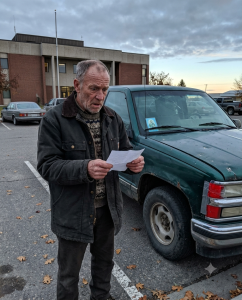
Every Monday morning for eight months, Earl Mackintosh walked to the courthouse parking lot before sunrise and slipped an envelope under the windshield wiper of a battered old pickup he did not own.
He never left a name.
He never waited around to be thanked.
He never told anyone what he was doing.
At sixty-seven, Earl had the kind of face Montana weather carves slowly and without apology. Broad forehead. Pale eyes. Deep lines cut by squinting into wind, snow, distance, and years of reading rail traffic reports under fluorescent light. He had spent thirty-one years as a railroad dispatcher for BNSF out of Havre, which meant he knew timetables better than birthdays and landmarks better than people. Grain elevators, highway crossings, lonely sidings, broken fences, creek beds, school bus routes—he could picture them all with his eyes closed.
He had once believed that after a lifetime in the same stretch of country, there was very little left to surprise him.
Then one February morning, on his way back from a coffee run before dawn, he noticed the truck.
A 1998 Chevy Silverado, dark green under dust and age. One taillight fixed with electrical tape. A windshield split by a crack running almost its full width. The kind of truck that had survived long enough to stop caring what anyone thought of it. It sat in the courthouse lot in the same place, angled slightly toward the street, as if the driver had parked quickly and with purpose.
At first Earl barely paid attention.
But the following Monday, the same truck was there again.
Same spot.
Same hour.
Same silence.
And on the third Monday, the rising light hit the windshield at just the right angle and showed him the thing he could not stop thinking about.
A prayer card tucked behind the cracked visor.
Laminated.
Blue border.
Faded image of Saint Joseph the Worker.
Earl stopped cold on the sidewalk.
He knew that card.
Saint Brendan’s Catholic Church had sold them in a small basket near the side entrance one winter, a few weeks before Lent. Five dollars apiece, maybe less. Patricia had bought three. Earl remembered because she had laughed at him for rolling his eyes.
“You don’t have to believe a card does anything,” she had told him, sliding one into her purse. “Sometimes it’s enough that it reminds you to keep going.”
Saint Brendan’s had burned to the ground eleven years earlier.
And as far as Earl knew, no one in town still carried those cards unless the church had once meant something very personal to them.
He stood there so long in the cold that his ears began to ache. Then he turned around, walked home, made coffee, sat at the kitchen table where Patricia used to sit across from him, and tried to understand why his chest felt tight.
Patricia had been gone three years.
Cancer, quick at the end and cruel in the middle. Earl had been holding her hand when she took her last breath. In the months after, the house became unbearable in small ways. Her coat no longer hanging by the door. Her handwriting on recipe cards. The untouched side of the bed. The silence after supper. Grief did not hit him all at once. It seeped in through ordinary routines until even making coffee could feel like stepping onto thin ice.
Maybe that was why the prayer card unsettled him so much. It carried Patricia with it. Saint Brendan’s, too. That old church had not simply been a building. It had been fish fries and winter drives, funeral casseroles and Christmas candles, whispered gossip and genuine mercy, all under one roof. When it burned, Havre lost something people did not know how to replace.
The next Monday Earl brought an envelope.
Inside he placed a single unused Forever stamp and a folded ten-dollar bill.
No note.
No signature.
No explanation.
He slipped it under the wiper and walked away.
He could not have explained the impulse even to himself, not honestly. Part of it was loneliness. Part of it was curiosity. Part of it was the sudden conviction that anyone still carrying a Saint Brendan’s prayer card all these years later was carrying something else too, something heavier. Earl knew what it was to move through the world with a weight no one else could see.
So he returned the next week.
And the next.
Some mornings the prairie wind cut through his coat so sharply it made his eyes water. Some mornings the temperature dropped below zero and his arthritic fingers fought him for control of the envelope. Once the parking lot was slick with old snow polished into ice, and he nearly fell. Once rain soaked the paper before he could get it fully under the blade. He kept going.
He never saw the driver.
Not once.
But every Monday the envelope was gone, and the prayer card remained tucked behind the visor, catching the dawn.
After a while Earl stopped pretending the ritual was simple kindness.
It felt like communication, even without words.
The prayer card called to something old in him, something buried and unfinished. Saint Brendan’s had not only been the church Patricia loved. It had also become the center of a silence Earl had carried for eleven years.
The fire happened on a Thursday night in late March. Officially, the cause was faulty wiring near the annex. The flames moved fast through dry wood and insulation. By the time fire crews got it under control, most of the structure was gone. No one died. That was what people repeated, as if the absence of a body made every other loss easier to name and file away.
But Earl had been there that night.
Not inside. Not during the fire itself.
Patricia had gone to a late parish committee meeting and forgotten her purse at home. Earl drove it over. By the time he reached the church, the main lights were off and only a glow came from a side room. He parked behind the annex. As he stepped out, he noticed another truck nearby, idling with its lights off.
He remembered that clearly.
He also remembered a figure near the side entrance. A woman, he thought. Moving fast. Looking over one shoulder.
He had only seen her profile for a second, maybe less. Dark hair. Denim jacket. A familiar shape to the face, but he could never say with certainty. Then someone inside the building called out, and the figure disappeared through the door.
Earl delivered Patricia’s purse and drove home.
The fire started later.
By morning the whole town had formed its own private theories. Insurance. Wiring. A hidden heater. A cigarette. Resentment. Carelessness. Sin. People always preferred a story with a villain, even when they had no evidence. One name floated through town more than others, never stated outright in public, only implied over coffee and in grocery aisles: a younger woman who had once attended Saint Brendan’s irregularly, the same woman some parishioners said Patricia had tried to help.
Patricia was furious about that.
“She was there,” Patricia told Earl two days after the fire, standing at their sink with her sleeves rolled up. “That doesn’t mean she did anything.”
Earl had stared into the yard.
Then Patricia asked, “Did you recognize her that night?”
He should have answered honestly. He should have told Patricia about the idling truck, the figure by the door, the uncertainty that had lodged in him like a splinter. Instead he said, “It was dark. I’m not sure.”
Patricia dried her hands and turned to look at him. “Not being sure isn’t the same thing as saying nothing.”
He had no good reply.
What Earl never told her was that he had recognized something else besides the truck. Fear. The unmistakable body language of someone hiding something or someone being trapped by it. And he had chosen the easiest path: silence. In a town like Havre, silence often dressed itself up as caution, but Earl knew better. Sometimes silence was cowardice with good manners.
He and Patricia never truly resolved that argument. Life moved on. The church ruins were cleared. A new parish joined another congregation across town. People stopped talking about the fire unless newcomers asked. The rumored woman disappeared from local conversation, then from town itself, as people sometimes do when too many eyes follow them for too long.
Then Patricia got sick.
By the time she died, Earl’s old silence had hardened into one more regret among many.
Which was why the prayer card behind the Silverado’s visor felt less like a coincidence and more like a door.
Eight months after he left the first envelope, that door opened.
It was the last Monday in October. Earl came around the corner toward the lot and stopped.
The Silverado was gone.
Its parking spot sat empty except for a dark oil stain and gravel flattened by the same tires that had rested there week after week. Earl’s first reaction was a sharp stab of disappointment, irrational and almost embarrassing in its strength. Whatever this strange exchange had been, it had ended.
Then he saw the note.
Folded paper under a small rock at the edge of the space.
He picked it up. Unfolded it.
And nearly dropped it when he saw the first three words.
I know you.
The handwriting was familiar in a way that reached straight into his chest. Not Patricia’s. Another woman’s hand. One he had seen years earlier on volunteer lists, on a casserole sign-up sheet, once on a short letter sent to the parish office after the fire.
The note said she had recognized him after the second envelope, but needed time to be sure. She wrote that Patricia used to fold bills in the same exact way—three crisp bends, corners lined up. She said if Earl had been leaving those envelopes because of the prayer card, then perhaps he remembered more than most people did. And if he wanted the truth, he should return the next Monday at the same time. Alone.
There was no signature.
There did not need to be.
Earl knew.
The following Monday he went back carrying an empty envelope and the old note in his coat pocket. The sky was pale with the first hint of sunrise. The Silverado was parked exactly where it always had been.
This time, as he approached, the driver’s door opened.
A woman stepped out and faced him.
She was older, of course. So was he. Time had thinned her face, marked the corners of her eyes, stiffened the way she moved. But the resemblance to the younger woman from Saint Brendan’s was undeniable. Her name was Marlene Voss.
Eleven years earlier she had been thirty-something, recently divorced, proud enough to reject help in public and desperate enough to accept it in private. Patricia had taken to her immediately, which made sense. Patricia always had a weakness for people trying not to fall apart where others could see.
“Marlene,” Earl said, the name scraping his throat.
She watched him for a long moment. “I wondered if you’d come.”
“I almost didn’t.”
“I know.”
There was no accusation in her voice, which somehow made things worse.
Earl glanced toward the visor, where the prayer card still sat. “Patricia gave you that.”
Marlene nodded. “After mass. The week before the fire.”
The lot was quiet except for the hum of a nearby transformer and the distant bark of a dog. Earl shoved his hands into his coat pockets to stop them shaking.
“I should’ve said something back then,” he told her.
“About seeing me?”
“About any of it.”
Marlene lowered her eyes briefly. “It might not have changed much.”
“Maybe not. But maybe enough.”
That made her look at him again.
Finally she reached into her coat and pulled out a small brass key tied with a faded blue ribbon. One edge was darkened, as if it had been near heat or smoke.
“I found this in my glove compartment the morning after the fire,” she said. “Wrapped in a church festival napkin. Patricia must’ve put it there.”
Earl stared. “What is it for?”
“A storage unit in Great Falls.”
He blinked. “What?”
“Eight months ago I got a final notice from a storage company. Patricia rented the unit years ago. My name was listed as alternate contact. I almost threw the letter away. Then I remembered the key.” Marlene held his gaze. “There’s a metal cash box inside. Locked.”
Earl felt the ground tilt slightly beneath him.
Patricia had kept almost no secrets from him. Not about money. Not about family. Not about her fears. Yet a storage unit in another city? A lockbox? Under her name? Connected to Marlene?
“Why would she do that?” he asked.
Marlene’s face tightened. “Because of what she found before the fire.”
The sentence hung there.
Earl heard again Patricia’s voice at the sink. Not being sure isn’t the same thing as saying nothing.
“What did she find?” he said.
Marlene opened the truck, reached inside, and pulled out a manila envelope. Earl recognized Patricia’s handwriting before Marlene even handed it to him.
Open only if Earl asks.
His breath caught.
“She wrote that?” he said.
Marlene nodded. “I never opened it. I was too scared. I left town a week after the fire. I told myself I was protecting myself. Maybe I was. Maybe I was also running.”
Earl turned the envelope over in his hands. It had been sealed so long the flap had yellowed at the edges. Patricia’s pen strokes leaned slightly right, just as they always had when she was writing quickly.
“She thought you’d come for it eventually,” Marlene said. “Or maybe she hoped you would.”
He looked up. “Why didn’t you contact me?”
Marlene let out a slow breath. “Because for years I didn’t trust anyone connected to that church. Then I didn’t trust myself. Then too much time had passed and I didn’t know how to start. When I saw you leaving money, I thought maybe you were trying to ease your conscience. After a while I realized maybe you were also trying to say you were ready.”
Earl could not argue with that.
He slipped one finger under the old flap and carefully opened the envelope.
Inside was a folded letter and a small photograph.
The photograph showed the annex office at Saint Brendan’s. Earl recognized the filing cabinets, the crooked bulletin board, the ugly brown carpet. But what mattered was the figure in the frame: a man leaning over a desk drawer, half turned toward the camera as if caught off guard.
Father Donnelly.
Not the parish priest people remembered fondly from funerals and Christmas Eve sermons, but the administrative priest who had handled diocesan paperwork, donations, and “difficult situations” with calm efficiency. Earl had never liked him. Patricia trusted him less.
On the back of the photo, in Patricia’s handwriting, were six words:
He was hiding the transfer records.
Earl unfolded the letter.
Patricia wrote plainly, without ornament. She said she had discovered financial files and private correspondence suggesting church funds had been used quietly over several years to pay settlements and move accusations away from public scrutiny. She wrote that Father Donnelly had been preparing to destroy records the night of the fire. She had asked Marlene to come because Marlene had once worked temporary bookkeeping and knew how to read account ledgers. Patricia believed Marlene had seen something she was too frightened to speak aloud.
Then came the line that made Earl grip the paper harder.
If you are reading this, it means I waited too long to force the truth into the light.
Patricia wrote that the fire may have started as a cover-up, or may have been triggered during a struggle over those records. She did not know for certain. But she knew the official story was incomplete, and she did not trust the people who wanted the matter buried. She had moved what evidence she could to a storage unit in Great Falls. She had given the key to Marlene because she believed Marlene was in the greatest danger and therefore the least likely person anyone would suspect of holding it.
At the bottom Patricia had added one final paragraph.
Earl, if you kept silent because you were afraid of being wrong, I forgive that. But if you stay silent after this, then it becomes a choice.
He finished reading and stood perfectly still.
The wind moved across the parking lot at last, lifting dust around their shoes.
Marlene spoke first. “I didn’t start the fire.”
“I know,” Earl said, and this time he did know.
“I was there because Patricia asked me to meet her. Father Donnelly came in through the annex. He saw me, panicked, started grabbing files. Patricia fought him for the box. I ran when the smoke alarm went off. I thought if I stayed, no one would believe me anyway.” Her voice cracked on the last sentence. “Turns out I was right.”
Earl closed his eyes briefly.
All those years. A town needing a story simple enough to live with. A woman made convenient by rumor. A man made comfortable by uncertainty. A wife trying to hold something honest together with bare hands and not enough time.
“When did you last look in the storage unit?” he asked.
“Never,” Marlene said. “I couldn’t do it alone.”
So they drove to Great Falls together two days later in Earl’s aging Buick, the manila envelope on the seat between them like a third passenger. The storage facility sat on the edge of an industrial strip, all chain link and roll-up metal doors. Earl expected some dramatic revelation the moment the unit opened, but what came instead was something more devastating: ordinary evidence. Banker’s boxes. Parish ledgers. Correspondence on diocesan letterhead. Copies of checks. Handwritten notes. A second smaller lockbox.
The brass key opened it.
Inside were flash drives, photographs, and a notarized statement Patricia had prepared but never submitted. In it she described what she had witnessed and why she believed records were being destroyed. There were names. Dates. Transfers. Complaints handled quietly and moved elsewhere. Enough to reopen not only the fire but a chain of misconduct far beyond one building in one town.
Earl sat on an overturned milk crate in that storage unit and cried for the first time since Patricia’s funeral.
Not loudly. Not theatrically. Just the helpless, exhausted crying of a man who understood too late that the person he loved had spent her final healthy years carrying a burden he had been too cautious to share.
They turned everything over.
First to an attorney in Billings recommended by the storage company manager’s wife, of all people. Then to investigators with enough distance from Havre to care more about records than reputations. The process was slow, ugly, and public in the way small-town reckonings always are. Some people denied. Some minimized. Some said the church should have been left in peace. Others came forward once they realized Patricia’s files had survived. The old fire report was reopened. Father Donnelly, long retired and living out of state, was forced into scrutiny he had evaded for years.
And Havre had to face the thing Earl had avoided for more than a decade: silence may feel neutral while you are living inside it, but later it reveals exactly who it protected.
Marlene stayed in town longer than she planned. Long enough to testify. Long enough to stop flinching every time she entered a grocery store. Long enough for people to begin meeting her eyes again. Some apologized. Most did not know how. Small towns rarely offer clean repentance. But the shape of the story changed, and that mattered.
As for Earl, he stopped walking to the courthouse on Mondays.
There was no truck there anymore.
One morning in early spring, though, he drove past the old lot and saw Marlene’s Silverado parked along the edge of the street. The prayer card still sat behind the visor. Faded now. Blue border almost gray.
He smiled despite himself.
Later that week he went home, took Patricia’s own Saint Joseph card from the drawer where he had kept it since her death, and set it on the kitchen windowsill where the morning sun could strike it. Not because he believed paper could work miracles. Patricia had been right about that. But because some objects keep a person walking when they might otherwise stop.
The truth, when it finally arrived, did not restore Saint Brendan’s. It did not erase eleven lost years. It did not give Earl another conversation with Patricia or take back the shame of how long he had hesitated.
But it did something almost as difficult.
It made him look directly at the moment where caution had turned into cowardice, and choose differently the second time.
Sometimes that is the only redemption a life allows.
And if there was any comfort left after all of it, it lived in this: Patricia had known him well enough to leave the letter anyway. She knew he might fail once. She must have hoped he would not fail forever.
That may have been the most painful truth in the box.
Or the kindest.